
Puck, 1879-07-09 · page 10 of 16
Puck — July 9, 1879 — page 10: what you’re looking at
What you’re looking at
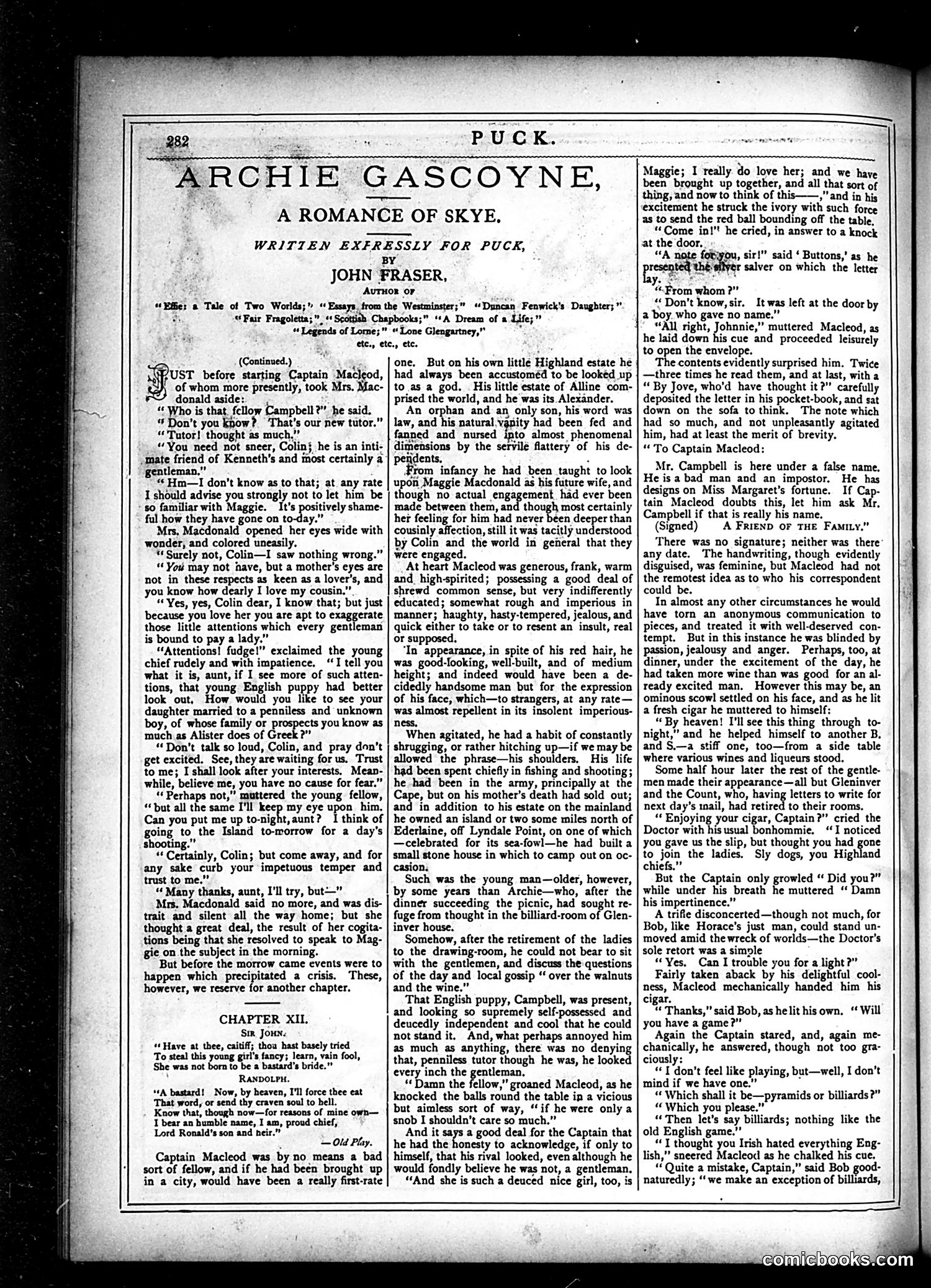
This page is primarily **serialized fiction rather than political satire**. It presents "Archie Gascoyne, A Romance of Skye," a romantic serial story by John Fraser written expressly for Puck magazine. The visible portion shows Chapter XII ("Sea-Lore"), continuing a narrative about Captain Macleod and various characters including Maggie, Archie, and others in what appears to be a Scottish island setting. The text focuses on romantic entanglements, social class tensions, and dramatic dialogue rather than political commentary. **There are no political cartoons or caricatures visible on this page.** It's a straightforward example of how Puck, despite its reputation for satire, also published fiction and serialized stories to fill its pages and entertain readers.
📄 Transcribed text from this page (OCR, searchable)
Machine-transcribed from the original scan — historical spelling and the odd misread are preserved.
PUCK. “ARCHIE GASCOYNE, ™ A ROMANCE OF SKYE, WRITTEN EXFRESSLY FOR PUCK, BY JOHN FRASER, Aurion oF “fies a Tale of Two Worlds;” «Essays. from the Westminster; “Duncan Fenwick's Daughter; ” “Fair Fragolétta;”, «Scottish Chapbooks;” ‘A Dream of a Life;” “Legends of Lome;” Lone Glengartney,” ete., ete., etc. (Continued.) TH FUST before starting Captain Macleod, of whom more presently, took Mrs. Mac- donald aside: , « Who is that. fellow Campbell?” he said. * Don’t you know? That's our new tutor.” “Tutor! thought as much,”” “You need not sneer, Colin}, he is an inti- -Mate friend of Kenneth’s and most certainly a gentleman,” * Hm—lI don’t know as to that; at. any rate I should advise you strongly not to let him be so familiar with Maggie. Tes positively shame- ful how they have gone on to-day.” Mrs, Macdonald opened her eyes wide with wonder, and colored uneasily. ** Surely not, Colin—I saw nothing wrong.” “You may not have, but a mother’s eyes are not in these respects as keen as a lover's, and you know how dearly I love my cousin.” Yes, yes, Colin dear, I know that; but just because you love her you are apt to exaggerate those little attentions which every gentleman is bound to pay a lady.” “Attentions! fudge!” exclaimed the young chief rudely and with impatience. ‘I tell you what it is, aunt, if I see more of such atten- tions, that young English puppy had better look out, How would you like to see your daughter married to a penniless and‘ unknown boy, of whose family or pi ts you know as much as Alister does of Greek ay “Don’t talk so loud, Colin, and pray don’t get excited. See, they are waiting for us. Trust to me; I shall look after your interests, Mean- while, believe me, you have no cause for fear.” ‘© Perhaps not,” muttered the young fellow, “but all the same I'll keep my eye upon him, Can you put me up to-night, aunt? I think of going to the Island to-morrow for a day's shooting.” “Certainly, Colin; but come away, and for any sake curb your impetuous temper and trust to me.” “ Many thanks, aunt, I'll try, but—” Mrs. Macdonald said no more, and was dis- trait and silent all the way home; but she thought a great deal, the result of her cogita- tions being that she resolved to speak to Mag- gie on the subject in the morning. But before the morrow came events were to happen which precipitated a crisis. These, however, we reserve for another chapter. CHAPTER XII. Sir Jou. «+ Have at thee, caitiff; thoa hast basely tried To steal this young gins fancy; learn, van fol, She was not born to be a bastard’s bride.” u RANDOLPH. “+A bastard! Now, by heaven, I'll force thee eat That word, or send thy craven soul to hell. Know that, though now—for reasons of mine own— I bear an humble name, I am, proud chief, Lord Ronald’s son and heir.” + Old Play. Captain Macleod was by no means a bad sort of fellow, and if he had been brought up in a city, would have been a really first-rate one. But on his own littlé Highland estate he had always been accustomed to be looked up to as a god. . His little estate of Alline com- prised the world, and he was its. Alexander. An orphan and an only son, his word was law, and his natural.vgpity had been fed and fanned and nursed ipto almost phenomenal dimensions by the servile flattery of his de- pendents, ‘ From infancy he had been taught to look upori Maggie Macdonald as his future wife, and though no actual engagement had ever been made between them, and though most certainly her feeling for him had never been deeper than cousinly affection, still it was tacitly understood by Colin and the world in general that they were engaged. At heart Macleod was generous, frank, warm and high-spirited; possessing a good deal of shrewd common sense, but very indifferently educated; somewhat rough and imperious in manner; haughty, hasty-tempered, jealous, and quick either to take or to resent an insult, real or supposed. “In appearance, in spite of his red hair, he was good-looking, well-built, and of medium height; and indeed would have been a de- cidedly handsome man but for the expression of his face, which—to strangers, at any rate— was almost repellent in its insolent imperious- ness, When agitated, he had a habit of constantly shrugging, or rather hitching up—if we may be allowed the phrase—his shoulders. His life had been spent chiefly in fishing and shooting; he had been in the army, principally at the Cape, but on his mother’s death had sold out; and in addition to his estate on the mainland he owned an island or two some miles north of Ederlaine, off Lyndale Point, on one of which —celebrated for its sea-fowl—he had built a small stone house in which to camp out on oc- casion, Such was the young man—older, however, by some years than Archie—who, after the dinner succeeding the picnic, had sought re- fuge from thought in the billiard-room of Glen- inver house. Somehow, after the retirement of the ladies to the drawing-room, he could not bear to sit with the gentlemen, and discuss the questions of the day and local gossip “‘ over the walnuts and the wine.” That English puppy, Campbell, was present, and looking so supremely self-possessed and deucedly independent and cool that he could not stand it, And, what perhaps annoyed him as much as anything, there was no denyin; that, penniless tutor though he was, he looke every inch the gentleman, “Damn the fellow,” groaned Macleod, as he knocked the balls round the table in a vicious but aimless sort of way, ‘if he were only a snob I shouldn't care so much,” And it says a good deal for the Captain that he had the honesty to acknowledge, if only to himself, that his rival looked, even although he would fondly believe he was not, a gentleman. “And she is such a deuced nice girl, too, is Maggie; I really do love her; and we hay been brought up together, and all that sort of thing, and now to think of this——,” and in his excitement he struck the ivory with such force ‘as to send the red ball bounding off the table, “Come in!" he cried, in answer to a knock ‘at the door, “A note foryou, sir!” said ‘ Buttons,’ as he presated thé silver salver on which the letter rom whom ?"” “Don’t know, sir. It was left at the door by a boy. who gave no name,” “All right, Johnnie,” muttered Macleod, as he laid down his cue and proceeded leisurely to open the envelope. The contents evidently surprised him. Twice —three times he read them, and at last, with a « By Jove, who'd have thought it?” carefully deposited the letter in his pocket-book, and sat down on the sofa to think. The note which had so much, and not unpleasantly agitated him, had at least the merit of brevity. “To Captain Macleod: Mr. Campbell is here under a false name. He is a bad man and an impostor. He has designs on Miss Margaret's fortune. If Cap- tain Macleod doubts this, let him ask Mr, Campbell if that is really his name. (Signed) A FRIEND OF THE Famity,” There was no signature; neither was there any date. The handwriting, though evidently disguised, was feminine, but Macleod had not the remotest idea as to who his correspondent could be. In almost any other circumstances he would have torn an anonymous communication to pieces, and treated it with well-deserved con- tempt. But in this instance he was blinded by passion, jealousy and anger. Perhaps, too, at dinner, under the excitement of the day, he had taken more wine than was good for an al- ready excited man. However this may be, an ominous scowl settled on his face, and as he lit a fresh cigar he muttered to himself: “ By heaven! I'll see this thing through to- night,” and he helped himself to another B, and S.—a stiff one, too—from a side table where various wines and liqueurs stood. Some half hour later the rest of the gentle- men made their appearance—all but Gleninver and the Count, who, having letters to write for next day’s mail, had retired to their rooms, “Enjoying your cigar, Captain?” cried the Doctor with his usual bonhommie. “I noticed you gave us the slip, but thought you had gone to join the ladies. Sly dogs, you Highland chiefs.” But the Captain only growled “ Did you?” while under his breath he muttered “ Damn his impertinence.” A trifle disconcerted—though not much, for Bob, like Horace's just man, could stand un- moved amid the wreck of worlds—the Doctor's sole retort was a simple “Yes, Can I trouble you for a light?” Fairly taken aback by his delightful cool- ness, Macleod mechanically handed him his cigar. “ Thanks,” said Bob, as he lit his own, ‘Will you have a game?” Again the Captain stared, and, again me- chanically, he answered, though not too gra- ciously: “ T don’t feel like playing, but—well, I don't mind if we have one.” “Which shall it be—pyramids or billiards?” “Which you please.” “Then let’s say billiards; nothing like the old English game.”’ “T thought you Irish hated everything Eng- lish,” sneered Macleod as he chalked his cue. “ Quite a mistake, Captain,” said Bob good- naturedly; ‘we make an exception of billiards,