
A complete issue · 16 pages · 1879
Puck — June 11, 1879
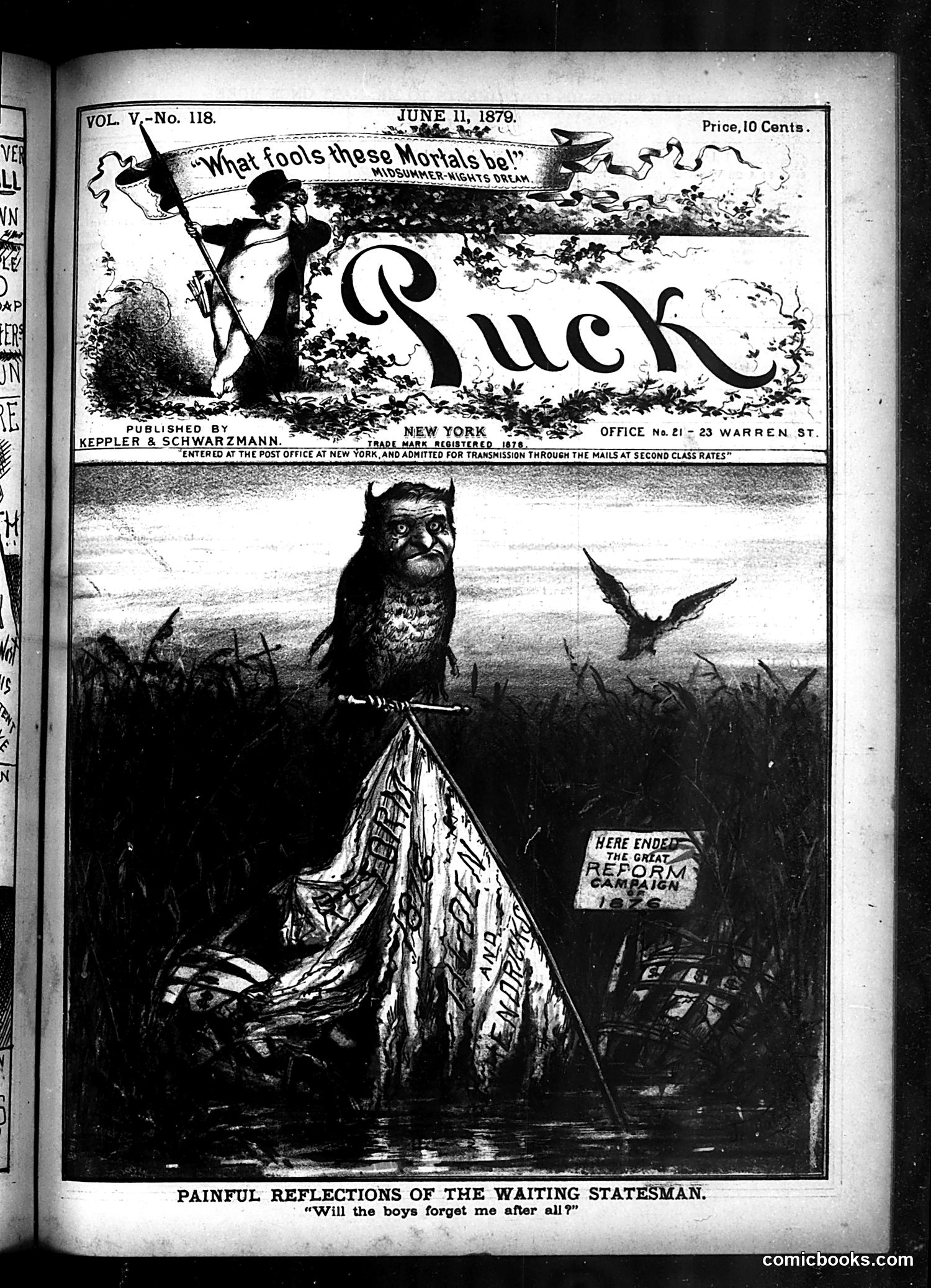
This cartoon satirizes a waiting political figure during the 1879 reform campaign. The demonic creature represents a politician—likely a prominent statesman—haunted by doubt about his political legacy. The "tent" displays banners referencing the "Great Reform Campaign," suggesting failed or incomplete political initiatives. The caption "Painful Reflections of the Waiting Statesman: 'Will the boys forget me after all?'" mocks the figure's vanity and anxiety about historical remembrance. The devilish appearance emphasizes corruption or moral compromise associated with his political career. The top header references Shakespeare's "A Midsummer Night's Dream," adding literary context to the satirical attack. This appears to critique a specific politician's legacy concerns during the reform-minded 1870s era.
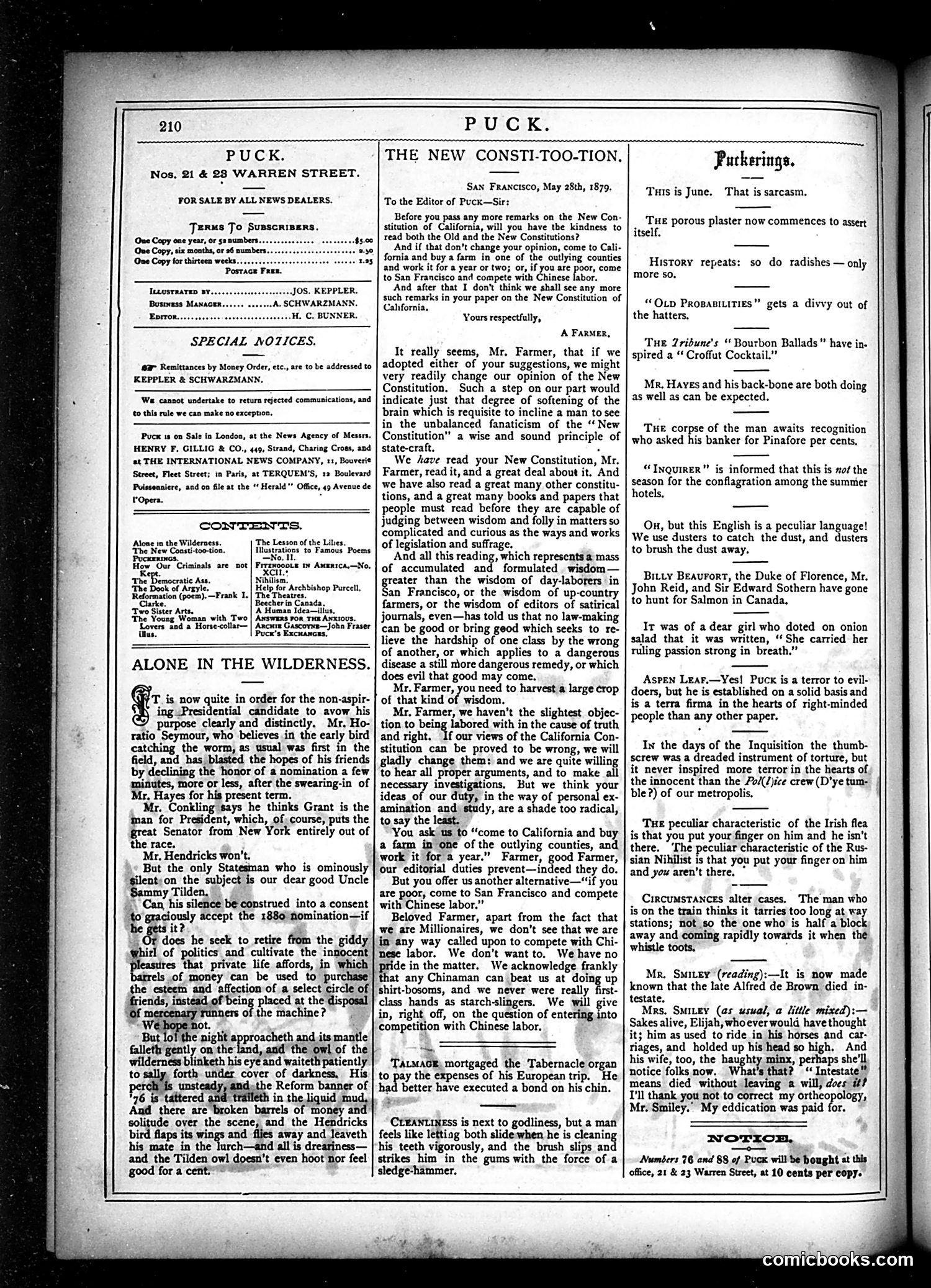
This page primarily contains editorial content and letters rather than political cartoons. The main article, "Alone in the Wilderness," appears to satirize a presidential candidate (likely Rutherford B. Hayes, given the 1879 date) who the writer suggests has isolated himself from practical politics. The piece mockingly criticizes his detachment, suggesting he's like the mythical figure Seymour who believed "the only bird catching the worm, as well as first in the field" could win. The satire targets what Puck views as naive political idealism disconnected from real-world machinations—suggesting the candidate's isolation from party machinery and compromise will doom his electoral hopes. The "wilderness" metaphor implies political inexperience and removal from necessary political engagement.
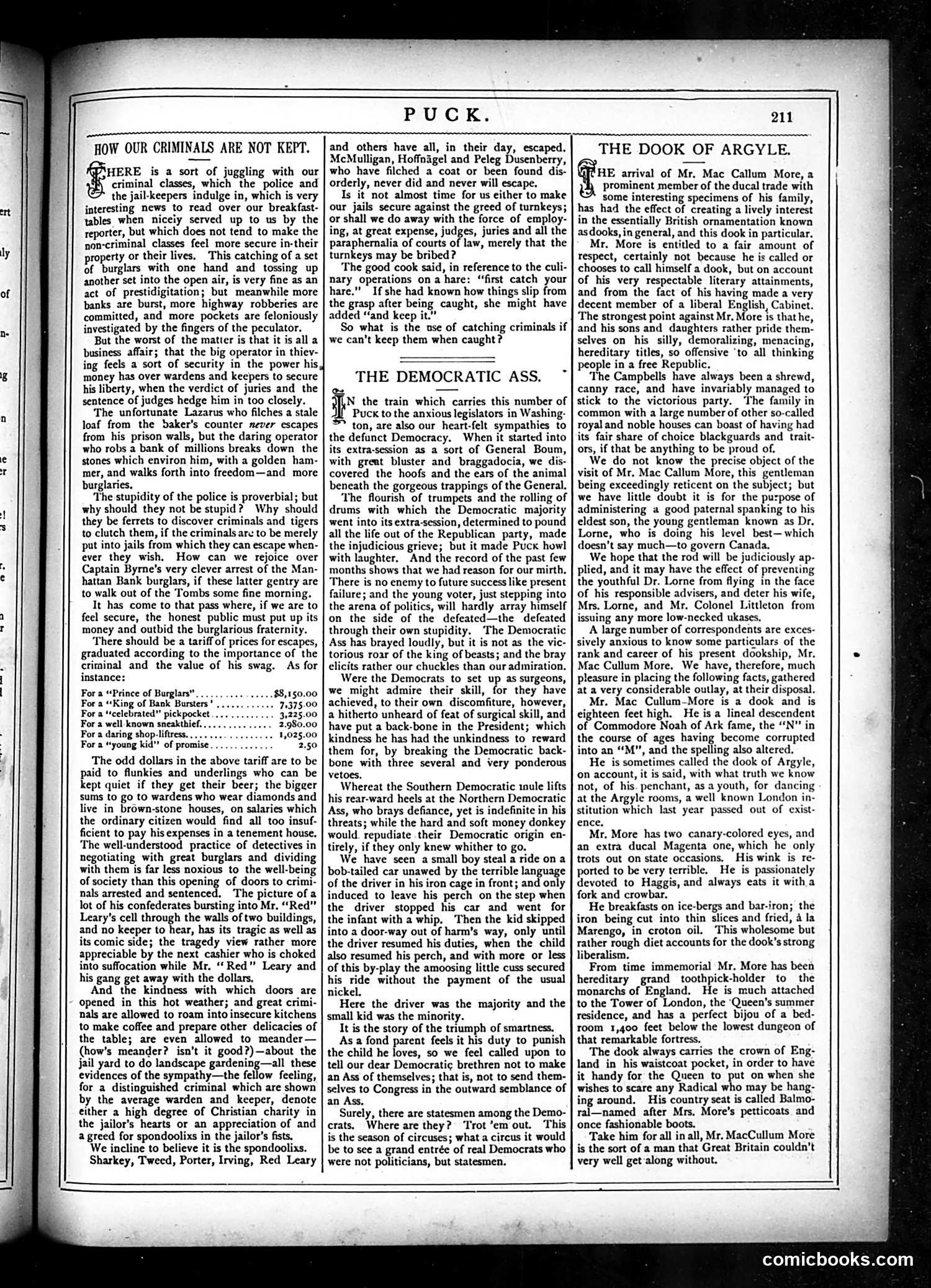
This page contains three distinct articles with satirical commentary on late 19th-century American politics and society. **"How Our Criminals Are Not Kept"** criticizes the lax security of jails, suggesting that criminals escape easily due to bribery and corruption of guards and judges—a commentary on systemic institutional failure. **"The Democratic Ass"** mocks the Democratic Party's strategy and leadership, using the donkey as a traditional symbol of Democrats. It appears to criticize Democratic politicians as foolish and ineffectual, contrasting their claimed ideals with actual incompetence. **"The Dook of Argyle"** profiles a Scottish nobleman (Mac Callum More), describing his eccentricities and obsession with genealogy. The satirical tone suggests mockery of hereditary nobility and their pretensions. The overall tone reflects Puck's characteristic irreverent attacks on institutions, political parties, and social elites.
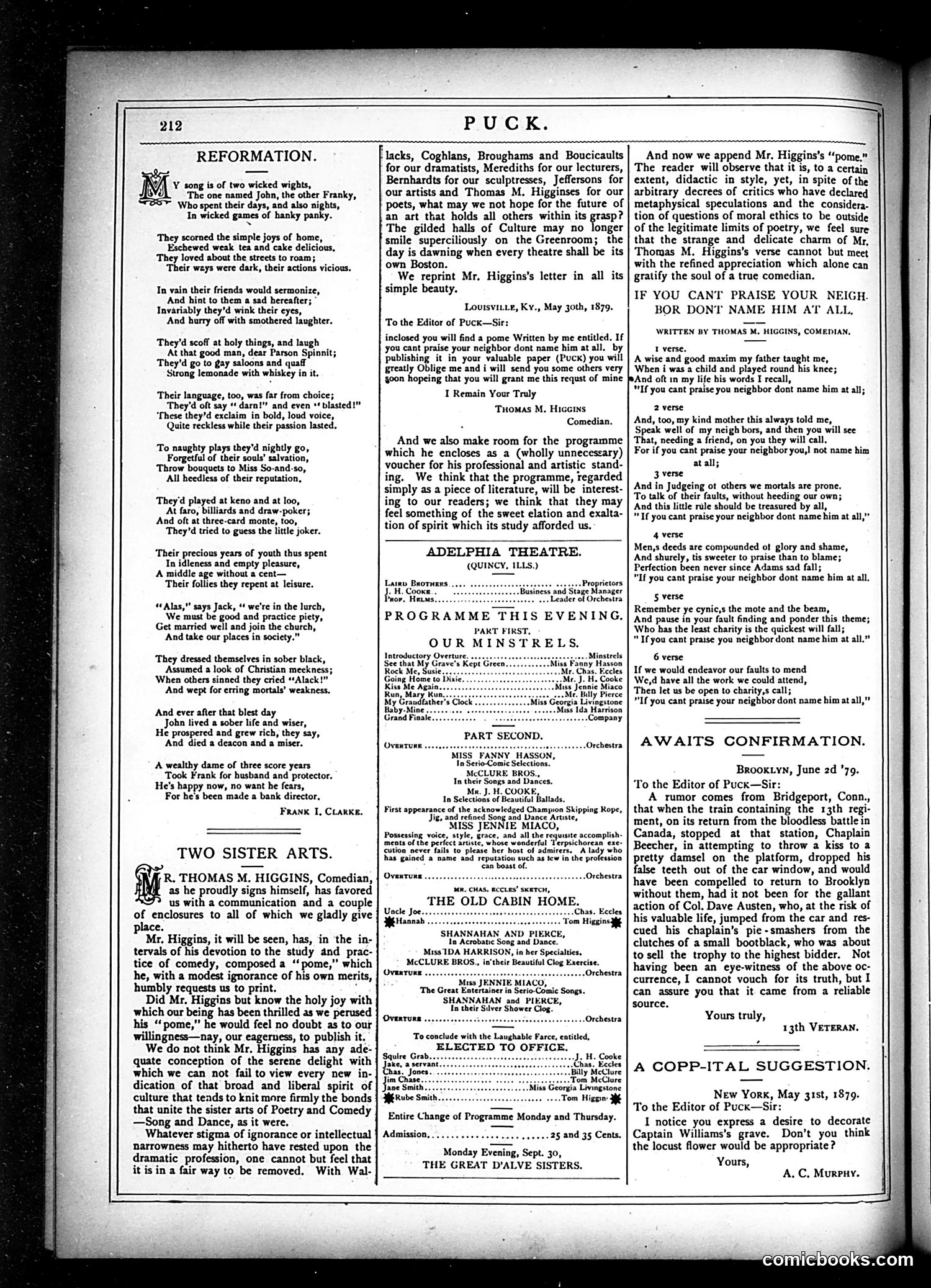
This page is primarily **theatrical advertising and letters to the editor** rather than political satire. The main content includes: 1. **"Reformation" poem** - A satirical verse criticizing theatrical excess and cultural pretension, likely mocking contemporary theater trends 2. **"Two Sister Arts"** - A letter from Thomas M. Higgins defending himself against criticism for not praising a neighbor, with a published response poem titled "If You Can't Praise Your Neighbor Don't Name Him At All" 3. **Theater advertisements** - Multiple venue listings (Adelphia Theatre, etc.) with performance details 4. **Letters to the editor** - Including "Awaits Confirmation" and "A Copp-ital Suggestion" The page lacks prominent political cartoons or caricatures typical of Puck's satirical content, focusing instead on cultural commentary through verse and theatrical notices.
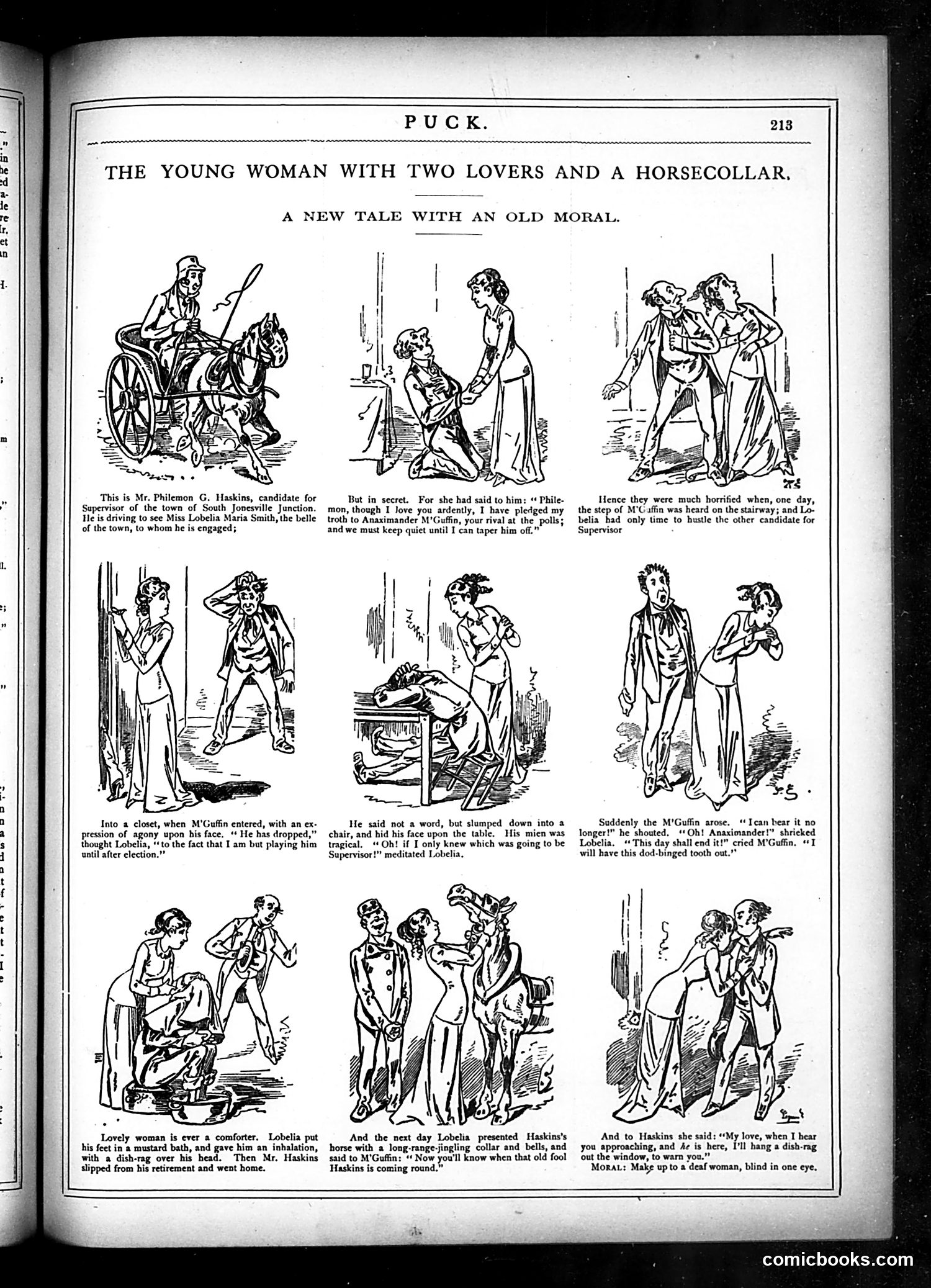
This is a satirical moral tale about a young woman named Lobelia who juggles two suitors: Mr. Philemon G. Haskins (a political candidate for Supervisor of South Jonsonville Junction) and Mr. M'Guffin. The cartoon depicts her romantic scheming—she secretly promises both men her support while keeping them competing for her favor. The satire targets small-town political corruption and female manipulation. Lobelia plays the candidates against each other, extracting promises and favors through flirtation. The "horsecollar" reference (a type of harness) suggests she's "yoked" or controlling them. The moral warns readers against deception in both romance and politics—ultimately, her schemes backfire when both men discover her duplicity.
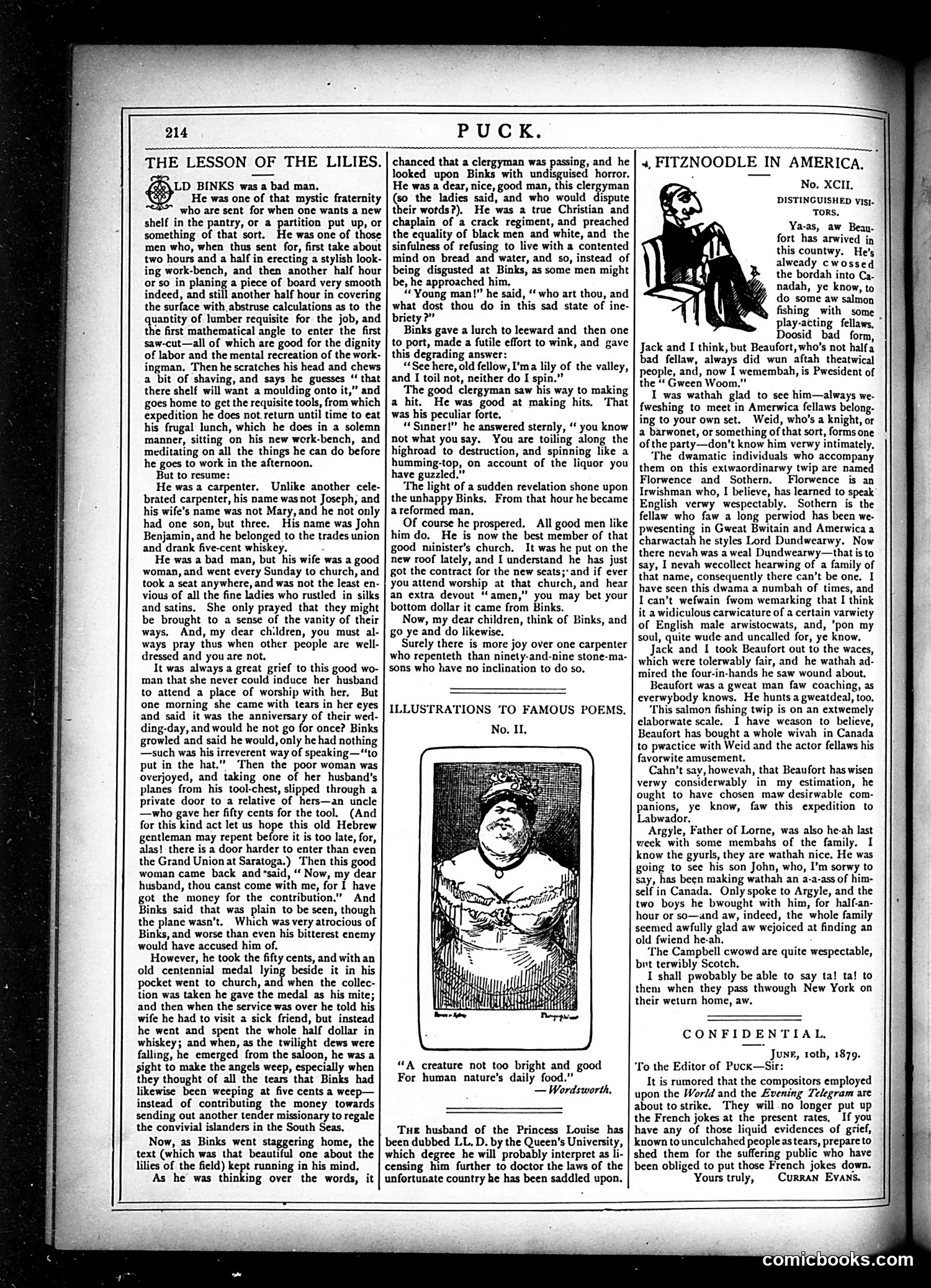
This page contains two distinct sections: **"The Lesson of the Lilies"** is a moral tale about Old Binks, a reformed carpenter and former drunkard who becomes a respected church member. The narrative emphasizes his transformation and Christian virtue, concluding with him donating fifty cents to charity—presented as redemptive despite his modest means. **"Illustrations to Famous Poems, No. II"** features an engraved portrait of a rotund woman in Victorian dress, paired with a Wordsworth quote about nature's daily sustenance. The page also contains a brief letter to the editor regarding compositors employed by the *World* and *Evening Telegram* newspapers striking. The satirical content is relatively mild on this particular page, focusing more on moral instruction and literary illustration than political commentary.
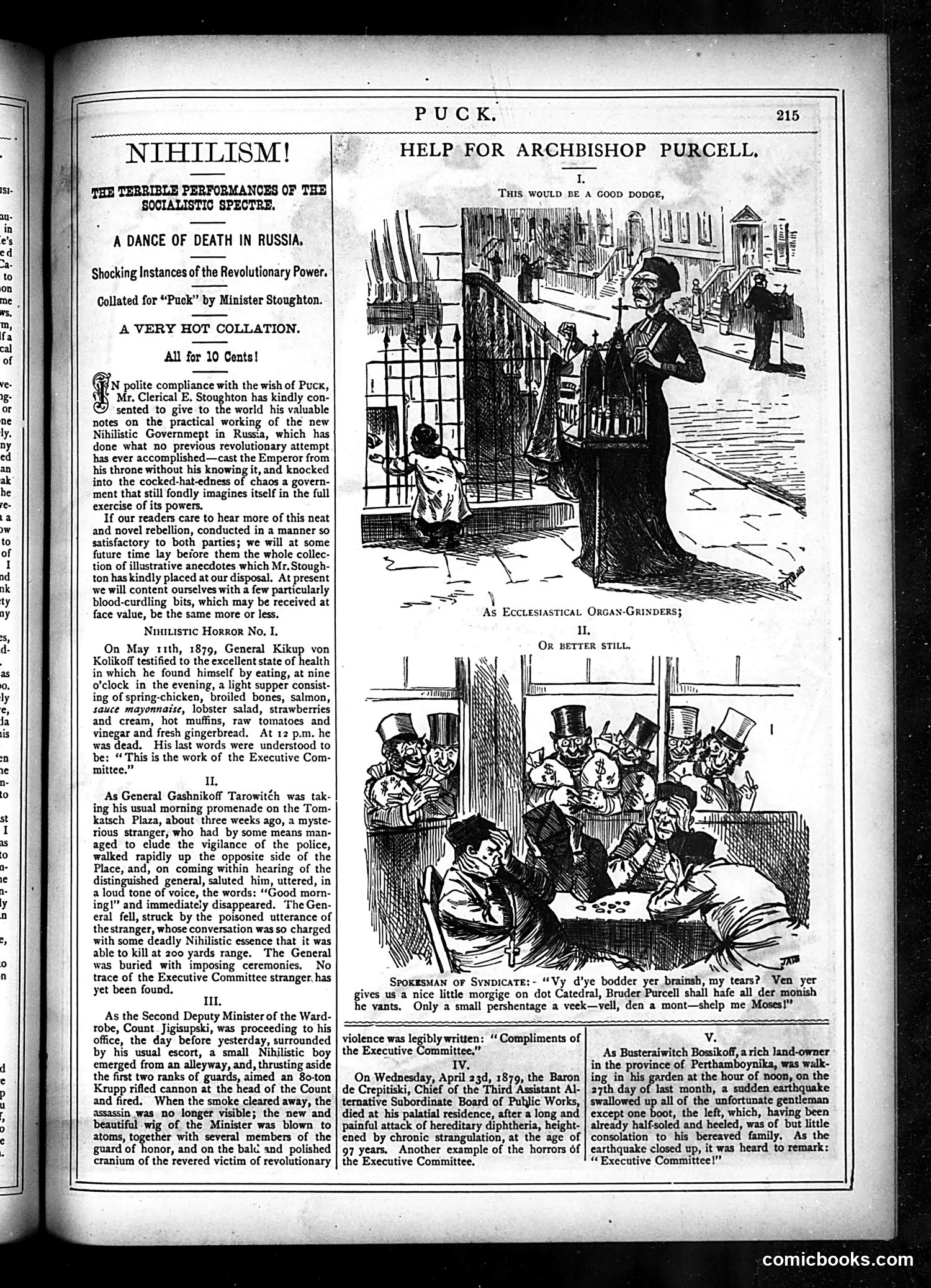
This page satirizes Russian nihilism and violence during the 1879 revolutionary period. The top cartoon depicts Archbishop Purcell encountering a dangerous nihilist on a snowy Russian street—the joke being that even a Catholic archbishop wouldn't be safe from revolutionary violence in Russia. The lower cartoon shows Russian nihilists (labeled "Ecclesiastical Organ-Grinders") as organ-grinders operating while wealthy figures drop coins—satirizing how nihilists use terror tactics to extort money and power from the establishment. The text includes anecdotes about Russian revolutionaries, including General Kikup von Kolikoff's death by poisoning and General Gashnikoff's assassination. The satire mocks both nihilist violence and the Russian establishment's inability to contain it, reflecting American anxiety about revolutionary movements in the 1870s.
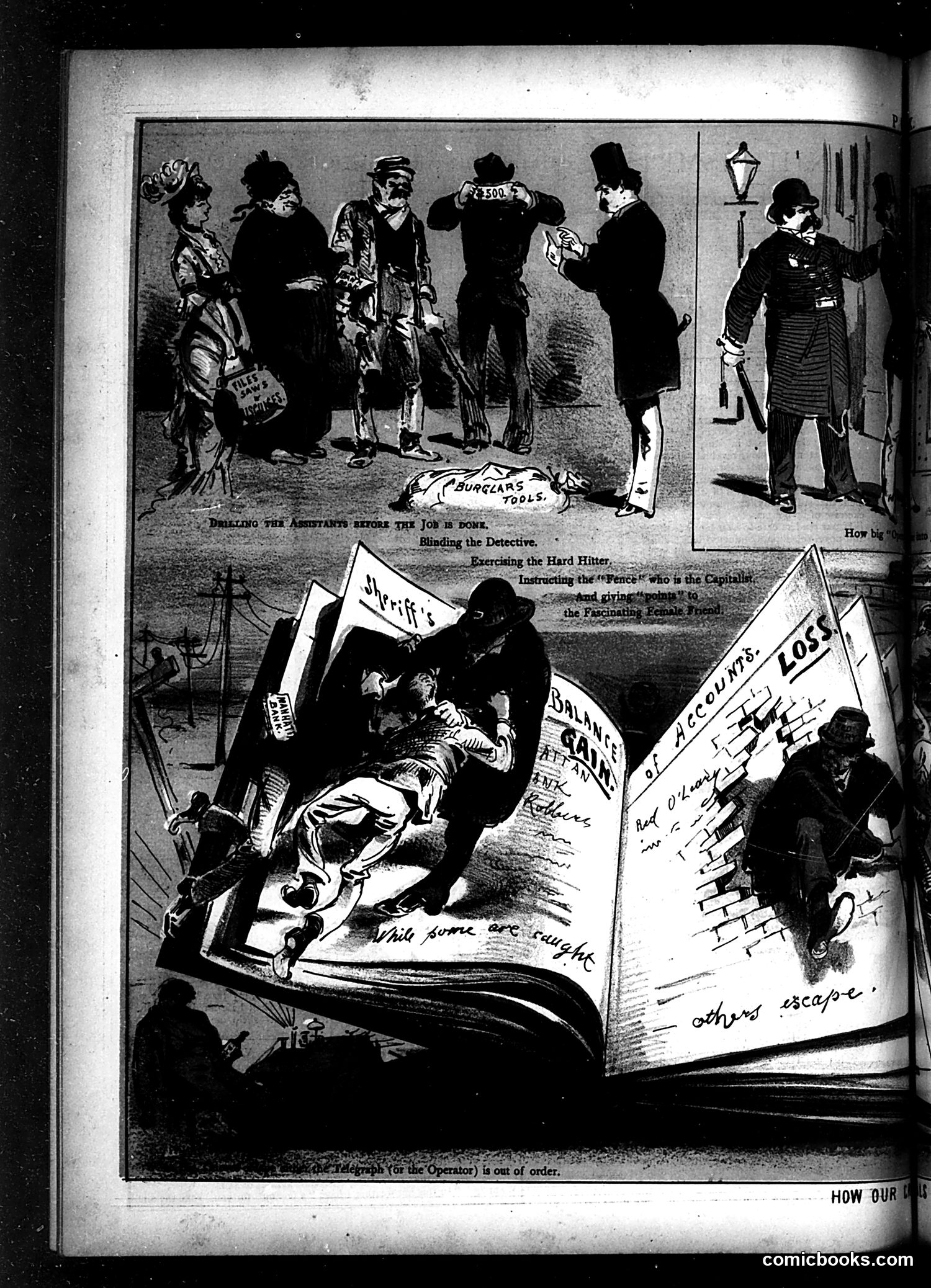
This Puck page depicts two satirical scenes about law enforcement corruption and judicial proceedings, likely from the late 19th or early 20th century. The upper panel shows officials "binding the assistants before the job is done" and "blinding the detective"—suggesting police obstruction of justice. The lower panel illustrates a massive open ledger labeled "Sheriff's" and "Accounts Lost," with figures apparently examining records of missing funds or accounts. Text references "the Capitalist" and mentions "propositions" to prosecutors. The satire attacks institutional corruption: law enforcement allegedly protecting wealthy interests, detectives being deliberately misled, and financial records disappearing. The exaggerated scale of the ledger emphasizes the magnitude of suspected embezzlement or fraud. The specific figures and incident remain unclear without additional context, but the cartoon criticizes systemic collusion between police, officials, and capitalists to obstruct justice.
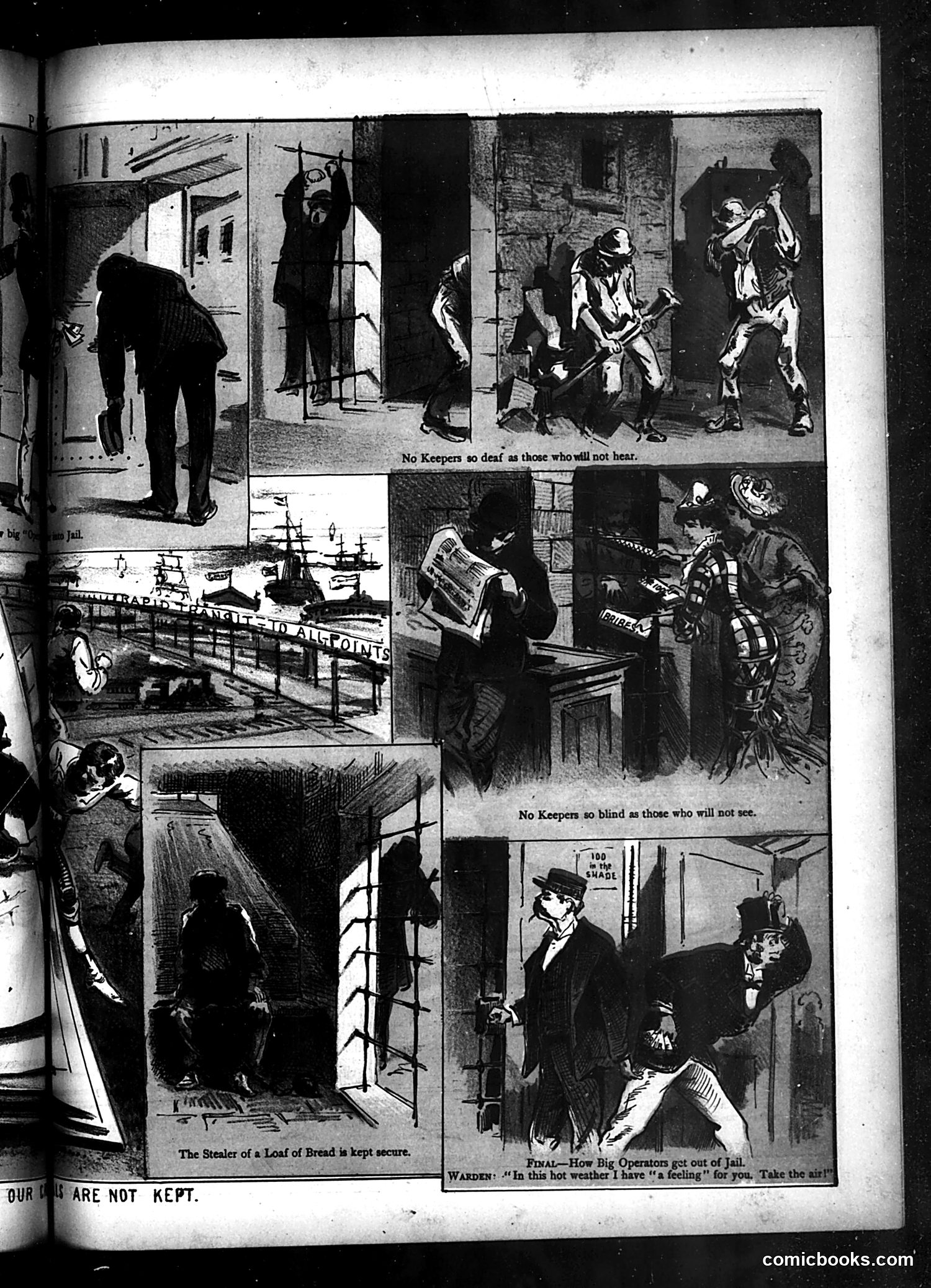
This appears to be a sequential narrative comic strip satirizing prison security and crime. The captions reference "keepers so deaf as those who will not hear" and "so blind as those who will not see"—suggesting corrupt prison officials who deliberately ignore contraband smuggling. The narrative follows what appears to be a theft operation: a loaf of bread being used to smuggle contraband into jail, various prisoners and guards in suspicious circumstances, and ultimately "Big Operators" escaping. The final panel shows wardens discussing weather while criminals flee—the joke being that authorities are willfully negligent or complicit. The satire criticizes prison corruption and the inadequate security that allows organized criminals to operate with apparent insider assistance.
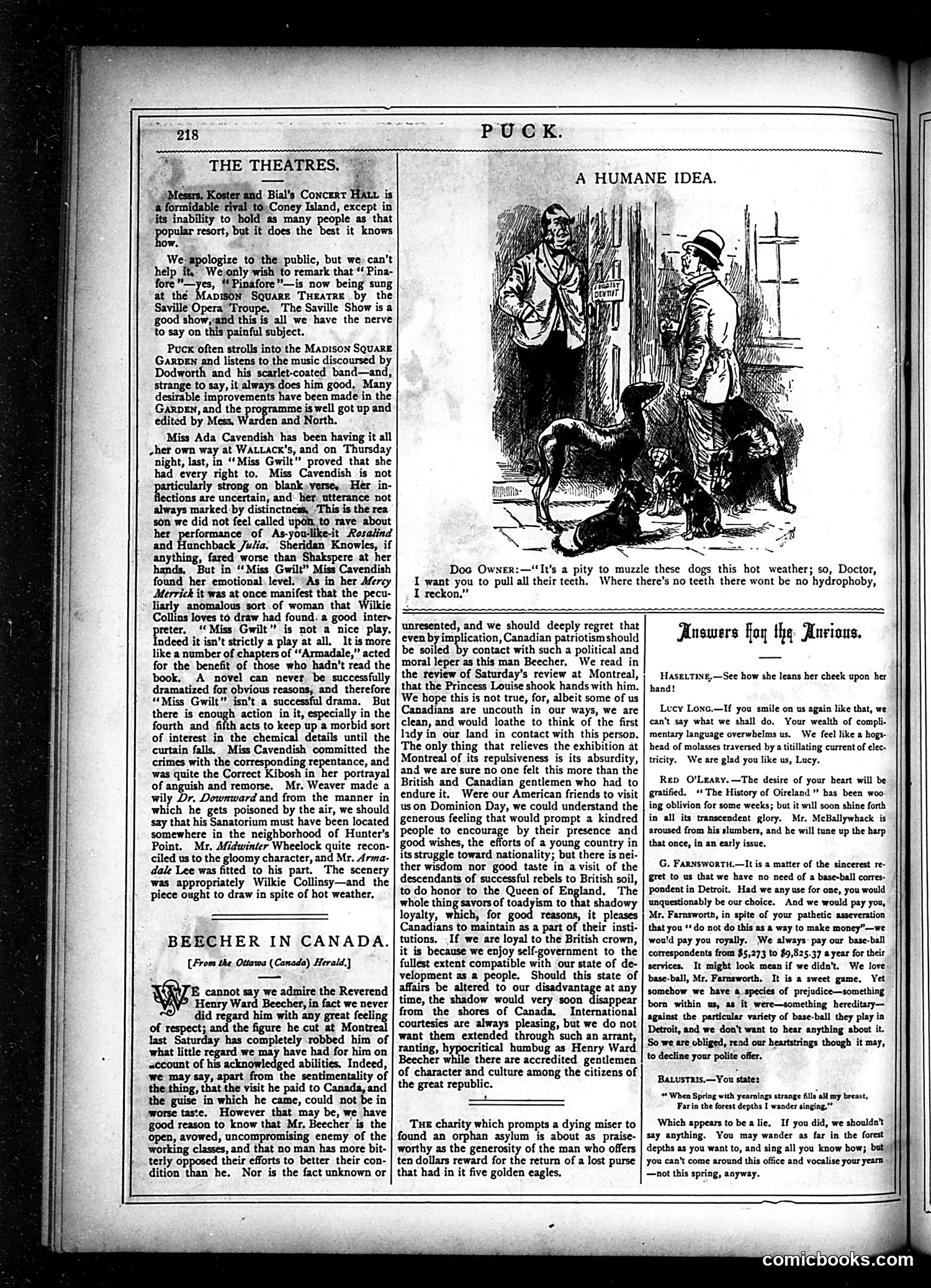
This cartoon depicts a dog owner instructing a dentist to extract all his dogs' teeth, claiming it's to spare them discomfort in hot weather. The satire targets Henry Ward Beecher, a prominent clergyman and abolitionist. The accompanying article "Beecher in Canada" criticizes Beecher for his recent Montreal visit, where he apparently made statements the editors found hypocritical—specifically regarding Canadian-British relations. The cartoon uses absurdist logic to mock what Puck views as Beecher's flawed moral reasoning: just as extracting teeth is a cruel "solution" to heat discomfort, Beecher's positions on Canadian nationalism and politics are presented as misguided despite claims of humanitarian intent. The satire suggests Beecher's reasoning is illogical and ultimately harmful, regardless of professed good intentions.
This page contains the continuation of a serialized short story by John Fraser, written expressly for Puck magazine. The narrative follows Archie Campbell, a young Highland man of modest means, as he interacts with Miss Macdonald and Bob Campbell. The text is purely literary fiction—a romantic story set in Scotland—rather than political satire or social commentary. There are no visible cartoons or caricatures on this page. The content represents Puck's practice of publishing serialized fiction alongside its better-known humorous illustrations and satirical content. This is a straightforward narrative passage with no apparent satirical intent toward contemporary figures or events.
This page contains **no political cartoon**. Instead, it features: 1. **"Puck's Jottings"** - a humor column with brief satirical observations about contemporary life, including jokes about Mark Twain's hotel rules, Chicago nightlife, and proper etiquette. 2. **"Chapter IX"** of what appears to be a serialized short story about a character named Archie and Miss Maggie, involving romantic misunderstandings and social situations. The content is primarily **literary/humorous fiction** rather than visual satire. The page demonstrates how Puck combined illustrated cartoons with written humor pieces. No specific political figures or events are referenced on this particular page.
This page is predominantly **advertisements**, not political satire. The main content features commercial ads for products like Puck Smoking Tobacco, Keep's Shirts, Manhattan Beach Railway, and various other 19th-century goods and services. The only cartoon illustration is the central image of a caricatured figure smoking a pipe, used to advertise "Puck Smoking Tobacco" by Marburg Bros. The figure appears to be the traditional "Puck" character (a mischievous sprite from folklore), which became the magazine's mascot and brand. This is a typical back page of the magazine dominated by revenue-generating advertisements rather than editorial content or political commentary.
This appears to be primarily an **advertising page** from Puck magazine (page 222), not a political cartoon or satirical content page. The advertisements feature various 19th-century commercial enterprises: clothing retailers (Edw. Ridley & Sons offering hats and suits), furniture sellers (Cowperthwait & Co.), photographers (Staegele, Otto Lewin, Isaac Smith), umbrella manufacturers (Isaac Smith's Umbrellas), beer brewers (Bohemian Bier), and other merchants. The only illustrated element is a **wine bottle advertisement** for "Piper-Heidsieck" champagne with German text, emphasizing quality. **No political satire or cartoon commentary is present** on this page. It's a standard commercial advertising section typical of Puck's revenue model, though the period advertisements themselves are historically interesting artifacts.
This is primarily an **advertising page** (page 223) from Puck magazine, not a political cartoon. The page features commercial advertisements for various products and services typical of the era, including: - A Vienna coffee pot - Kurtz's portrait studio - Patent and trademark services - Keppich & Co. (Havana cigars) - Dental rooms - Various clothing retailers (dress shirts, gloves, undergarments) - Furniture manufacturers - A restaurant - Table waters and wines The only illustration with potential satirical content is **Kurtz's Portraits** section, which shows caricatured figures in exaggerated poses, though their specific identities or satirical intent isn't clear from this image alone. Overall, this appears to be a standard late 19th-century magazine advertising section.
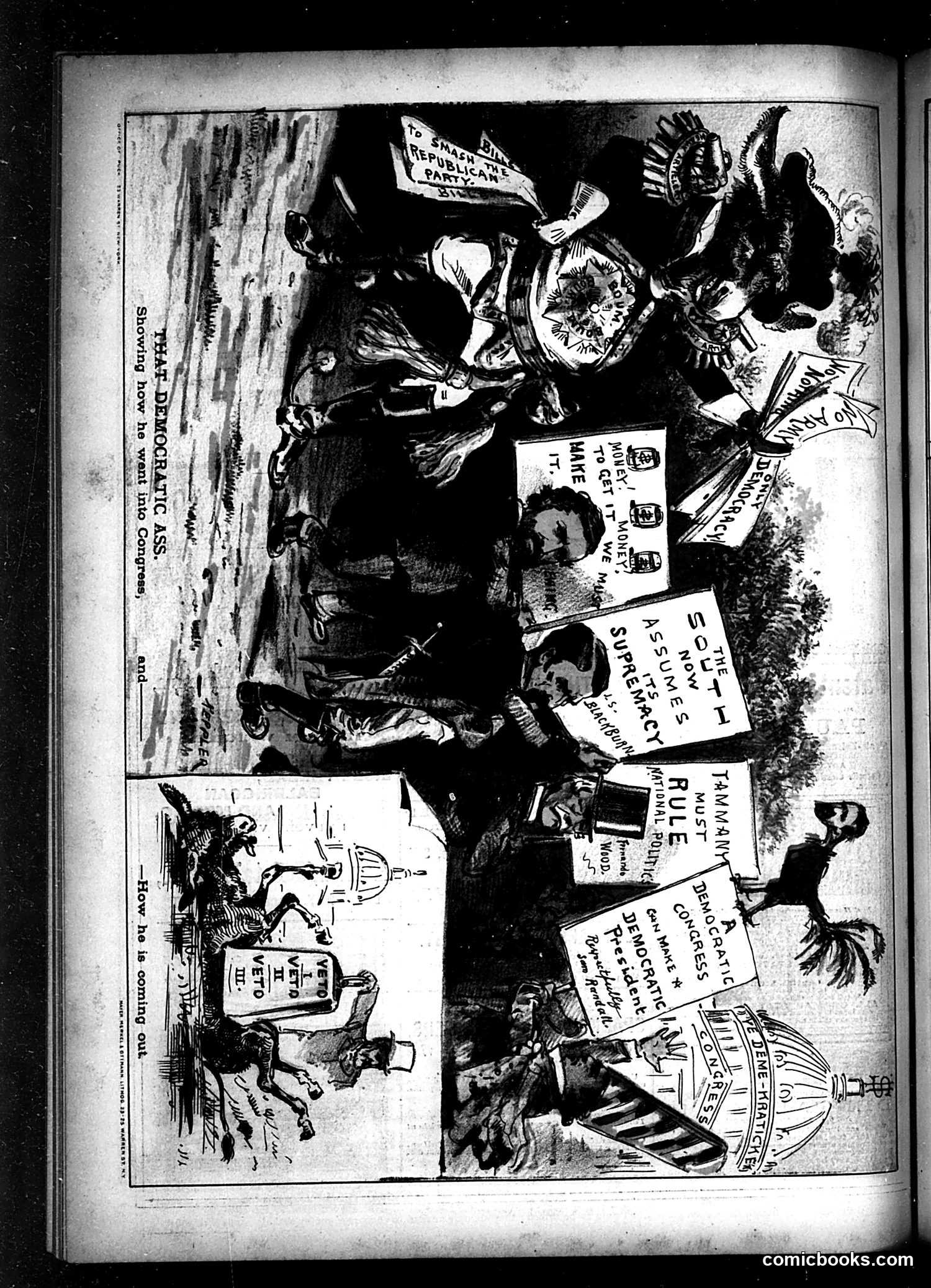
This page contains a satirical cartoon critiquing the Democratic Party during what appears to be a presidential election cycle. The main image depicts Democratic figures (identifiable by the Democratic rooster symbol visible in the illustration) in disarray—fighting, divided, and holding conflicting signs about party platforms and candidates. The signs reference internal party disputes, likely concerning campaign promises, electoral strategy, or candidate selection. The cartoon's central message is that the Democrats are fundamentally fractured and contradictory, unable to present a unified front to voters. The smaller cartoon below appears to show related political commentary, though specific details are difficult to discern in this reproduction. The overall satire mocks Democratic Party dysfunction and inconsistency during what was clearly a contentious political moment.