
Puck, 1879-06-11 · page 10 of 16
Puck — June 11, 1879 — page 10: what you’re looking at
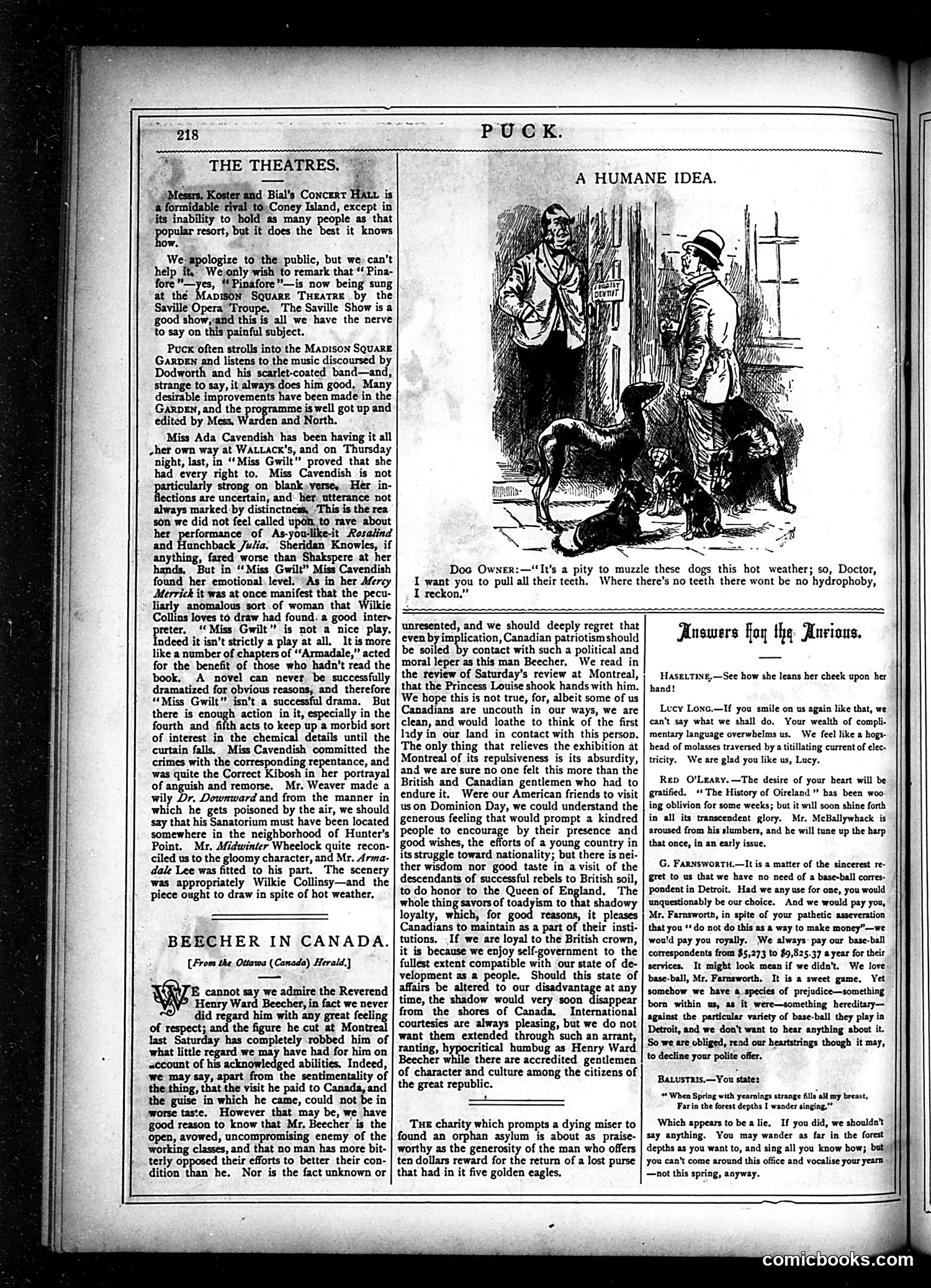
What you’re looking at
This cartoon depicts a dog owner instructing a dentist to extract all his dogs' teeth, claiming it's to spare them discomfort in hot weather. The satire targets Henry Ward Beecher, a prominent clergyman and abolitionist. The accompanying article "Beecher in Canada" criticizes Beecher for his recent Montreal visit, where he apparently made statements the editors found hypocritical—specifically regarding Canadian-British relations. The cartoon uses absurdist logic to mock what Puck views as Beecher's flawed moral reasoning: just as extracting teeth is a cruel "solution" to heat discomfort, Beecher's positions on Canadian nationalism and politics are presented as misguided despite claims of humanitarian intent. The satire suggests Beecher's reasoning is illogical and ultimately harmful, regardless of professed good intentions.
📄 Transcribed text from this page (OCR, searchable)
Machine-transcribed from the original scan — historical spelling and the odd misread are preserved.
THE THEATRES, Messrs, Koster and Bial’s Concert Hat is ‘formidable rival to)Coney Island, except in its inability to hold as many people as that porales resort bat it does the best it knows w. $ We. ize to the public, but we. can’t help ae wish remark that “ Pina- fore "—yes, Pinafore”—is now being sung at the DISON SQUARE THEATRE by the Saville'Opera "Froupe. The Saville Show is a good show,and this is all we have the nerve to say on this painful subject. Puck often strolls into the Mapison SQUARE Garpen and listens to the music discoursed by Dodworth and his Beaupcosted band “<ad si! to say, it always does him good, Many desirable im Doreen have been made in the Garpen, an ibeip me is well got up and edited by Mess, len and North. Miss Ada Cavendish has been having it all her own way at Wattacr’s, and on Thursday night, last, in ‘Miss Gwilt” proved that she had every right to. Miss Cavendish is not icularly strong on blank» verse, Her in- lections are uncertain, and: her. utterance not always marked by distinctness, ‘This is the rea son we did not feel called upon to rave about her Peston of As-you-like-it Rosalind and Hunchback Ju/ia. Sheridan Knowles, if anything, fared worse than Shakspere at her hands, But in ‘Miss Gwilt” Miss Cavendish found her emotional. level,” “As in her Mercy Merrick it was at once manifest that the pecu- Tiarly anomalous sort.of woman that Wilkie Collins loves to draw had found. a good intere reter, ‘Miss Gwilt”” is not a nice play. Todeea it isn’t strictly a play at all, It is more like a number of chapters of ‘‘Armadale,” acted for the benefit of those who hadn't read the book. A novel can never be successfully dramatized for obvious reasons, and therefore “Miss Gwilt” isn’t a successful drama. But there is enough action in it, especially in the fourth and fifth acts to keep up a morbid sort of interest in the chemical details until the curtain falls, Miss Cavendish committed the crimes with the corresponding repentance, and was quite the Correct Kibosh in her portrayal of anguish and remorse. Mr. Weaver made a wily Dr. Downward and from the manner in which he gets poisoned by the air, we should say that his Sanatorium must have been located somewhere in the neighborhood of Hunter’s Point. ciled us to the gloomy character, and Mr. Arma- dale Lee was fitted to his part. The scenery was appropriately Wilkie Collinsy—and the piece ought to draw in spite of hot weather, BEECHER IN CANADA. [From the Ottawa (Canada) Herald.) E cannot say we admire the Reverend Henry Ward Beecher, in fact we never did regard him with any great feelin; of respect; and the figure he cut at Montr last Saturday has completely robbed him of what little regard we may have had for him on account of his acknowledged abilities. Indeed, we may say, apart from the sentimentality of the thing, that the visit he paid to Canada, and the guise in which he came, could not be in worse taste. However that may be, we have good reason to know that Mr, Beecher is the open, avowed, uncompromising enemy of the working classes, and that no man has more bit- terly opposed their efforts to better their con- dition he. Nor is the fact unknown or Mr. Midwinter Wheelock quite recon- | 8' A HUMANE IDEA. Doo Owner:—“It’s a pity to muzzle these dogs this hot weather; so, Doctor, I want you to pull all their teeth: Where there’s no teeth there wont be no hydrophoby, I reckon.” unresented, and we should deeply regret that even by in lication, Canadian patriotism should be soiled by contact with such a political and moral leper as this man Beecher, We read in the review of Saturday's review at Montreal, that the Princess Louise shook hands with him. We hope this is not true, for, albeit some of us jians are uncouth in our ways, we are clean, and would loathe to think of the first hdy in our land in contact with this person. The only thing that relieves the exhibition at Montreal of its repulsiveness is its absurdity, and we are sure no one felt this more than the British and Canadian gentlemen who had to endure it. Were our American friends to visit uson Dominion Day, we could understand the generous feeling that would prompt a kindred people to encourage by their presence and ood wishes, the efforts of a young country in its struggle toward nationality; but there is nei- ther wisdom nor good taste in a visit of the descendants of successful rebels to British soil, to do honor to the Queen of England. The whole thing savors of toadyism to that shadowy loyalty, which, for gi reasons, it pleases Canadians to maintain as a part of their insti- tutions, .If we are loyal to the British crown, it is because we enjoy self-government to the fullest extent compatible with our state of de- velopment as a people. Should this state of affairs be altered to our disadvantage at any time, the shadow would very soon disappear from the shores of Canada, International courtesies are always pleasing, but we do not want them extended through such an arrant, ranting, hypocritical humbug as Henry Ward Beecher while there are accredited gentlemen of character and culture among the citizens of the great republic. eee ‘Tne charity which prompts a dying miser to found an orphan asylum is about as praise- worthy as the generosity of the man who offers ten dollars reward for the return of a lost purse that had in it five golden eagles. Answers Hoy the Anrious. HAsELTINE,—See how she leans her cheek upon her hand! Lucy Loxc.—If you smile on us again like that, we can’t say what we shall do. Your wealth of compli- mentary language overwhelms us. We feel like a hogs- head of molasses traversed by a titillating current of elec- tricity. We are glad you like us, Lucy. Rep O’LEARY.—The desire of your heart will be gratified. “The History of Oireland ” has been woo: ing oblivion for some weeks; but it will soon shine forth in all its transcendent glory. Mr. McBallywhack is aroused from his slumbers, and he will tune up the harp that once, in an early issue, G. FARNsworTH.—It is a matter of the sincerest re- gret to us that we have no need of a base-ball corres- pondent in Detroit. Had we any use for one, you would unquestionably be our choice. And we would pay you, Mr, Farnsworth, in spite of your pathetic asseveration that you ‘do not do this as a way to make money”—we would pay you royally. We always: pay our base-ball correspondents from $5,273 to $9,825.37 a year for their services. It might look mean if we didn’t. We love base-ball, Mr. Farnsworth, It is a sweet game, Yet somehow we have a species of prejudice—something born within us, as it were—something hereditary— against the particular variety of base-ball they play in Detroit, and we don’t want to hear anything about it. So we are obliged, read our heartstrings though it may, to decline your polite offer. Ba.ustais.—You state: When Spring with yearnings strange fills all my breast, Farin the forest depths I wander singing.” Which appears to be a lie. If you did, we shouldn't say anything. You may wander as far in the forest depths as you want to, and sing all you know how; but you can’t come around this office and vocalise your yearn —not this spring, anyway.