
Puck, 1879-06-11 · page 4 of 16
Puck — June 11, 1879 — page 4: what you’re looking at
What you’re looking at
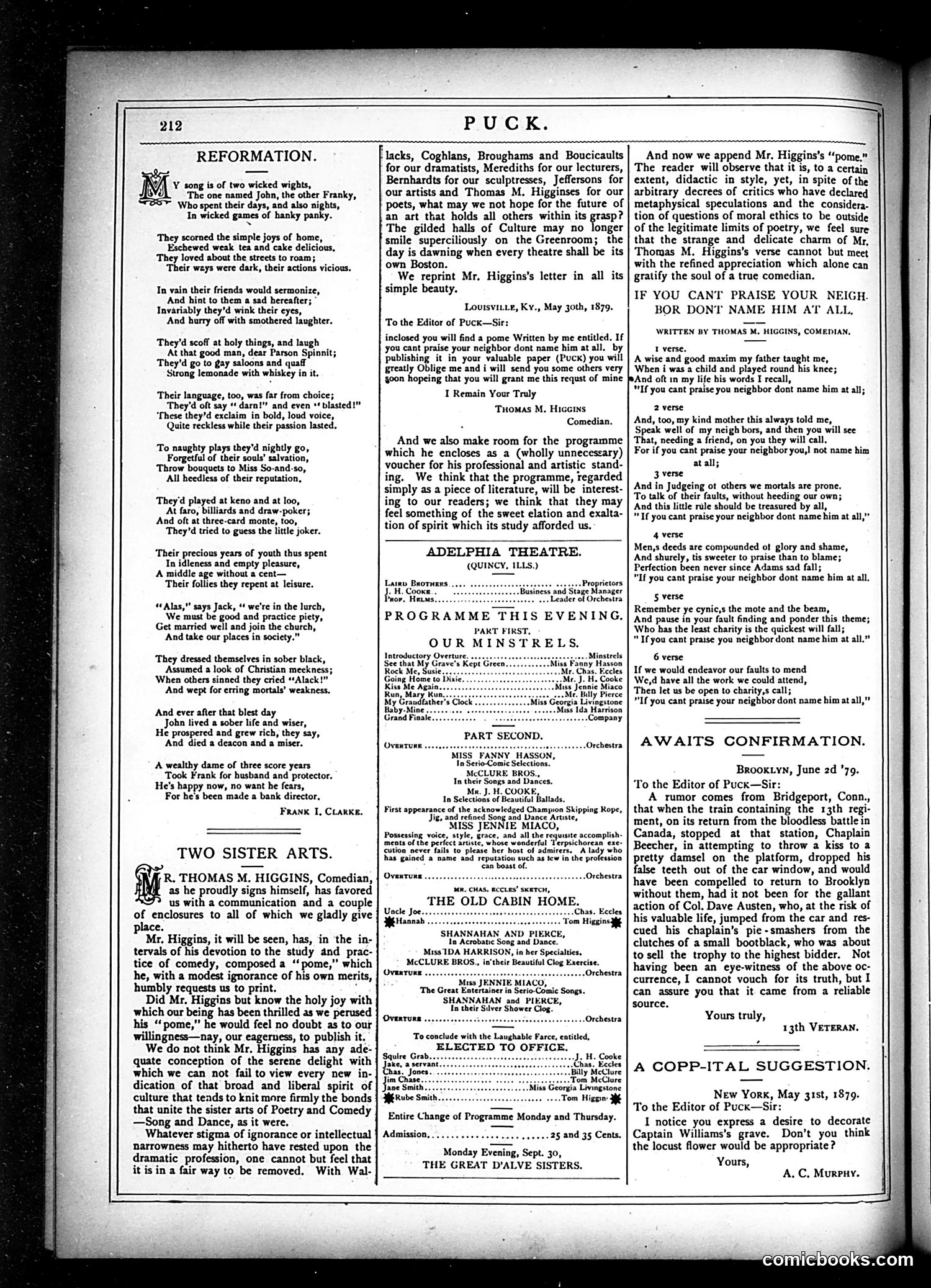
This page is primarily **theatrical advertising and letters to the editor** rather than political satire. The main content includes: 1. **"Reformation" poem** - A satirical verse criticizing theatrical excess and cultural pretension, likely mocking contemporary theater trends 2. **"Two Sister Arts"** - A letter from Thomas M. Higgins defending himself against criticism for not praising a neighbor, with a published response poem titled "If You Can't Praise Your Neighbor Don't Name Him At All" 3. **Theater advertisements** - Multiple venue listings (Adelphia Theatre, etc.) with performance details 4. **Letters to the editor** - Including "Awaits Confirmation" and "A Copp-ital Suggestion" The page lacks prominent political cartoons or caricatures typical of Puck's satirical content, focusing instead on cultural commentary through verse and theatrical notices.
📄 Transcribed text from this page (OCR, searchable)
Machine-transcribed from the original scan — historical spelling and the odd misread are preserved.
PUCK. REFORMATION. Y song is of two wicked wights, The one named John, the other Franky, Who spent their days, and also nights, In wicked games of hanky panky. ‘They scorned the simple joys of home, Eschewed weak tea and cake delicious, They loved about the streets to roam; Their ways were dark, their actions vicious. In vain their friends would sermonize, And hint to them a sad hereafter; Invariably they'd wink their eyes, And hurry off with smothered laughter. They'd scoff at holy things, and laugh At that good man, dear Parson Spinnit; They'd go to gay saloons and quaff ‘Strong lemonade with whiskey in it. Their language, too, was far from choice; ‘They'd oft say “darn!” and even “blasted!” ‘These they'd exclaim in bold, loud voice, Quite reckless while their passion lasted. To naughty plays they'd nightly go, Forgetful of their souls’ salvation, ‘Throw bouquets to Miss So-and-so, All heediess of their reputation, They'd played at keno and at loo, At faro, billiards and draw-poker; ‘And oft at three-card monte, too, They'd tried to guess the little joker. Their precious years of youth thus spent In idleness and empty pleasure, A middle age without a cent— Their follies they repent at leisure. “Alas,” says Jack, “ we're in the lurch, ‘We must be good and practice piety, Get married well and join the church, ‘And take our places in society.” ‘They dressed themselves in sober black, ‘Assumed a look of Christian meekness; ‘When others sinned they cried *Alack!” ‘And wept for erring mortals’ weakness. And ever after that blest day John lived a sober life and wiser, He prospered and grew rich, they say, ‘And died a deacon and a miser. A wealthy dame of three score years Took Frank for husband and protector. He's happy now, no want he fears, For he's been made a bank director, FRANK I, CLARKE. TWO SISTER ARTS. R. THOMAS M. HIGGINS, Comedian, as he proudly signs himself, has favored us with a communication and a couple of enclosures to all of which we gladly give place. Mr. Higgins, it will be seen, has, in the in- tervals of his devotion to the study and prac- tice of comedy, composed a ‘ pome,” which he, with a modest ignorance of his own merits, humbly requests us to print. ; Did Mr. Higgins but know the holy joy with which our being has been thrilled as we perused his ‘‘pome,” he would feel no doubt as to our willingness—nay, our eagerness, to publish it. We do not think Mr. Higgins has any ade- quate conception of the serene delight with which we can not fail to view every new in- dication of that broad and liberal spirit of culture that tends to knit more firmly the bonds that unite the sister arts of Poetry and Comedy —Song and Dance, as it were. Whatever stigma of ignorance or intellectual narrowness may hitherto have rested upon the dramatic profession, one cannot but feel that it is in a fair way to be removed. With Wal- Hlacks, Coghlans, Broughams and Boucicaults for our dramatists, Merediths for our lecturers, Bernhardts for our sculptresses, Jeffersons for our artists and Thomas M. Higginses for our poets, what may we not hope for the future of an art that holds all others within its grasp? The gilded halls of Culture may no longer smile superciliously on the Greenroom; the day is dawning when every theatre shall be its own Boston. We reprint Mr. Higgins’s letter in all its simple beauty. Louisvitie, Ky., May 3oth, 1879. To the Editor of Puck—Sir: inclosed you will find a pome Written by me entitled. If you cant praise your neighbor dont name him at all, by publishing it in your valuable paper (Pucx) you will greatly Oblige me and i will send you some others very §00n hopeing that you will grant me this requst of mine I Remain Your Truly Tuomas M. Hiccins Comedian. And we also make room for the programme which he encloses as a (wholly unnecescary) voucher for his professional and artistic stand- ing. We think that the programme, regarded simply as a piece of literature, will be interest- ing to our readers; we think that they may feel something of the sweet elation and exalta- tion of spirit which its study afforded us. ADELPHIA THEATRE. (QUINCY, ILLS.) -Proprietors Business and Stage Manager ses Leader of Orchestra, Lary Buoarrs . H. Coxe nor. Heiats. PROGRAMME THIS EVENING. PART FIRST, OUR MINSTRELS, Introductory Overture. . See that My Grave's K ily Perce Sins td3 Hareson «Company Orchestra McCLURE BROS., In their Songs and Dances. Mx. J. H. COOKE, In Selectioas of Beautiful Ballads. First appearance of the acknowledged Champion Jig, and refined Song and Dance Artiste, MISS JENNIE MIACO, tyle, grace, and all the requisite accomplish- ments of the perfect aruiste, whose wonderful Terpsichorean exe- Gution never fails to please her host of admirers. A lady who has gained a name and reputation such as few in the profession ipping Rope, Possessing voice, SHANNAHAN AND PIEKCE, In Acrobatic Sc Miss IDA HARRISON, in her Speci McCLURE BROS., in'their Beautiful Clog Exercise. Oventun --Orchestra Miss JENNIE MIACO, ‘The Great Entertainer in Serio-Comic Songs. SHANNAHAN and PIERCE, In their Silver Shower Clog. Overture. Orchestra To conclude with the Laughable Farce, entitled, ELECTED TO OFFICE. Squire Grab. Jake, a servani Lomi jaan jane Smith, BERude Smith. ++ Tom Higgin: 46 Entire Change of Programme Monday and Thursday. Admission, ..... sees ve seeeee25 and 35 Cents, Monday Evening, Sept. 30, THE GREAT D'ALVE SISTERS. And now we append Mr. Higgins’s “‘pome,” The reader will observe that it is, to a certain extent, didactic in style, yet, in spite of the arbitrary decrees of critics who have declared metaphysical speculations and the considera- tion of questions of moral ethics to be outside of the legitimate limits of poetry, we feel sure that the strange and delicate charm of Mr, Thomas M. Higgins's verse cannot but meet with the refined appreciation which alone can gratify the soul of a true comedian. IF YOU CANT PRAISE YOUR NEIGH. BOR DONT NAME HIM AT ALL, WRITTEN BY THOMAS M, HIGGINS, COMEDIAN, 1 verse. ‘A wise and good maxim my father taught me, When i was a child and played round his knee; And oft in my life his words I recall, “IIE you cant praise you neighbor dont name him at all; 2 verse And, too, my kind mother this always told me, Speak well of my neigh bors, and then you will see That, needing a friend, on you they will call. For if you cant praise your neighbor you,! not name him at all; 3 verse And in Judgeing ot others we mortals are prone. To talk of their faults, without heeding our own; And this little rule should be treasured by all, "If you cant praise your neighbor dont name him at all,” 4 verse Men,s deeds are compounded ot glory and shame, And shurely, tis sweeter to praise than to blame; Perfection been never since Adams sad fall; "If you cant praise your neighbor dont name him at all. 5 verse Remember ye cynic,s the mote and the beam, And pause in your fault finding and ponder this theme; Who has the least charity is the quickest will fall; "Ifyou cant praise you neighbor dont name him at all.” 6 verse If we would endeavor our faults to mend Weyd have all the work we could attend, Then let us be open to charity,s call; "If you cant praise your neighbor dont name him at all,”” AWAITS CONFIRMATION. Brooxtyn, June 2d ’79. To the Editor of Puck—Sir: A rumor comes from Bridgeport, Conn., that when the train containing the 13th regi- ment, on its return from the bloodless battle in Canada, stopped at that station, Chaplain Beecher, in attempting to throw a kiss to a pretty damsel on the platform, dropped his false teeth out of the car window, and would have been compelled to return to Brooklyn without them, had it not been for the gallant action of Col, Dave Austen, who, at the risk of his valuable life, jumped from the car and res- cued his chaplain’s pie-smashers from the clutches of a small bootblack, who was about to sell the trophy to the highest bidder. Not having been an eye-witness of the above oc- currence, I cannot vouch for its truth, but I can assure you that it came from a reliable source, Yours truly, 13th VETERAN. A COPP-ITAL SUGGESTION. New York, May 31st, 1879. To the Editor of Puck—Sir: I notice you express a desire to decorate Captain Williams's grave. Don’t you think the locust flower would be appropriate? Yours, A.C, Murpuy.