
Puck, 1879-06-11 · page 11 of 16
Puck — June 11, 1879 — page 11: what you’re looking at
What you’re looking at
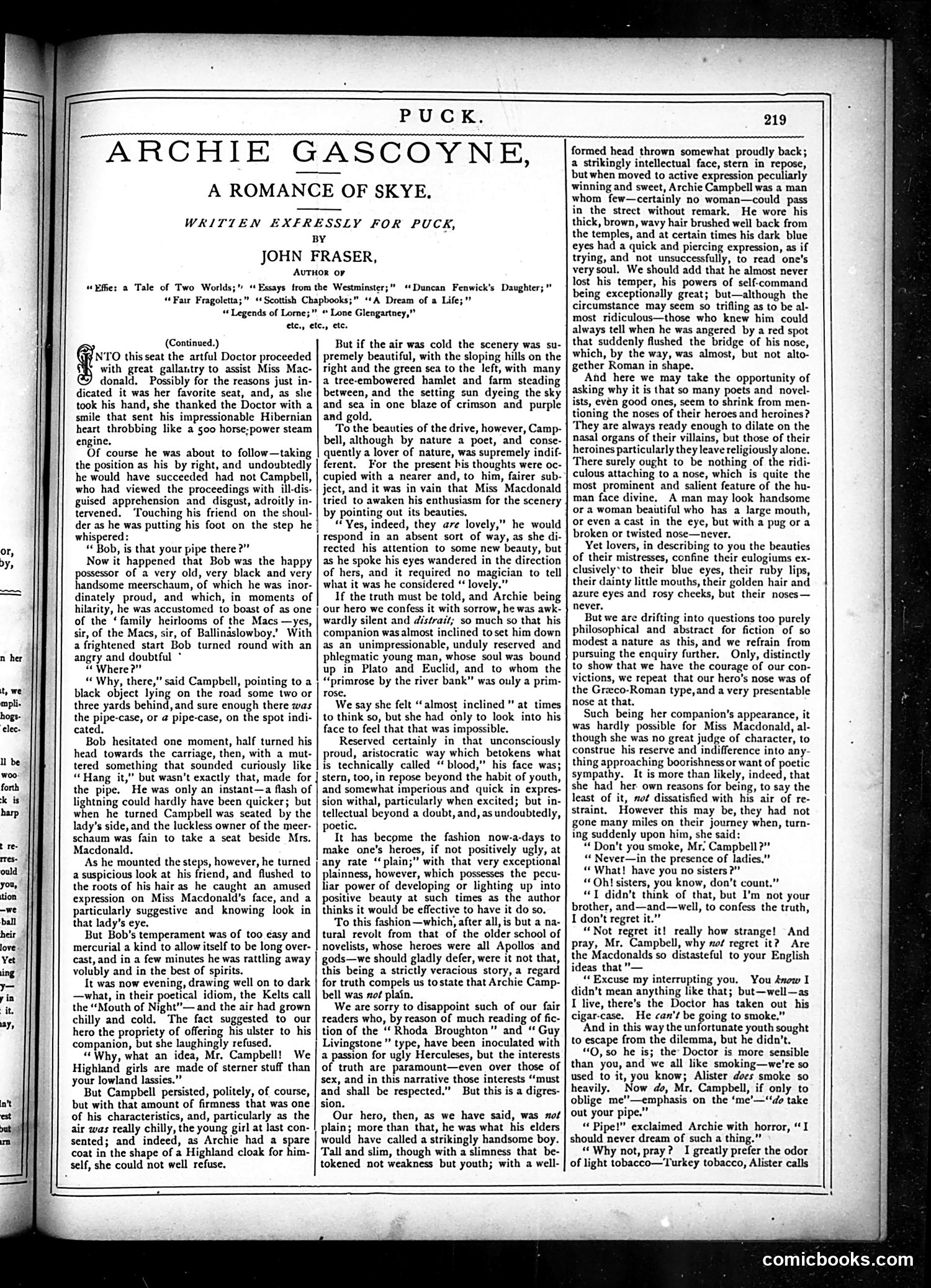
This page contains the continuation of a serialized short story by John Fraser, written expressly for Puck magazine. The narrative follows Archie Campbell, a young Highland man of modest means, as he interacts with Miss Macdonald and Bob Campbell. The text is purely literary fiction—a romantic story set in Scotland—rather than political satire or social commentary. There are no visible cartoons or caricatures on this page. The content represents Puck's practice of publishing serialized fiction alongside its better-known humorous illustrations and satirical content. This is a straightforward narrative passage with no apparent satirical intent toward contemporary figures or events.
📄 Transcribed text from this page (OCR, searchable)
Machine-transcribed from the original scan — historical spelling and the odd misread are preserved.
PUCK. 219 ARCHIE GASCOYNE, A ROMANCE OF SKYE. WRITTEN EXFRESSLY FOR PUCK, BY JOHN FRASER, AUTHOR OF “Effie: a Tale of Two Worlds;" ‘Essays from the Westminster;” Duncan Fenwick's Daughter; ” “Fair Fragoletta; “ Legends of Lorne;” ete., et (Continued.) NTO this seat the artful Doctor proceeded with great gallantry to assist Miss Mac- donald. Possibly for the reasons just in- dicated it was her favorite seat, and, as she took his hand, she thanked the Doctor with a smile that sent his impressionable Hibernian heart throbbing like a 500 horse;power steam engine. Of course he was about to follow—taking the position as his by right, and undoubtedly he would have succeeded had not Campbell, who had viewed the proceedings with ill-dis- guised apprehension and disgust, adroitly in- tervened, ‘Touching his friend on the shoul- der as he was putting his foot on the step he whispered: “ Bob, is that your pipe there ?” Now it happened that Bob was the happy possessor of a very old, very black and very handsome meerschaum, of which he was inor- dinately proud, and which, in moments of hilarity, he was accustomed to boast of as one of the ‘family heirlooms of the Macs —yes, sir, of the Macs, sir, of Ballinaslowboy.’ With a frightened start Bob turned round with an angry and doubtful * “ Where?” “ Why, there,” said Campbell, pointing to a black object lying on the road some two or three yards behind, and sure enough there was the pipe-case, or @ pipe-case, on the spot indi- cated, Bob hesitated one moment, half turned his head towards the carriage, then, with a mut- tered something that sounded curiously like “ Hang it,” but wasn’t exactly that, made for the pipe. He was only an instant—a flash of lightning could hardly have been quicker; but when he turned Campbell was seated by the lady's side, and the luckless owner of the meer- schaum was fain to take a seat beside Mrs. Macdonald. As he mounted the steps, however, he turned a suspicious look at his friend, and flushed to the roots of his hair as he caught an amused expression on Miss Macdonald's face, and a particularly suggestive and knowing look in that lady’s eye. But Bob's temperament was of too éasy and mercurial a kind to allow itself to be long over- cast, and in a few minutes he was rattling away volubly and in the best of spirits. It was now evening, drawing well on to dark —what, in their poetical idiom, the Kelts call the “Mouth of Night”— and the air had grown chilly and cold, The fact suggested to our hero the propriety of offering his ulster to his companion, but she laughingly refused. “Why, what an idea, Mr, Campbell! We Highland girls are made of sterner stuff than your lowland lassies.”” But Campbell persisted, politely, of course, but with that amount of firmness that was one of his characteristics, and, particularly as the air was really chilly, the young girl at last con- sented; and indeed, as Archie had a spare coat in the shape of a Highland cloak for him- self, she could not well refuse, “Scottish Chapbooks;” ‘*A Dream of a Life;”” Lone Glengartney,” » ete. But if the air was cold the scenery was su- premely beautiful, with the sloping hills on the right and the green sea to the left, with many a tree-embowered hamlet and farm steading between, and the setting sun dyeing the sky and sea in one blaze of crimson and purple and gold. To the beauties of the drive, however, Camp- bell, although by nature a poet, and’ conse- quently a lover of nature, was supremely indif- ferent. For the present his thoughts were oc- cupied with a nearer and, to him, fairer sub- ject, and it was in vain that Miss Macdonald tried to awaken his enthusiasm for the scenery by pointing out its beauties, “Yes, indeed, they are lovely,” he would respond in an absent sort of way, as she di- rected his attention to some new beauty, but as he spoke his eyes wandered in the direction of hers, and it required no magician to tell what it was he considered ‘ lovely.” If the truth must be told, and Archie being our hero we confess it with sorrow, he was awk- wardly silent and distrait; so much so that his companion was almost inclined toset him down as an unimpressionable, unduly reserved and phlegmatic young man, whose soul was bound up in Plato and Euclid, and to whom the “primrose by the river bank” was ouly a prim- rose. We say she felt “almost inclined" at times to think so, but she had only to look into his face to feel that that was impossible. Reserved certainly in that unconsciously proud, aristocratic way which betokens what is technically called ‘“ blood,” his face was; stern, too, in repose beyond the habit of youth, and somewhat imperious and quick in expres- sion withal, particularly when excited; but in- tellectual beyond a doubt, and, as undoubtedly, poetic, It has become the fashion now-a-days to make one’s heroes, if not positively ugly, at any rate ‘plain;” with that very exceptional plainness, however, which the pecu- liar power of developing or lighting up into positive beauty at such times as the author thinks it would be effective to have it do so. To this fashion—which, after all, is but a na- tural revolt from that of the older school of novelists, whose heroes were all Apollos and gods—we should gladly defer, were it not that, this being a strictly veracious story, a regard for truth compels us tostate that Archie Camp- bell was nof plain. We are sorry to disappoint such of our fair readers who, by reason of much reading of fic- tion of the ‘‘ Rhoda Broughton” and “ Guy Livingstone ” type, have been inoculated with a passion for ugly Herculeses, but the interests of truth are paramount—even over those of sex, and in this narrative those interests “must and shall be respected.” But this is a digres- sion. Our hero, then, as we have said, was not plain; more than that, he was what his elders would have called a strikingly handsome boy. Tall and slim, though with a slimness that be- tokened not weakness but youth; with a well- formed head thrown somewhat proudly back; a strikingly intellectual face, stern in repose, but when moved to active expression peculiarly winning and sweet, Archie Campbell was a man whom few—certainly no woman—could pass in the strect without remark. He wore his thick, brown, wavy hair brushed well back from the temples, and at certain times his dark blue eyes had a quick and piercing expression, as if trying, and not unsuccessfully, to read one’s very soul, We should add that he almost never lost his temper, his powers of self-command being exceptionally great; but—although the circumstance may seem so trifling as to be al- most ridiculous—those who knew him could always tell when he was angered by a red spot that suddenly flushed the bridge of his nose, which, by the way, was almost, but not alto- gether Roman in shape. And here we may take the opportunity of asking why it is that so many poets and novel- ists, evén good ones, seem to shrink from men- tioning the noses of their heroes and heroines? ‘They are always ready enough to dilate on the nasal organs of their villains, but those of their heroines particularly they leave religiously alone. ‘There surely ought to be nothing of the ridi- culous attaching to a nose, which is quite the most prominent and salient feature of the hu- man face divine. A man may look handsome or a woman beaitiful who has a large mouth, or even a cast in the eye, but with a pug or a broken or twisted nose—never. Yet lovers, in describing to you the beauties of their mistresses, confine their eulogiums ex- clusively*to their blue eyes, their ruby lips, their dainty little mouths, their golden hair and azure eyes and rosy cheeks, but their noses— never, But we are drifting into questions too purely philosophical and abstract for fiction of so modest a nature as this, and we refrain from pursuing the enquiry further. Only, distinctly to show that we have the courage of our con- victions, we repeat that our hero's nose was of the Greco-Roman type, and a very presentable nose at that. Such being her companion’s appearance, it was hardly possible for Miss Macdonald, al- though she was no great judge of character, to construe his reserve and indifference into any. thing approaching boorishness or want of poetic sympathy. It is more than likely, indeed, that she had her. own reasons for being, to say the least of it, not dissatisfied with his air of re- straint. However this may be, they had not gone many miles on their journey when, turn- ing suddenly upon him, she said: “Don't you smoke, Mr. Campbell ?” “‘ Never—in the presence of ladies.” “ What! have you no sisters?” “Oh! sisters, you know, don’t count.” “T didn’t think of that, but I’m not your brother, and—and—well, to confess the truth, I don’t regret it.” “Not regret it! really how strange! And pray, Mr. Campbell, why nof regret it? Are the Macdonalds so distasteful to your English ideas that "— “Excuse my interrupting you. You dnow I didn’t mean anything like that; but—well—as I live, there’s the Doctor has taken out his cigar-case. He can't be going to smoke.” And in this way the unfortunate youth sought to escape from the dilemma, but he didn’t. "OQ, so he is; the Doctor is more sensible than you, and we all like smoking—we're so used to it, you know; Alister does smoke so heavily, Now do, Mr. Campbell, if only to oblige me’’—emphasis on the ‘me’—‘‘do take out your pipe.” “ Pipe!” exclaimed Archie with horror, “I should never dream of such a thing.” “Why not, pray? I greatly prefer the odor of light tobacco—Turkey tobacco, Alister calls = — li comicbooks.com