
Puck, 1879-06-11 · page 2 of 16
Puck — June 11, 1879 — page 2: what you’re looking at
What you’re looking at
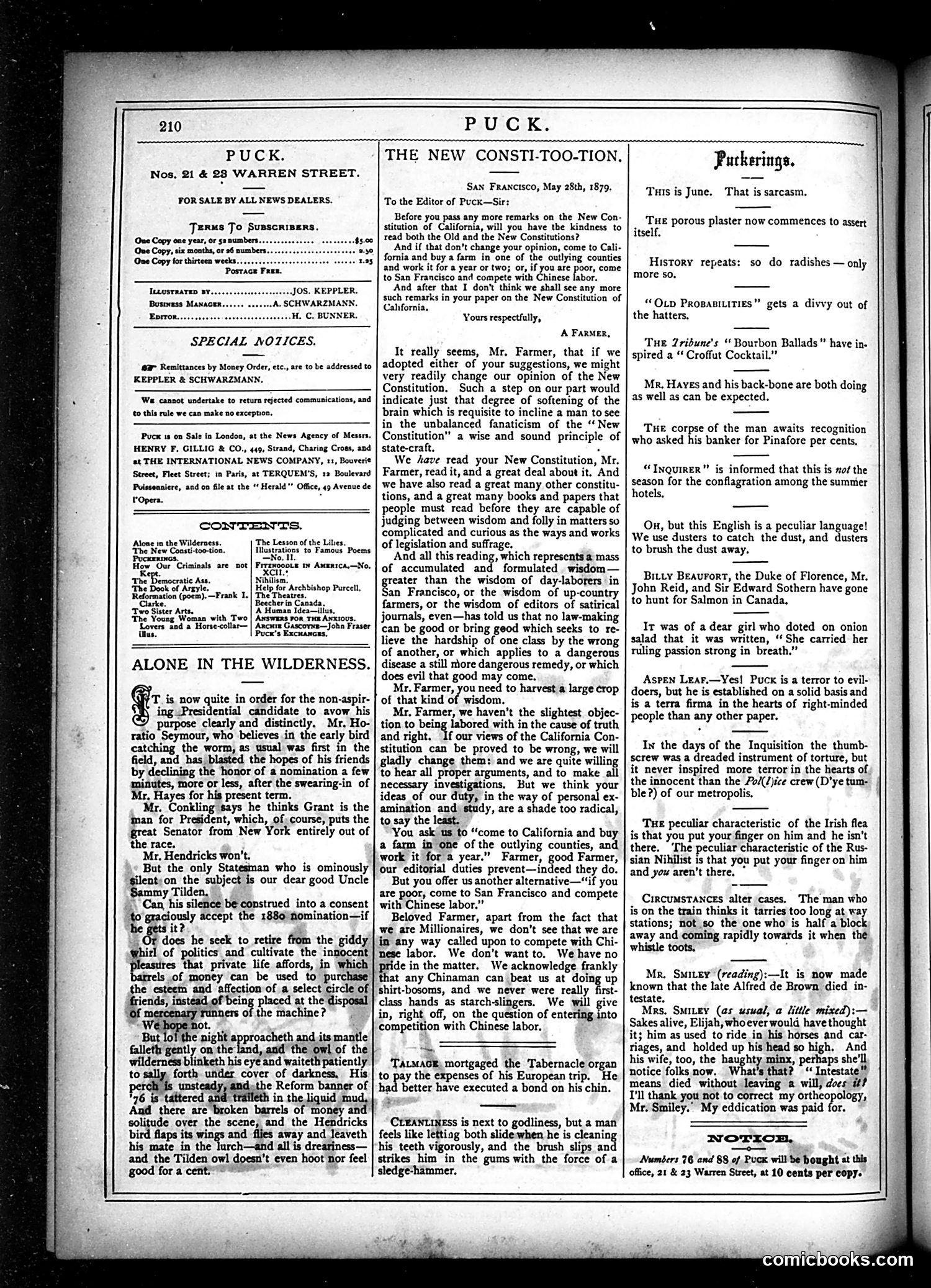
This page primarily contains editorial content and letters rather than political cartoons. The main article, "Alone in the Wilderness," appears to satirize a presidential candidate (likely Rutherford B. Hayes, given the 1879 date) who the writer suggests has isolated himself from practical politics. The piece mockingly criticizes his detachment, suggesting he's like the mythical figure Seymour who believed "the only bird catching the worm, as well as first in the field" could win. The satire targets what Puck views as naive political idealism disconnected from real-world machinations—suggesting the candidate's isolation from party machinery and compromise will doom his electoral hopes. The "wilderness" metaphor implies political inexperience and removal from necessary political engagement.
📄 Transcribed text from this page (OCR, searchable)
Machine-transcribed from the original scan — historical spelling and the odd misread are preserved.
PUCK. PUCK. Nos, 21 & 28 WARREN STREET. FOR SALE BY ALL NEWS DEALERS. Jenus To Susscripens. Que Copy one year, or sa numbers. One Copy, six months, or 96 umbers, Postack Freez. SPECIAL NOTICES. ar Remittances by Money Order, etc., are to be addressed to KEPPLER & SCHWARZMANN. We cannot undertake to return rejected communications, and to this rule we can make no exception. Puck 1s on Sale in London, at the News Agency of Messrs. HENRY F. GILLIG & CO., 449, Strand, Charing Cross, and a¢ THE INTERNATIONAL NEWS COMPANY, 11, Bouveri¢ Street, Fleet Street; in Paris, at TERQUEM'S, 12 Boulevard Puisseaniere, and on file at the ‘ Herald" Office, 49 Avenue de Opera. . CONTENTS. The Lesson of the Lilies. Alone io the Wilderness. Illustrations to Famous Poems ‘The New Consti-too-tioa. ——_ How Our Criminals are not = iN Asanica,—No, The Democratic Ass. ‘The Dook of Argyle. chbishop Purcell, Reformation (poem).—Frank 1. Help ‘The Theatres. Clarke. Beecher in Canada, ‘Two Sister Arts, A Human Idea—ilius, ‘The Young Woman with Two overs and a Horse-ollar— jus. VOR THE ANXIOUS. ‘Ancuts Gascovee—Joha Fraser Pocx’s Excuances. ALONE IN THE WILDERNESS. 'T_is now quite in order for the non-aspir- ing Presidential candidate to avow his purpose clearly and rink Mr, Ho- ratio Seymour, who believes in the early bird catching the worm, as usual was first in the field, and has, blasted the hopes of his friends by declining the honor of a nomination a few minutes, more or less, after the swearing-in of Mr, Hayes for his present term. Mr. Conkling says he thinks Grant is the fman for President, which, ofcourse, puts the great Senator from New York entirely out of the race. Mr. Hendricks won't. But the only Statesman who is ominously gilentyon the subject is our dear good Uncle Sammy Tilden, \ Can his silence be construed into a consent to graciously accept the 1880) nomination—if he it? GF docs he seek to retire from the giddy @hirl of politics and cultivate the innocent Pao that private life affords, in which Is of money can be used to purchase Gicnds stad of Being placed at the disposal jends, instead.of bein, at the dis a cenary runners of the machine? Bi t. k But lof the night epproacheth and. its mantle d, and falleth gently onthe the ‘owl of the wilderness blinketh his eye and waiteth patiently to sally, forth under cover of darkness, His perch ds unsteady, andsthe Reform banner of 76 is tattered and traileth in the liquid, mud, And there are broken barrels of money and solitude over the scene, and the Hendricks i its wings and flies away and Jéaveth ¢ lurch—and all is dreariness— and the Tilden owl doesn’t even hoot nor feel good for a cents" THE NEW CONSTI-TOO-TION. SAN FRANCISCO, May 28th, 1879. To the Editor of Puck—Sir: Before you pass any more remarks on the New Con- stitution of California, will you have the kindness to read both the Old and the New Constitutions? ‘And if that don’t change your opinion, come to Cali- fornia and buy a farm in one of the outlying counties and work it for a year or two; or, if you are poor, come to San Francisco and compete with Chinese labor. And after that I don't think we shall see any more such remarks in your paper on the New Constitution of California, Yours respectfully, A FARMER, It really seems, Mr, Farmer, that if we adopted either of your suggestions, we might very readily change our opinion of the New Constitution. Such a step on our part would indicate just that degree of softening of the brain which is requisite to incline a man to see in the unbalanced fanaticism of the ‘New Constitution” a wise and sound principle of state-craft. . We have read your New Constitution, Mr. Farmer, read it, and a great deal about it. And we have also read a great many other constitu- tions, and a great many books and papers that people must read before they are capable of judging between wisdom and folly in matters so complicated and curious as the ways and works of legislation and suffrage. And all this reading, which represents @ mass of accumulated and formulated wisdom— gate than the wisdom of day-laborers in an Francisco, or the wisdom of up-country farmers, or the wisdom of editors of satirical journals, even—has told us that no law-making can be good or bring geod which seeks to re- lieve the hardship of one class by the wrong of another, or which applies to a dangerous disease a still more dangerous remedy, or which does evil that good may come. Mr. Farmer, you need to harvest a large crop of that kind of wisdom. Mr, Farmer, we haven't the slightest objec- tion to being labored with in the cause of truth and right. If our views of the California Con- stitution can be proved to be wrong, we will gladly change them: and we are quite willing to hear all proper arguments, and to make all necessary investigations, But we think your ideas of our duty, in the way of personal ex- amination and study, are a shade too radical, to say the least. You ask us to “come to California and buy a farm in one of the outlying counties, and work it for a year.” Farmer, good Farmer, our editorial duties prevent—indeed they do. But you offer us another alternative—“‘if you are poor, come to San Francisco and compete with Chinese labor.” Beloved Farmer, apart from the fact that we are Millionaires, we don’t see that we are in any way called upon to compete with Chi- nese labor. We don’t want to. We have no pride in the matter. We acknowledge frankly that any Chinaman can beat us at doing up shirt-bosoms, and we never were really first- class hands as starch-slingers. We will give in, right, off, on the question of entering.into competition with Chinese labor. ‘TALMAGE) mortgaged the Tabernacle organ to pay the expenses of his Euro, trip. He had better have executed a bond on his chin. CYrEANLINEss is next to godliness, but a man feels like lettiag both slide-when he is cleanin; his teeth vigorously, and the brush slips and strikes him in the gums with the force of a sledge-hammer. Puckerings, Tus is June, That is sarcasm. ‘THE porous plaster now commences to assert itself. History repeats: so do radishes — only more so. “Otp Prosasitities” gets a divvy out of the hatters, Tue Tribune's “ Bourbon Ballads” have ine spired a “ Croffut Cocktail.” Mr. Hayes and his back-bone are both doing as well as can be expected. THe corpse of the man awaits recognition who asked his banker for Pinafore per cents, “Inquirer” is informed that this is nof the season for the conflagration among the summer hotels, Ou, but this English is a peculiar language! We use dusters to catch the dust, and dusters to brush the dust away. Bitty Beaurort, the Duke of Florence, Mr. John Reid, and Sir Edward Sothern have gone to hunt for Salmon in Canada. Ir was of a dear girl who doted on onion salad that it was written, ‘She carried her ruling passion strong in breath.” Aspen Lear.—Yes! Puck is a terror to evil- doers, but he is established on a solid basis and is a terra firma in the hearts of right-minded people than any other paper. In the days of the Inquisition the thumb- screw was a dreaded instrument of torture, but it never inspired more terror in the hearts of. the innocent than the Fo/(/)ice crew (D'ye tum- ble?) of our metropolis. Tue peculiar characteristic of the Irish flea is that you put your finger on him and he isn’t there. ‘The peculiar characteristic of the Rus- sian Nihilist is that you put your finger on him and you aren’t there, Circumstances alter cases. The man who is on the train thinks it tarries too long at wa) stations; not so the one who is half 1 block away and coming rapidly towatds it when the whistle toots. Mr. Smitey (reading):—It is now made known that the late Alfred de Brown died in- testate. Mrs. Ssitey (as usual, a little mixed):— Sakes alive, Elijah, whoever would have thought it; him as used to ride in his horses and car- riages, and holded up his head so high. And his wife, too, the haughty minx, perhaps she'll notice folks now. What's that? “‘ Intestate” means died without leaving a will, docs it? I'll thank you not to correct my ortheopology, Mr. Smiley.” My eddication was paid for. NOTICE. —— Numbers 76 and 88 of Puck will be bought st this office, 21 & 23 Warren Street, at 10 cents per copy.