
Puck, 1879-06-11 · page 6 of 16
Puck — June 11, 1879 — page 6: what you’re looking at
What you’re looking at
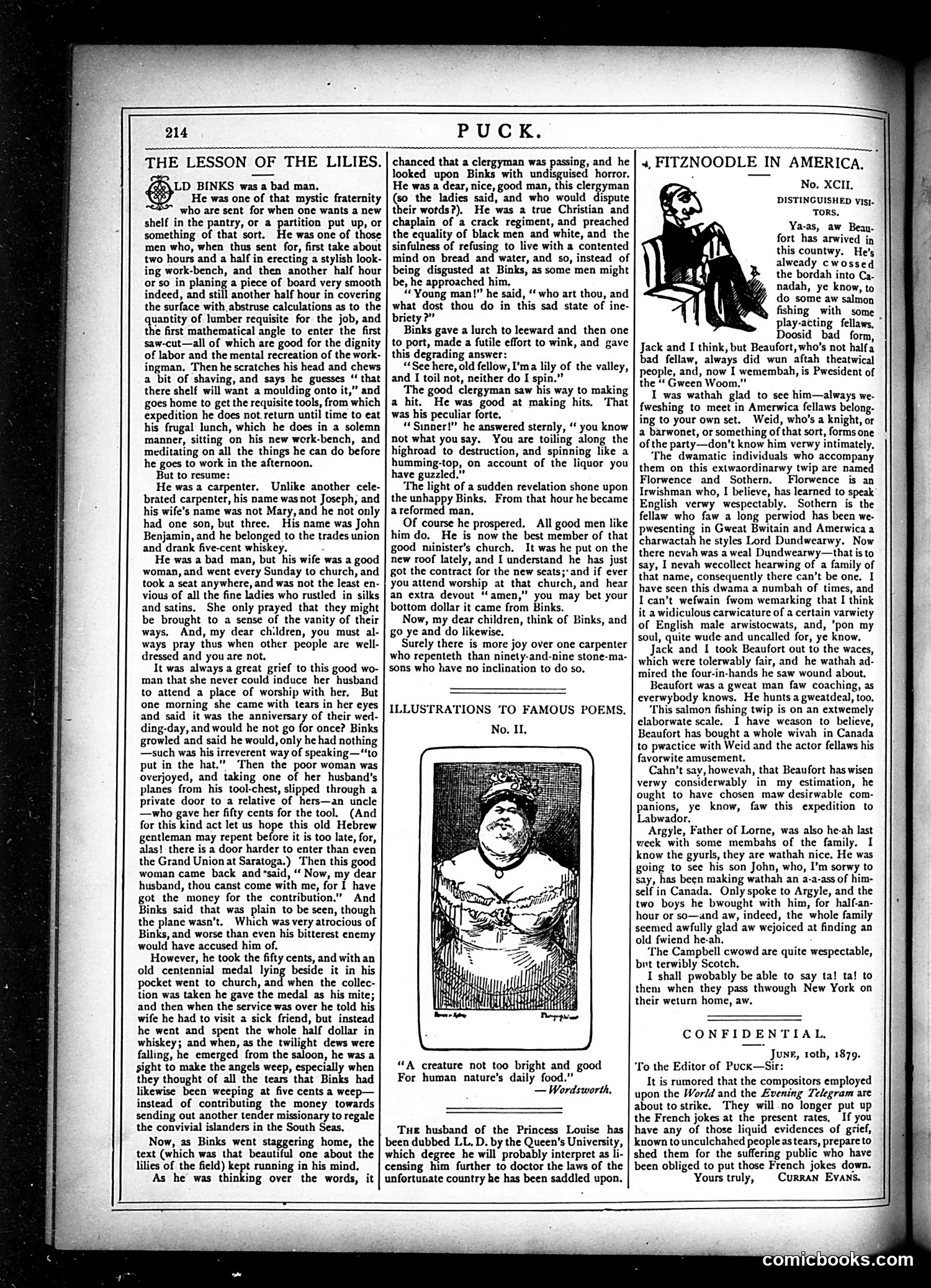
This page contains two distinct sections: **"The Lesson of the Lilies"** is a moral tale about Old Binks, a reformed carpenter and former drunkard who becomes a respected church member. The narrative emphasizes his transformation and Christian virtue, concluding with him donating fifty cents to charity—presented as redemptive despite his modest means. **"Illustrations to Famous Poems, No. II"** features an engraved portrait of a rotund woman in Victorian dress, paired with a Wordsworth quote about nature's daily sustenance. The page also contains a brief letter to the editor regarding compositors employed by the *World* and *Evening Telegram* newspapers striking. The satirical content is relatively mild on this particular page, focusing more on moral instruction and literary illustration than political commentary.
📄 Transcribed text from this page (OCR, searchable)
Machine-transcribed from the original scan — historical spelling and the odd misread are preserved.
214 THE LESSON OF THE LILIES. LD BINKS was a bad man. He was one of that mystic fraternity who are sent for when one wants a new shelf in the pantry, or a partition put up, or something of that sort. He was one of those men who, when thus sent for, first take about two hours and a half in erecting a stylish look- ing work-bench, and then another half hour or so in planing a piece of board very smooth indeed, and still another half hour in covering the surface with abstruse calculations as to the quantity of lumber requisite for the job, and the first mathematical angle to enter the first saw-cut—all of which are good for the dignity of labor and the mental recreation of the work- ingman, Then he scratches his head and chews a bit of shaving, and says he guesses ‘‘ that there shelf will want a moulding onto it,” and goes home to get the requisite tools, from which expedition he does not.return until time to eat his frugal lunch, which he does in a solemn manner, sitting on his new work-bench, and meditating on all the things he can do before he goes to work in the afternoon. But to resume: He was a carpenter. Unlike another cele- brated carpenter, his name was not Joseph, and his wife's name was not Mary, and he not only had one son, but three. His name was John Benjamin, and he belonged to the trades union and drank five-cent whiskey. He was a bad man, but his wife was a good woman, and went every Sunday to church, and took a seat anywhere, and was not the least en- vious of all the fine ladies who rustled in silks and satins. She only prayed that they might be brought to a sense of the vanity of their ways, And, my dear children, you must al- ways pray thus when other people are well- dressed and you are not. It was always a great grief to this good wo- man that she never could induce her husband to attend a place of worship with her. But one morning she came with tears in her eyes and said it was the anniversary of their wed- ding-day, and would he not go for once? Binks growled and said he would, only he had nothing —such was his irreverent way of speaking—“to put in the hat.” Then the poor woman was overjoyed, and taking one of her husband's planes from his tool-chest, slipped through a private door to a relative of hers—an uncle —who gave her fifty cents for the tool. (And for this kind act let us hope this old Hebrew gentleman may repent before it is too late, for, alas! there is a door harder to enter than even the Grand Union at Saratoga.) Then this good woman came back and °said, “‘ Now, my dear husband, thou canst come with me, for I have got the money for the contribution.” And Binks said that was plain to be seen, though the plane wasn’t. Which was very atrocious of Binks, and worse than even his bitterest enemy would have accused him of. However, he took the fifty cents, and with an old centennial medal lying beside it in his pocket went to church, and when the collec- tion was taken he gave the medal as his mite; and then when the service was over he told his wife he had to visit a sick friend, but instead he went and spent the whole half dollar in whiskey; and when, as the twilight dews were falling, he emerged from the saloon, he was a sight to make the angels weep, especially when they thought of all the tears that Binks had likewise been weeping at five cents a weep— instead of contributing the money towards sending out another tender missionary to regale the convivial islanders in the South Seas, Now, as Binks went staggering home, the text (which was that beautiful one about the lilies of the field) kept running in his mind. As he was thinking over the words, it chanced that a clergyman was passing, and he looked upon Binks with undisguised horror. He was a dear, nice, good man, this clergyman ‘so the ladies said, and who would dispute their wotds?). He was a true Christian and chaplain of a crack regiment, and preached the equality of black men and white, and the sinfulness of refusing to live with a contented mind on bread and water, and so, instead of being disgusted at Binks, as some men might be, he approached him. “Young man!” he said, “‘ who art thou, and what dost thou do in this sad state of ine- briety 2” Binks gave a lurch to leeward and then one to port, made a futile effort to wink, and gave this degrading answer: “See here, old fellow, I'ma lily of the valley, and I toil not, neither do I spin.” ‘The good clergyman saw his way to making a hit. He was good at making hits. ‘That was his peculiar forte. “Sinner!” he answered sternly, “ you know not what you say. You are toiling along the highroad to destruction, and spinning like a humming-top, on account of the liquor you have guzzled.” ‘The light of a sudden revelation shone upon the unhappy Binks. From that hour he became areformed man, Of course he prospered. All good men like him do, He is now the best member of that good minister’s church. It was he put on the new roof lately, and I understand he has just got the contract for the new seats;-and if ever you attend worship at that church, and hear an extra devout “amen,” you may bet your bottom dollar it came from Binks. Now, my dear children, think of Binks, and go ye and do likewise. Surely there is more joy over one carpenter who repenteth than ninety-and-nine stone-ma- sons who have no inclination to do so. ILLUSTRATIONS TO FAMOUS POEMS. “A creature not too bright and good For human nature’s daily food.” — Wordsworth, Tue husband of the Princess Louise has been dubbed LL, D. by the Queen's University, which degree he will probably interpret as li- censing him further to doctor the laws of the unfortunate country he has been saddled upon. “4 FITZNOODLE IN AMERICA, _ . “No. XCIL. DISTINGUISHED visj- TORS, Ya-as, aw Beau- fort has arwived in this countwy. He's alweady cwossed the bordah into Ca- nadah, ye know, to do some aw salmon fishing with some play-acting fellaws. ° Doosid bad form, Jack and I think, but Beaufort, who’s not halfa bad fellaw, always did wun aftah theatwical people, and, now I wemembah, is Pwesident of the “ Gween Woom.” I was wathah glad to see him—always we- f{weshing to meet in Amerwica fellaws belong- ing to your own set. Weid, who's a knight, or a barwonet, or something of that sort, forms one of the party—don’t know him verwy intimately, ‘The dwamatic individuals who accompany them on this extwaordinarwy twip are named Florwence and Sothern, Florwence is an Irwishman who, I believe, has learned to speak English verwy wespectably. Sothern is the fellaw who faw a long perwiod has been we- pwesenting in Gweat Bwitain and Amerwica a charwactah he styles Lord Dundwearwy. Now there nevah was a weal Dundwearwy—that is to say, I nevah wecollect hearwing of a family of that name, consequently there can’t be one, I have seen this dwama a numbah of times, and I can’t wefwain fwom wemarking that I think it a widiculous carwicature of a certain varwiety of English male arwistocwats, and, ‘pon my soul, quite wude and uncalled for, ye know. Jack and 1 took Beaufort out to the waces, which were tolerwably fair, and he wathah ad- mired the four-in-hands he saw wound about, Beaufort was a gweat man faw coaching, as everwybody knows. He hunts a gweatdeal, too, ‘This salmon fishing twip is onan extwemely elaborwate scale. I have weason to believe, Beaufort has bought a whole wivah in Canada to pwactice with Weid and the actor fellaws his favorwite amusement. Cahn’t say, howevah, that Beaufort has wisen verwy considerwably in my estimation, he ought to have chosen maw desirwable com- panions, ye know, faw this expedition to Labwador. Argyle, Father of Lorne, was also he-ah last week with some membahs of the family. 1 know the gyurls, they are wathah nice, He was going to see his son John, who, I’m sorwy to say, has been making wathah an a-a-ass of him- self in Canada. Only spoke to Argyle, and the two boys he bwought with him, for half-an- hour or so—and aw, indeed, the whole family seemed awfully glad aw wejoiced at finding an old fwiend he-ah. ‘The Campbell cwowd are quite wespectable, but terwibly Scotch, I shall pwobably be able to say ta! ta! to them when they pass thwough New York on their weturn home, aw. CONFIDENTIAL Jung, roth, 1879. ‘To the Editor of Puck—Sir: It is rumored that the compositors employed upon the World and the Evening Telegram are about to strike. They will.no longer put up the French jokes at the present rates, If you have any of those liquid evidences of giief, known to unculchahed people astears, prepare to shed them for the suffering public who have been obliged to put those French jokes down. Yours truly, Curran Evans.