
A complete issue · 16 pages · 1879
Puck — June 4, 1879
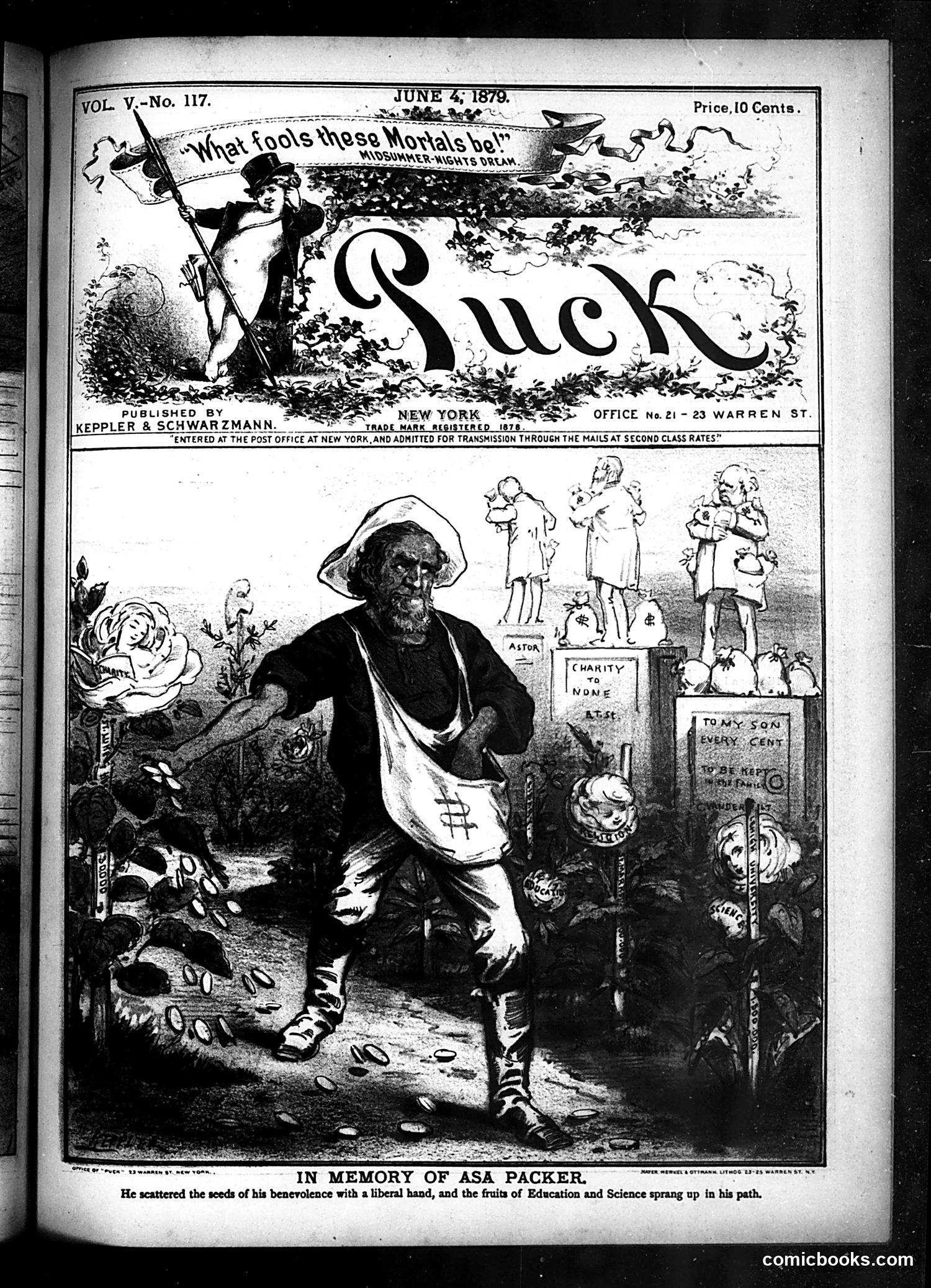
This is a memorial cartoon honoring **Asa Packer**, a prominent 19th-century industrialist and philanthropist. The central figure depicts Packer as a sower scattering seeds—a biblical metaphor for generosity. The caption states: "He scattered the seeds of his benevolence with a liberal hand, and the fruits of Education and Science sprang up in his path." The growing plants labeled "Charity to Home," "To Every Cent," and similar phrases represent Packer's charitable legacy. The figures emerging from the flora appear to be beneficiaries of his educational and scientific donations. The satire's tone is respectful rather than mocking—Puck is honoring Packer's philanthropic contributions through allegorical imagery common to 19th-century memorial cartoons.
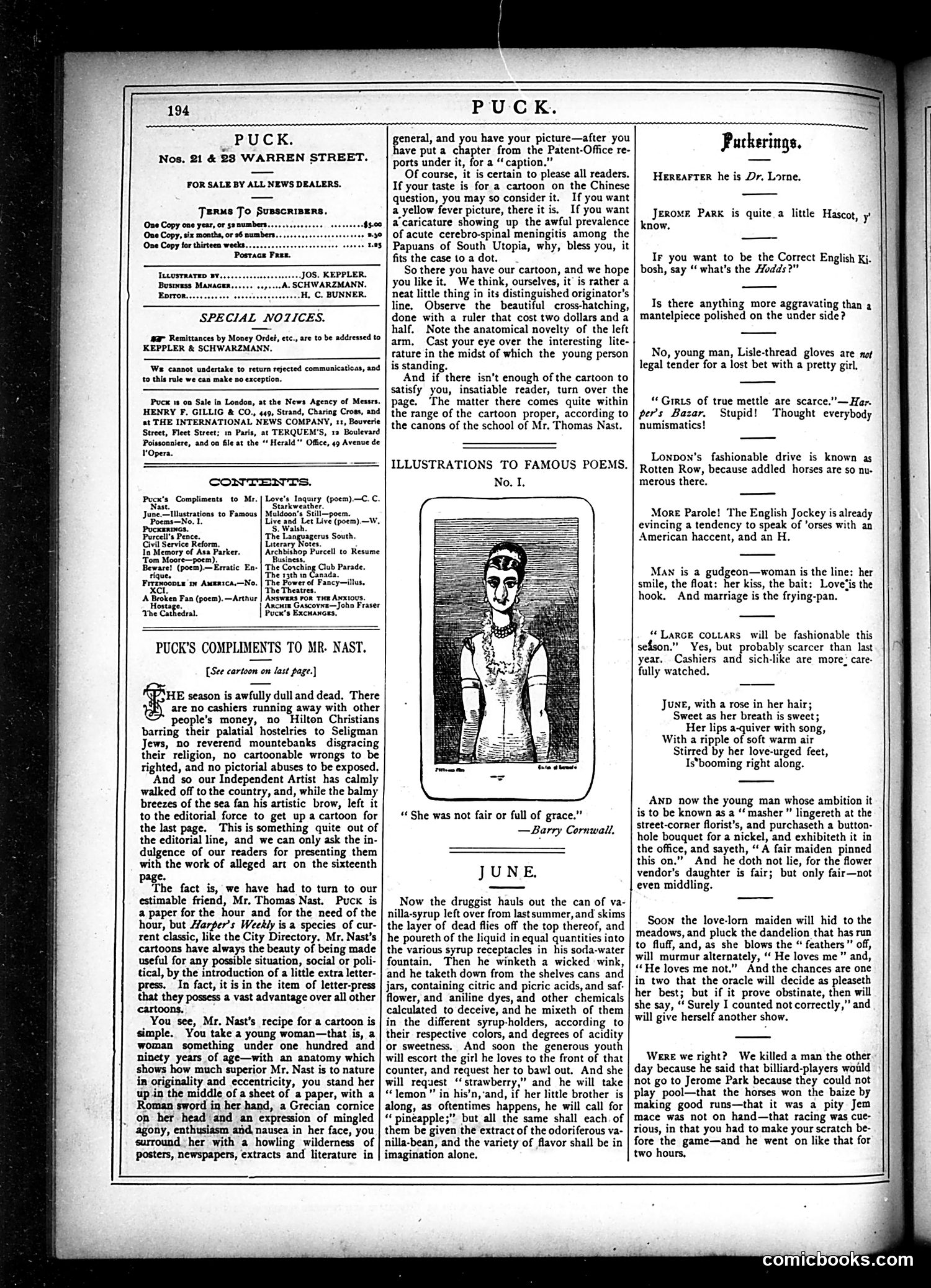
This page contains miscellaneous satirical commentary and poems rather than a central political cartoon. The main illustration shows a woman's portrait labeled "She was not fair of full of grace" (attributed to Barry Cornwall), accompanying a section titled "JUNE." The text includes scattered social commentary, such as critiques of fashion trends (large collars becoming fashionable), observations about London's Rotten Row, and mockery of American accents among English jockeys. There are also humorous observations about relationships—describing man as "a gudgeon" and marriage as "the frying-pan." The content appears designed as light, topical humor for Puck's educated readership rather than focused political satire. Without clearer context on specific current events, the exact targets of most jokes remain unclear.
This page contains three distinct articles with no visible cartoons. The content includes: 1. **"Purcell's Pence"** - A satirical piece criticizing Archbishop Purcell's mismanagement of Church finances and his questionable banking practices, suggesting his "system of counteracting decrees" lacks transparency. 2. **"Civil Service Reform"** - A humorous Q&A section mocking the civil service exam system, with questions about frogs, literary men, and Joe Cook's lectures. The satire targets the arbitrary and disconnected nature of civil service testing. 3. **"In Memory of Asa Packer"** - An obituary-style tribute praising a wealthy businessman for his philanthropic legacy and liberal gift-giving during his lifetime. The page is primarily text-based satirical commentary rather than illustrated political cartoons.
The page contains three distinct pieces: **"Tom Moore" (top)**: A poem celebrating Irish poet Tom Moore's birthday, contrasting him favorably with English literary figures like Milton and Pope. It's nationalist satire praising Irish cultural achievement. **"Beware!"**: A cautionary poem warning against flattery, false friends, and deceitful behavior—generic moral instruction rather than specific political satire. **"Fitznoodle in America" (bottom right)**: Social satire about an American fellow (Fitznoodle) attempting to impress through wealth and pretense. The text mocks nouveau riche behavior, excessive spending on status symbols (yacht, guns, dogs), and superficial social climbing—a common Puck theme targeting American materialism and class aspiration among the newly wealthy.
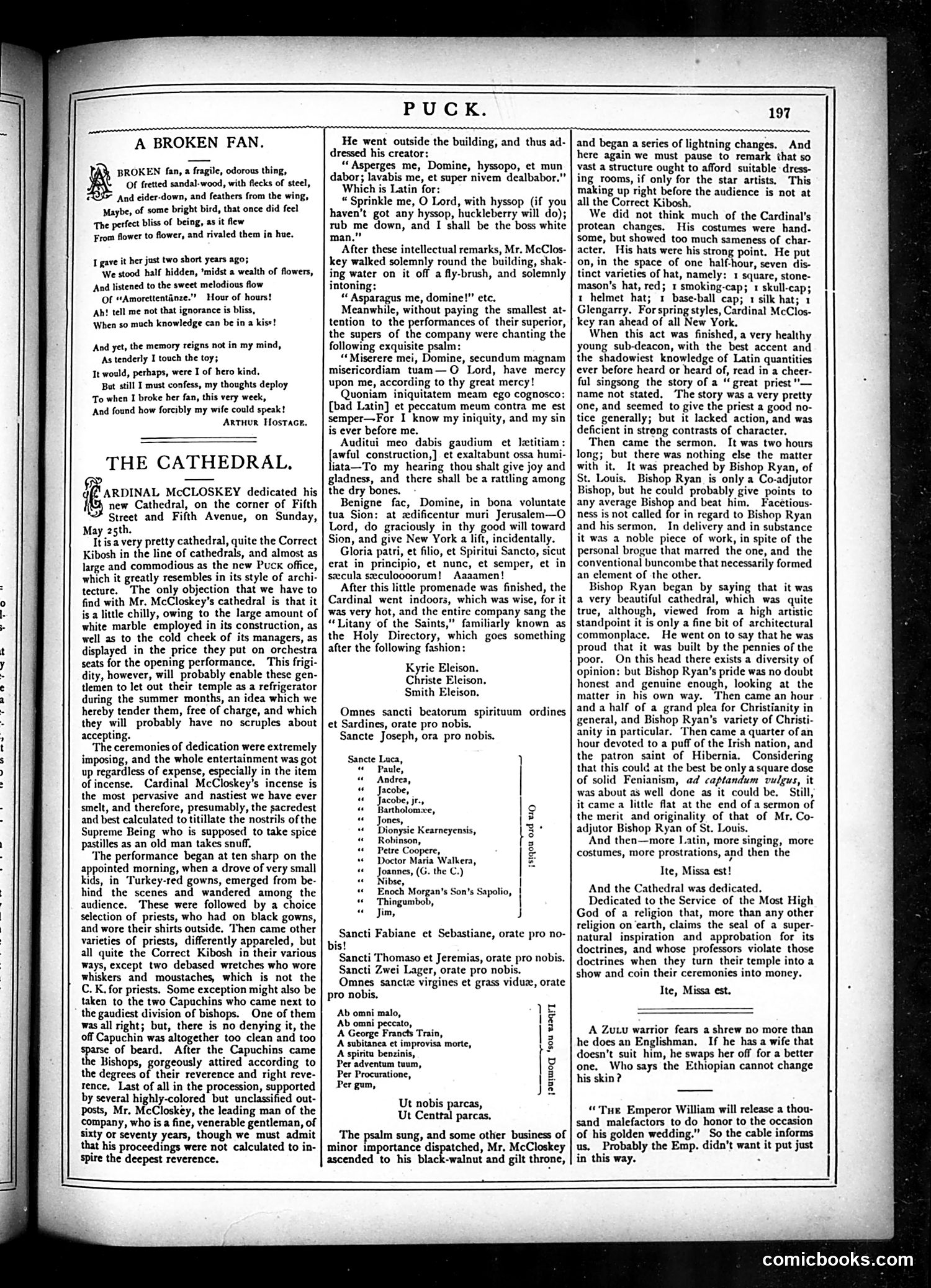
This page contains two distinct pieces: **"A Broken Fan"** is a sentimental poem about a damaged fan that once belonged to the speaker's mother, evoking nostalgic memories of her. **"The Cathedral"** is a satirical piece describing Cardinal McCloskey's dedication of a new cathedral on Fifth Avenue in New York. The satire mocks the elaborate ceremony and the cardinal's pretensions. It ridicules the ornate religious proceedings—the Latin chanting, the ceremonial pomp—while suggesting the church's wealth and grandeur contrast with genuine spirituality. The piece appears to critique both ecclesiastical ostentation and the social climbing associated with such high-profile religious events in Gilded Age New York. The page reflects Puck's characteristic irreverent approach to religious institutions and the wealthy elite.
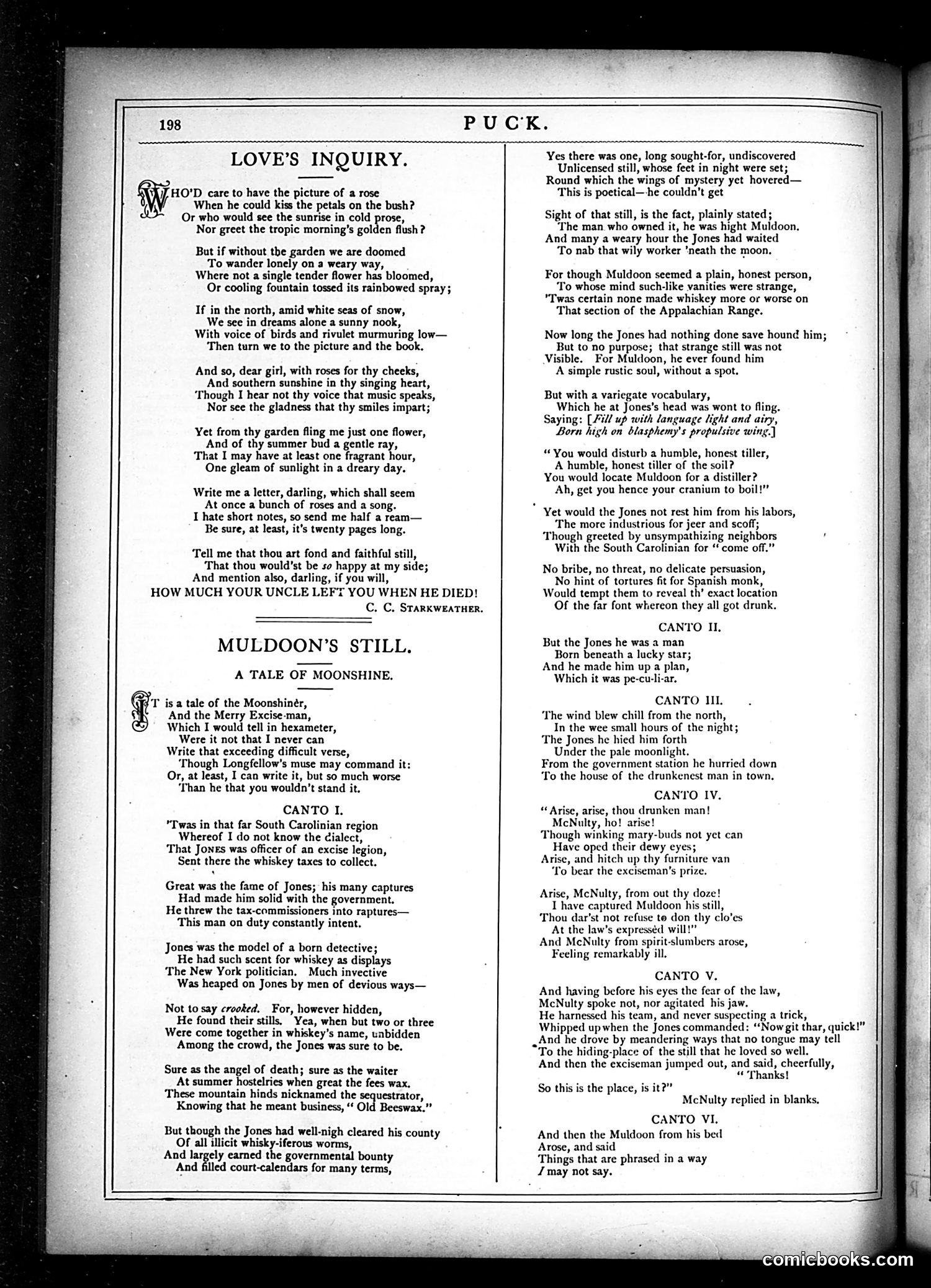
This page contains two literary pieces rather than political cartoons: 1. **"Love's Inquiry"** — A romantic poem by C.C. Starkweather asking "Who cared to have the picture of a rose / When he could kiss the petals on the bush?" It's conventional Victorian courtship verse with no political content. 2. **"Muldoon's Still: A Tale of Moonshine"** — A humorous narrative poem about illegal alcohol production in the Appalachian region. It describes Muldoon, a man running a moonshine operation who avoids capture by government excise officers. The poem depicts the conflict between rural moonshiners and federal revenue agents—a genuine social issue of the era—but treats it as comic material rather than serious political satire. The page is primarily literary content, not editorial cartooning.
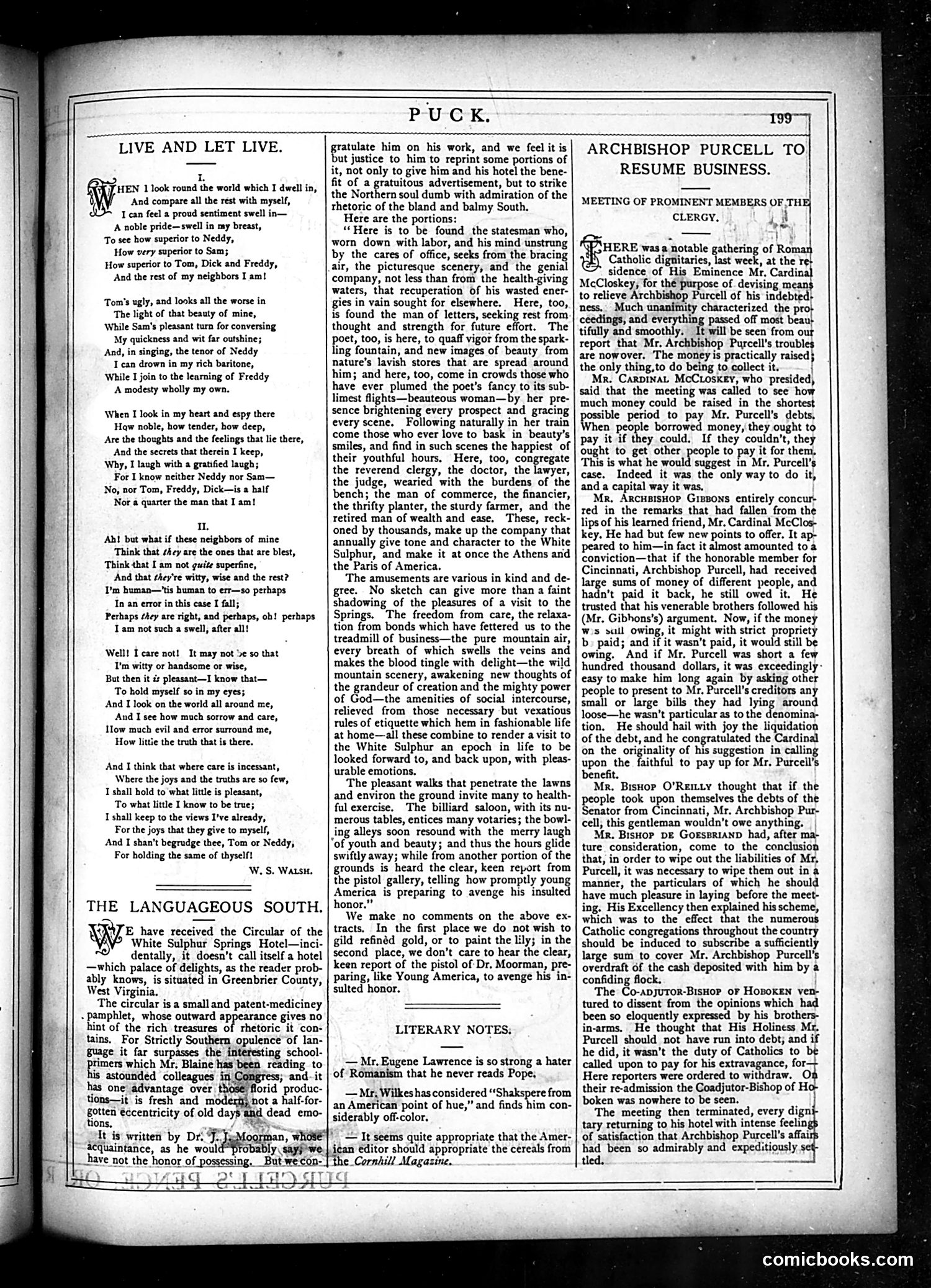
This page contains three distinct sections: a poem titled "Live and Let Live" by W.S. Walsh; an article about "Archbishop Purcell to Resume Business" discussing Catholic fundraising efforts; and a section called "The Languageous South" about Southern dialect and a White Sulphur Springs hotel pamphlet. The main satirical content addresses Archbishop Purcell's financial troubles and attempts to raise money from Catholic congregations. The article criticizes his debt management and suggests he's soliciting funds improperly from the faithful. "Literary Notes" at the bottom contains brief book commentary, including a joke about Pope Leo XIII never reading Pope. The page primarily focuses on religious and regional American social issues rather than featuring prominent political cartoons.
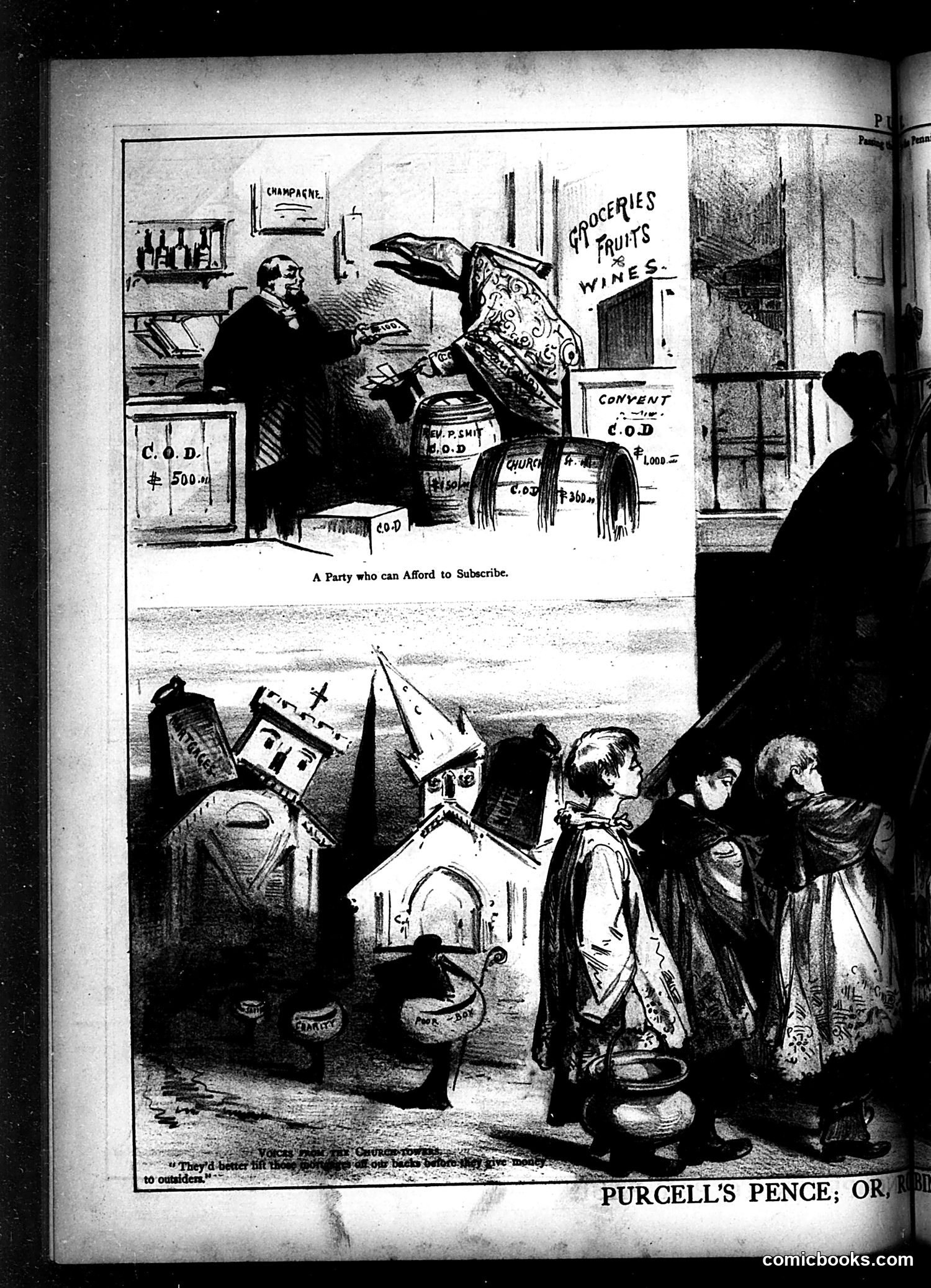
This page contains two Puck cartoons satirizing Catholic charity practices. **Top cartoon** ("A Party who can Afford to Subscribe"): A well-dressed man at a shop counter labeled "C.O.D" (Cash on Delivery) purchases groceries and wine while a sign advertises "Convent C.O.D" with a $1,000 price. The satire suggests wealthy Catholics could "subscribe" to the Church through monetary donations rather than genuine piety. **Bottom cartoon** ("Purcell's Pence"): Children in ragged clothes kneel before church buildings with collection boxes, while a figure above (likely Archbishop Purcell) profits. The title references "Peter's Pence" (Catholic donations to Rome). The satire criticizes the Church extracting money from poor children while church leaders grow wealthy—portraying organized religion as exploitative rather than charitable. Both cartoons mock the contradiction between Catholic charity teachings and actual financial practices.
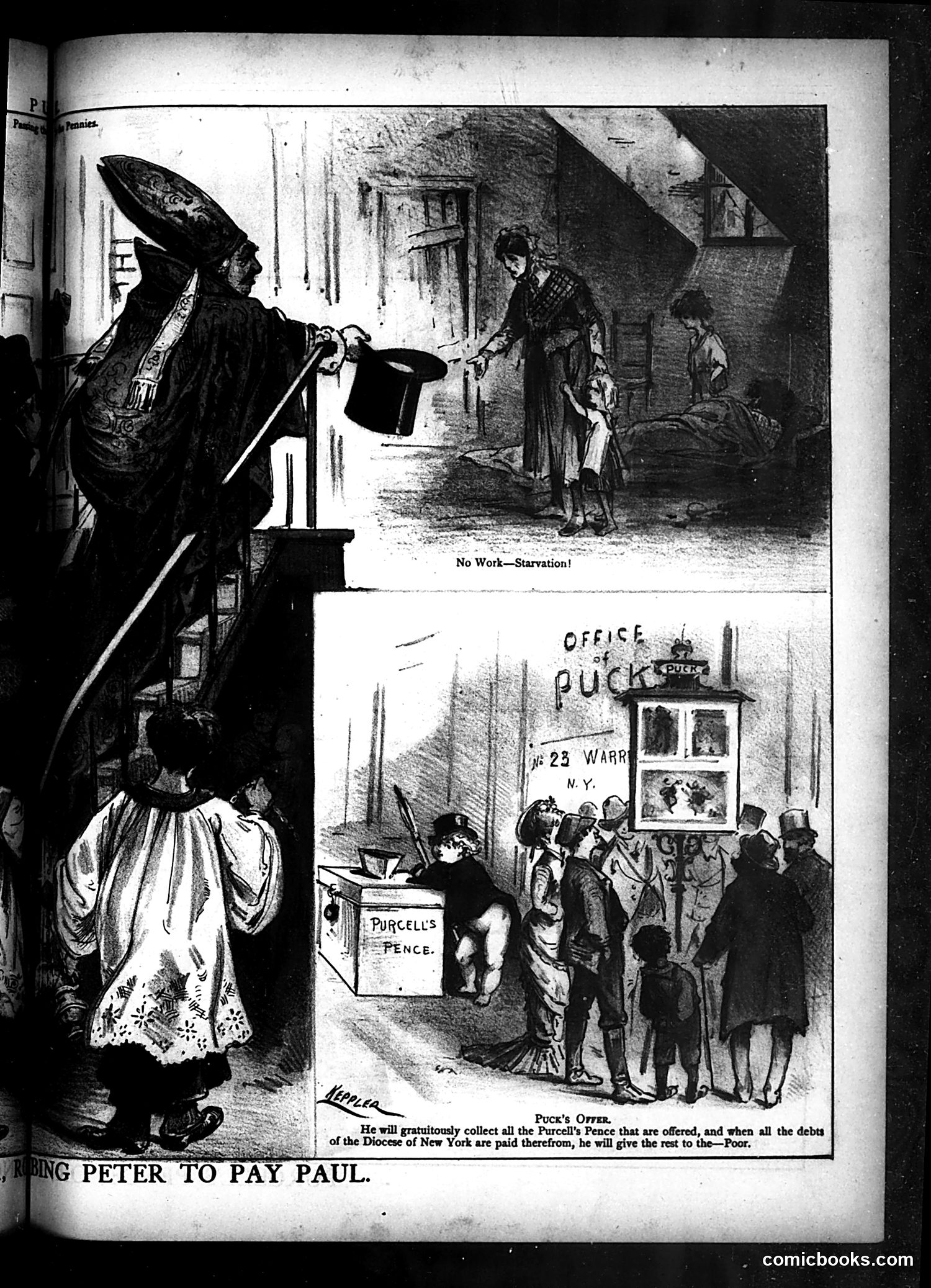
This Puck cartoon critiques charitable fundraising practices in New York City. The top panel shows poverty and starvation ("No Work—Starvation!"). The bottom panel depicts the "Office of Puck" collecting donations for Purcell's Pence, a charitable fund for the Diocese of New York. The satire's point: rather than addressing root causes of poverty, charitable organizations simply redistribute existing money from one group of poor people to another. The caption explicitly states that collected funds will go to church debts, with only leftovers reaching the actual poor—hence "robbing Peter to pay Paul," an idiom meaning transferring resources from one needy group to benefit another, accomplishing nothing substantive. The cartoon attacks institutional inefficiency and self-serving charity.
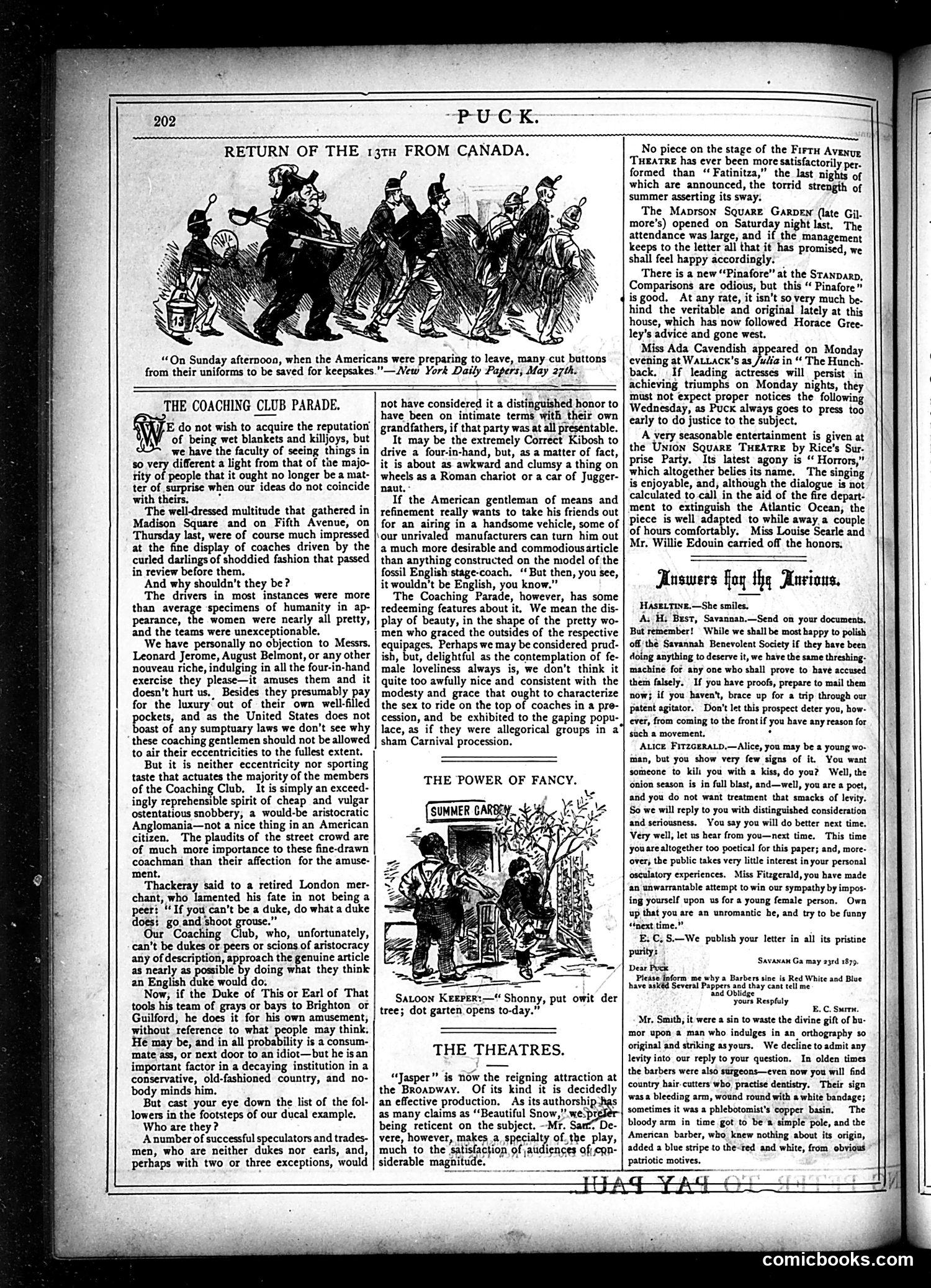
This page's main cartoon depicts uniformed soldiers returning from Canada, apparently depicting the return of American military forces after the War of 1812. The illustration shows mounted soldiers in formation, celebrating their homecoming. The accompanying article critiques the "Coaching Club Parade"—a social event where wealthy New Yorkers displayed expensive coaches and horses. The satire mocks this aristocratic display as pretentious and un-American, contrasting ostentatious wealth with genuine civic pride. The piece argues that while elaborate carriages might suit European nobility, they're inappropriate for a democratic society. The theater section reviews current Broadway productions, including "Jasper" and references to popular entertainment of the era.
This page contains **no political cartoon or satire**. Instead, it presents "Archie Gascoyne: A Romance of Skye," a serialized fiction story by John Fraser, written expressly for Puck magazine. The page shows Chapter VII and Chapter VIII of this romantic narrative set in Scotland, featuring characters named Archie, Hilton, the Doctor, and others engaged in fishing adventures and personal drama on the Isle of Skye. While Puck was primarily known for satirical cartoons, this demonstrates the magazine also published literary fiction to entertain its readership. The page is straightforward narrative content rather than political or social commentary through illustration or caricature.
This page contains primarily fictional narrative text with a small decorative header illustration labeled "Puck's Exchanges." The main content is a serialized story about characters visiting Scotland—featuring dialogue among Mr. and Mrs. Macdonald, Miss Maggie, Professor, Alister, and others discussing their Highland travels and a character named Kenneth/the Doctor. The right column contains "Congressional Proceedings"—satirical summaries of actual legislative bills from the U.S. House, including items about gold reserves, mining development, rainfall regulation, and church matters. These brief descriptions mock Congressional activity through absurdist or exaggerated summaries of real proposals. There are no significant political cartoons visible on this page—it's primarily text-based satire of Congress rather than visual caricature.
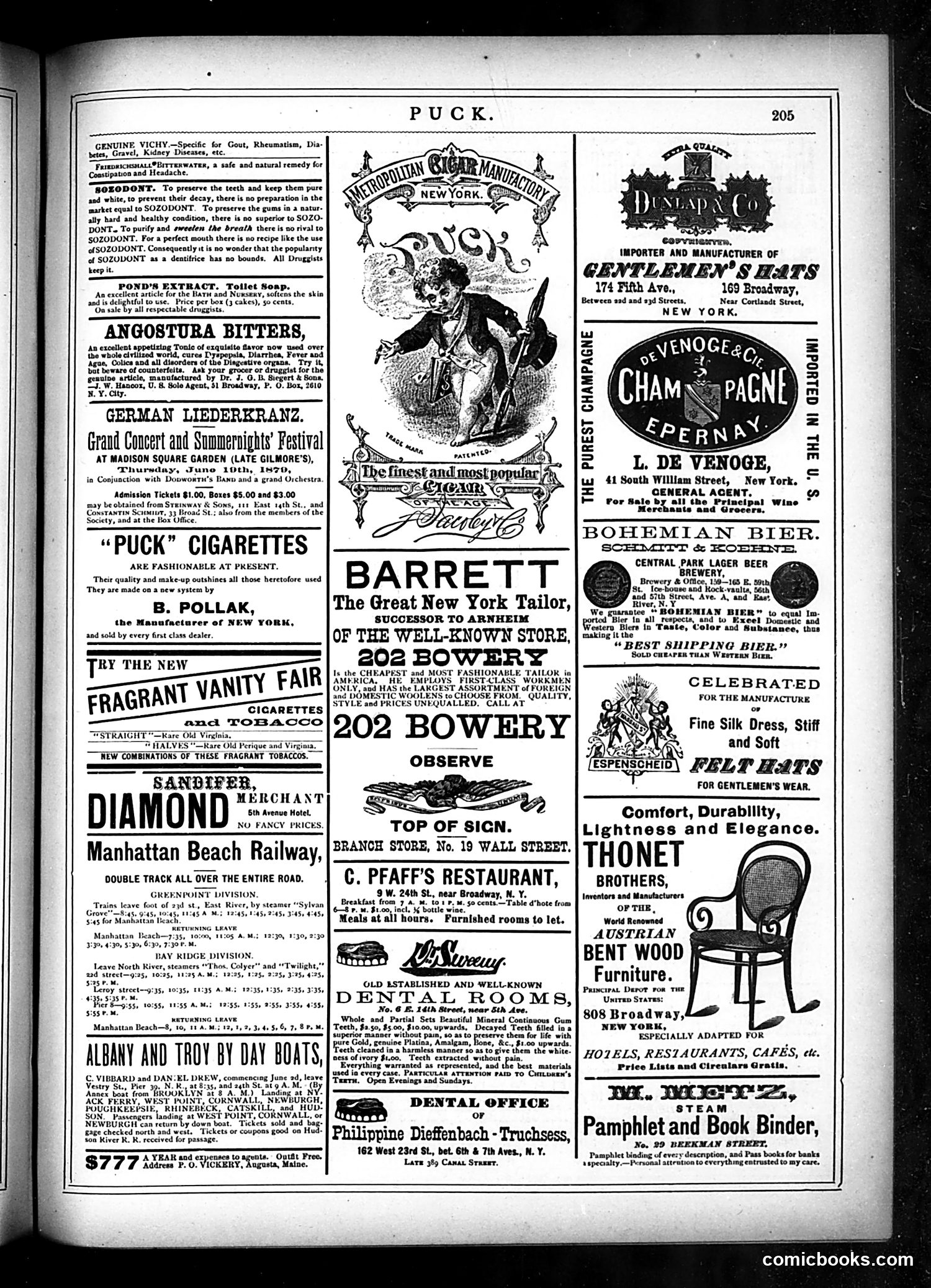
This page is primarily **advertising content** rather than political satire or editorial cartoons. It consists of late 19th-century commercial advertisements for various products and services in New York City, including: - Patent medicines (Vichy water, Sozodont toothpaste, Pond's Extract) - Cigarettes and tobacco - Fine dining and restaurants - Transportation (Manhattan Beach Railway, steamboats) - Furniture and clothing - Dental services The only illustration with potential satirical intent is the large "Puck" masthead showing a classical jester figure—the magazine's namesake—but it functions primarily as branding rather than commentary. The page demonstrates how 19th-century satirical magazines relied heavily on advertising revenue, blending commerce with editorial content.
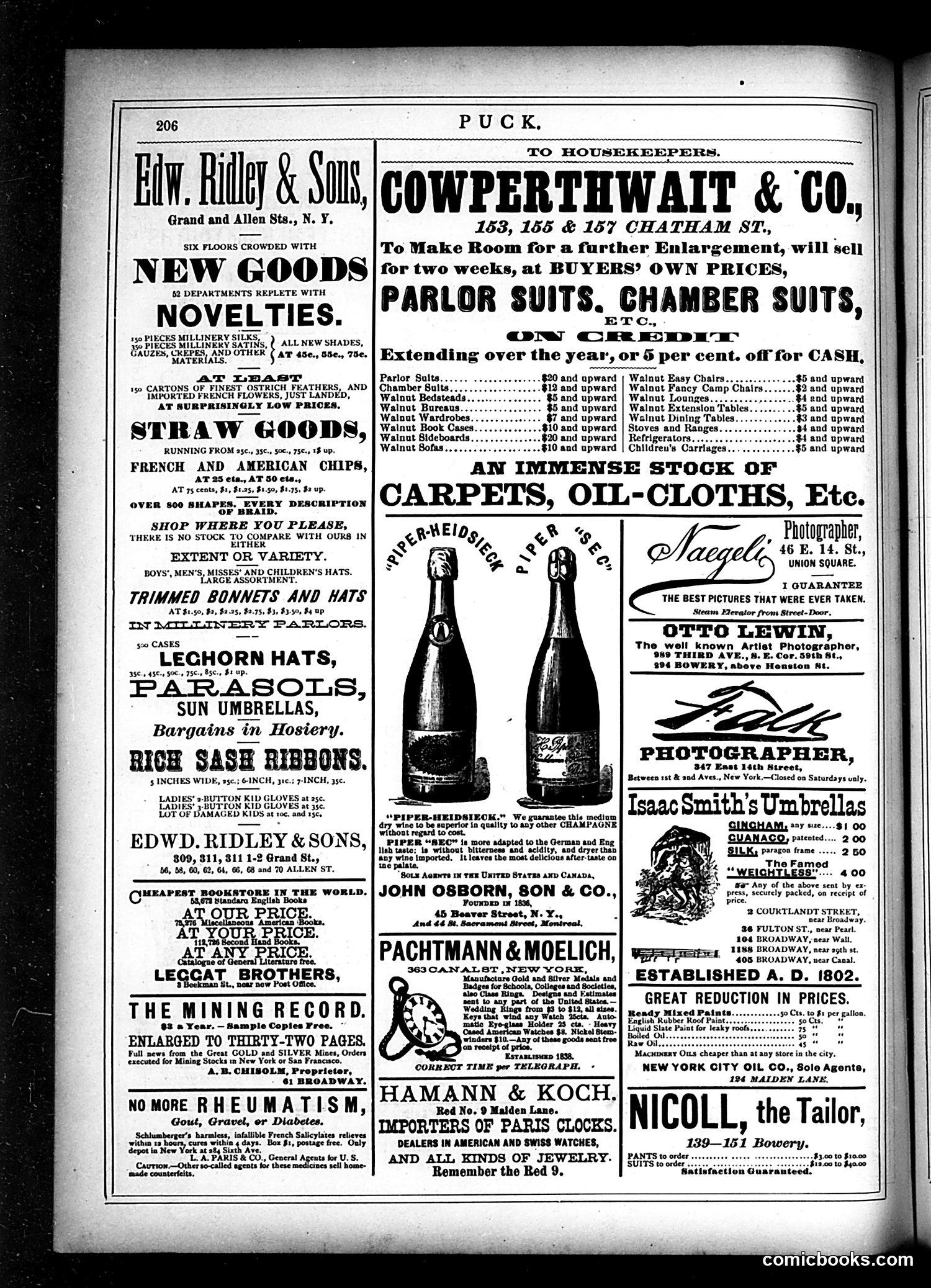
This is primarily an **advertising page** from Puck magazine (page 206), not a political cartoon or satirical content page. The page contains numerous commercial advertisements for late 19th-century products and services, including: - Furniture and household goods (Cowperthwait & Co., carpets, oil-cloths) - Clothing and accessories (Edw. Ridley & Sons hats, parasols, ribbons) - Photography services (Nagel, Otto Lewin, photograph studios) - Beverages (Piper-Heidsick champagne) - Patent medicines and remedies (rheumatism cure, umbrellas) - Watches and jewelry (Hamann & Koch) - Tailoring services (Nicoll the Tailor) There are no political cartoons or satirical content visible on this particular page. It functions solely as a revenue-generating advertising section typical of period magazines.
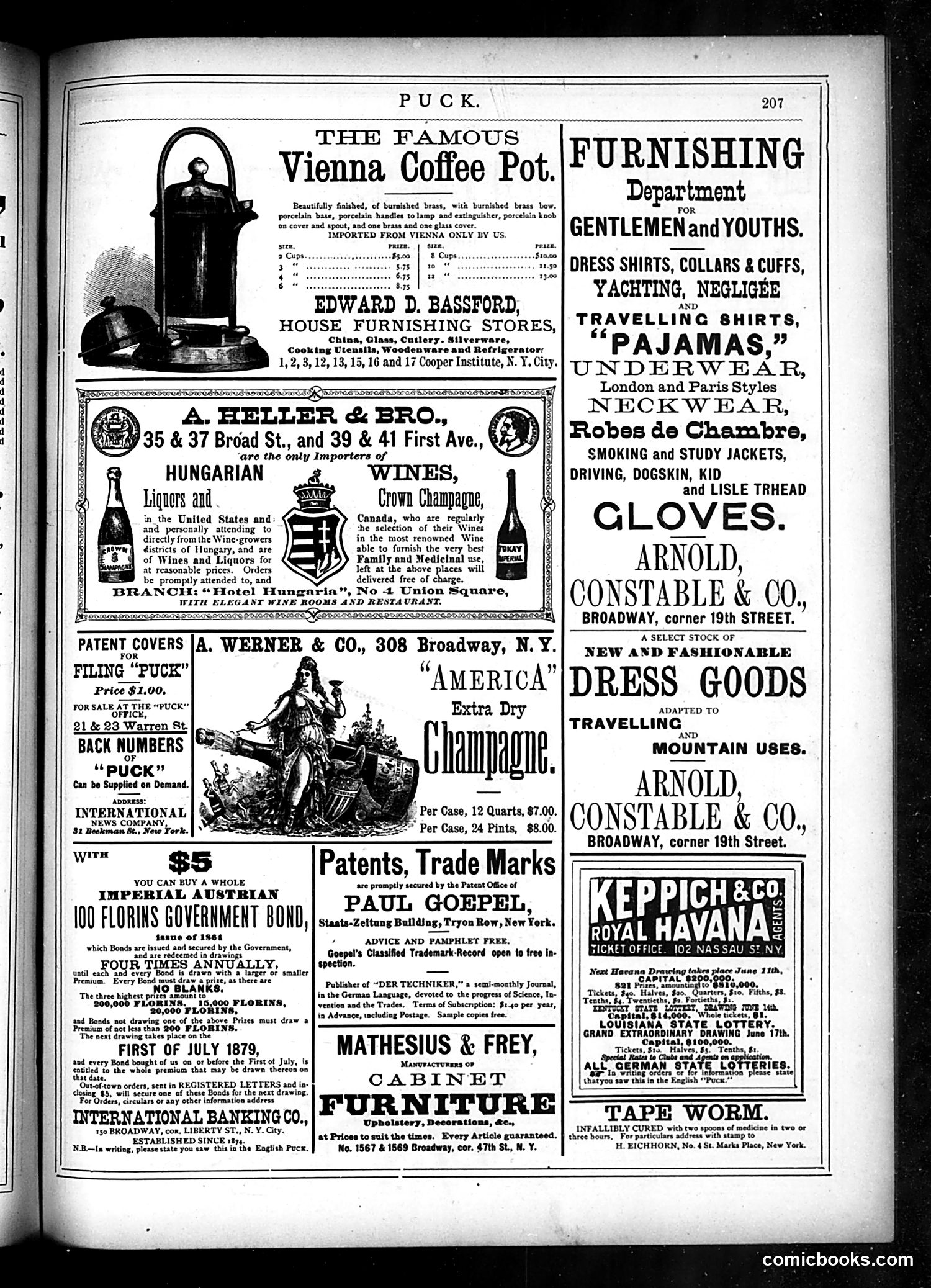
This page is primarily **advertising**, not editorial content or political satire. It contains numerous commercial advertisements from the late 19th century, including: - The famous Vienna Coffee Pot (a beverage vessel) - Edward D. Bassford's furnishing stores - Ernest Keil's wines and champagne - Arnold, Constable & Co.'s clothing and dress goods - A.Werner & Co.'s patent filing system - Various lottery and bond schemes - Mathesius & Frey furniture The page reflects Puck magazine's business model: satirical editorial content subsidized by paid advertisements. The ads target upper-class gentlemen, offering luxury goods—wines, fine clothing, furniture—typical of Gilded Age consumer culture. There is **no visible political cartoon or satirical commentary** on this particular page.
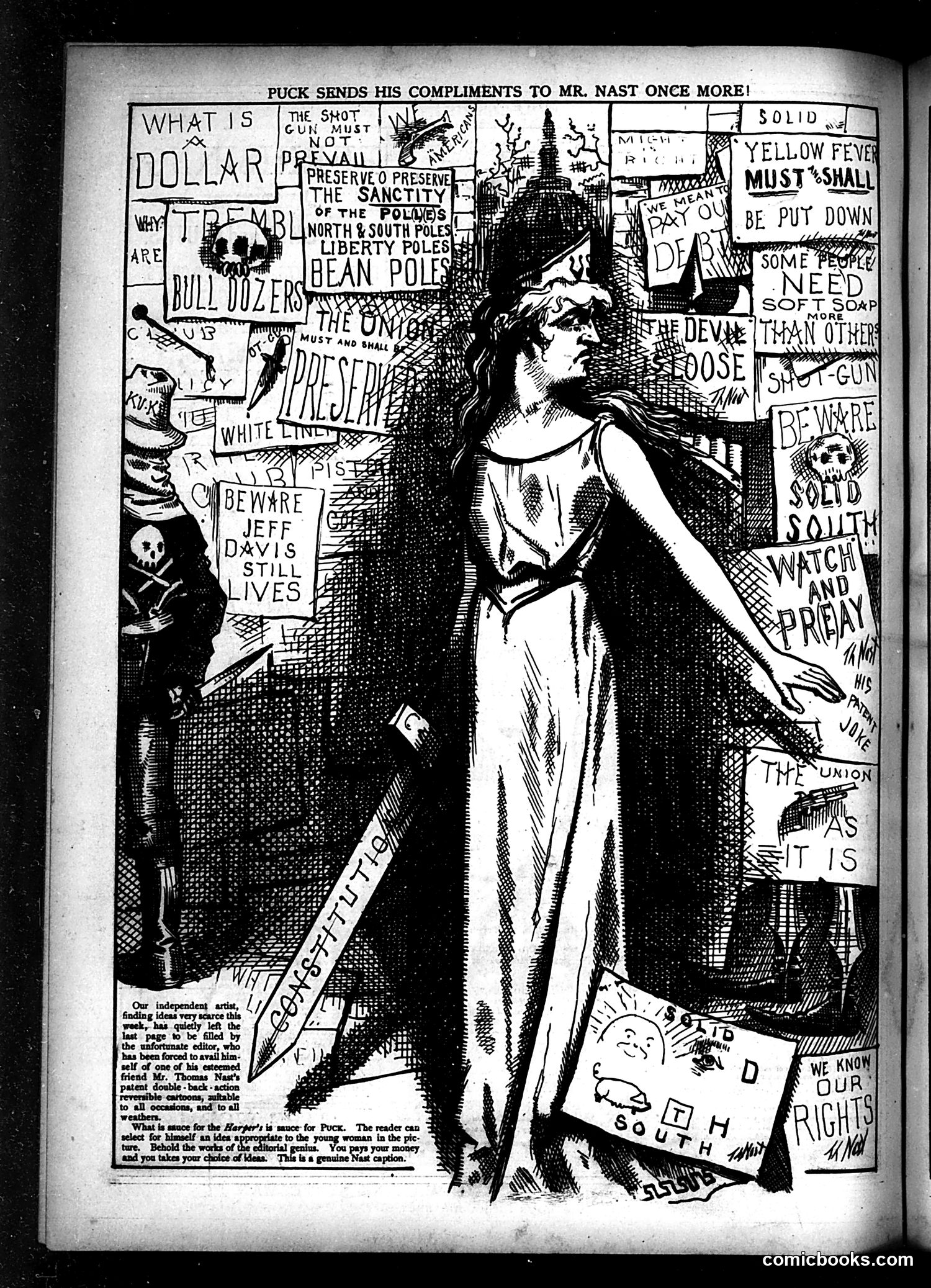
This Puck cartoon depicts Lady Liberty surrounded by warning signs and threats reflecting turn-of-the-century anxieties. The signs address contemporary concerns: "Yellow Fever," labor unrest ("Solid South"), economic issues ("What is a Dollar?"), and threats like "Preserve the Sanctity of the North & South Poles" and "Bean Poles." The central figure represents America's republic under siege from multiple dangers. References to "Davis Still Lives" and "Beware of Jeff Davis" appear to reference the post-Civil War South, while "White Lines" and sectional tensions suggest ongoing regional divisions. The overall message satirizes how America faces competing threats and contradictions—some real (disease, labor conflict), some paranoid or absurd (the "poles")—that distract from coherent national purpose. The cartoon critiques sensationalism and conflicting anxieties plaguing the nation.