
Puck, 1879-06-04 · page 3 of 16
Puck — June 4, 1879 — page 3: what you’re looking at
What you’re looking at
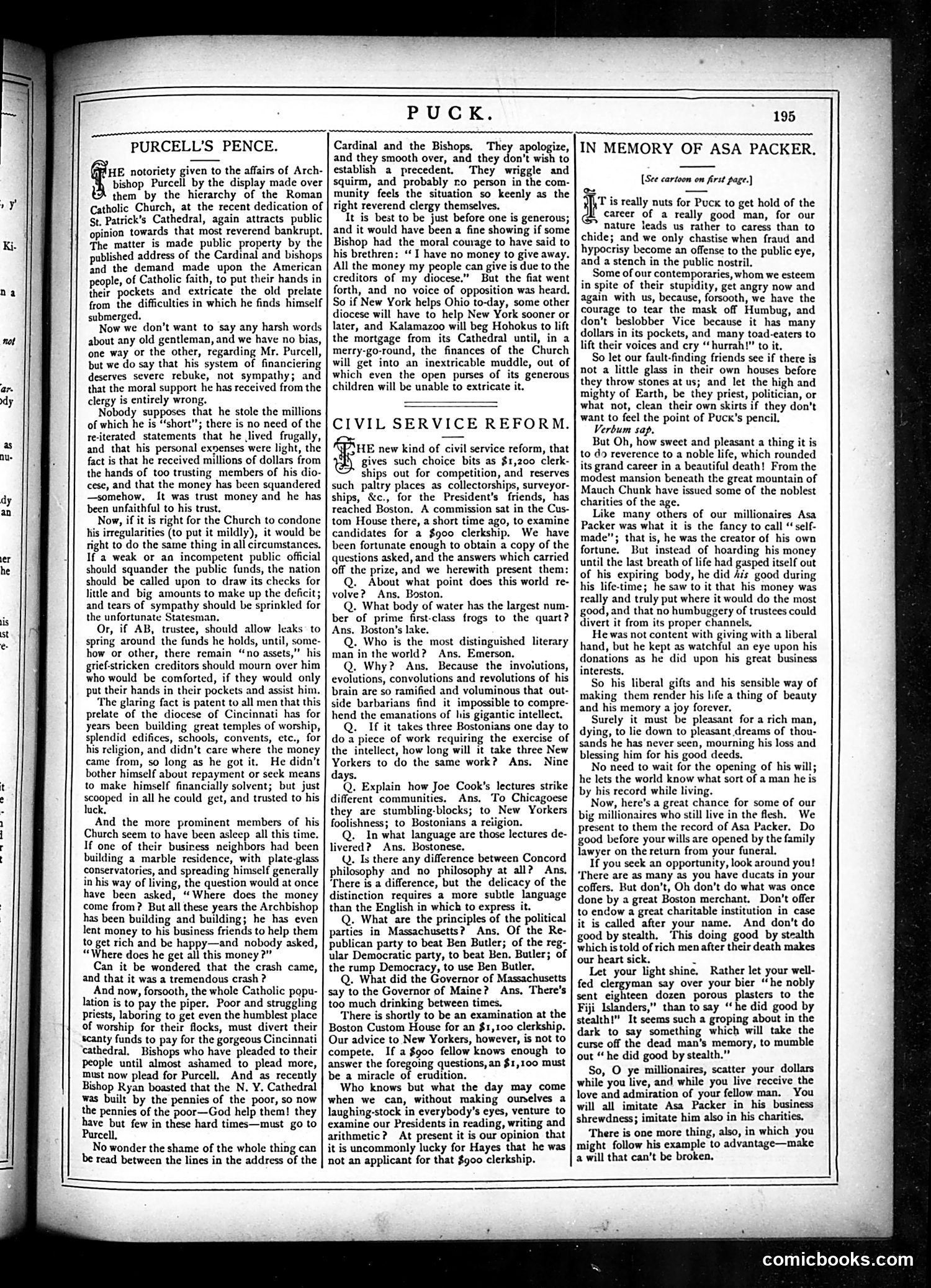
This page contains three distinct articles with no visible cartoons. The content includes: 1. **"Purcell's Pence"** - A satirical piece criticizing Archbishop Purcell's mismanagement of Church finances and his questionable banking practices, suggesting his "system of counteracting decrees" lacks transparency. 2. **"Civil Service Reform"** - A humorous Q&A section mocking the civil service exam system, with questions about frogs, literary men, and Joe Cook's lectures. The satire targets the arbitrary and disconnected nature of civil service testing. 3. **"In Memory of Asa Packer"** - An obituary-style tribute praising a wealthy businessman for his philanthropic legacy and liberal gift-giving during his lifetime. The page is primarily text-based satirical commentary rather than illustrated political cartoons.
📄 Transcribed text from this page (OCR, searchable)
Machine-transcribed from the original scan — historical spelling and the odd misread are preserved.
PUCK. 195 PURCELL’S PENCE. HE notoriety given to the affairs of Arch- bishop Purcell by the display made over them by the hierarchy of the Roman Catholic Church, at the recent dedication of St. Patrick’s Cathedral, again attracts public opinion towards that most reverend bankrupt. The matter is made public property by the published address of the Cardinal and bishops and the demand made upon the American people, of Catholic faith, to put their hands in their pockets and extricate the old prelate from the difficulties in which he finds himself submerged. Now we don’t want to say any harsh words about any old gentleman, and we have no bias, one way or the other, regarding Mr. Purcell, but we do say that his system of financiering deserves severe rebuke, not sympathy; and that the moral support he has received from the clergy is entirely wrong. Nobody supposes that he stole the millions of which he is “short”; there is no need of the re-iterated statements that he lived frugally, and that his personal expenses were light, the fact is that he received millions of dollars from the hands of too trusting members of his dio- cese, and that the money has been squandered —somehow, It was trust money and he has been unfaithful to his trust. Now, if it is right for the Church to condone his irregularities (to put it mildly), it would be right to do the same thing in all circumstances. If a weak or an incompetent public official should squander the public funds, the nation should be called upon to draw its checks for little and big amounts to make up the deficit; and tears of sympathy should be sprinkled for the unfortunate Statesman, Or, if AB, trustee, should allow leaks to spring around the funds he holds, until, some- how or other, there remain “no assets,” his grief-stricken creditors should mourn over him who would be comforted, if they would only put their hands in their pockets and assist him. The glaring fact is patent to all men that this prelate of the diocese of Cincinnati has for years been building great temples of worship, splendid edifices, schools, convents, etc., for his religion, and didn’t care where the money came from, so long as he got it. He didn’t bother himself about repayment or seck means to make himself financially solvent; but just scooped in all he could get, and trusted to his luck, And the more prominent members of his Church seem to have been asleep all this time. If one of their business neighbors had been building a marble residence, with plate-glass conservatories, and spreading himself generally in his way of living, the question would at once have been asked, “Where does the money come from? But all these years the Archbishop has been building and building; he has even lent money to his business friends to help them to get rich and be happy—and nobody asked, “Where does he get all this moncy ?” Can it be wondered that the crash came, and that it was a tremendous crash ? And now, forsooth, the whole Catholic popu- lation is to pay the piper. Poor and struggling Priests, laboring to get even the humblest place of worship for their flocks, must divert their ‘scanty funds to pay for the gorgeous Cincinnati ‘cathedral, Bishops who have pleaded to their People until almost ashamed to plead more, must now plead for Purcell, And as recently Bishop Ryan boasted that the N. Y. Cathedral was built by the pennies of the poor, so now the pennies of the poor—God help them! they have but few in these hard times—must go to Purcell. No wonder the shame of the whole thing can be read between the lines in the address of the Cardinal and the Bishops. They apologize, and they smooth over, and they don’t wish to establish a precedent. They wriggle and squirm, and probably ro person in the com- munity feels the situation so keenly as the right reverend clergy themselves. It is best to be just before one is generous; and it would have been a fine showing if some Bishop had the moral courage to have said to his brethren: ‘I have no money to give away. All the money my people can give is due to the creditors of my diocese.” But the fiat went forth, and no voice of opposition was heard. So if New York helps Ohio to-day, some other diocese will have to help New York sooner or later, and Kalamazoo will beg Hohokus to lift the mortgage from its Cathedral until, in a merry-go-round, the finances of the Church will get into an inextricable muddle, out of which even the open purses of its generous children will be unable to extricate it. CIVIL SERVICE REFORM. HE new kind of civil service reform, that gives such choice bits as $1,200 clerk- ships out for competition, and reserves such paltry places as collectorships, surveyor- ships, &c., for the President's friends, has reached Boston. A commission sat in the Cus- tom House there, a short time ago, to examine candidates for a $900 clerkship. We have been fortunate enough to obtain a copy of the questions asked, and the answers which carried off the prize, and we herewith present them: Q. About what point does this world re- volve? Ans, Boston. Q. What body of water has the largest num- ber of prime first-class frogs to the quart? Ans. Boston’s lake. Q. Who is the most distinguished literary man in the world? Ans, Emerson. Q. Why? Ans, Because the invoiutions, evolutions, convolutions and revolutions of his brain are so ramified and voluminous that out- side barbarians find it impossible to compre- hend the emanations of his gigantic intellect. Q. If it takes three Bostonians one day to doa piece of work requiring the exercise of the intellect, how long will it take three New Yorkers to do the same work? Ans. Nine days. Q. Explain how Joe Cook's lectures strike different communities. Ans, To Chicagoese they are stumbling-blocks; to New Yorkers foolishness; to Bostonians a reiigion. In what language are those lectures de- livered? Ans. Bostonese. Q. Is there any difference between Concord philosophy and no philosophy at all? Ans. ‘There is a difference, but the delicacy of the distinction requires a more subtle language than the English in which to express it. Q. What are the principles of the political parties in Massachusetts? Ans, Of the Re- publican party to beat Ben Butler; of the reg- ular Democratic party, to beat Ben. Butler; of the rump Democracy, to use Ben Butler, Q. What did the Governor of Massachusetts say to the Governor of Maine? Ans, There's too much drinking between times. There is shortly to be an examination at the Boston Custom House for an $1,100 clerkship. Our advice to New Yorkers, however, is not to compete. If a $900 fellow knows enough to answer the foregoing questions, an $1,100 must be a miracle of erudition. Who knows but what the day may come when we can, without making ourselves a laughing-stock in everybody's eyes, venture to examine our Presidents in reading, writing and arithmetic? At present it is our opinion that it is uncommonly lucky for Hayes that he was not an applicant for that $900 clerkship. IN MEMORY OF ASA PACKER. [See cartoon on first page.) T is really nuts for Puck to get hold of the career of a really good man, for our ” Mature leads us rather to caress than to chide; and we only chastise when fraud and hypocrisy become an offense to the public eye, and a stench in the public nostril. Some of our contemporaries, whom we esteem in spite of their stupidity, get angry now and again with us, because, forsooth, we have the courage to tear the mask off Humbug, and don’t beslobber Vice because it has many dollars in its pockets, and many toad-eaters to lift their voices and cry “hurrah!” to it. So let our fault-finding friends see if there is not a little glass in their own houses before they throw stones at us; and let the high and mighty of Earth, be they priest, politician, or what not, clean their own skirts if they don't want to feel the point of Puck's pencil. Verbum sap. But Oh, how sweet and pleasant a thing it is to do reverence to a noble life, which rounded its grand career in a beautiful death! From the modest mansion beneath the great mountain of Mauch Chunk have issued some of the noblest charities of the age. Like many others of our millionaires Asa Packer was what it is the fancy to call “ self- made"; that is, he was the creator of his own fortune. But instead of hoarding his money until the last breath of life had gasped itself out of his expiring body, he did Ais good during his life-time; he saw to it that his money was really and truly put where it would do the most good, and that no humbuggery of trustees could divert it from its proper channels, He was not content with giving with a liberal hand, but he kept as watchful an eye upon his donations as he did upon his great business interests, So his liberal gifts and his sensible way of making them render his life a thing of beauty and his memory a joy forever. Surely it must be pleasant for a rich man, dying, to lie down to pleasant dreams of thou- sands he has never seen, mourning his loss and blessing him for his good deeds. No need to wait for the opening of his will; he lets the world know what sort of a man he is by his record while living. Now, here's a great chance for some of our big millionaires who still live in the flesh, We present to them the record of Asa Packer. Do good before your wills are opened by the family lawyer on the return from your funeral. If you seek an opportunity, look around you! ‘There are as many as you have ducats in your coffers, But don’t, Oh don’t do what was once done by a great Boston merchant. Don't offer to endow a great charitable institution in case it is called after your name. And don't do good by stealth. ‘This doing good by stealth which is told of rich men after their death makes our heart sick. : Let your light shine, Rather let your well- fed clergyman say over your bier “he nobly sent eighteen dozen porous plasters to the Fiji Islanders,” than to say “he did good by stealth!” It seems such a groping about in the dark to say something which will take the curse off the dead man’s memory, to mumble out “he did good by stealth.” So, O ye millionaires, scatter your dollars while you live, and while you live receive the love and admiration of your fellow man. You will all imitate Asa Packer in his business shrewdness; imitate him also in his charities. ‘There is one more thing, also, in which you might follow his example to advantage—make a will that can’t be broken. comicbooks.com