
Puck, 1879-06-04 · page 10 of 16
Puck — June 4, 1879 — page 10: what you’re looking at
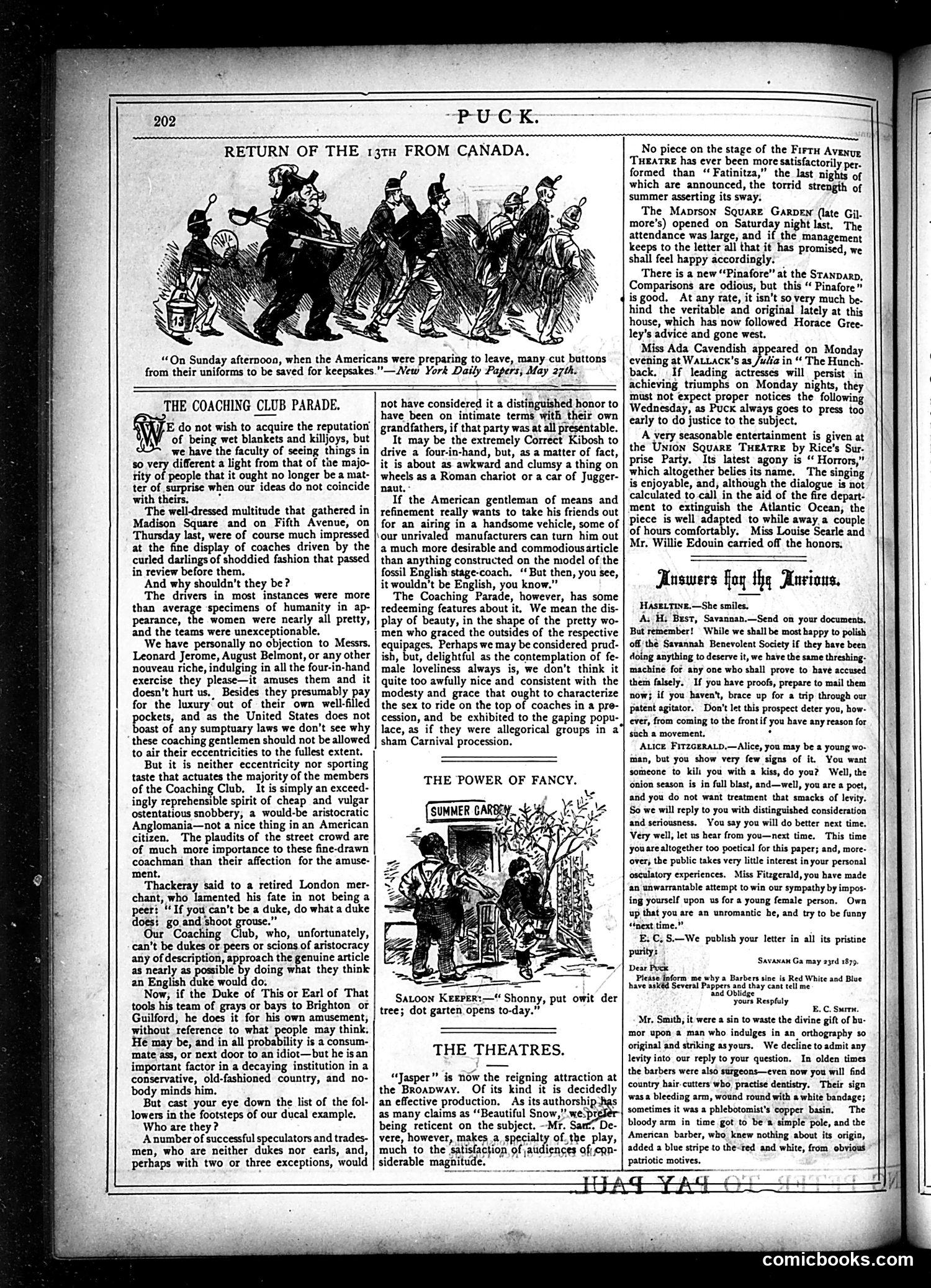
What you’re looking at
This page's main cartoon depicts uniformed soldiers returning from Canada, apparently depicting the return of American military forces after the War of 1812. The illustration shows mounted soldiers in formation, celebrating their homecoming. The accompanying article critiques the "Coaching Club Parade"—a social event where wealthy New Yorkers displayed expensive coaches and horses. The satire mocks this aristocratic display as pretentious and un-American, contrasting ostentatious wealth with genuine civic pride. The piece argues that while elaborate carriages might suit European nobility, they're inappropriate for a democratic society. The theater section reviews current Broadway productions, including "Jasper" and references to popular entertainment of the era.
📄 Transcribed text from this page (OCR, searchable)
Machine-transcribed from the original scan — historical spelling and the odd misread are preserved.
“PUCK. RETURN OF THE 131s FROM CANADA. “On Sunday afternoon, when the Americans were preparing to leave, many cut buttons from their uniforms to be saved for keepsakes."—New York Daily Papers; May 27th. THE COACHING CLUB PARADE. ‘E do not wish to acquire the reputation’ (Ys of being wet blankets and killjoys, but we have the faculty of seeing things in so very different a light from that of the majo- tity of people that it ought no longer be a mat- ter of surprise when our ideas do not coincide with theirs. a The well-dressed multitude that gathered in Madison Square and on Fifth Avenue, on Thursday last, were of course much impressed at the fine display of coaches driven by the curled darlings of shoddied fashion that passed in review before them, And why shouldn't they be? The drivers in most instances were more than average ‘specimens of humanity in ap- pearance, the women were nearly all pretty, and the teams were unexceptionable. We have personally no objection to Messrs. Leonard Jerome, August Belmont, or any other nouveau riche, indulging in all the four-in-hand exercise they please—it amuses them and it doesn’t hurt us. Besides they presumably pay for the luxury’ out of their own well-filled pockets, and as the United States does not boast of any sumptuary laws we don’t see why these coaching gentlemen should not be allowed to air their eccentricities to the fullest extent. But it is neither eccentricity nor sporting taste that actuates the majority of the members of the Coaching Club. It is simply an exceed- ingly reprehensible spirit of cheap and vulgar ostentatious snobbery, a would-be aristocratic Anglomania—not a nice thing in an American citizen. The plaudits of the street crowd are of much more importance to these fine-drawn coachman than their affection for the amuse- ment. Thackeray said to a retired London mer- chant, who lamented his fate in not being a peer: "If you can’t be a duke, do what a duke does: go.and’shoot grouse.” Our Coaching Club, who, unfortunately, can’t be dukes or peers or scions of aristocracy any of description, approach the genuine article as nearly as possible by doing what they think an English duke would do. Now, if the Duke of This or Earl of That tools his team of grays or bays to Brighton or Guilford, he does it for his own amusement, without reference to what ple may think, He may be, and in all probability is a consum- mate ass, or next door to an idiot—but he isan important factor in a decaying institution in a conservative, old-fashioned country, and no- body minds him. But cast your eye down the list of the fol- lowers in the footsteps of our ducal example. Who are they? A number of successful speculators and trades- men, who are neither dukes nor earls, and, perhaps with two or three exceptions, would not have considered it a distinguished honor to have been on intimate terms with their own grandfathers, if that party was at all presentable. It may be the extremely Correct Kibosh to drive a four-in-hand, but, as a matter of fact, it is about as awkward and clumsy a thing on wheels as a Roman chariot or a car of Jugger- naut. If the American gentleman of means and refinement really wants to take his friends out for an airing in a handsome vehicle, some of our unrivaled manufacturers can turn him out a much more desirable and commodiousarticle than anything constructed on the model of the fossil English stage-coach. ‘‘ But then, you see, it wouldn’t be English, you know.” The Coaching Parade, however, has some redeeming features about it. We mean the dis- play of beauty, in the shape of the pretty wo- men who graced the outsides of the respective equipages. Perhaps we may be considered prud- ish, but, delightful as the contemplation of fe- male loveliness always is, we don’t think it quite too awfully nice and consistent with the modesty and grace that ought to characterize the sex to ride on the top of coaches in a pre- cession, and be exhibited to the gaping popu- lace, as if they were allegorical groups in a sham Carnival procession. THE POWER OF FANCY. Satoon Keeper:—‘ Shonny, put owit der tree; dot garten opens to-day.” THE THEATRES. “Jasper” is now the reigning attraction at the Broapway. Of its kind it is decidedly an effective production. As its authors! ‘ as many claims as ‘Beautiful Snow,’’.we:pu being reticent on the subject. Mr. ~ De- vere, however, makes a, specialty of. the play, much to the satisfaction of audiences afi siderable magnituc No piece on the stage of the Firra Avenue THEATRE has ever been more satisfactorily per- formed than “ Fatinitza,” the last nights of which are announced, the torrid strength of summer asserting its sway. The Maprson Square GarpeN (late Gil- more's) opened on Saturday night last. The attendance was large, and if the management keeps to the letter all that it has promised, we shall feel happy accordingly. There is a new “Pinafore” at the Stanparp, Comparisons are odious, but this “ Pinafore” is good. At any rate, it isn't so.very much be- hind the veritable and original lately at this house, which has now followed Horace Gree- ley's advice and gone west. Miss Ada Cavendish appeared on Monday evening at Watxack's as /u/ia in “ The Hunch- back. If leading actresses will persist in achieving triumphs on Monday nights, they Must not expect proper notices the following Wednesday, as Puck always goes to press too early to do justice to the subject, A very seasonable entertainment is given at the Union Square THEATRE by Rice’s Sur- prise Party. Its latest agony is ‘“ Horrors,” which altogether belies its name. The singing is enjoyable, and, although the dialogue is not calculated to call in the aid of the fire depart- ment to extinguish the Atlantic Ocean, the piece is well adapted to while away a couple of hours comfortably. Miss Louise Searle and Mr. Willie Edouin carried off the honors, Auswers fon. thy Aneions, Hasextive.—She smiles. A. Hi Best, Savannan.—Send on your documents, But remember! While we shall be most happy to polish off'thé Savannah Benevolent Society if they have been doing anything to deserve it, we have the same threshing- machine fot any one who shall prove to have accused them falsely. If you have proofs, prepare to mail them now; if you haven’, brace up for a trip through our patent agitator. Don’t let this prospect deter you, how- ever, from coming to the front if you have any reason for such a movement. ig ALice FrtzceRaLp.—Alice, you may be a young wo- man, but you show very few signs of it. You want someone to kil you with a kiss, do you? Well, the onion season is in full blast, and—well, you are a poet, and you do not want treatment that smacks of levity. So we will reply to you with distinguished consideration and seriousness. You say you will do better next time. Very well, let us hear from you—next time. This time youare altogether too poetical for this paper; and, more- over, the public takes very little interest in your personal ‘osculatory experiences. Miss Fitzgerald, you have made an unwarrantable attempt to win our sympathy by impos- ing yourself upon us for a young female person. Own up that you are an unromantic he, and try to be funny “énext time.” E.C, S.—We publish your letter in ail its pristine purity: Dear Puck Please inform me why a Barbers sine is Red White and Blue have askéd Several Pappers and thay cant tell me Bad Oblidge yours Respfuly Savaxan Ga may 23rd 1879. E.C. Ssrre. Mr, Smith, it were a sin to waste the divine gift of bu- mor upon a man who indulges in an orthography so original and striking as yours. We decline to admit any levity into our reply to your question. In olden times the barbers were also surgeons—even now you will find country hair-cutters who, practise dentistry. Their sign was a bleeding arm, wound round with a white bandage; sometimes it was a phlebotomist's copper basin. The bloody arm in time got to bea simple pole, and the American barber, who knew nothing about its origin, added a blue stripe to the-red and white, from obvious patriotic motives. ‘comicbooks.com