
Puck, 1879-06-04 · page 6 of 16
Puck — June 4, 1879 — page 6: what you’re looking at
What you’re looking at
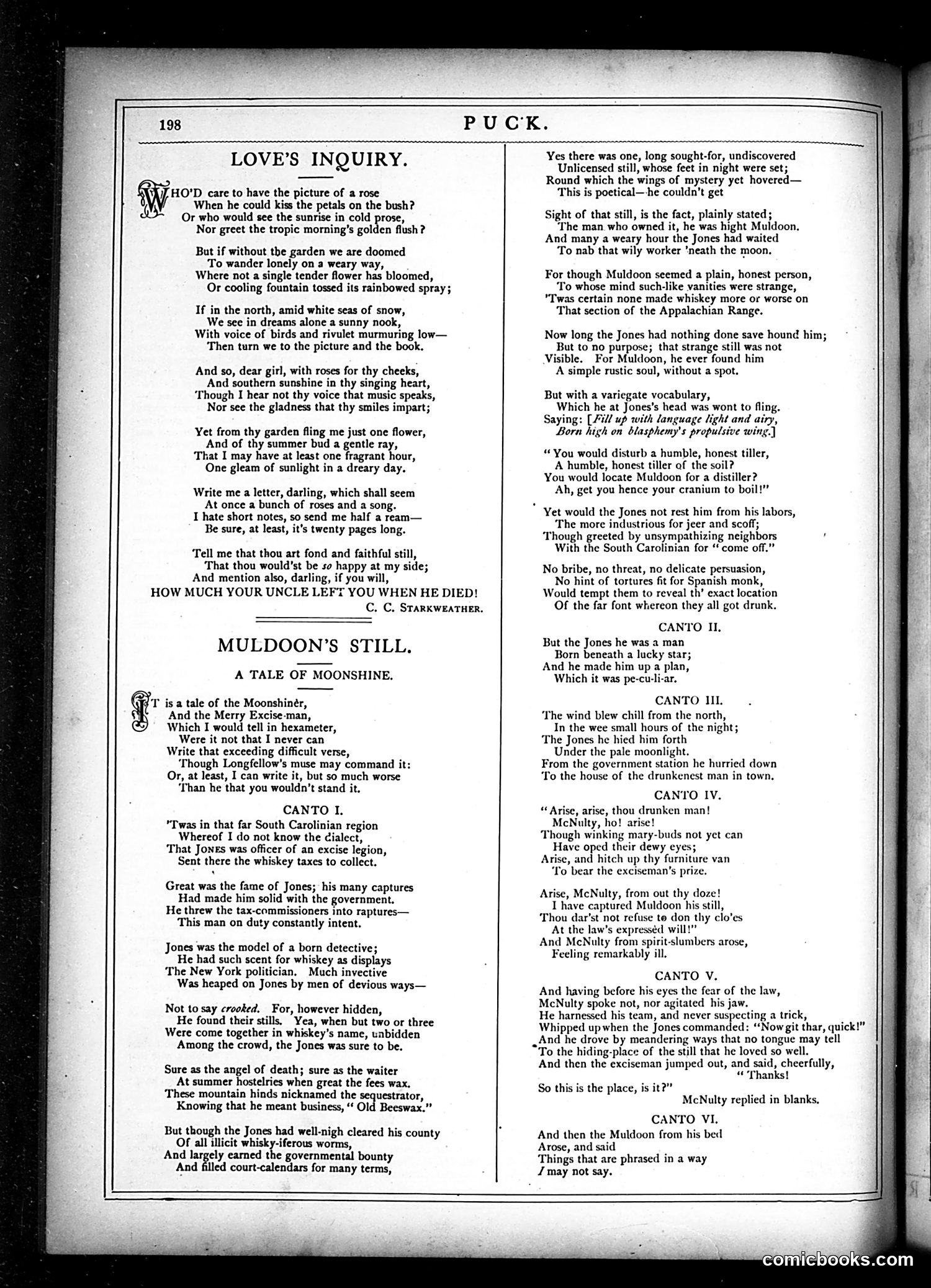
This page contains two literary pieces rather than political cartoons: 1. **"Love's Inquiry"** — A romantic poem by C.C. Starkweather asking "Who cared to have the picture of a rose / When he could kiss the petals on the bush?" It's conventional Victorian courtship verse with no political content. 2. **"Muldoon's Still: A Tale of Moonshine"** — A humorous narrative poem about illegal alcohol production in the Appalachian region. It describes Muldoon, a man running a moonshine operation who avoids capture by government excise officers. The poem depicts the conflict between rural moonshiners and federal revenue agents—a genuine social issue of the era—but treats it as comic material rather than serious political satire. The page is primarily literary content, not editorial cartooning.
📄 Transcribed text from this page (OCR, searchable)
Machine-transcribed from the original scan — historical spelling and the odd misread are preserved.
LOVE’S INQUIRY. J, HO'D care to have the picture of a rose AA When he could kiss the petals on the bush? Or who would see the sunrise in cold prose, Nor greet the tropic morning's golden flush ? But if without the garden we are doomed To wander lonely on a weary way, Where not a single tender flower has bloomed, Or cooling fountain tossed its rainbowed spray; If in the north, amid white seas of snow, We see in dreams alone a sunny nook, With voice of birds and rivulet murmuring low— Then turn we to the picture and the book. And so, dear girl, with roses for thy cheeks, And southern sunshine in thy singing heart, ‘Though I hear not thy voice that music speaks, Nor see the gladness that thy smiles impart; Yet from thy garden fling me just one flower, And of thy summer bud a gentle ray, That I may have at least one fragrant hour, One gleam of sunlight in a dreary day. Write me a letter, darling, which shall seem At once a bunch of roses and a song. I hate short notes, so send me half a ream— Be sure, at least, it's twenty pages long. Tell me that thou art fond and faithful still, That thou would’st be so happy at my side; And mention also, darling, if you will, HOW MUCH YOUR UNCLE LEFT YOU WHEN HE DIED! C. C. STARKWEATHER. MULDOON’S STILL. A TALE OF MOONSHINE, is a tale of the Moonshinér, And the Merry Excise-man, Which I would tell in hexameter, Were it not that I never can Write that exceeding difficult verse, ‘Though Longfellow’s muse may command it: Or, at least, I can write it, but so much worse ‘Than he that you wouldn’t stand it. CANTO I. *Twas in that far South Carolinian region Whereof I do not know the dialect, That Jones was officer of an excise legion, Sent there the whiskey taxes to collect. Great was the fame of Jones; his many captures Had made him solid with the government. He threw the tax-commissioners into raptures— This man on duty constantly intent, Jones was the model of a born detective; He had such scent for whiskey as displays ‘The New York politician. Much invective Was heaped on Jones by men of devious ways— Not to say crooked. For, however hidden, He found their stills, Yea, when but two or three Were come together in whiskey’s name, unbidden Among the crowd, the Jones was sure to be. Sure as the angel of death; sure as the waiter At summer hostelries when great the fees wax. These mountain hinds nicknamed the sequestrator, Knowing that he meant business, “ Old Beeswax.” But though the Jones had well-nigh cleared his county Of all illicit eis iterons, worms, And largely earned the governmental bounty And filled court-calendars for many terms, Yes there was one, long sought-for, undiscovered Unlicensed still, whose feet in night were set; Round which the wings of mystery yct hovered— This is poetical—-he couldn't get Sight of that still, is the fact, plainly stated; The man who owned it, he was hight Muldoon, And many a weary hour the Jones had waited To nab that wily worker ‘neath the moon. For though Muldoon seemed a plain, honest person, ‘To whose mind such-like vanities were strange, "Twas certain none made whiskey more or worse on That section of the Appalachian Range. Now long the Jones had nothing done save hound him; But to no purpose; that strange still was not Visible. For Muldoon, he ever found him A simple rustic soul, without a spot. But with a variegate vocabulary, Which he at Jones’s head was wont to fling. Saying: [Fid/ up with language light and airy, Born high on blasphemy's propulsive wing.] “You would disturb a humble, honest tiller, A humble, honest tiller af the soil? You would locate Muldoon for a distiller? Ah, get you hence your cranium to boil!” * Yet would the Jones not rest him from his labors, The more industrious for jeer and scoff; ‘Though greeted by unsympathizing neighbors With the South Carolinian for “come off.” No bribe, no threat, no delicate persuasion, No hint of tortures fit for Spanish monk, Would tempt them to reveal th’ exact location Of the far font whereon they all got drunk, CANTO II, But the Jones he was a man Born beneath a lucky star; And he made him up a plan, Which it was pe-cu-li-ar. CANTO HI. ‘The wind blew chill from the north, In the wee small hours of the night; The Jones he hied him forth Under the pale moonlight. From the government station he hurried down To the house of the drunkenest man in town, CANTO IV. “ Arise, arise, thou drunken man! McNulty, ho! arise! ‘Though winking mary-buds not yet can Have oped their dewy eyes; Arise, and hitch up thy furniture van ‘To bear the exciseman’s prize. Arise, McNulty, from out thy doze! I have captured Muldoon his still, Thou dar'st not refuse te don thy clo’es At the law’s expressed will!” And McNulty from spirit-slumbers arose, Feeling remarkably ill. CANTO V. And having before his eyes the fear of the law, McNulty spoke not, nor agitated his jaw. He harnessed his team, and never suspecting a trick, Whipped upwhen the Jones commanded: “Now git thar, quick!” And he drove by meandering ways that no tongue may tell “To the hiding-place of the still that he loved so well. And then the exciseman jumped out, and said, cheerfully, “Thanks! So this is the place, is it?” McNulty replied in blanks. CANTO VI. And then the Muldoon from his bed Arose, and said ‘Things that are phrased in a way J may not say.