
Puck, 1879-06-04 · page 7 of 16
Puck — June 4, 1879 — page 7: what you’re looking at
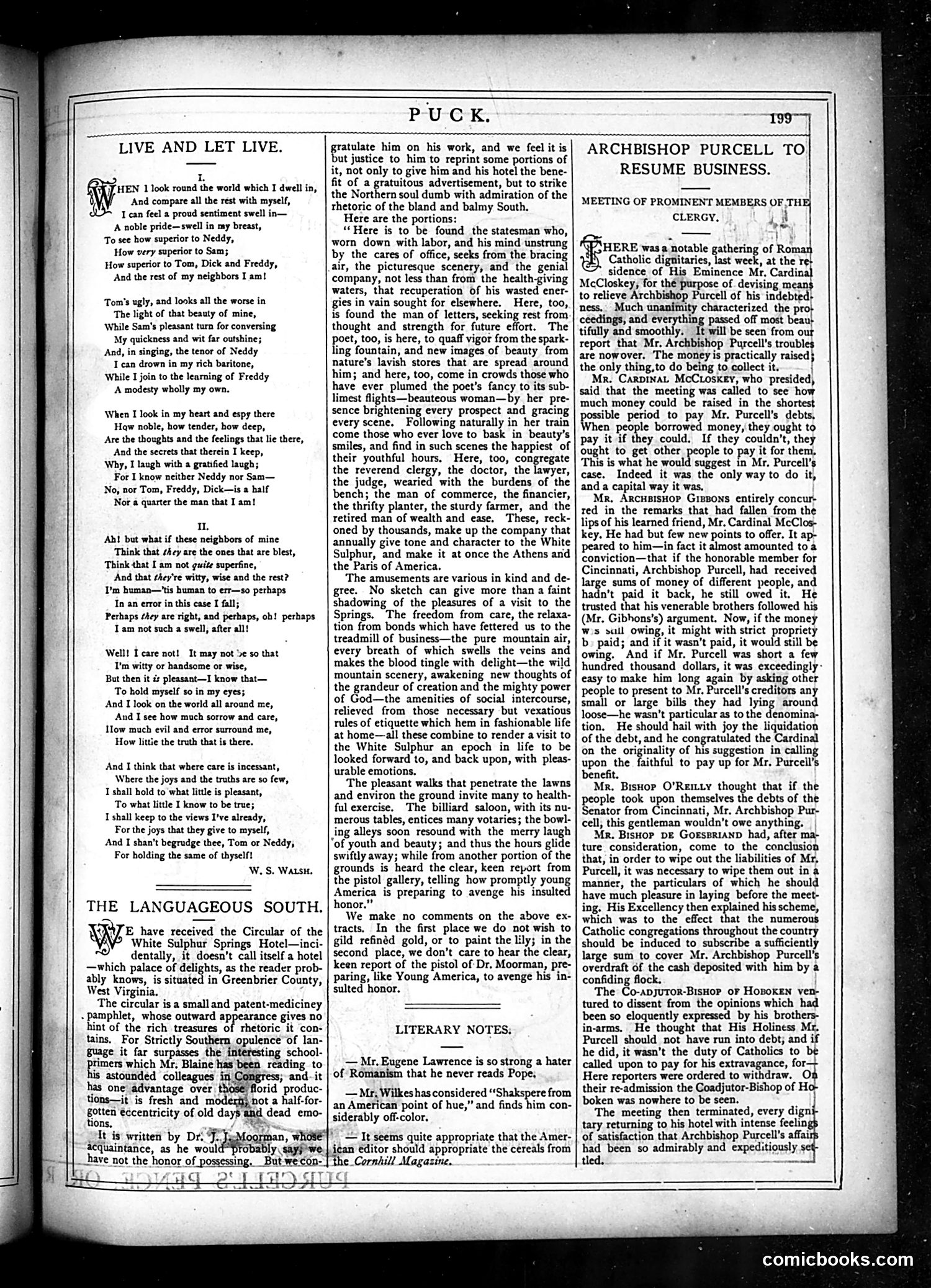
What you’re looking at
This page contains three distinct sections: a poem titled "Live and Let Live" by W.S. Walsh; an article about "Archbishop Purcell to Resume Business" discussing Catholic fundraising efforts; and a section called "The Languageous South" about Southern dialect and a White Sulphur Springs hotel pamphlet. The main satirical content addresses Archbishop Purcell's financial troubles and attempts to raise money from Catholic congregations. The article criticizes his debt management and suggests he's soliciting funds improperly from the faithful. "Literary Notes" at the bottom contains brief book commentary, including a joke about Pope Leo XIII never reading Pope. The page primarily focuses on religious and regional American social issues rather than featuring prominent political cartoons.
📄 Transcribed text from this page (OCR, searchable)
Machine-transcribed from the original scan — historical spelling and the odd misread are preserved.
PUCK, LIVE AND LET LIVE. 1 ws Look round the world which I dwell in, ‘And compare all the rest with myself, I can feel a proud sentiment swell in— A noble pride—swell in my breast, To see how superior to Neddy, How very superior to Sam; How superior to Tom, Dick and Freddy, ‘And the rest of my neighbors I am! Tom's ugly, and looks all the worse in The light of that beauly of mine, While Sam's pleasant turn for conversing My quickness and wit far outshine; ‘And, in singing, the tenor of Neddy I can drown in my rich baritone, While I join to the learning of Freddy A modesty wholly my own, When I look in my heart and espy there Haw noble, how tender, how deep, Are the thoughts and the feelings that lie there, ‘And the secrets that therein I keep, Why, I laugh with a gratified laugh; For I know neither Neddy nor Sam— No, nor Tom, Freddy, Dick—is a half Nog a quarter the man that I am! I. Abt but what if these neighbors of mine Think that ¢hey are the ones that are blest, Think that [ am not quite superfine, And that ¢hey're witty, wise and the rest? I’m human—'tis human to err—so perhaps In an error in this case I fall; Perhaps they are right, and perhaps, ob! perhaps Iam not such a swell, after all! Well! I care not! It may not ve so that I'm witty or handsome or wise, Bot then it is pleasant—I know that— To hold myself so in my eyes; And I look on the world all around me, And I see how much sorrow and care, Mow much evil and error surround me, How littie the truth that is there. And I think that where care is incessant, Where the joys and the truths are so few, I shall hold to what litle is pleasant, To what little I know to be true; I shall keep to the views I've already, For the joys that they give to myself, And I shan't begrudge thee, Tom or Neddy, For holding the same of thyself! W. S. Watsx. THE LANGUAGEOUS SOUTH. WORE. have received the Circular of the White Sulphur Springs Hotel—inci- dentally, it doesn't call itself a hotel Zieh palace of delights, as the reader prob- ably knows, is situate West Virginia. The circular is a small and patent-mediciney + Pamphlet, whose outward appearance gives no hint of the rich treasures of rhetoric it con- tains, For Strictly Southern opulence of lan- guage it far su the interesting school- eae wich Me Blaine has been ee to astount col es in Congress; and-it has one: Bavantage ever those? florid produc- tions—it is fresh and not a half-for- potien eccentricity of old days and dead emo- ions, / in Greenbrier County, It is) written by Dri 4 gratulate him on his work, and we feel it is but justice to him to reprint some portions of it, not only to give him and his hotel the bene- fit of a gratuitous advertisement, but to strike the Northern soul dumb with admiration of the thetoric of the bland and balmy South. Here are the portions: “Here is to be found the statesman who, worn down with labor, and his mind unstrung by the cares of office, seeks from the bracing air, the picturesque scenery, and the genial company, not less than from the health-giving waters, that recuperation of his wasted ener- gies in vain sought for elsewhere. Here, too, is found the man of letters, seeking rest from thought and strength for future effort. The poet, too, is here, to quaff vigor from the spark- ling fountain, and new images of beauty from nature’s lavish stores that are spread around him; and here, too, come in crowds those who have ever plumed the poet’s fancy to its sub- limest flights—beauteous woman—by her pre- sence brightening every prospect and gracing every scene, Following naturally in her train come those who ever love to bask in beauty’s smiles, and find in such scenes the happiest of their youthful hours, Here, too, congregate the reverend clergy, the doctor, the lawyer, the judge, wearied with the burdens of the bench; the man of commerce, the financier, the thrifty planter, the sturdy farmer, and the retired man of wealth and ease. These, reck- oned by thousands, make up the company that annually give tone and character to the White Sulphur, and make it at once the Athens and the Paris of America. The amusements are various in kind and de- gree. No sketch can give more than a faint shadowing of the pleasures of a visit to the Springs. ‘The freedom from care, the relaxa- tion from bonds which have fettered us to the treadmill of business—the pure mountain air, every breath of which swells the veins and makes the blood tingle with delight—the wild mountain scenery, awakening new thoughts of the grandeur of creation and the mighty power of God—the amenities of social intercourse, relieved from those necessary but vexatious tules of etiquette which hem in fashionable life at home—all these combine to render a visit to the White Sulphur an epoch in life to be looked forward to, and back upon, with pleas- urable emotions. The pleasant walks that penetrate the lawns and environ the ground invite many to health- ful exercise. The billiard saloon, with its nu- merous tables, entices many votaries; the bowl- ing alleys soon resound with the merry taugh “of youth and beauty; and thus the hours glide swiftly away; while from another portion of the grounds is heard the clear, keen report from the pistol gallery, telling how promptly young America is preparing to avenge his insulted honor.” We make no comments on the above ex- tracts. In the first place we do not wish to gild refinéd gold, or to paint the lily; in the second place, we don’t care to hear the clear, keen report of the pistol of Dr. Moorman, pre- paring, like Young America, to avenge his in- sulted honor. LITERARY NOTES, — Mr. Eugene Lawrence is so strong a hater of Romanism that he never reads Pope, — Mr, Wilkes has considered ‘‘Shakspere from an American point of hue,” and finds him con- siderably off-color. — It seems quite appropriate that the Amer- acquaintance, as he would” sbably say we. ican editor should appropriate the cereals from -have not the honor of possessing, But we con: the Cornhill Magazine. ARCHBISHOP PURCELL TO RESUME BUSINESS. MEETING OF PROMINENT MEMBERS OF TH CLERGY. ha oe HERE was a notable gathering of Ro! Catholic dignitaries, last week, at the re sidence of His Eminence Mr. Cardinal McCloskey, for thé ¢ of devising mean$ to relieve Archbishop Purcell of his indebted+ ness.. Much unanimity characterized the Prot ceedings, and badge passed off most beau; tifully and smoothly. It will be seen from our report that Mr. Archbishop Purcell’s troubles are nowover. The moneyis practically raised} the only thing,to do being to collect it. i Mr. CarpinaL McCtoskey, who presided, said that the meeting was called to see how much money could be raised in the shortest possible period to pay Mr. Purcell’s debts, When people borrowed money, they ought to pay it if they could, If they couldn’t, they ought to get other ppeople to pay it for them, ‘This is what he would suggest in Mr. Purcell’s case. Indeed it was the only way to do it, and a capital way it was, Mr. ArcusisHop Gippons entirely concur- red in the remarks that had fallen from the lips of his learned friend, Mr. Cardinal McClos- key. He had but few new points to offer. It ap- peared to him—in fact it almost amounted toa conviction—that if the honorable member for Cincinnati, Archbishop Purcell, had received large sums of money of different people, and hadn't paid it back, he still owed it. He trusted that his venerable brothers followed his (Mr. Gibhons’s) argument. Now, if the money ws sail owing, it might with strict propriety b. paid; and if it wasn't paid, it would still be owing. And if Mr. Purcell was short a few hundred thousand dollars, it was exceedingly- easy to make him long again by asking other people to present to Mr. Purcell’s creditors any small or large bills they had lying around loose—he wasn't particular as to the denomina- tion, He should hail with joy the liquidation of the debt, and he congratulated the Cardinal on the originality of his suggestion in calling upon the faithful to pay up for Mr. Purcell’s benefit. Mr. Bisuor O'Remtty thought that if the ple took upon themselves the debts of the Senator from Cincinnati, Mr. Archbishop Pur- cell, this gentleman wouldn’t owe anything. Mr. Bishop pe GogsprianpD had, after ma- ture consideration, come to the conclusion that, in order to wipe out the liabilities of Mr, Purcell, it was necessary to wipe them out ina manner, the particulars of which he should have much pleasure in laying before the meet- ing. His Excellency then explained his scheme, which was to the effect that the numerous Catholic congregations throughout the country should be induced to subscribe a sufficiently large sum to cover Mr. Archbishop Purcell’s overdraft of the cash deposited with him by a confiding flock. The Co-apjutor-BisHoPp oF Hoboken ven- tured to dissent from the opinions which had been so eloquently expressed by his brothers- in-arms, He thought that His Holiness Mr. Purcell should not have run into debt; and if he did, it wasn’t the duty of Catholics to be called upon to pay for his extravagance, for— Here reporters were ordered to withdraw. O1 their re-admission the Coadjutor-Bishop of Ho- boken was nowhere to be seen. : The meeting then terminated, every dign’ tary returning to his hotel with intense feelin, of satisfaction that Archbishop Purcell’s affai had been so admirably and expeditiously tled. comicbooks.com