
Puck, 1879-06-04 · page 5 of 16
Puck — June 4, 1879 — page 5: what you’re looking at
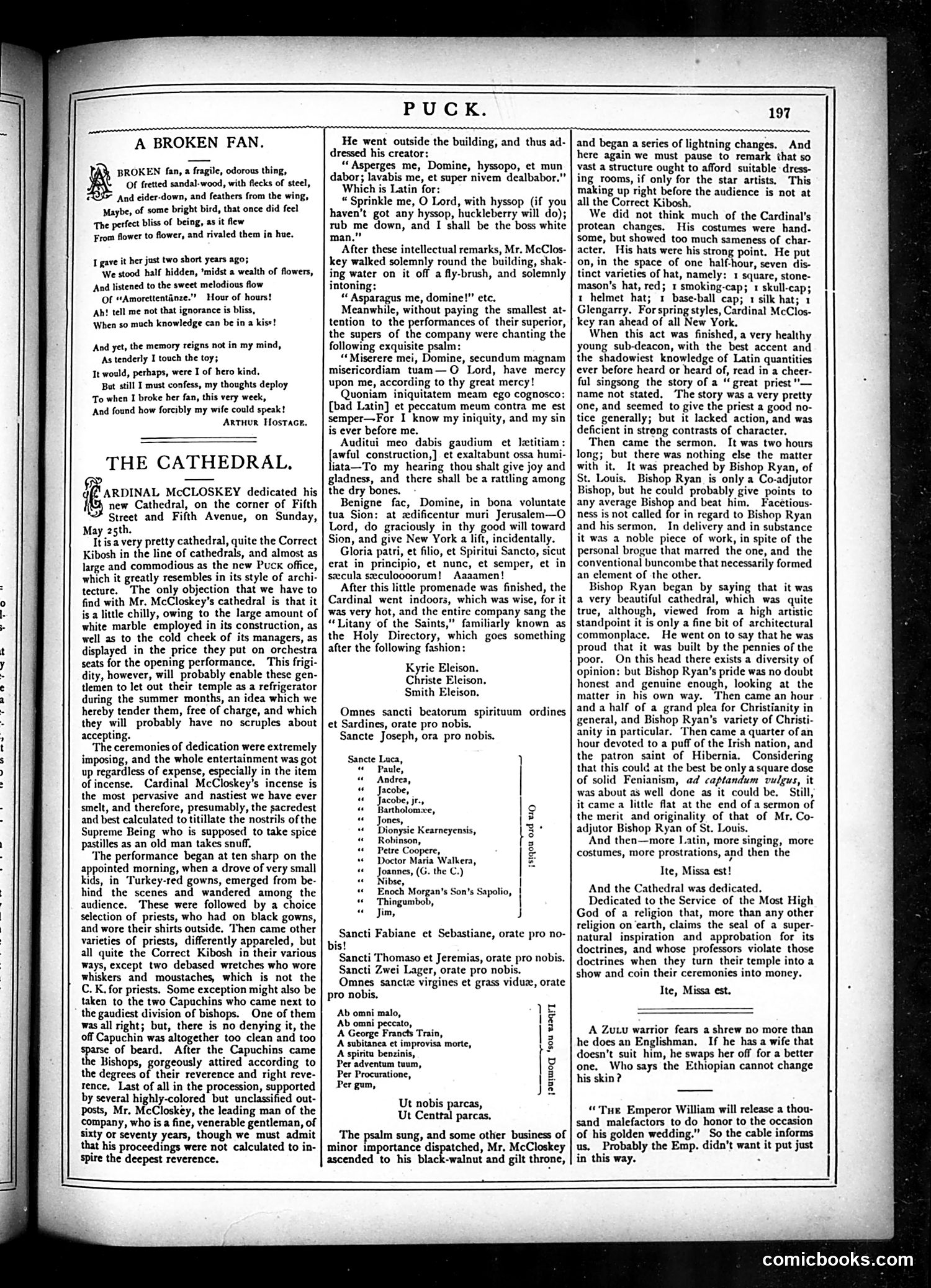
What you’re looking at
This page contains two distinct pieces: **"A Broken Fan"** is a sentimental poem about a damaged fan that once belonged to the speaker's mother, evoking nostalgic memories of her. **"The Cathedral"** is a satirical piece describing Cardinal McCloskey's dedication of a new cathedral on Fifth Avenue in New York. The satire mocks the elaborate ceremony and the cardinal's pretensions. It ridicules the ornate religious proceedings—the Latin chanting, the ceremonial pomp—while suggesting the church's wealth and grandeur contrast with genuine spirituality. The piece appears to critique both ecclesiastical ostentation and the social climbing associated with such high-profile religious events in Gilded Age New York. The page reflects Puck's characteristic irreverent approach to religious institutions and the wealthy elite.
📄 Transcribed text from this page (OCR, searchable)
Machine-transcribed from the original scan — historical spelling and the odd misread are preserved.
PUCK. 197 A BROKEN FAN. BN BROKEN fan, a fragile, odorous thing, Of fretted sandal-wood, with flecks of steel, FOIF And cider-down, and feathers from the wing, Maybe, of some bright bird, that once did feel ‘The perfect bliss of being, as it flew From flower to flower, and rivaled them in hue. I gave it her just two short years ago; ‘We stood half hidden, 'midst a wealth of flowers, ‘And listened to the sweet melodious flow Of “Amorettentinze.”” Hour of hours! ‘Ab! tell me not that ignorance is bliss, When so much knowledge can be in a kist! ‘And yet, the memory reigns not in my mind, ‘As tenderly I touch the toy; It would, perhaps, were I of hero kind. But still I must confess, my thoughts deploy To when I broke her fan, this very week, ‘And found how forcibly my wife could speak! ARTHUR HosTAcE. THE CATHEDRAL, ARDINAL McCLOSKEY dedicated his new Cathedral, on the corner of Fifth Street and Fifth Avenue, on Sunday, May 25th. It isa very pretty cathedral, quite the Correct Kibosh in the line of cathedrals, and almost as large and commodious as the new Puck office, which it greatly resembles in its style of archi- tecture. The only objection that we have to find with Mr. McCloskey’s cathedral is that it is a little chilly, owing to the large amount of white marble employed in its construction, as well as to the cold cheek of its managers, as displayed in the price they put on orchestra seats for the opening performance. This frigi- dity, however, will probably enable these gen- tlemen to let out their temple as a refrigerator during the summer months, an idea which we hereby tender them, free of charge, and which they will probably have no scruples about accepting. The ceremonies of dedication were extremely imposing, and the whole entertainment was got up regardless of expense, especially in the item of incense. Cardinal McCloskey’s incense is the most pervasive and nastiest we have ever smelt, and therefore, presumably, the sacredest and best calculated to titillate the nostrils ofthe Supreme Being who is supposed to take spice pastilles as an old man takes snuff, The performance began at ten sharp on the appointed morning, when a drove of very small kids, in ‘Turkey-red gowns, emerged from be- hind the scenes and wandered among the audience. These were followed by a choice selection of priests, who had on black gowns, and wore their shirts outside. Then came other varieties of priests, differently appareled, but all quite the Correct Kibosh in their various ways, except two debased wretches who wore whiskers and moustaches, which is not the C.K. for priests. Some exception might also be taken to the two Capuchins who came next to the gaudiest division of bishops. One of them was all right; but, there is no denying it, the off Capuchin was altogether too clean and too sparse of beard. After the Capuchins came ¢ Bishops, gorgeously attired according to the degrees of their reverence and right reve- rence, Last of all in the procession, supported by several highly-colored but unclassified out- posts, Mr. McCloskey, the leading man of the company, who is a fine, venerable gentleman, of Sixty or seventy years, though we must admit his proceedings were not calculated to in- spire the deepest reverence. T He went outside the building, and thus ad- dressed his creator: “ Asperges me, Domine, hyssopo, et mun dabor; lavabis me, et super nivem dealbabor.”” Which is Latin for: “ Sprinkle me, O Lord, with hyssop (if you haven’t got any hyssop, huckleberry will do); rub me down, and I shall be the boss white man.” After these intellectual remarks, Mr. McClos- key walked solemnly round the building, shak- ing water on it off a fly-brush, and solemnly intoning: “ Asparagus me, domine!” etc. Meanwhile, without paying the smallest at- tention to the performances of their superior, the supers of the company were chanting the following exquisite psalm: “«Miserere mei, Domine, secundum magnam misericordiam tuam—O Lord, have mercy upon me, according to thy great mercy! Quoniam iniquitatem meam ego cognosco: [bad Latin] et peccatum meum contra me est semper—-For I know my iniquity, and my sin is ever before me. Auditui meo dabis gaudium et letitiam: fastol construction,] et exaltabunt ossa humi- iata—To my hearing thou shalt give joy and gladness, and there shall be a rattling among the dry bones. Benigne fac, Domine, in bona voluntate tua Sion: at zdificentur muri Jerusalem—O Lord, do graciously in thy good will toward Sion, and give New York a lift, incidentally. Gloria patri, et filio, et Spiritui Sancto, sicut erat in principio, et nunc, et semper, et in sxcula seculoooorum! Aaaamen! After this little promenade was finished, the Cardinal went indoors, which was wise, for it was very hot, and the entire company sang the “Litany of the Saints,” familiarly known as the Holy Directory, which goes something after the following fashion: Kyrie Eleison. Christe Eleison, Smith Eleison, Omnes sancti beatorum spirituum ordines et Sardines, orate pro nobis. Sancte Joseph, ora pro nobis. Sancte Luca, “ Paule, Andrea, Jacobe, Jacobe, jr., Bartholome, Jones, Dionysie Kearneyensis, Robinson, Petre Coopere, Doctor Maria Walkera, Joannes, (G. the C.) Nibse, Enoch Morgan's Son's Sapolio, Thingumbob, Jim, istqou oad 19 Sancti Fabiane et Sebastiane, orate pro no- bis! Sancti Thomaso et Jeremias, orate pro nobis. Sancti Zwei Lager, orate pro nobis. Omnes sanctx virgines et grass viduzx, orate pro nobis. ‘Ab omni malo, } £ ‘Ab omni peccato, A George Francts Train, A subitanea et improvisa morte, A spiritu benzinis, Per adventum tuum, Per Procuratione, Per gum, Ut nobis parcas, Ut Central parcas, The Im sung, and some other business of minor importance dispatched, Mr. McCloskey ascended to his black-walnut and gilt throne, and began a series of lightning changes. And here again we must pause to remark that so vast a structure ought to afford suitable dress- ing rooms, if only for the star artists. This making up right before the audience is not at all the Correct Kibosh, We did not think much of the Cardinal’s protean changes. His costumes were hand- some, but showed too much sameness of char- acter, His hats were his strong point. He put on, in the space of one half-hour, seven dis- tinct varieties of hat, namely: 1 square, stone- mason’s hat, red; 1 smoking-cap; 1 skull-cap; 1 helmet hat; 1 base-ball cap; 1 silk hat; 1 Glengarry. For spring styles, Cardinal McClos- key ran ahead of all New York. When this act was finished, a very healthy young sub-deacon, with the best accent and the shadowiest knowledge of Latin quantities ever before heard or heard of, read in a cheer- ful singsong the story of a “ great priest "— name not stated, ‘The story was a very pretty one, and seemed to give the priest a good no- tice generally; but it lacked action, and was deficient in strong contrasts of character. Then came the sermon. It was two hours long; but there was nothing else the matter with it. It was preached by Bishop Ryan, of St. Louis. Bishop Ryan is only a Co-adjutor Bishop, but he could probably give points to any average Bishop and beat him. Facetious- ness is not called for in regard to Bishop Ryan and his sermon, In delivery and in substance it was a noble piece of work, in spite of the personal brogue that marred the one, and the conventional buncombe that necessarily formed an element of the other. Bishop Ryan began by saying that it was a very beautiful cathedral, which was quite true, although, viewed from a high artistic standpoint it is only a fine bit of architectural commonplace. He went on to say that he was proud that it was built by the pennies of the poor. On this head there exists a diversity of opinion: but Bishop Ryan’s pride was no doubt honest and genuine enough, looking at the matter in his own way, Then came an hour and a half of a grand plea for Christianity in general, and Bishop Ryan’s variety of Christi- anity in particular. Then came a quarter ofan hour devoted to a puff of the Irish nation, and the patron saint of Hibernia. Considering that this could at the best be only a square dose of solid Fenianism, ad captandum vulgus, it was about as well done as it could be. Still, it came a little flat at the end of a sermon of the merit and originality of that of Mr. Co- adjutor Bishop Ryan of St. Louis. And then—more Latin, more singing, more costumes, more prostrations, and then the Ite, Missa est! And the Cathedral was dedicated. Dedicated to the Service of the Most High God of a religion that, more than any other religion on earth, claims the seal of a super- natural inspiration and approbation for its doctrines, and whose professors violate those doctrines when they turn their temple into a show and coin their ceremonies into money. Ite, Missa est. A Zutu warrior fears a shrew no more than he does an Englishman, If he has a wife that doesn’t suit him, he swaps her off for a better one. Who says the Ethiopian cannot change his skin? “Tue Emperor William will release a thou- sand malefactors to do honor to the occasion of his golden wedding.” So the cable informs us, Probably the Emp. didn't want it put just in this way. 5 comicbooks.com