
Puck, 1879-06-04 · page 12 of 16
Puck — June 4, 1879 — page 12: what you’re looking at
What you’re looking at
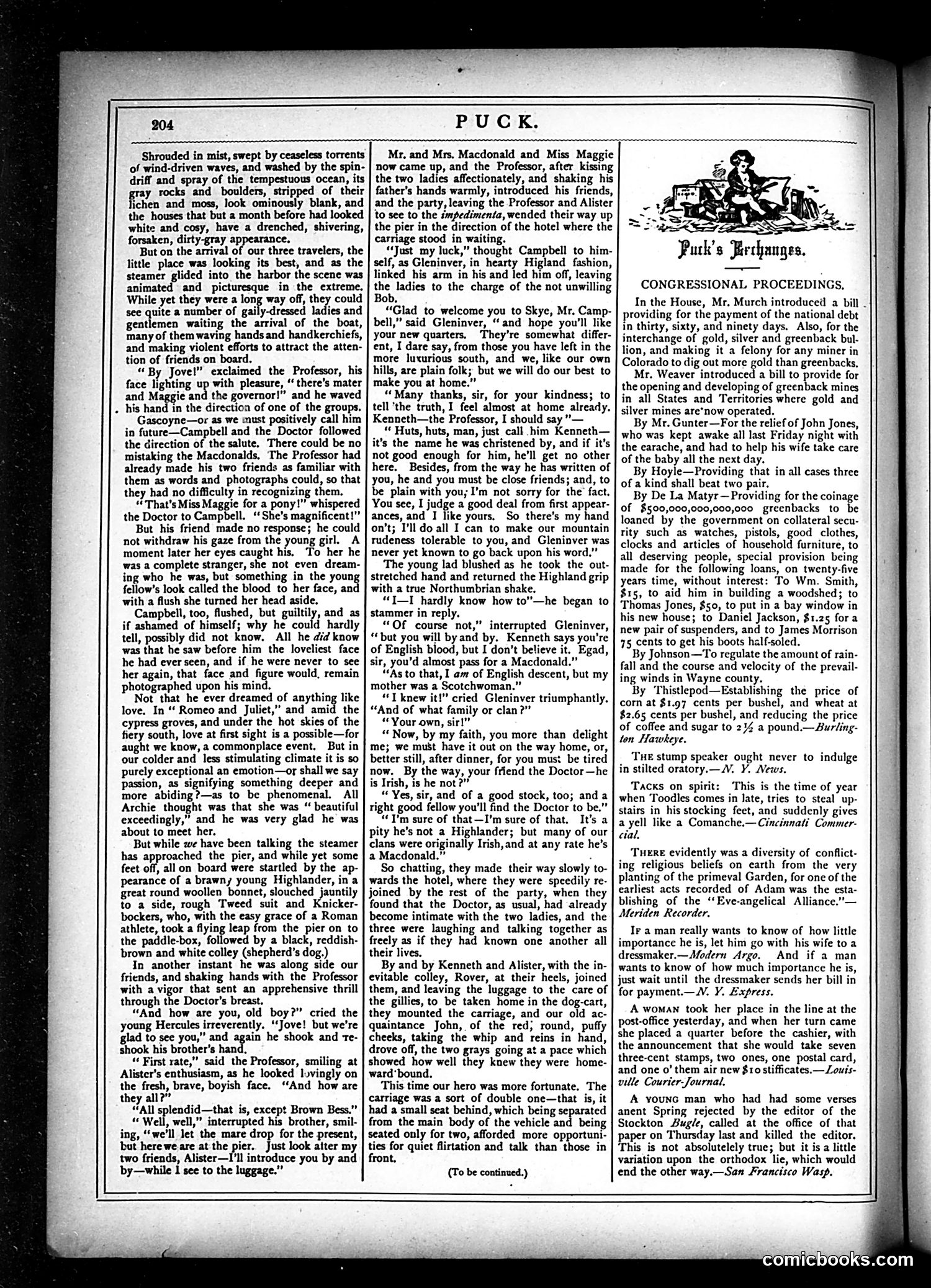
This page contains primarily fictional narrative text with a small decorative header illustration labeled "Puck's Exchanges." The main content is a serialized story about characters visiting Scotland—featuring dialogue among Mr. and Mrs. Macdonald, Miss Maggie, Professor, Alister, and others discussing their Highland travels and a character named Kenneth/the Doctor. The right column contains "Congressional Proceedings"—satirical summaries of actual legislative bills from the U.S. House, including items about gold reserves, mining development, rainfall regulation, and church matters. These brief descriptions mock Congressional activity through absurdist or exaggerated summaries of real proposals. There are no significant political cartoons visible on this page—it's primarily text-based satire of Congress rather than visual caricature.
📄 Transcribed text from this page (OCR, searchable)
Machine-transcribed from the original scan — historical spelling and the odd misread are preserved.
PUCK. Shrouded in mist, swept by ceaseless torrents of wind-driven waves, and washed by the spin- driff and spray of the tempestuous ocean, its y rocks and boulders, stripped of their fen and moss, look ominously blank, and the houses that but a month before had looked white and cosy, have a drenched, shivering, forsaken, dirty-gray ap) ce, But on the arrival of our three travelers, the little place was looking its best, and as the steamer glided into the harbor the scene was animated and picturesque in the extreme. While yet they were a long way off, they could see quite a number of gaily-dressed ladies and faulenen waiting the arrival of the boat, many of them waving hands and handkerchiefs, and making violent efforts to attract the atten- tion of friends on board. “ By Jove!” exclaimed the Professor, his face lighting up with pleasure, “there's mater and Maggie and the governor!” and he waved . his hand in the direction of one of the groups. Gascoyne—or as we must positively call him in future—Campbell and the Doctor followed the direction of the salute. There could be no mistaking the Macdonalds, The Professor had already made his two friends as familiar with them as words and photographs could, so that they had no difficulty in recognizing them, «That's Miss Maggie for a pony!” whispered the Doctor to Campbell. “She's magnificent!" But his friend made no response; he could not withdraw his gaze from the young girl. A moment later her eyes caught his, To her he was a complete stranger, she not even dream- ing who he was, but something in the youn, fellow’s look called the blood to her face, an with a flush she turned her head aside. Campbell, too, flushed, but guiltily, and as if ashamed of himself; why he could hardly tell, possibly did not know. All he did know was that he saw before him the loveliest face he had ever seen, and if he were never to see her again, that face and figure would, remain photographed upon his mind. Not that he ever dreamed of anything like love. In “‘ Romeo and Juliet,” and amid the cypress groves, and under the hot skies of the fiery south, love at first sight is a possible—for aught we know, a commonplace event. But in our colder and less stimulating climate it is so purely exceptional an emotion—or shall we say passion, as signifying something deeper and more abiding?—as to be phenomenal. All Archie thought was that she was “ beautiful exceedingly,” and he was very glad he was about to meet her. But while we have been talking the steamer has approached the pier, and while yet some feet off, allon board were startled by the ap- pearance of a brawny young Highlander, ina great round woollen bonnet, slouched jauntily to a side, rough Tweed suit and Knicker- bockers, who, with the easy grace of a Roman athlete, took a flying leap from the pier on to the paddle-box, followed by a black, reddish- brown and white colley (shepherd's dog.) In another instant he was along side our friends, and shaking hands with the Professor with a vigor that sent an apprehensive thrill through the Doctor's breast. “And how are you, old boy?” cried the young Hercules irreverently. “Jove! but we're glad to see you,” and again he shook and tre- shook his brother’s hand, “ First rate,” said the Professor, smiling at Alister’s enthusiasm, as he looked lovingly on the fresh, brave, boyish face. ‘And how are they all?” “All splendid—that is, except Brown Bess,” “ Well, well,” interrupted his brother, smil- ing, ‘‘we'll let the mare drop for the present, but herewe are at the pier. Just look atter my two friends, Alister—I'll introduce you by and by—while 1 see to the luggage.” Mr. and Mrs. Macdonald and Miss Maggie now came up, and the Professor, after kissing the two ladies affectionately, and shaking his father’s hands warmly, introduced his friends, and the party, leaving the Professor and Alister to see to the impedimenta, wended their way up the pier in the direction of the hotel where the carriage stood in waiting. “Just my luck,” thought Campbell to him- self, as Gleninver, in hearty Higland fashion, linked his arm in his and led him off, leaving the ladies to the charge of the not unwilling “Glad to welcome you to Skye, Mr. Camp- bell,” said Gleninver, “and hope you'll like your new quarters, They’re somewhat differ- ent, I dare say, from those you have left in the more luxurious south, and we, like our own hills, are plain folk; but we will do our best to make you at home.” “Many thanks, sir, for your kindness; to tell ‘the truth, I feel almost at home already. Kenneth—the Professor, I should say "— “ Huts, huts, man, just call him Kenneth— it’s the name he was christened by, and if it's not good enough for him, he'll get no other here. Besides, from the way he has written of you, he and you must be close friends; and, to be plain with you, I’m not sorry for the’ fact. You see, I judge a good deal from first appear- ances, and I like yours, So there's my hand on’t; I'll do all I can to make our mountain rudeness tolerable to you, and Gleninver was never yet known to go back upon his word.” The young lad blushed as he took the out- stretched hand and returned the Highland grip with a true Northumbrian shake. “T—I hardly know how to”—he began to stammer in reply, “Of course not,” interrupted Gleninver, “but you will byand by. Kenneth says you're of English blood, but I don’t believe it. Egad, sir, you'd almost pass for a Macdonald.” “As to that, I am of English descent, but my mother was a Scotchwoman.” “T knew it!” cried Gleninver triumphantly. “And of what family or clan?” “Your own, sir!” “Now, by my faith, you more than delight me; we must have it out on the way home, or, better still, after dinner, for you mus: be tired now, By the way, your friend the Doctor—he is Irish, is he not?” “Yes, sir, and of a good stock, too; anda tight good fellow you'll find the Doctor to be.” “I'm sure of that—I'm sure of that. It’s a pity he's not a Highlander; but many of our clans were originally Irish,and at any rate he’s a Macdonald.” So chatting, they made their way slowly to- wards the hotel, where they were speedily re- joined by the rest of the party, when they found that the Doctor, as usual, had already become intimate with the two ladies, and the three were laughing and talking together as freely as if they had known one another all their lives, By and by Kenneth and Alister, with the in- evitable colley, Rover, at their heels, joined them, and leaving the luggage to the care of the gillies, to be taken home in the dog-cart, they mounted the carriage, and our old ac- quaintance John, of the red; round, puffy cheeks, taking the whip and reins in hand, drove off, the two grays going at a pace which showed how well they knew they were home- ward'bound, This time our hero was more fortunate. The carriage was a sort of double one—that is, it had a small seat behind, which being separated from the main body of the vehicle and being seated only for two, afforded more opportuni- tics for quiet flirtation and talk than those in front, (To be continued.) CONGRESSIONAL PROCEEDINGS, In the House, Mr. Murch introduced a bill - providing for the payment of the national debt in thirty, sixty, and ninety days. Also, for the interchange of gold, silver and greenback bul- lion, and making it'a felony for any miner in Colorado to dig out more gold than greenbacks, Mr. Weaver introduced a bill to provide for the opening and developing of greenback mines in all States and Territories where gold and silver mines are‘now operated. By Mr. Gunter—For the relief of John Jones, who was kept awake all last Friday night with the earache, and had to help his wife take care of the baby all the next day. By Hoyle—Providing that in all cases three of a kind shall beat two pair. By De La Matyr—Providing for the coinage Of $500,000,000,000,000 greenbacks to be loaned by the government on collateral secu- rity such as watches, pistols, good clothes, clocks and articles of household furniture, to all deserving people, special provision being made for the following loans, on twenty-five years time, without interest: To Wm. Smith, $15, to aid him in building a woodshed; to Thomas Jones, $50, to put in a bay window in his new house; to Daniel Jackson, $1.25 for a new pair of suspenders, and to James Morrison 75 cents to get his boots half-soled. By Johnson—To regulate the amount of rain- fall and the course and velocity of the prevail- ing winds in Wayne county. By Thistlepod—Establishing the price of corn at $1.97 cents per bushel, and wheat at $2.65 cents per bushel, and reducing the price of coffee and sugar to 244 a pound.—Burling- ton Hawkeye. Tue stump speaker ought never to indulge in stilted oratory.—V. Y. News. Tacks on spirit: This is the time of year when Toodles comes in late, tries to steal up- stairs in his stocking feet, and suddenly gives a yell like a Comanche.— Cincinnati Commer- cial, ‘Tuere evidently was a diversity of conflict- ing religious beliefs on earth from the very planting of the primeval Garden, for one of the earliest acts recorded of Adam was the esta- blishing of the ‘‘Eve-angelical Alliance.”— Meriden Recorder. Ir a man really wants to know of how little importance he is, let him go with his wife toa dressmaker.—Afodern Argo. And if a man wants to know of how much importance he is, just wait until the dressmaker sends her bill in for payment.—M. Y. Express. A woman took her place in the line at the post-office yesterday, and when her turn came she placed a quarter before the cashier, with the announcement that she would take seven three-cent stamps, two ones, one postal card, and one o’ them air new $1o stifficates.— Louis- ville Courier-Journal, A younc man who had had some verses anent Spring rejected by the editor of the Stockton Bugle, called at the office of that paper on Thursday last and killed the editor. This is not absolutelely true; but it is a little variation upon the orthodox lie, which would end the other way.—San Francisco Wasp. ‘omicbooks.com