
A complete issue · 16 pages · 1879
Puck — May 21, 1879
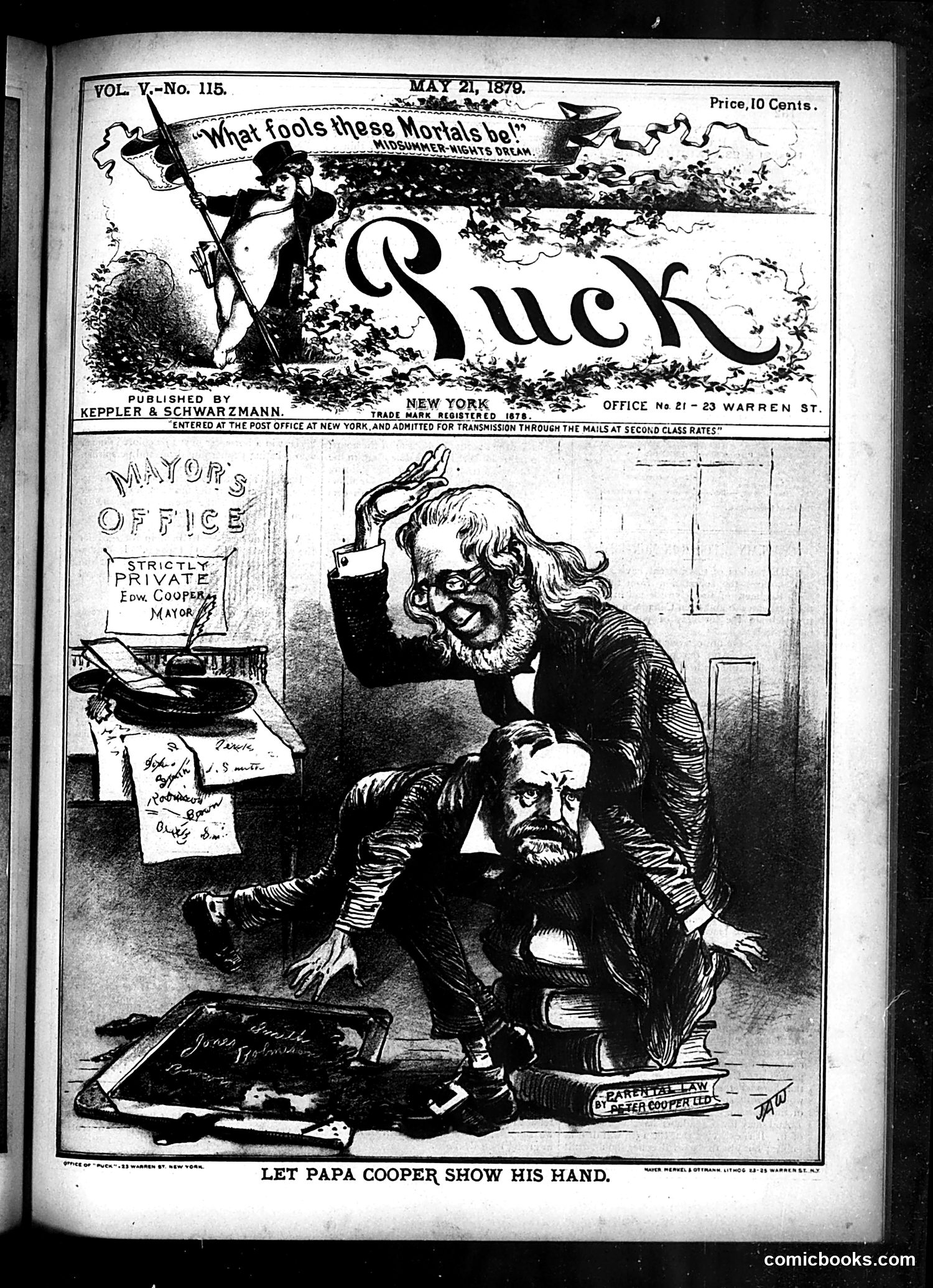
This **Puck** cartoon from May 21, 1879, satirizes Mayor **Edward Cooper** of New York (visible on the office door nameplate). The central figure appears to be Cooper, depicted as a manipulative puppet-master holding strings attached to another official or politician below him. The cartoon's title and composition suggest Cooper is being criticized for hidden control or corrupt influence over city governance—he's being asked to "show his hand" and reveal his true role in directing affairs. The caricatured style and the "Mayor's Office" setting indicate this was likely commentary on municipal politics and suspected backroom dealings or patronage during the Gilded Age. The exact political incident referenced is unclear without additional historical context.
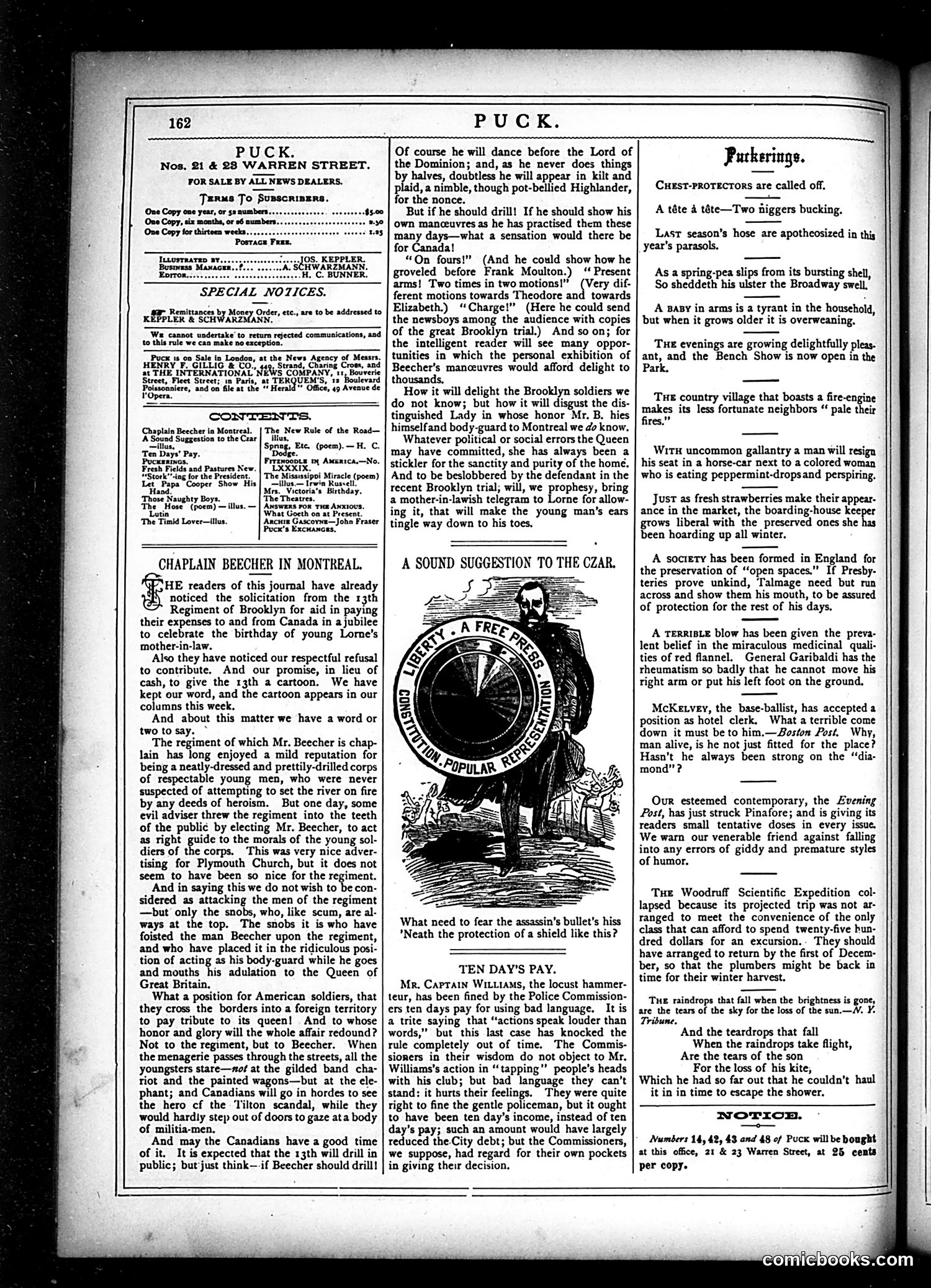
The main cartoon illustrates "A Sound Suggestion to the Czar," depicting a bearded figure (the Russian Czar) holding a large circular shield labeled "LIBERTY, A FREE PRESS" with radiating lines suggesting protection. The satirical point appears to be that a free press and liberty function as protective shields against assassination—likely referencing political violence or anarchist threats targeting Russian imperial rule during this period. The text beneath suggests that adopting freedom of the press would paradoxically protect the Czar better than military force. The accompanying articles discuss Chaplain Beecher's involvement with Brooklyn's 13th Regiment and various social commentary pieces, including critiques of police conduct and military discipline. Without a clear date visible, the specific historical context remains uncertain, though it references late 19th-century Russian political tensions.
This page contains three distinct sections: political commentary about Mayor Cooper of New York City, a satirical piece titled "Stork-ing for the Presidency" about presidential candidates, and a short poem "A Rhyme of the Day." The main article "Let Papa Cooper Show His Hand" criticizes Mayor Cooper's municipal governance, suggesting he should demonstrate leadership rather than serve as a political "dummy." The "Stork-ing" section mocks various presidential hopefuls through playful wordplay, noting candidates' attempts to gain public attention. The satirical tone targets political posturing and suggests these figures lack genuine substance. Without identifying specific illustrations, the text clearly positions this as commentary on late-19th/early-20th-century American electoral politics and urban governance—typical Puck fare criticizing public figures through humor and pointed editorial rhetoric.
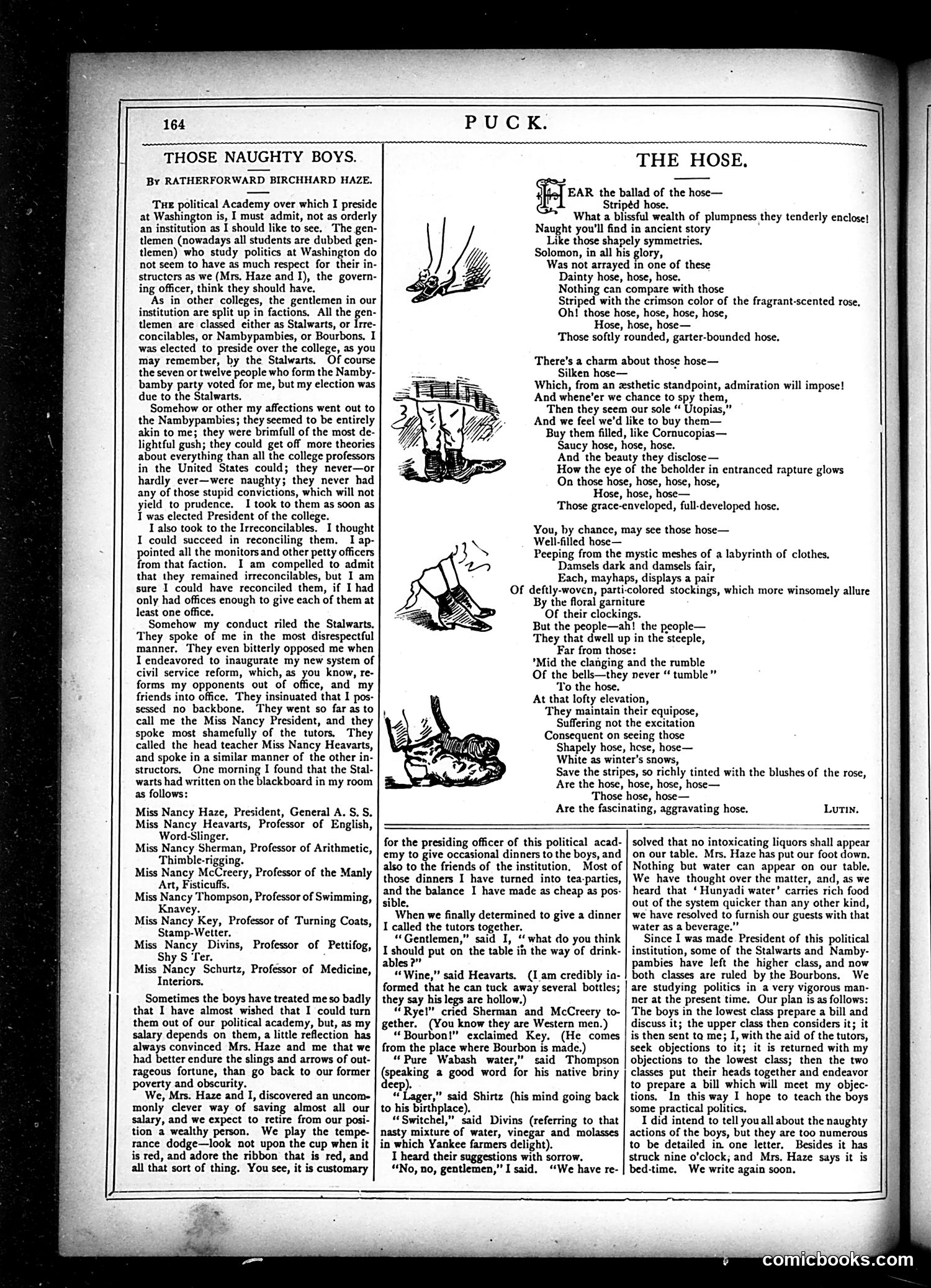
**"Those Naughty Boys"** by Ratherforward Birchhard Haze satirizes a political academy where the author presides. The piece complains that gentlemen students studying politics at Washington lack respect for governing institutions and engage in partisan factionalism—divided into "Stalwarts, irreconcilables, Nambypambies, or Bourbons." The author claims he attempted civil service reform but faced obstruction from these student factions, who even appealed to "Miss Nancy President" against him. The satire mocks both the students' political immaturity and the author's frustration managing them. **"The Hose"** is a lyrical poem celebrating striped stockings—their beauty, symmetry, and aesthetic appeal—with accompanying illustrations of legs/feet wearing various hosiery styles. This appears to be light, decorative verse rather than political commentary.
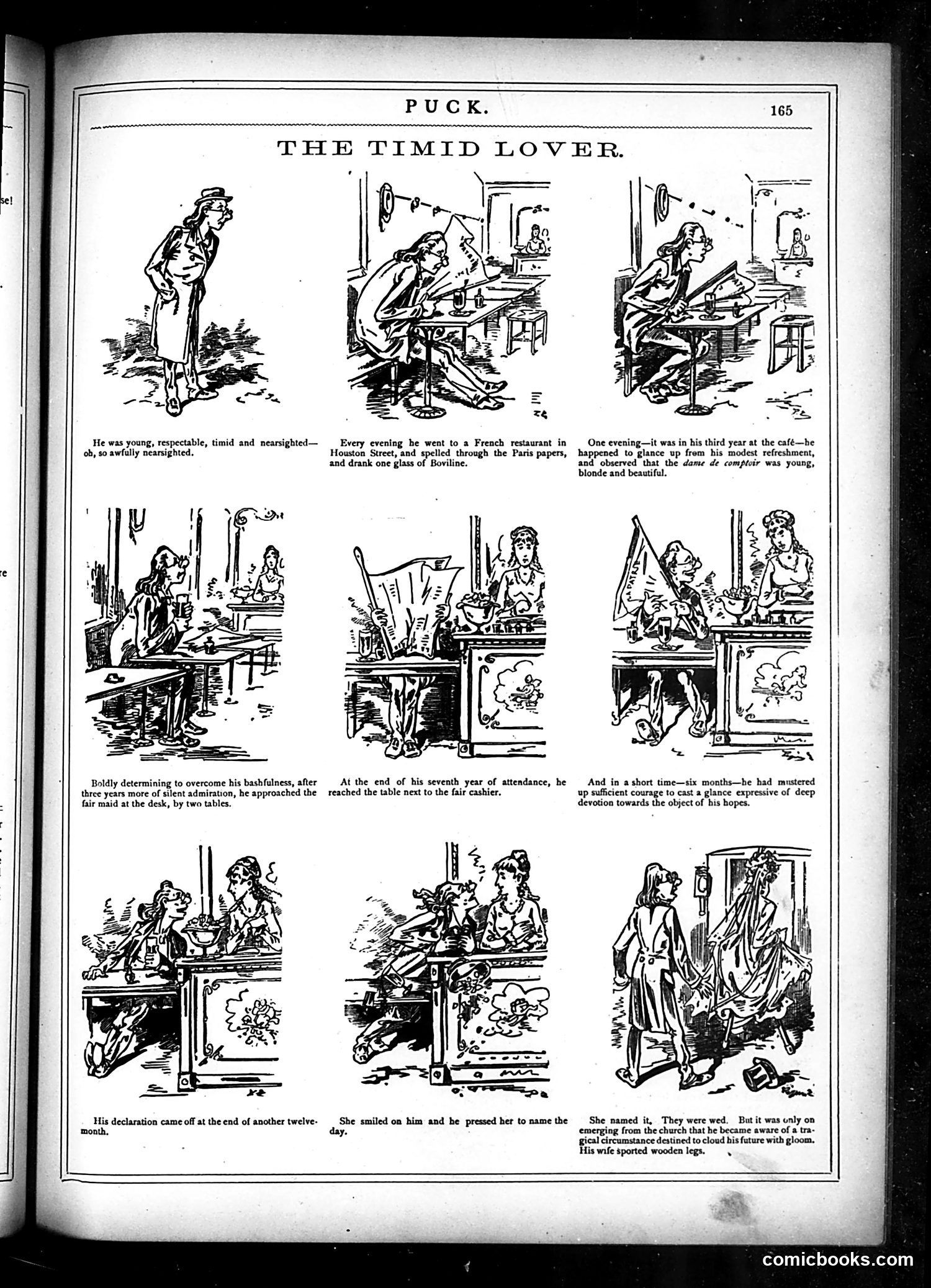
This is a humorous serial comic strip following an awkward, timid young man over twelve months at a Parisian café. The narrative traces his painstaking courtship: he begins by simply observing a beautiful waitress ("dame de comptoir"), gradually builds courage to glance at her, and eventually—after three years of silent admiration—is approached by the fair maid at dusk. The joke satirizes excessive romantic timidity and hesitation. By the final panels, their relationship culminates in marriage, with the punchline suggesting his wife now "spotted wooden legs"—a darkly humorous twist implying he's trapped or compromised by matrimony after his prolonged indecision. The strip gently mocks both romantic paralysis and male anxiety about courtship.
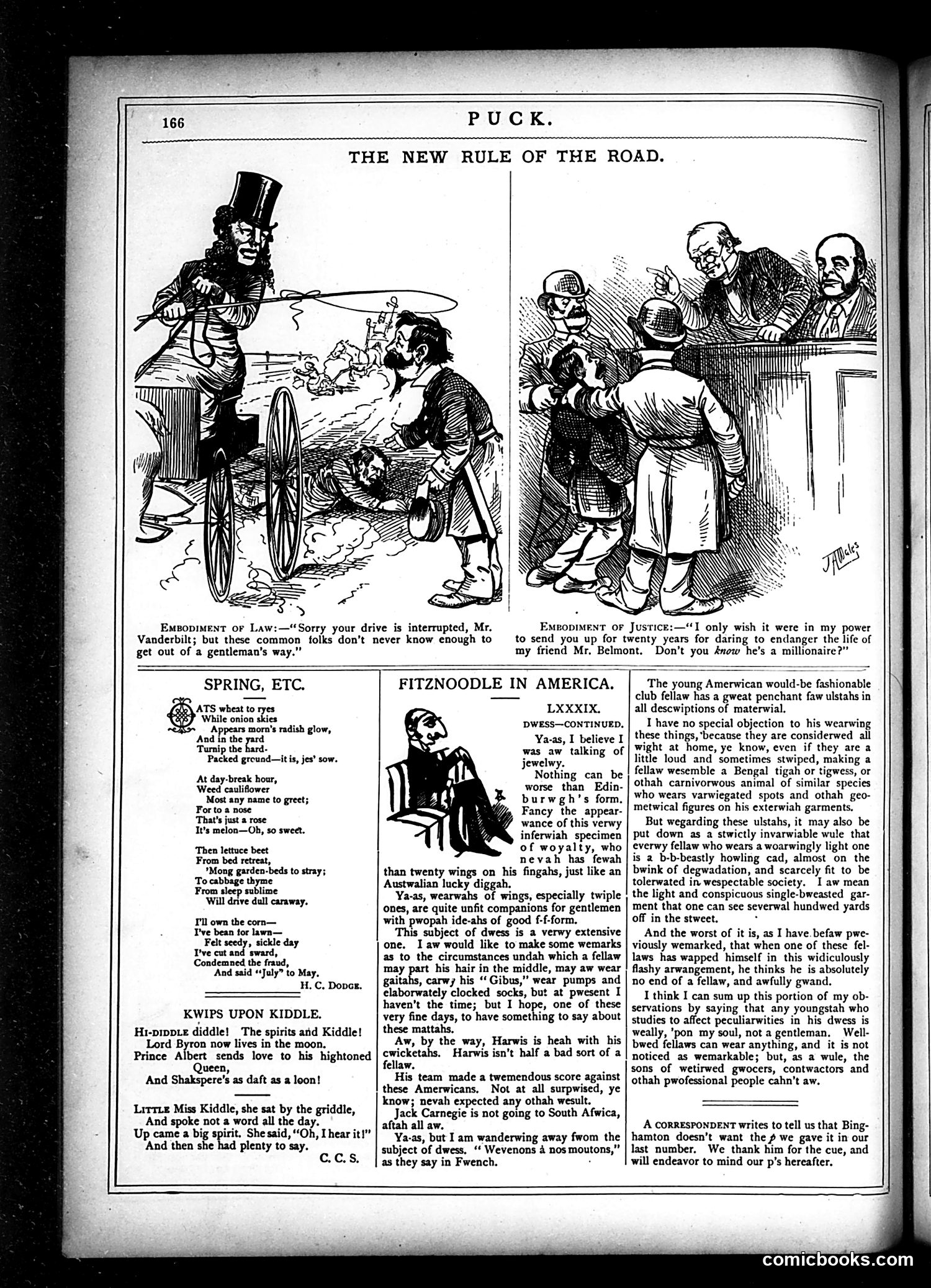
The top cartoon depicts two scenes satirizing street safety and social hierarchy. On the left, a wealthy man in a top hat whips a carriage driver with a riding crop, claiming "these common folks don't know enough to get out of a gentleman's way." On the right, he faces justice—judges reprimand him, noting they wish they could send him up for years of "daring to endanger the life of my friend Mr. Belmont." The satire mocks the aristocracy's sense of entitlement on roads, suggesting wealthy elites believe ordinary people should yield to them. The contrast between his arrogance and the court's rebuke represents Puck's critique of class privilege and the emerging legal consequences for dangerous driving as automobiles became common.
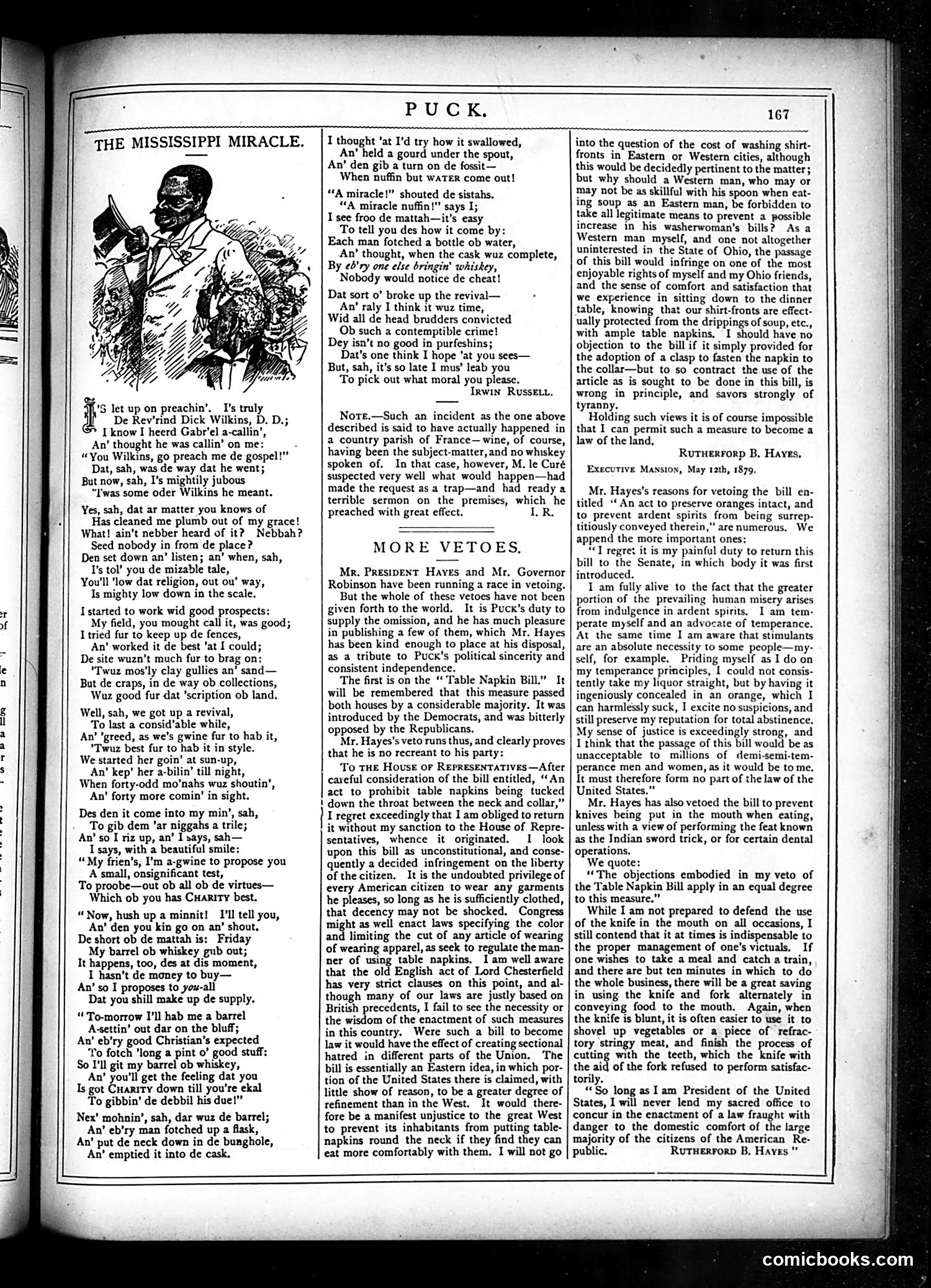
This poem satirizes what the text calls "an incident as the one above described" involving whiskey and miraculous revival in a French parish. The cartoon depicts a disheveled preacher or revival figure with an exaggerated facial expression. The satire mocks religious revival meetings and their theatrical nature. The poem's humor centers on the absurdity of using whiskey as a supposed miracle cure—contradicting temperance morality. References to "preachers" and "head-busters" suggest commentary on evangelical revival movements of the era. The accompanying "More Vetoes" section discusses President Hayes' vetoes of bills, including one regarding table napkins, likely political satire about executive overreach or trivial legislation. Overall, Puck attacks both religious hypocrisy and contemporary political debates.
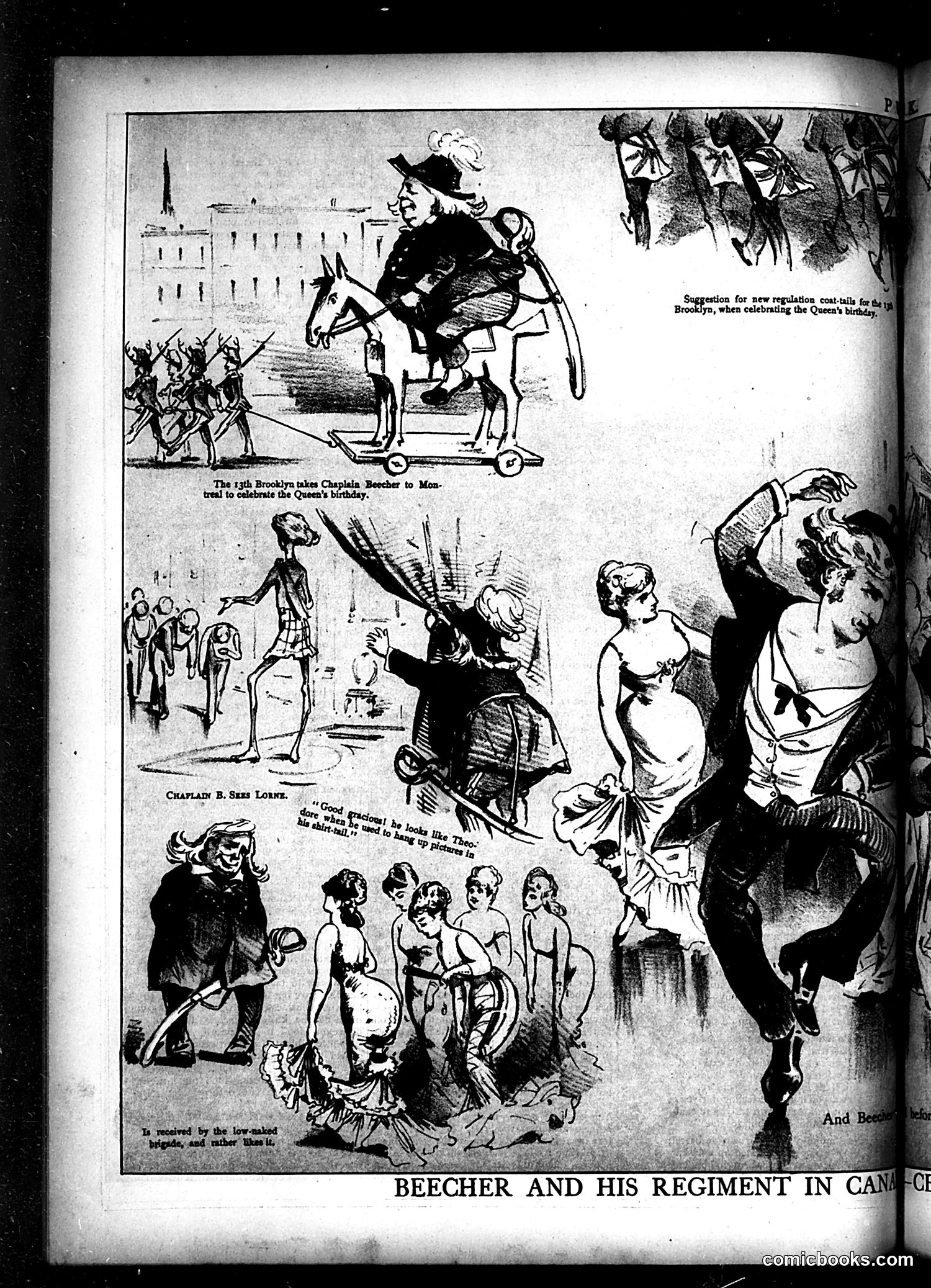
This page satirizes **Henry Ward Beecher**, the famous Brooklyn clergyman (identified in the caption "Chaplain B. Sees Looks"). The cartoons mock his leadership of a volunteer military regiment during what appears to be the Civil War era. The top cartoon shows Beecher riding absurdly on a donkey toward Montreal to celebrate the Queen's birthday—satirizing his awkward military command. Middle panels depict him as an incompetent chaplain struggling to maintain discipline among barely-clothed, unruly soldiers. The bottom panel shows chaos among his troops. The satire targets Beecher's military incompetence and the general disorder of volunteer units, contrasting his civilian preaching authority with his laughable inability to command soldiers.
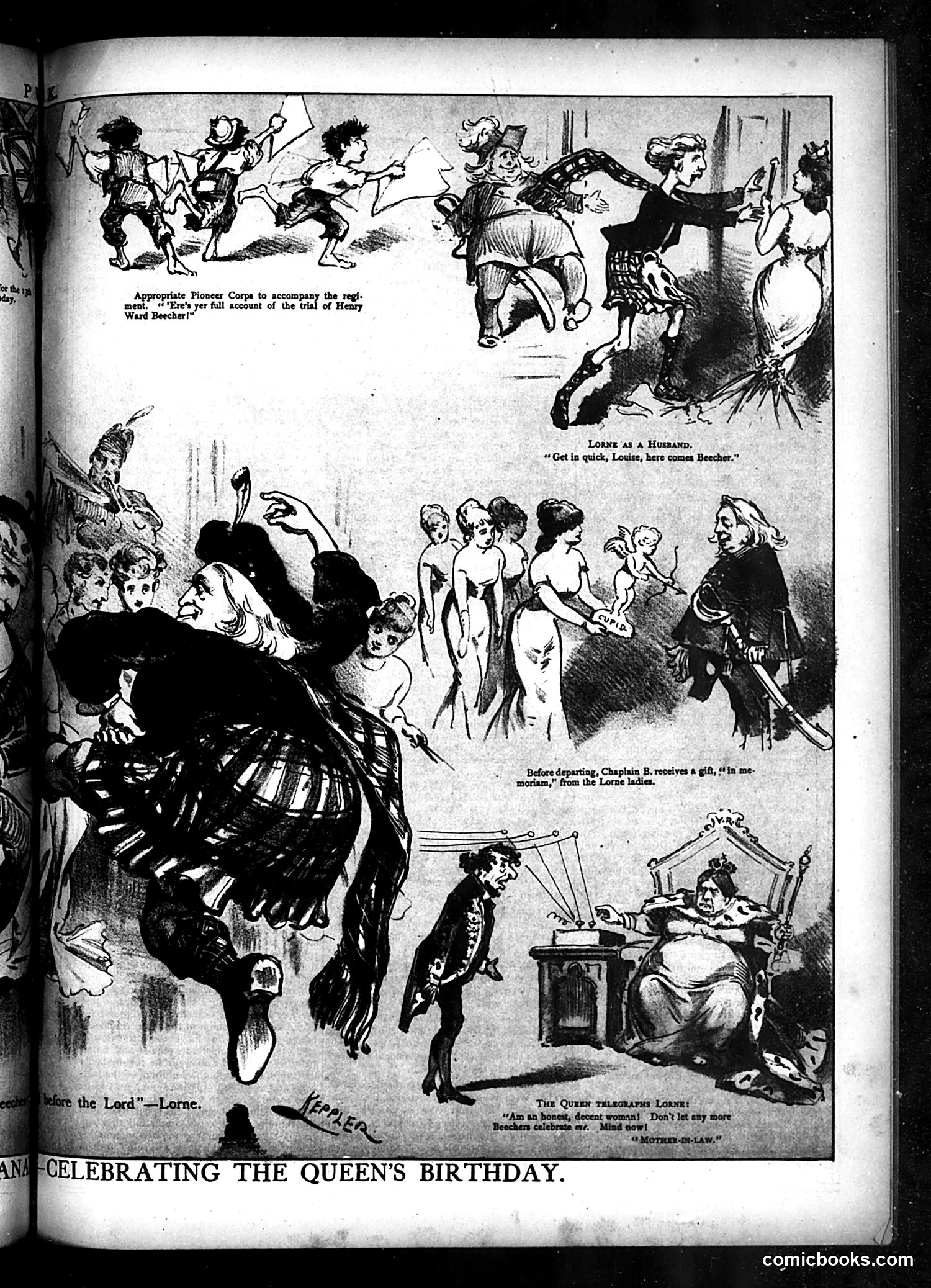
This page satirizes the trial of Henry Ward Beecher, a famous 19th-century Brooklyn clergyman accused of adultery. The cartoon mocks how various social figures—"Lorne as a Husband," "Lord," and others—respond to the scandal. The top panel shows a "Pioneer Corps" commentary on the trial proceedings. The middle section depicts the "Lord" receiving gifts from "Lords' ladies" before Beecher's arrival. The bottom shows "The Queen telegraphs Lorne" with bedroom humor about "honesty" and "decent women." The satire ridicules how high-society figures attempted to maintain respectability amid the salacious trial, using the Beecher scandal as commentary on hypocrisy among the elite during this period of public moral scrutiny.
This page from *Puck* magazine consists primarily of written content rather than political cartoons. The main articles discuss Mrs. Victoria's birthday celebration and the 13th Regiment of Brooklyn's Canadian expedition, alongside theater reviews and a advice column titled "Answers for the Curious." The text satirizes English attitudes toward national holidays and suggests British people should adopt similar observances to America's patriotic celebrations. There's also commentary on theatrical performances and social customs of the era. Without prominent illustrated political cartoons visible on this particular page, the satire operates through written commentary rather than visual caricature. The page exemplifies *Puck's* format of combining political/social criticism with entertainment coverage and reader correspondence.
This page from *Puck* magazine (page 171) contains the continuation of a serialized story titled **"Archie Gascoyne: A Romance of Skye,"** written by John Fraser expressly for the publication. This is **not a political cartoon** but rather literary fiction—a serialized romantic narrative. The page shows dialogue between characters including Gascoyne, the Professor, Doctor, and Bob, discussing a tutoring arrangement and various personal matters related to an estate or inheritance dispute. The text reveals a Victorian-era comedy of manners involving romantic entanglements, social climbing, and questions of propriety—typical serialized fiction content that *Puck* published alongside its satirical illustrations and political commentary.
This page contains primarily **text content** rather than political cartoons. The main feature is a travel narrative describing a scenic journey along what appears to be a Scottish waterway, with vivid descriptions of landscapes and a steamboat excursion. The right column contains **"Puck's Jottings,"** brief satirical commentary on contemporary topics including: - Richard Grant White and literary matters - References to the Nihilists and Russian politics - Theatrical reviews and social observations - Commentary on women's fashion and behavior - Criticism of various public figures and customs The satire employs **short, punchy remarks** rather than visual caricature, mocking contemporary society, politics, and culture through witty editorial commentary typical of Puck's style as a satirical publication.
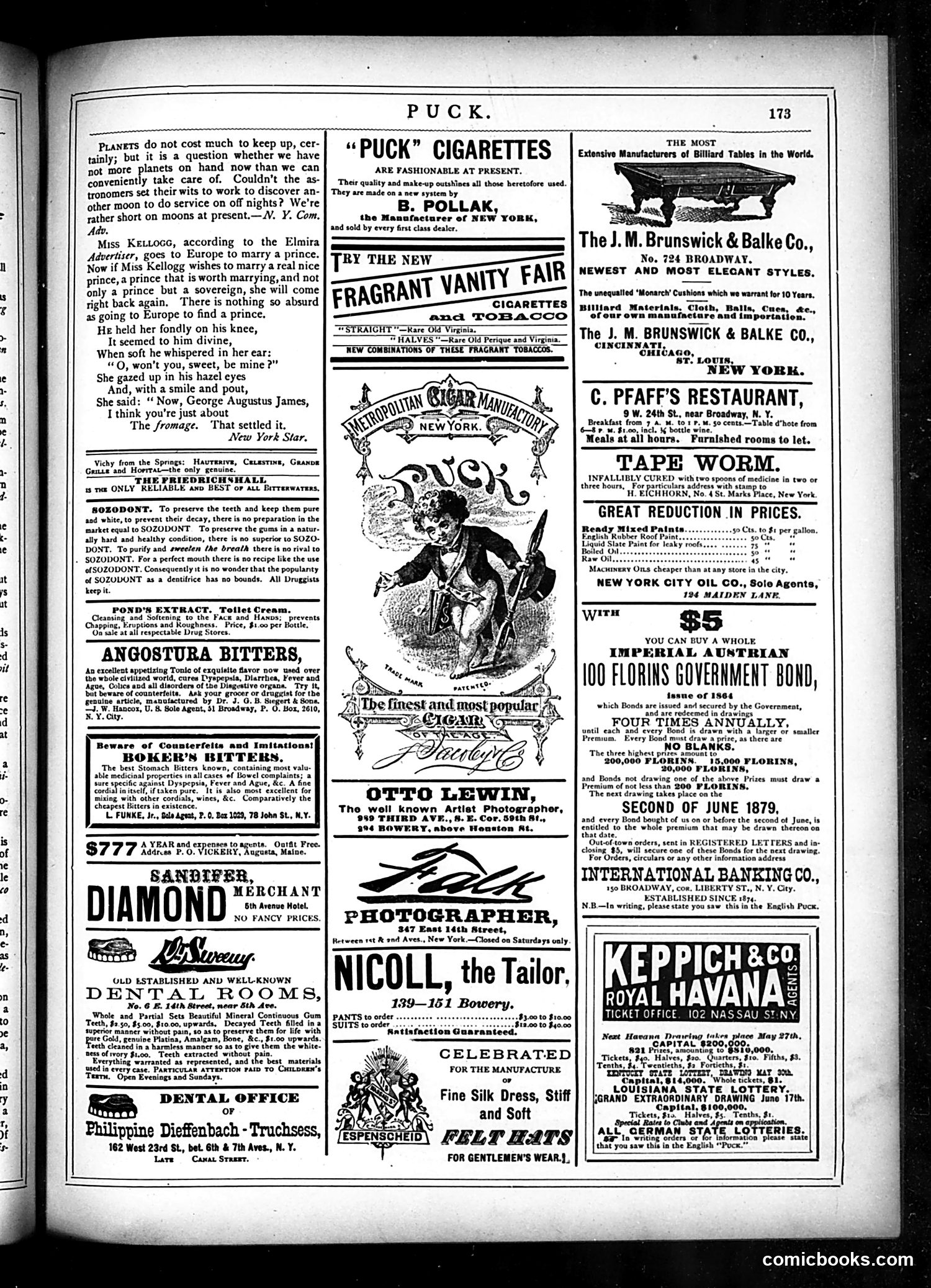
This page is primarily **advertisements and notices** rather than political satire. The page number (173) and header "PUCK" identify it as from the satirical magazine, but the content is commercial. Notable ads include: - **"Puck" Cigarettes** by B. Pollak (manufacturer of New York) - **Fragrant Vanity Fair** tobacco products - **Punch Cigar** (Metropolitan Cigar Manufactory, New York) - Various other commercial products (dental work, photography, tailoring, theater tickets) The only illustration with potential satirical content is the **Punch Cigar advertisement**, featuring a classical figure, but it appears to be purely decorative branding rather than political commentary. This reflects Puck's business model: the magazine subsidized its satirical content through extensive paid advertising.
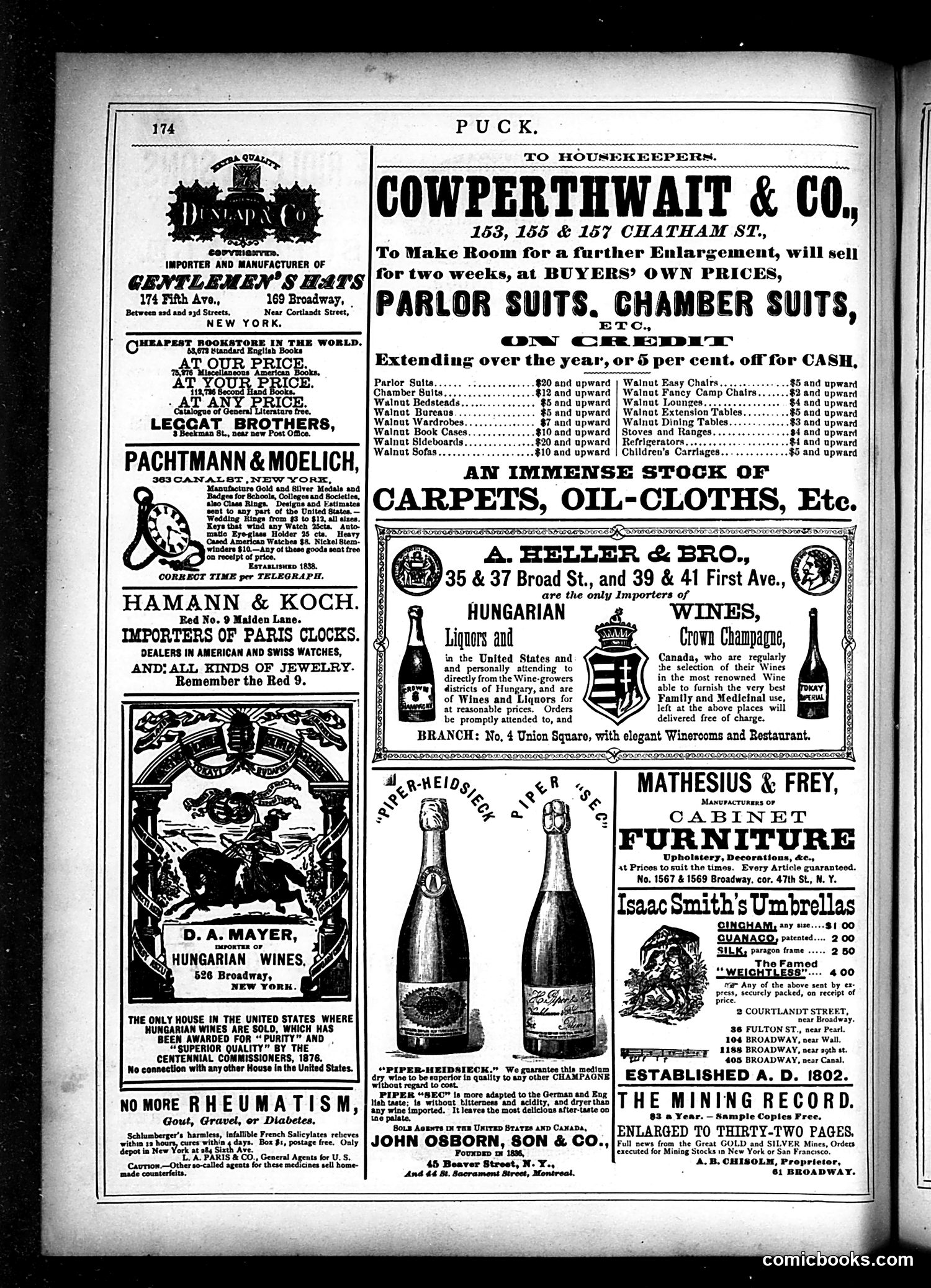
This appears to be primarily an **advertising page** from Puck magazine (page 174), not a satirical cartoon page. The page contains various commercial advertisements for late 19th-century products and services, including: - Gentlemen's hats (Dunlap & Co.) - Furniture and household goods (Cowperthwait & Co., Mathesius & Frey) - Watches and clocks (Hamann & Koch) - Hungarian wines (D.A. Mayer, Piper-Heidsieck) - Carpets and oil-cloths - Umbrellas (Isaac Smith's) - A patent medicine for rheumatism The page also advertises **The Mining Record**, a publication about mining stocks. While Puck was a satirical magazine, this particular page functions as a revenue-generating advertising section rather than containing political or social satire.
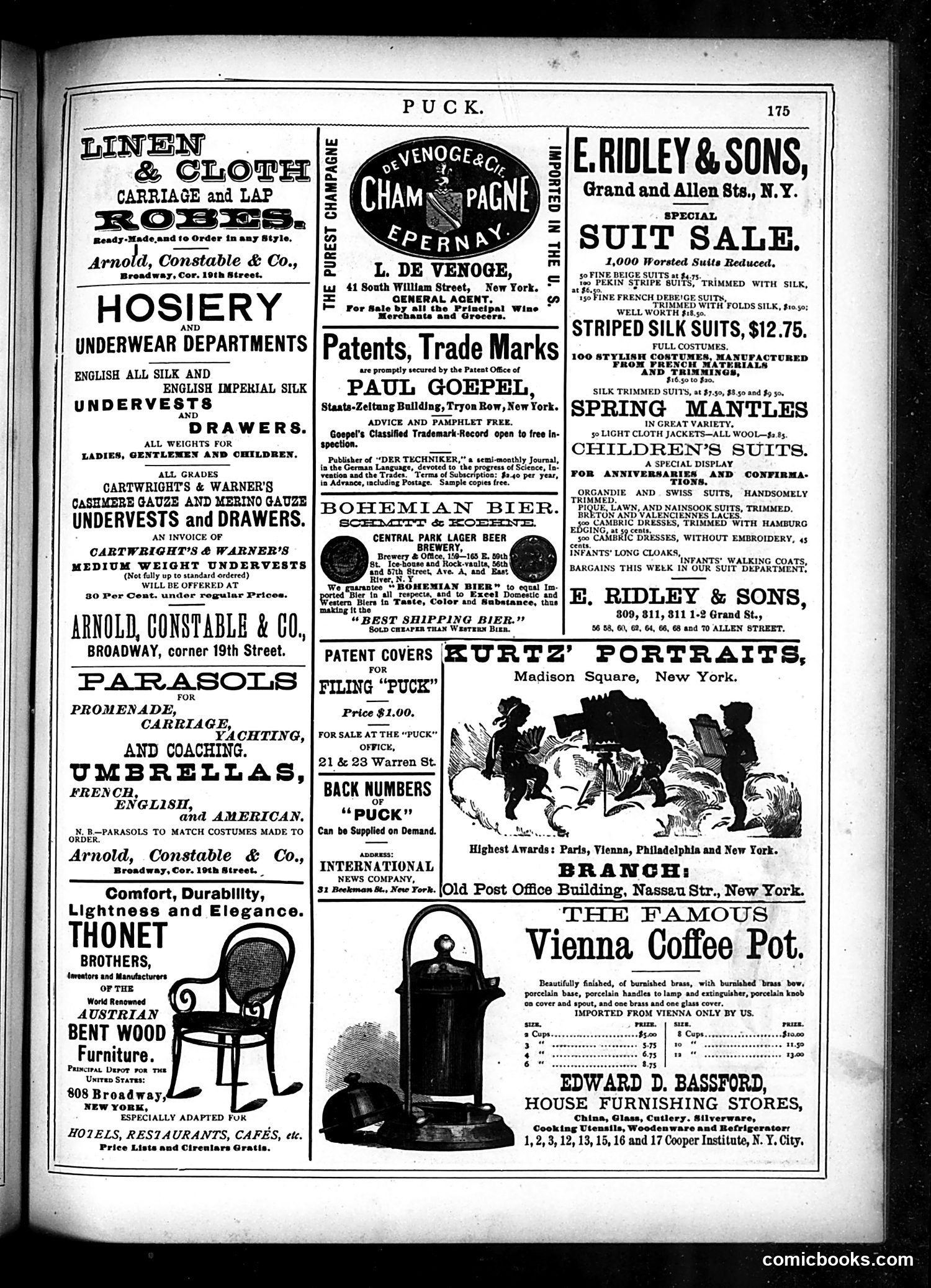
This is primarily a **commercial advertising page** from Puck magazine (page 175), not a political cartoon or satirical content page. The advertisements showcase late 19th/early 20th-century consumer goods: clothing (suits, hosiery, underwear), parasols, umbrellas, furniture (the "Austrian Bent Wood" chair by Thonet Brothers), beer, and housewares including the "Vienna Coffee Pot." The single illustration—"Kurtz' Portraits" at bottom center—depicts cherubic figures in a classical style, advertising portrait services at Madison Square, New York, with "Highest Awards: Paris, Vienna, Philadelphia and New York." Most text promotes New York businesses (Arnold Constable & Co., E. Ridley & Sons, Edward D. Bassford) and imported European goods, reflecting Puck's audience of affluent urban consumers.
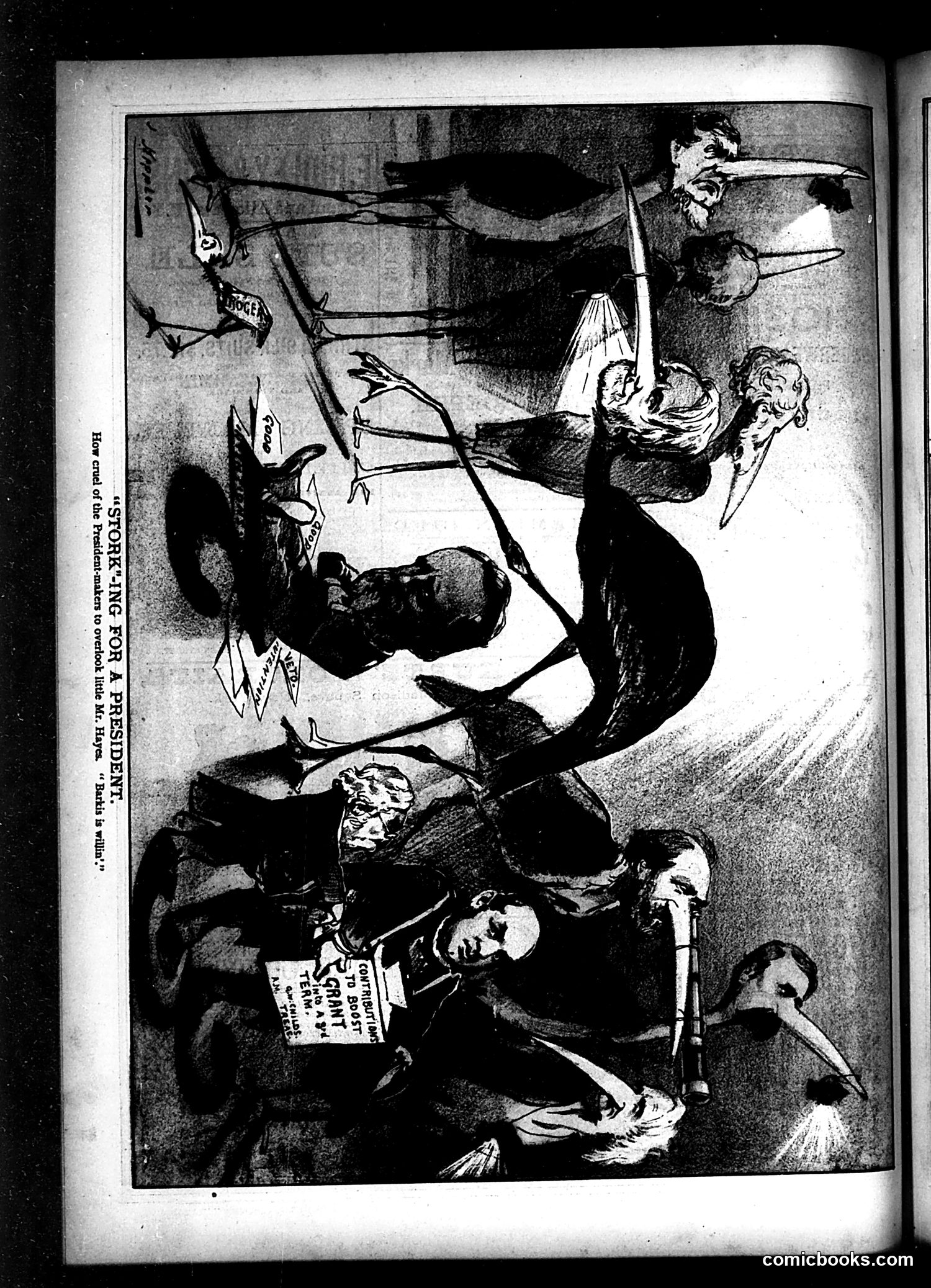
This Puck cartoon satirizes the 1884 presidential election. The image depicts figures as marionettes or puppets being manipulated by strings, with "stocking" (preparing/outfitting candidates) for the presidency as the central metaphor. The cartoon critiques how political parties and special interests control their candidates like puppets rather than allowing genuine democratic choice. The various caricatured figures represent different political factions or interest groups pulling the strings of would-be presidential candidates. The satirical point suggests that American presidential selection is theatrical manipulation rather than authentic democratic process—candidates are mere puppets dancing to the tune of party bosses and wealthy interests. This was a common Puck theme: exposing the artificiality of politics and the hidden powers controlling public figures.