
Puck, 1879-05-21 · page 4 of 16
Puck — May 21, 1879 — page 4: what you’re looking at
What you’re looking at
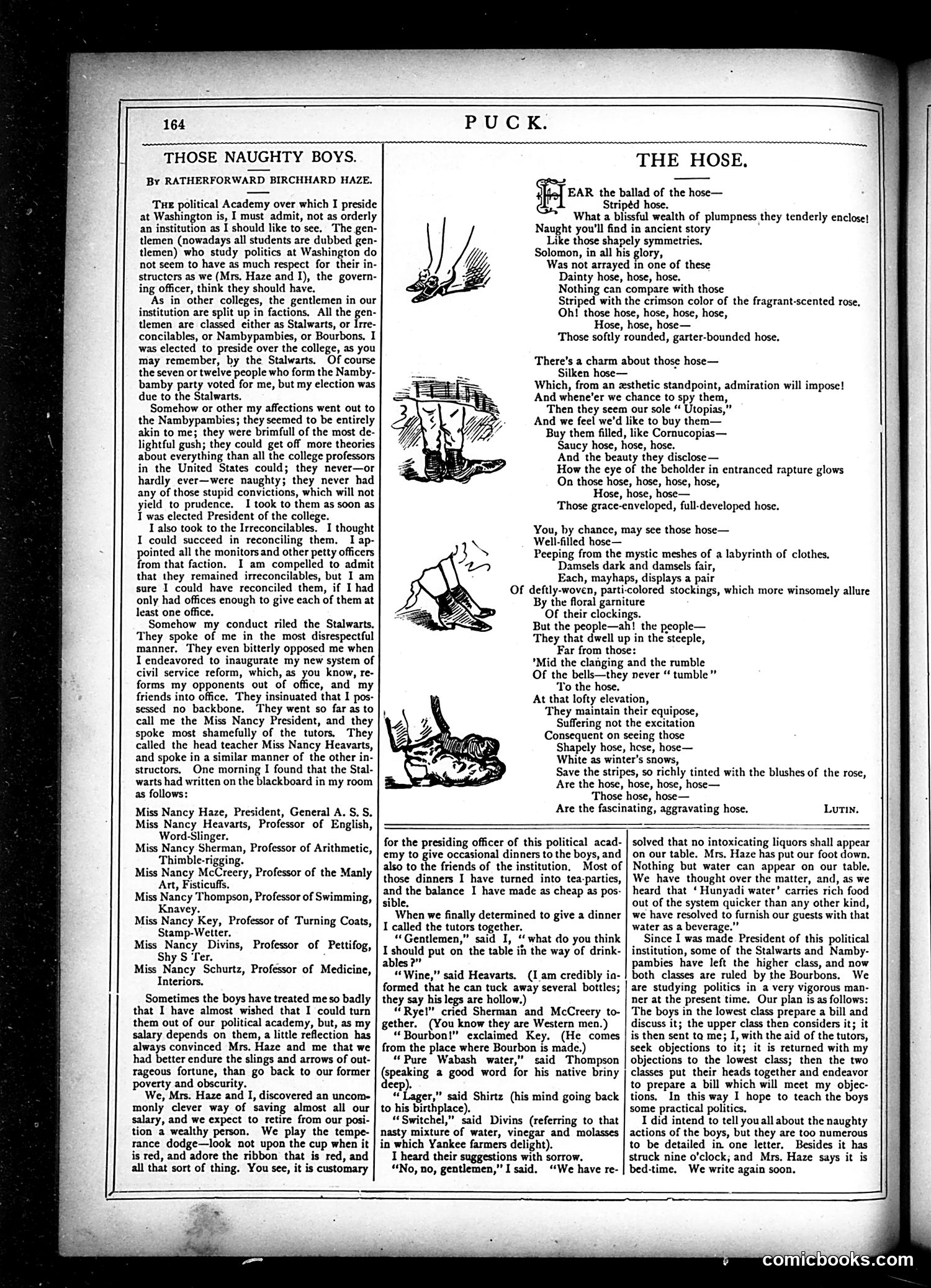
**"Those Naughty Boys"** by Ratherforward Birchhard Haze satirizes a political academy where the author presides. The piece complains that gentlemen students studying politics at Washington lack respect for governing institutions and engage in partisan factionalism—divided into "Stalwarts, irreconcilables, Nambypambies, or Bourbons." The author claims he attempted civil service reform but faced obstruction from these student factions, who even appealed to "Miss Nancy President" against him. The satire mocks both the students' political immaturity and the author's frustration managing them. **"The Hose"** is a lyrical poem celebrating striped stockings—their beauty, symmetry, and aesthetic appeal—with accompanying illustrations of legs/feet wearing various hosiery styles. This appears to be light, decorative verse rather than political commentary.
📄 Transcribed text from this page (OCR, searchable)
Machine-transcribed from the original scan — historical spelling and the odd misread are preserved.
THOSE NAUGHTY BOYS. By RATHERFORWARD BIRCHHARD HAZE. ‘Tue political Academy over which I preside at Washington is, I must admit, not as orderly an institution as I should like to see. The gen- tlemen (nowadays all students are dubbed gen- tlemen) who study politics at Washington do not seem to have as much respect for their in- structcrs as we (Mrs, Haze and I), the govern- ing officer, think they should have. As in other colleges, the gentlemen in our institution are split up in factions. All the gen- tlemen are classed either as Stalwarts, or Irre- concilables, or Nambypambies, or Bourbons. I was elected to preside over the college, as you may remember, by the Stalwarts. Of course the seven or twelve people who form the Namby- bamby party voted for me, but my election was due to the Stalwarts. Somehow or other my affections went out to the Nambypambies; they seemed to be entirely akin to me; they were brimfull of the most de- lightful gush; they could get off more theories about everything than all the college professors in the United States could; they never—or hardly ever—were naughty; they never had any of those stupid convictions, which will not yield to prudence. I took to them as soon as I was elected President of the college. I also took to the Irreconcilables. I thought I could succeed in reconciling them. I ap- pointed all the monitors and other petty officers from that faction. I am compelled to admit that they remained irreconcilables, but I am sure I could have reconciled them, if I had only had offices enough to give each of them at least one office, Somehow my conduct riled the Stalwarts. They spoke of me in the most disrespectful manner. They even bitterly opposed me when I endeavored to inaugurate my new system of civil service reform, which, as you know, re- forms my opponents out of office, and my friends into office. They insinuated that 1 pos- sessed no backbone, They went so far as to call me the Miss Nancy President, and they spoke most shamefully of the tutors, They called the head teacher Miss Nancy Heavarts, and spoke in a similar manner of the other in- structors, One morning I found that the Stal- warts had written on the blackboard in my room as follows: Miss Nancy Haze, President, General A. S. S. Miss Nancy Heavarts, Professor of English, Word-Slinger. Miss Nancy Sherman, Professor of Arithmetic, Thimble-rigging. Miss Nancy McCreery, Professor of the Manly Art, Fisticuffs. Miss Nancy Thompson, Professor of Swimming, Knavey. Miss Nancy Key, Professor of Turning Coats, Stamp-Wetter. Miss Nancy Divins, Professor of Pettifog, Shy S Ter. Miss Nancy Schurtz, Professor of Medicine, Interiors. Sometimes the boys have treated meso badly that I have almost wished that I could turn them out of our political academy, but, as my salary depends on them, a little reflection has always convinced Mrs. Haze and me that we had better endure the slings and arrows of out- rageous fortune, than go back to our former poverty and obscurity. We, Mrs. Haze and I, discovered an uncom- monly clever way of saving almost all our salary, and we expect to retire from our posi- tion a wealthy person. We play the tempe- rance dodge—look not upon the cup when it is red, and adore the ribbon that is red, and all that sort of thing. You see, it is customary THE HOSE. EAR the ballad of the hose— Striped hose. What a blissful wealth of plumpness they tenderly enclose! Naught you'll find in ancient story Like those shapely symmetries, Solomon, in all his glory, Was not arrayed in one of these Dainty hose, hose, hose. Nothing can compare with those Striped with the crimson color of the fragrant-scented rose, Oh! those hose, hose, hose, hose, Hose, hose, hose— ‘Those softly rounded, garter-bounded hose. There's a charm about those hose— Silken hose— Which, from an zsthetic standpoint, admiration will impose! And whene’er we chance to spy them, Then they seem our sole “ Utopias,” And we feel we'd like to buy them— Buy them filled, like Cornucopias— Saucy hose, hose, hose. And the beauty they disclose— How the eye of the beholder in entranced rapture glows On those hose, hose, hose, hose, Hose, hose, hose— Those grace-enveloped, full-developed hose. You, by chance, may sce those hose— Well-filled hose— Peeping from the mystic meshes of a labyrinth of clothes. Damsels dark and damsels fair, Each, mayhaps, displays a pair Of deftly-woven, parti-colored stockings, which more winsomely allure By the floral garniture Of their clockings. But the people—ah! the people— They that dwell up in the steeple, Far from those: 'Mid the clanging and the rumble Of the bells—they never “ tumble” To the hose, At that lofty elevation, ‘They maintain their equipose, Suffering not the excitation Consequent on seeing those Shapely hose, hese, hose— White as winter’s snows, Save the stripes, so richly tinted with the blushes of the rose, Are the hose, hose, hose, hose— Those hose, hose— Are the fascinating, aggravating hose, Lutin. for the presiding officer of this political acad- emy to give occasional dinners to the boys, and also to the friends of the institution, Most of those dinners I have turned into tea-parties, and the balance I have made as cheap as pos: sible. When we finally determined to give a dinner I called the tutors together. “Gentlemen,” said I, what do you think I should put on the table ih the way of drink- ables?” “Wine,” said Heavarts. (Iam credibly ia- formed that he can tuck away several bottles; they say his legs are hollow.) “Ryel” cried Sherman and McCreery to- gether. (You know they are Western men.) “Bourbon!” exclaimed Key. (He comes from the place where Bourbon is made.) “Pure Wabash water,” said Thompson (peaking a good word for his native briny ep). aves ae it," said Shirtz (his mind going back to his birthplace). “‘Switchel,” said Divins (referring to that nasty mixture of water, vinegar and molasses in which Yankee farmers delight). I heard their suggestions with sorrow. “No, no, gentlemen,” I said. ‘We have re- solved that no intoxicating liquors shall appear on our table. Mrs, Haze has put our foot down. Nothing but water can appear on our table, We have thought over the matter, and, as we heard that ‘ Hunyadi water’ carries rich food out of the system quicker than any other kind, we have resolved to furnish our guests with that water as a beverage.” Since I was made President of this political institution, some of the Stalwarts and Namby- pambies have left the higher class, and now both classes are ruled by the Bourbons. We are studying politics in a very vigorous man- ner at the present time. Our plan is as follows: The boys in the lowest class prepare a bill and discuss it; the upper class then considers it; it is then sent ta me; I, with the aid of the tutors, seek objections to it; it is returned with my objections to the lowest class; then the two classes put their heads together and endeavor to prepare a bill which will meet my objec- tions. In this way I hope to teach the boys some practical politics. 1 did intend to tell youall about the naughty actions of the boys, but they are too numerous to be detailed in one letter. Besides it has struck nine o'clock; and Mrs. Haze says it is bed-time. We write again soon,