
Puck, 1879-05-21 · page 7 of 16
Puck — May 21, 1879 — page 7: what you’re looking at
What you’re looking at
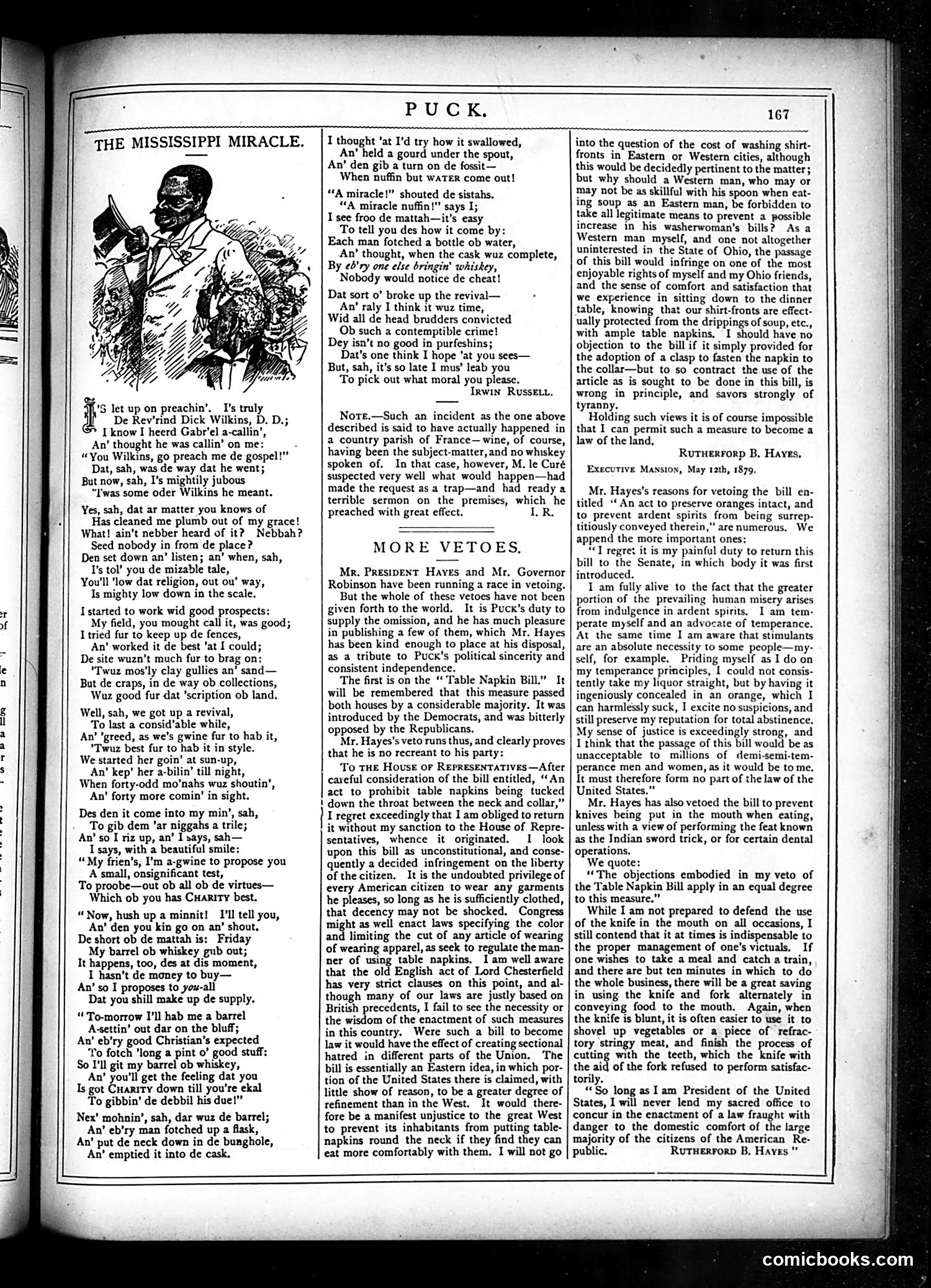
This poem satirizes what the text calls "an incident as the one above described" involving whiskey and miraculous revival in a French parish. The cartoon depicts a disheveled preacher or revival figure with an exaggerated facial expression. The satire mocks religious revival meetings and their theatrical nature. The poem's humor centers on the absurdity of using whiskey as a supposed miracle cure—contradicting temperance morality. References to "preachers" and "head-busters" suggest commentary on evangelical revival movements of the era. The accompanying "More Vetoes" section discusses President Hayes' vetoes of bills, including one regarding table napkins, likely political satire about executive overreach or trivial legislation. Overall, Puck attacks both religious hypocrisy and contemporary political debates.
📄 Transcribed text from this page (OCR, searchable)
Machine-transcribed from the original scan — historical spelling and the odd misread are preserved.
PUCK, 167 *$ let up on preachin’. I's truly De Rev’rind Dick Wilkins, D. D.; I know I heerd Gabr’el a-callin’, An’ thought he was callin’ on me: “You Wilkins, go preach me de gospel!” Dat, sah, was de way dat he went; But now, sah, I’s mightily jubous “Iwas some oder Wilkins he meant. Yes, sah, dat ar matter you knows of Has cleaned me plumb out of my grace! What! ain’t nebber heard of it? Nebbah? Seed nobody in from de place? Den set down an’ listen; an’ when, sah, l’s tol’ you de mizable tale, You'll ‘low dat religion, out ou’ way, Is mighty low down in the scale. Istarted to work wid good prospects: My field, you mought call it, was good; I tried fur to keep up de fences, An’ worked it de best ‘at [ could; De site wuzn’t much fur to brag on: *Twuz mos'ly clay gullies an’ sand— But de craps, in de way ob collections, Wuz good fur dat ‘scription ob land. Well, sah, we got up a revival, To last a consid’able while, An’ 'greed, as we’s gwine fur to hab it, 'Twuz best fur to hab it in style. We started her goin’ at sun-up, An’ kep’ her a-bilin’ till night, When forty-odd mo’nahs wuz shoutin’, An’ forty more comin’ in sight. Des den it come into my min’, sah, To gib dem 'ar niggahs a trile; An’ so I riz up, an’ I says, sah— I says, with a beautiful smile: “My frien’s, I'm a-gwine to propose you A small, onsignificant test, To proobe—out ob all ob de virtues— Which ob you has Cuarity best. “Now, hush up a minnit! I'll tell you, An’ den you kin go on an’ shout, De short ob de mattah is: Friday My barrel ob whiskey gub out; It happens, too, des at dis moment, I hasn’t de money to buy— An’ so I proposes to you-all Dat you shill make up de supply. “To-morrow I'll hab me a barrel A-settin’ out dar on the bluff; An’ eb’ry good Christian's expected ‘To fotch ‘long a pint o’ good stuff: So I'll git my barrel ob whiskey, An’ you'll get the feeling dat you Is got Cuarity down till you're ekal To gibbin’ de debbil his due!” Nex’ mohnin’, sah, dar wuz de barrel; An’ eb’ry man fotched up a flask, An’ put de neck down in de bunghole, An’ emptied it into de cask. I thought ‘at I’d try how it swallowed, An’ held a gourd under the spout, An’ den gib a turn on de fossit— When nuffin but wATER come out! “A miracle!” shouted de sistahs. “A miracle nuffin!” says I; I see froo de mattah—it’s easy To tell you des how it come by: Each man fotched a bottle ob water, An’ thought, when the cask wuz complete, By eb'ry one else bringin’ whiskey, Nobody would notice de cheat! Dat sort o’ broke up the revival— An’ raly I think it wuz time, Wid all de head brudders convicted Ob such a contemptible crime! Dey isn’t no good in purfeshins; Dats one think I hope ‘at you sees— But, sah, it’s so late I mus’ leab you To pick out what moral you please. Irwin Russet. Nore.—Such an incident as the one above described is said to have actually happened in a country parish of France—wine, of course, having been the subject-matter, and no whiskey spoken of. In that case, however, M, le Curé suspected very well what would happen—had made the request as a trap—and had ready a terrible sermon on the premises, which he preached with great effect. LR. MORE VETOES. Mr. Presipent Hayes and Mr. Governor Robinson have been running a race in vetoing. But the whole of these vetoes have not been given forth to the world, It is Puck’s duty to supply the omission, and he has much pleasure in publishing a few of them, which Mr. Hayes has been kind enough to place at his disposal, as a tribute to Puck's political sincerity and consistent independence. The first is on the “‘ Table Napkin Bill.” It will be remembered that this measure passed both houses by a considerable majority. It was introduced by the Democrats, and was bitterly opposed by the Republicans. Mr. Hayes’s veto runs thus, and clearly proves that he is no recreant to his party: To THE House or REpReseNTaTives—After careful consideration of the bill entitled, “An act to prohibit table napkins being tucked 1‘ down the throat between the neck and collar,” I regret exceedingly that I am obliged to return it without my sanction to the House of Repre- sentatives, whence it originated. I look upon this bill as unconstitutional, and conse- quently a decided infringement on the liberty of thecitizen. It is the undoubted privilege of every American citizen to wear any garments he pleases, so long as he is sufficiently clothed, that decency may not be shocked. Congress might as well enact laws specifying the color and limiting the cut of any article of wearing of wearing apparel, as seek to regulate the man- ner of using table napkins. I am well aware that the old English act of Lord Chesterfield has very strict clauses on this point, and al- though many of our laws are justly based on British precedents, I fail to see the necessity or the wisdom of the enactment of such measures in this country, Were such a bill to become law it would have the effect of creating sectional hatred in different parts of the Union. The bill is essentially an Eastern idea, in which por- tion of the United States there is claimed, with little show of reason, to be a greater degree of refinement than in the West. It would there- fore be a manifest unjustice to the great West to prevent its inhabitants from putting table- napkins round the neck if they find they can eat more comfortably with them. I will not go into the question of the cost of washing shirt- fronts in Eastern or Western cities, although this would be decidedly pertinent to the matter; but why should a Western man, who may or may not be as skillful with his spoon when eat- ing soup as an Eastern man, be forbidden to take all legitimate means to prevent a possible increase in his washerwoman’s bills? As a Western man myself, and one not altogether uninterested in the State of Ohio, the passage of this bill would infringe on one of the most enjoyable rights of myself and my Ohio friends, and the sense of comfort and satisfaction that we experience in sitting down to the dinner table, knowing that our shirt-fronts are effect- ually protected from the drippings of soup, etc., with ample table napkins, I should have no objection to the bill if it simply provided for the adoption of a clasp to fasten the napkin to the collar—but to so contract the use of the article as is sought to be done in this bill, is wrong in principle, and savors strongly of tyranny. Holding such views it is of course impossible that I can permit such a measure to become a law of the land, Rutuerrorp B, Haves. EXecuTive MANston, May 12th, 1879. Mr. Hayes’s reasons for vetoing the bill en- titled ‘An act to preserve oranges intact, and to prevent ardent spirits from being surrep- titiously conveyed therein,” are numerous. We append the more important ones: “7 regret it is my painful duty to return this bill to the Senate, in which body it was first introduced. I am fully alive to the fact that the greater portion of the prevailing human misery arises from indulgence in ardent spirits, I am tem- perate myself and an advocate of temperance. At the same time I am aware that stimulants are an absolute necessity to some people—my- self, for example, Priding myself as I do on my temperance principles, | could not consis- tently take my liquor straight, but by having it ingeniously concealed in an orange, which I can harmlessly suck, I excite no suspicions, and still preserve my reputation for total abstinence, My sense of justice is exceedingly strong, and I think that the passage of this bill would be as unacceptable to millions of demi-semi-tem- perance men and women, as it would be to me. It must therefore form no part of the law of the United States.” Mr. Hayes has also vetoed the bill to prevent knives being put in the mouth when eating, unless with a view of performing the feat known as the Indian sword trick, or for certain dental operations. We quote: “The objections embodied in my veto of the Table Napkin Bill apply in an equal degree to this measure,” While I am not prepared to defend the use of the knife in the mouth on all occasions, I still contend that it at times is indispensable to the proper management of one’s victuals. If one wishes to take a meal and catch a train, and there are but ten minutes in which to do the whole business, there will be a great saving in using the knife and fork alternately in conveying food to the mouth. Again, when the knife is blunt, it is often easier to use it to shovel up vegetables or a piece of refrac- tory ‘stringy meat, and finish the process of cutting with the teeth, which the knife with the aid of the fork refused to perform satisfac- torily. “So long as I am President of the United States, I will never lend my sacred office to concur in the enactment of a law fraught with danger to the domestic comfort of the large majority of the citizens of the American Re- public. RuTHerrorp B. Hayes" = comicbooks.com