
Puck, 1879-05-21 · page 12 of 16
Puck — May 21, 1879 — page 12: what you’re looking at
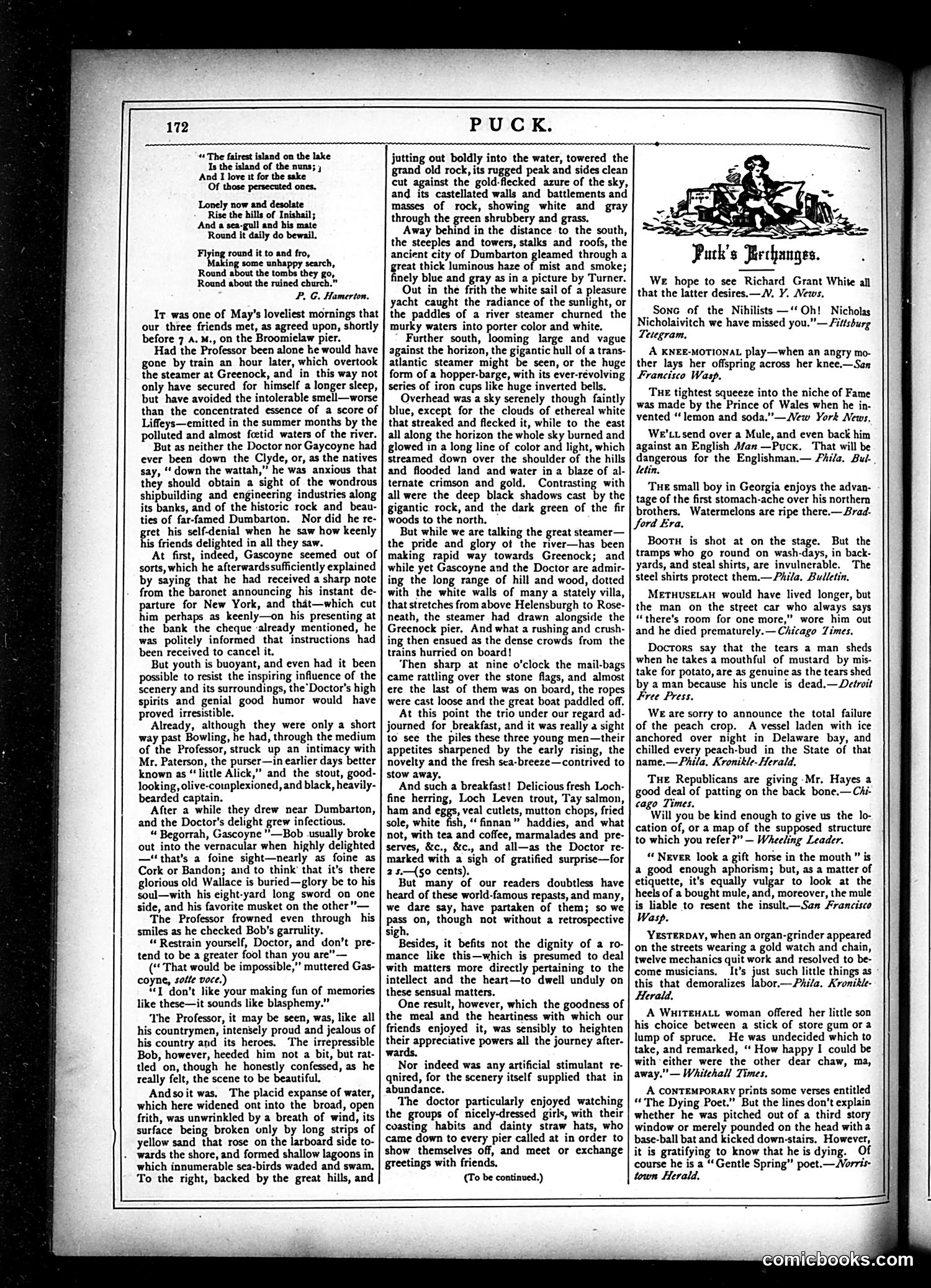
What you’re looking at
This page contains primarily **text content** rather than political cartoons. The main feature is a travel narrative describing a scenic journey along what appears to be a Scottish waterway, with vivid descriptions of landscapes and a steamboat excursion. The right column contains **"Puck's Jottings,"** brief satirical commentary on contemporary topics including: - Richard Grant White and literary matters - References to the Nihilists and Russian politics - Theatrical reviews and social observations - Commentary on women's fashion and behavior - Criticism of various public figures and customs The satire employs **short, punchy remarks** rather than visual caricature, mocking contemporary society, politics, and culture through witty editorial commentary typical of Puck's style as a satirical publication.
📄 Transcribed text from this page (OCR, searchable)
Machine-transcribed from the original scan — historical spelling and the odd misread are preserved.
PUCK. «The fairest island on the lake Is the island of the nuns; , And I love it for the sake Of those persecuted ones. Lonely now and desolate Rise the hills of Inishail; ‘And a sea-gull and his mate Round it daily do bewail. Flying round it to and fro, laking some unhappy search, Round about the tombs they go, Round about the ruined church.” P. G. Hamerton, Ir was one of May's loveliest mornings that our three friends met, as agreed upon, shortly before 7 A. M., on the Broomielaw pier. Had the Professor been alone he would have gone by train an hour later, which overtook the steamer at Greenock, and in this way not only have secured for himself a longer sleep, but have avoided the intolerable smell—worse than the concentrated essence of a score of Liffeys—emitted in the summer months by the polluted and almost foetid waters of the river. But as neither the Doctor nor Gaycoyne had ever been down the Clyde, or, as the natives say, “ down the wattah,” he was anxious that they should obtain a sight of the wondrous shipbuilding and engineering industries along its banks, and of the historic rock and beau- ties of far-famed Dumbarton. Nor did he re- ret his self-denial when he saw how keenly EES friends delighted in all they saw. At first, indeed, Gascoyne seemed out of sorts, which he afterwardssufficiently explained by saying that he had received a sharp note from the baronet announcing his instant de- parture for New York, and that—which cut him perhaps as keenly—on his presenting at the bank the cheque ‘already mentioned, he was politely informed that instructions had been received to cancel it. But youth is buoyant, and even had it been possible to resist the inspiring influence of the scenery and its surroundings, the’ Doctor's high spirits and genial good humor would have proved irresistible. Already, although they were only a short way past Bowling, he had, through the medium of the Professor, struck up an intimacy with Mr. Paterson, the purser—in earlier days better known as “little Alick,” and the stout, good- looking, olive-complexioned, and black, heavily- bearded captain, After a while they drew near Dumbarton, and the Doctor's delight grew infectious. « Begorrah, Gascoyne "—Bob usually broke out into the vernacular when highly delighted —‘‘that’s a foine sight—nearly as foine as Cork or Bandon; and to think’ that it’s there glorious old Wallace is buried—glory be to his soul—with his eight-yard long sword on one side, and his favorite musket on the other"— The Professor frowned even through his smiles as he checked Bob's garrulity. “ Restrain yourself, Doctor, and don’t pre- tend to be a greater fool than you are”— (“That would be impossible,” muttered Gas- coyne, softe voce.) “J don’t like your making fun of memories like these—it sounds like blasphemy.” ‘The Professor, it may be seen, was, like all his countrymen, intensely proud and jealous of his country and its heroes. The irrepressible Bob, however, heeded him not a bit, but rat- tled on, though he honestly confessed, as he really felt, the scene to be beautiful. Andsoit was. The placid expanse of water, which here widened ont into the broad, open frith, was unwrinkled by a breath of wind, its surface being broken only by long strips of yellow sand that rose on the larboard side to- wards the shore, and formed shallow lagoons in which innumerable sea-birds waded and swam. To the right, backed by the great hills, and jutting out boldly into the water, towered the grand old rock, its rugged peak and sides clean cut against the gold-fiecked azure of the sky, and its castellated walls and battlements and masses of rock, showing white and gray through the mn shrubbery and grass. Away behind in the distance to the south, the steeples and towers, stalks and roofs, the ancient city of Dumbarton gleamed through a reat thick luminous haze of mist and smoke; inely blue and gray as in a picture by Turner. Out in the frith the white sail of a pleasure yacht caught the radiance of the sunlight, or the paddles of a river steamer churned the murky waters into porter color and white. Further south, looming large and vague against the horizon, the gigantic hull of a trans- atlantic steamer might be seen, or the huge form of a hopper-barge, with its ever-révolving series of iron cups like huge inverted bells, Overhead was a sky serenely though faintly blue, except for the clouds of ethereal white that streaked and flecked it, while to the east all along the horizon the whole sky burned and glowed in a long line of color and light, which streamed down over the shoulder of the hills and flooded land and water in a blaze of al- ternate crimson and gold. Contrasting with all were the deep black shadows cast by the gigantic rock, and the dark green of the fir woods to the north, But while we are talking the great steamer— the pride and glory of the river—has been making rapid way towards Greenock; and while yet Gascoyne and the Doctor are admir- ing the long range of hill and wood, dotted with the white walls of many a stately villa, that stretches from above Helensburgh to Rose- neath, the steamer had drawn alongside the Greenock pier. And what a rushing and crush- ing then ensued as the dense crowds from the trains hurried on board! ‘Then sharp at nine o'clock the mail-bags came rattling over the stone flags, and almost ere the last of them was on board, the ropes were cast loose and the great boat paddled off. At this point the trio under our regard ad- journed for breakfast, and it was really a sight to see the piles these three young men—their appetites sharpened by the early rising, the novelty and the fresh sea-breeze—contrived to stow away. And such a breakfast! Delicious fresh Loch- fine herring, Loch Leven trout, Tay salmon, ham and eggs, veal cutlets, mutton chops, fried sole, white fish, ‘‘finnan” haddies, and what not, with tea and coffee, marmalades and pre- serves, &c., &c., and all—as the Doctor re- marked with a sigh of gratified surprise—for 2 s.—(50 cents). But many of our readers doubtless have heard of these world-famous repasts, and many, we dare say, have partaken of them; so we Pass on, though not without a retrospective sigh. Besides, it befits not the dignity of a ro- mance like this—which is presumed to deal with matters more directly pertaining to the intellect and the heart—to dwell unduly on these sensual matters. One result, however, which the goodness of the meal and the heartiness with which our friends enjoyed it, was sensibly to heighten their appreciative powers all the journey after- wards, Nor indeed was any artificial stimulant re- qnired, for the scenery itself supplied that in abundance. The doctor particularly enjoyed watching the groups of nicely-dressed girls, with their coasting habits and dainty straw hats, who came down to every pier called at in order to show themselves off, and meet or exchange greetings with friends, (To be continued.) BS changes. We hope to see Richard Grant White all that the latter desires.—V. Y. Mews, Sonc of the Nihilists —“Oh! Nicholas Nicholaivitch we have missed you.""—Fittsburg Tetegram, A KNEE-MOTIONAL play—when an angry mo- ther lays her offspring across her knee.—San Francisco Wasp. Tue tightest squeeze into the niche of Fame was made by the Prince of Wales when he in- vented “‘lemon and soda.”"—New York News. We'tisend over a Mule, and even back him against an English Afan —Puck. That will be dangerous for the Englishman.— Phila, Bul- kein, ‘Tue small boy in Georgia enjoys the advan- tage of the first stomach-ache over his northern brothers. Watermelons are ripe there.— Brad- ford Era. Bootu is shot at on the stage. But the tramps who go round on wash-days, in back- yards, and steal shirts, are invulnerable. The steel shirts protect them.—Phila, Bulletin, METHUSELAH would have lived longer, but the man on the street car who always says “there's room for one more,” wore him out and he died prematurely.— Chicago Times. Docrors say that the tears a man sheds when he takes a mouthful of mustard by mis- take for potato, are as genuine as the tears shed by a man because his uncle is dead.—Detroit Pree Press. We are sorry to announce the total failure of the peach crop. A vessel laden with ice anchored over night in Delaware bay, and chilled every peach-bud in the State of that name.—Phila, Kronikle- Herald. Tue Republicans are giving Mr. Hayes a good deal of patting on the back bone.—Chi- cago Times. Will you be kind enough to give us the lo- cation of, or a map of the supposed structure to which you refer?” — Wheeling Leader. “ Never look a gift horse in the mouth ” is a good enough aphorism; but, as a matter of etiquette, it’s equally vulgar to look at the heels of a bought mule, and, moreover, the mule is liable to resent the insult,—San Francisco Wasp. Yestervay, when an organ-grinder appeared on the streets wearing a gold watch and chain, twelve mechanics quit work and resolved to be- come musicians, It’s just such little things as this that demoralizes labor.— Phila, Kronikle- Herald. A WHITEHALL woman offered her little son his choice between a stick of store gum ora lump of spruce. He was undecided which to take, and remarked, “ How happy I could be with either were the other dear chaw, ma, away.” — Whitehall Times. A CONTEMPORARY prints some verses entitled “The Dying Poet.” But the lines don’t explain whether he was pitched out of a third story window or merely pounded on the head witha base-ball bat and kicked down-stairs. However, it is gratifying to know that he is dying. Of course he is a “Gentle Spring” poet.— Norris: town Herald,