
A complete issue · 16 pages · 1879
Puck — March 12, 1879
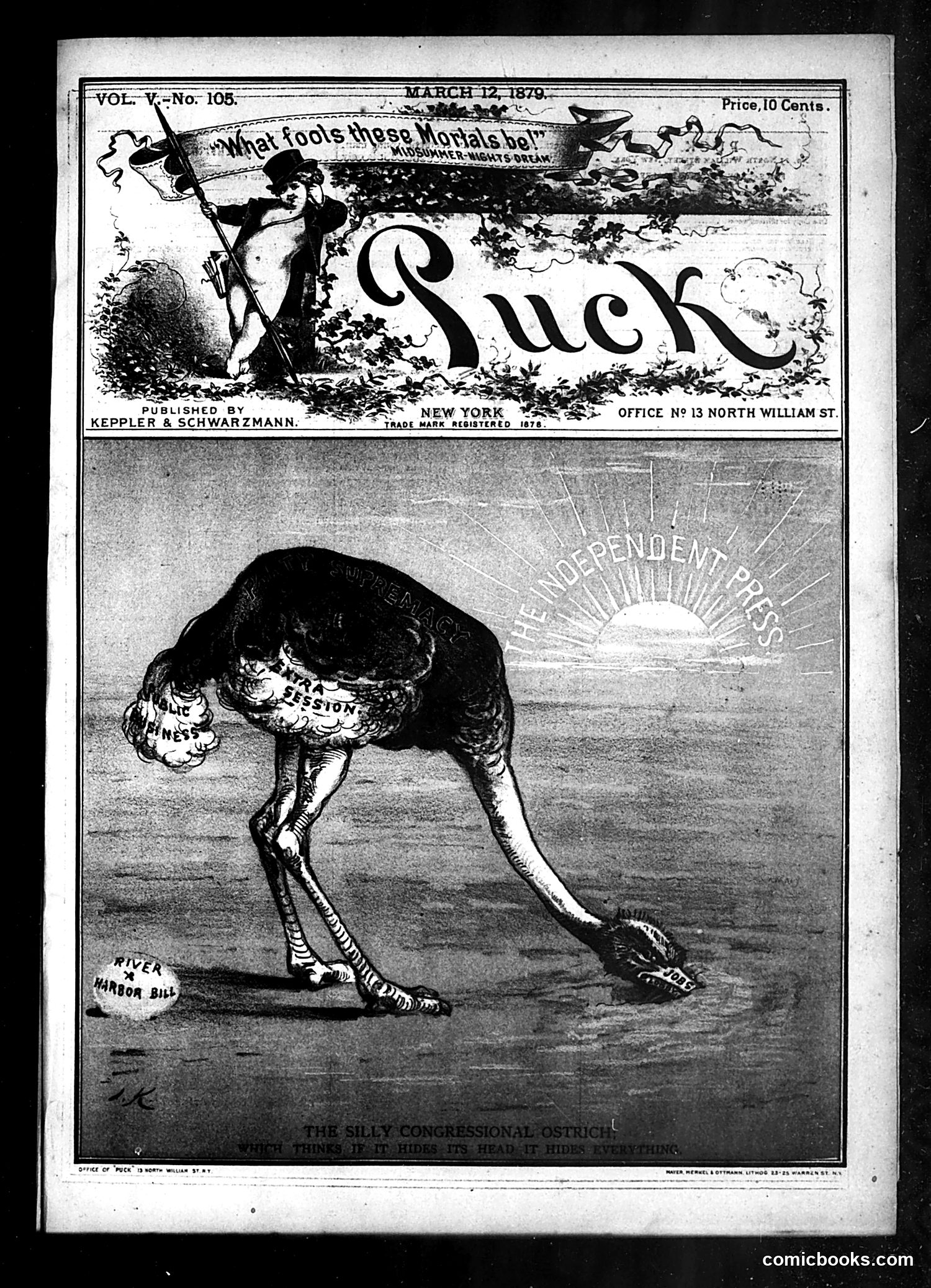
This March 12, 1879 *Puck* cartoon satirizes Congress's avoidance of controversial issues. The ostrich—a creature legendary for hiding its head in sand when threatened—represents Congress burying its head while facing problems labeled "River and Harbor Bill," "Inflation," and "Pension." The caption states the ostrich "thinks if it hides its head it hides everything," mocking Congressional evasion tactics. The sun labeled "Independent Press" shines above, suggesting the media exposes what lawmakers ignore. This appears critical of Congress's reluctance to address major fiscal and spending issues of the post-Civil War era—particularly debates over federal spending on infrastructure, currency policy, and veterans' benefits—by simply avoiding substantive action or debate.
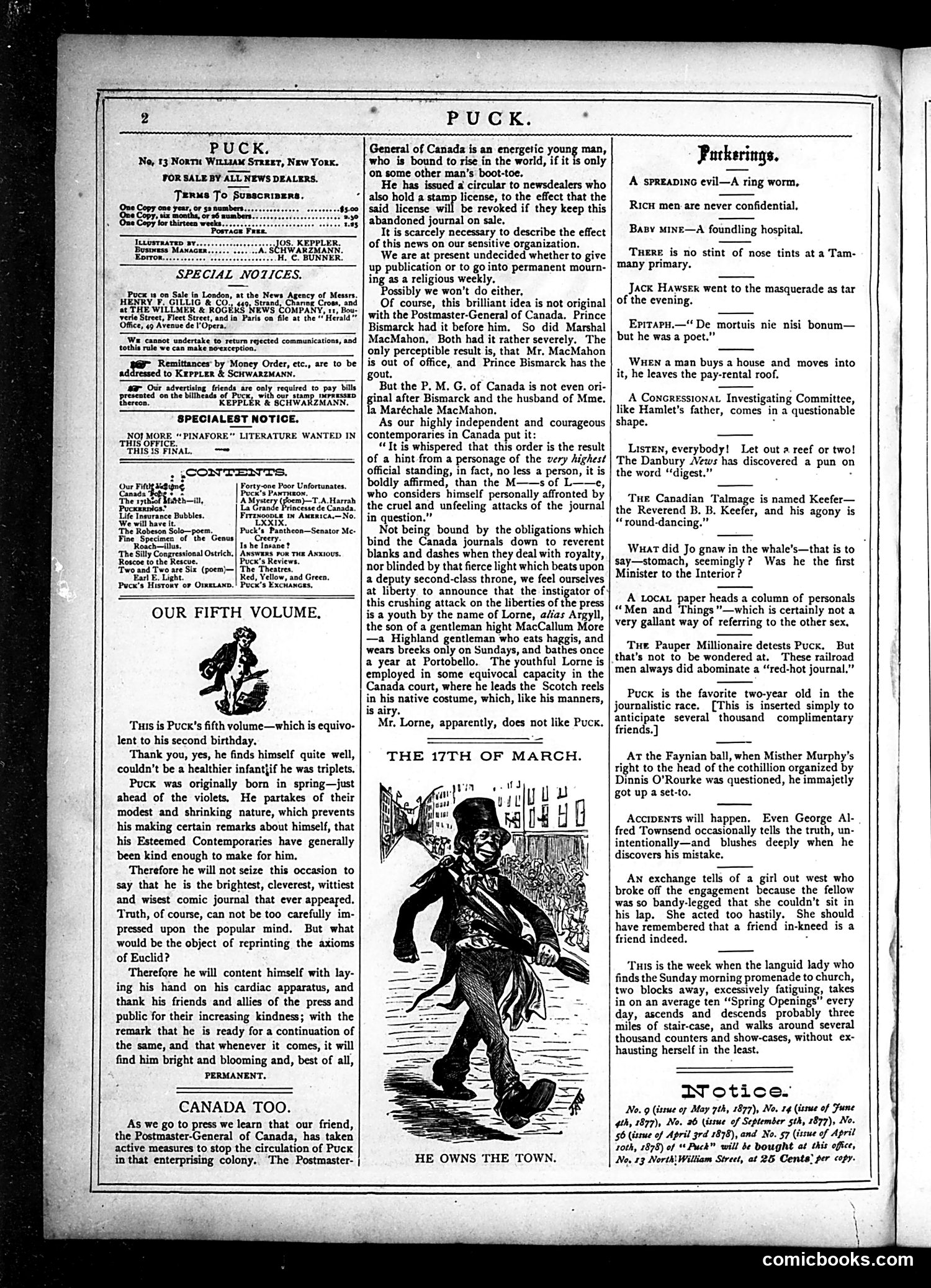
This Puck cartoon satirizes the Postmaster-General of Canada's attempt to suppress the magazine's circulation in Canada. The accompanying text explains that the Canadian official issued threats against newsdealer stamp licenses to pressure them not to sell Puck. The caricatured figure—depicted as a rotund, disheveled man striding confidently through a street—represents this overreaching government authority claiming dominion over the town and press freedom. The cartoon's title "HE OWNS THE TOWN" is sarcastic, mocking the official's assumption of absolute power. The satire criticizes government censorship and coercion tactics. Puck uses the exaggerated, grotesque visual style typical of 19th-century political cartooning to ridicule bureaucratic tyranny and defend press liberty.
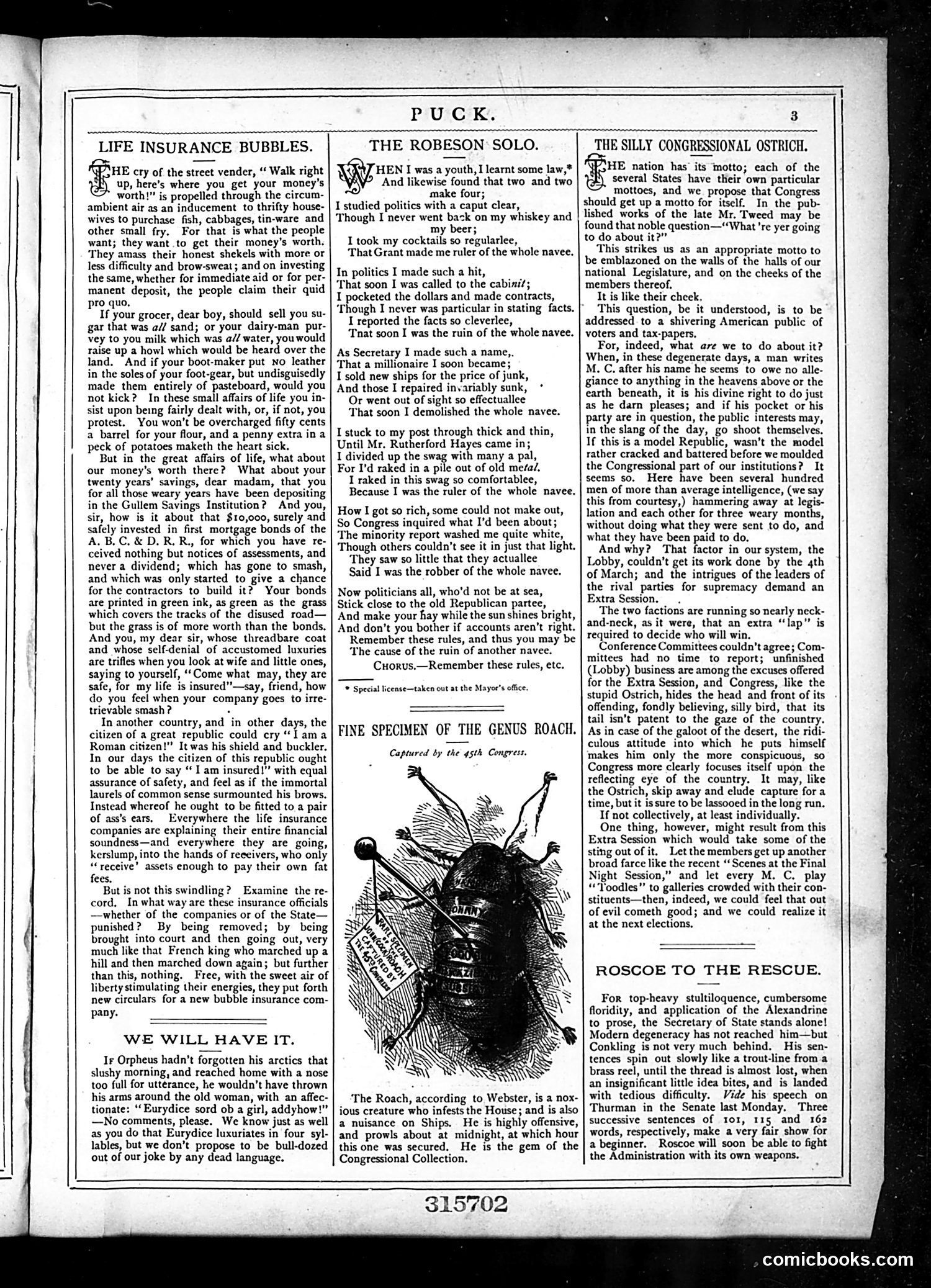
This page contains three distinct satirical pieces: 1. **"Life Insurance Bubbles"**: Mocks life insurance companies' deceptive practices, comparing them to financial schemes that collapse, leaving citizens defrauded of savings. 2. **"The Robeson Solo"**: A poem satirizing a politician (appears to be named Robeson) who rose through corrupt practices—accepting bribes, manipulating politics, and enriching himself while claiming democratic service. 3. **"The Silly Congressional Ostrich"**: Critiques Congress for avoiding a contentious national question about state mottos, with members burying their heads like ostriches rather than addressing the issue directly. The accompanying roach illustration represents the unwanted pest Congress ignores. **"Roscoe to the Rescue"**: Brief item mocking Secretary of State Gresham's ineffectual diplomatic efforts. All target governmental and institutional corruption and incompetence.
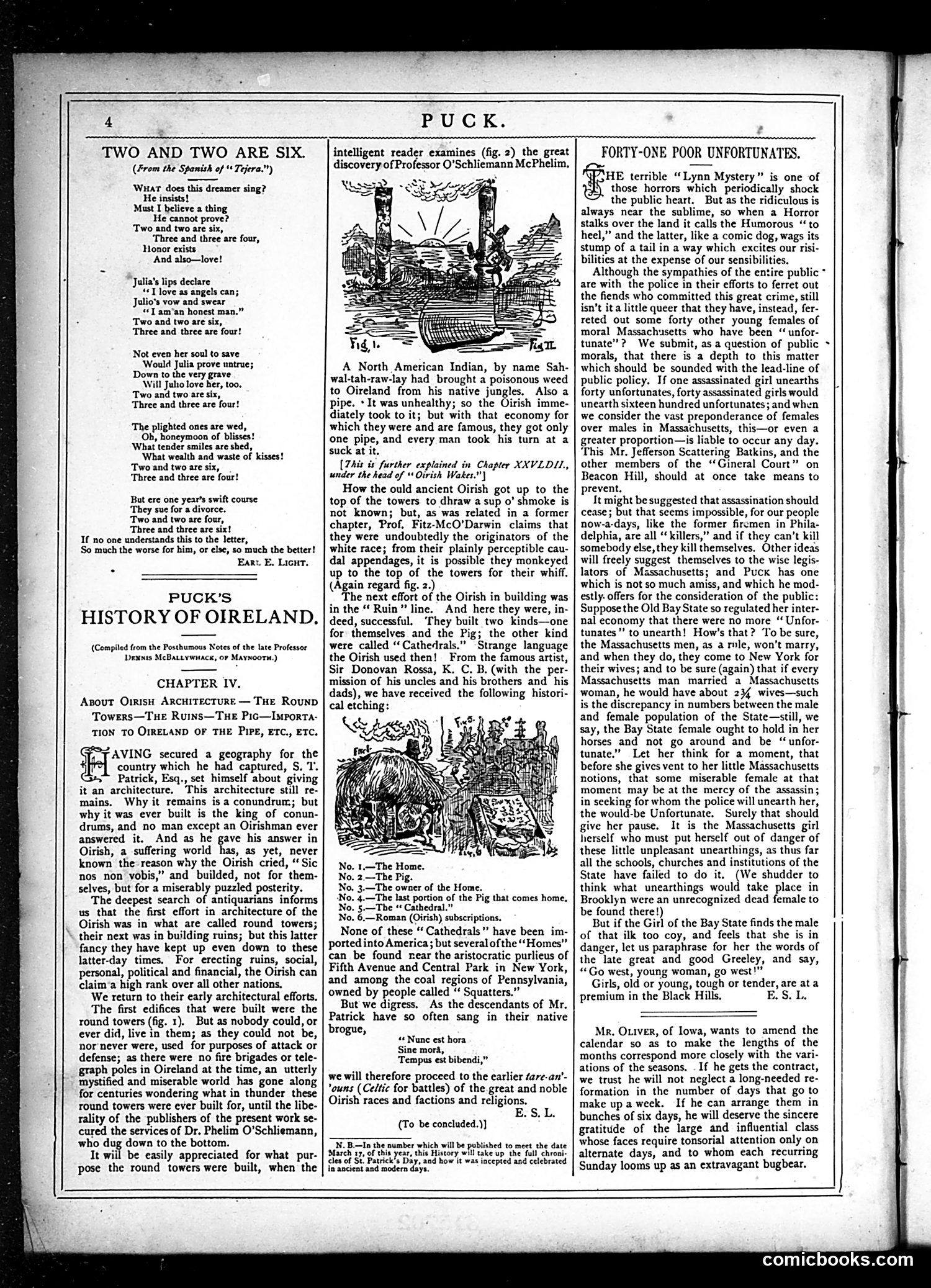
This page contains three distinct sections: 1. **"Two and Two Are Six"** - A poem (from Spanish) about mathematical absurdity and romantic declarations, with no apparent political content. 2. **"Forty-One Poor Unfortunates"** - A satirical editorial criticizing the inadequate response to the "Lynn Mystery"—apparently the deaths of forty-one young women in Massachusetts. The piece attacks authorities and suggests the state failed its female population. It appears to advocate for better investigation and protection of vulnerable women, using sarcastic language ("Unfortunate"?) to mock official indifference. 3. **"Puck's History of Oireland"** - The opening of a serialized history of Irish architecture, featuring illustrations of round towers and Oirish (stereotyped Irish) figures and dialect, typical of period ethnic humor. The page mixes literary content with social criticism and entertainment.
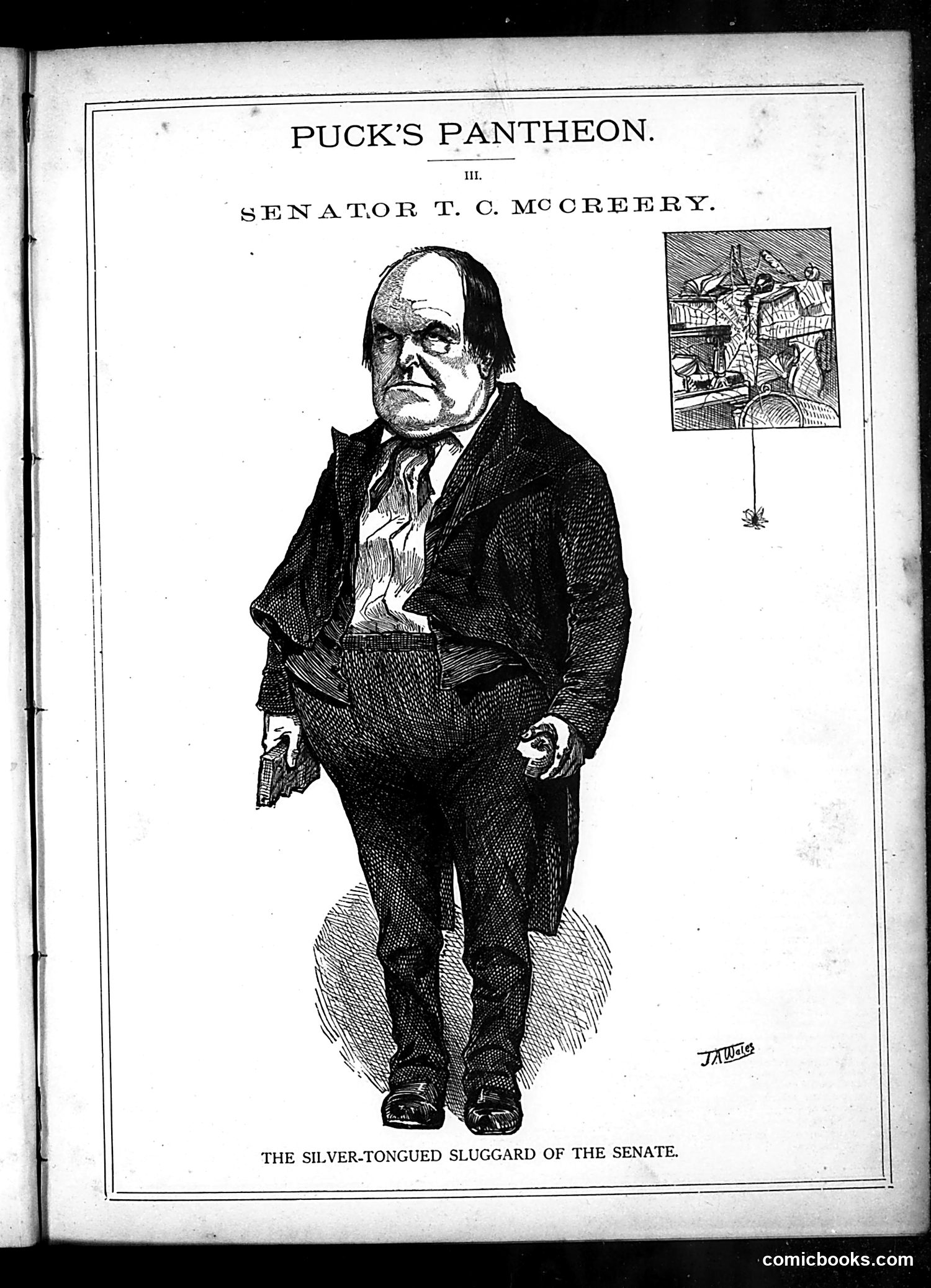
This is a caricature of **Senator T.C. McCreery**, identified by the caption as "The Silver-Tongued Sluggard of the Senate." The satire attacks McCreery as an eloquent but lazy legislator—"silver-tongued" praising his rhetorical skills while "sluggard" mocks his lack of productive action. The small illustration in the upper right (appearing to show classical or allegorical figures) likely reinforces the "Pantheon" theme, positioning him among notable senators for mockery. The exaggerated physical caricature—heavy-set, stern expression—emphasizes his unflattering public image. This piece uses Puck's typical approach: witty wordplay combined with visual ridicule to critique a political figure's character or record.
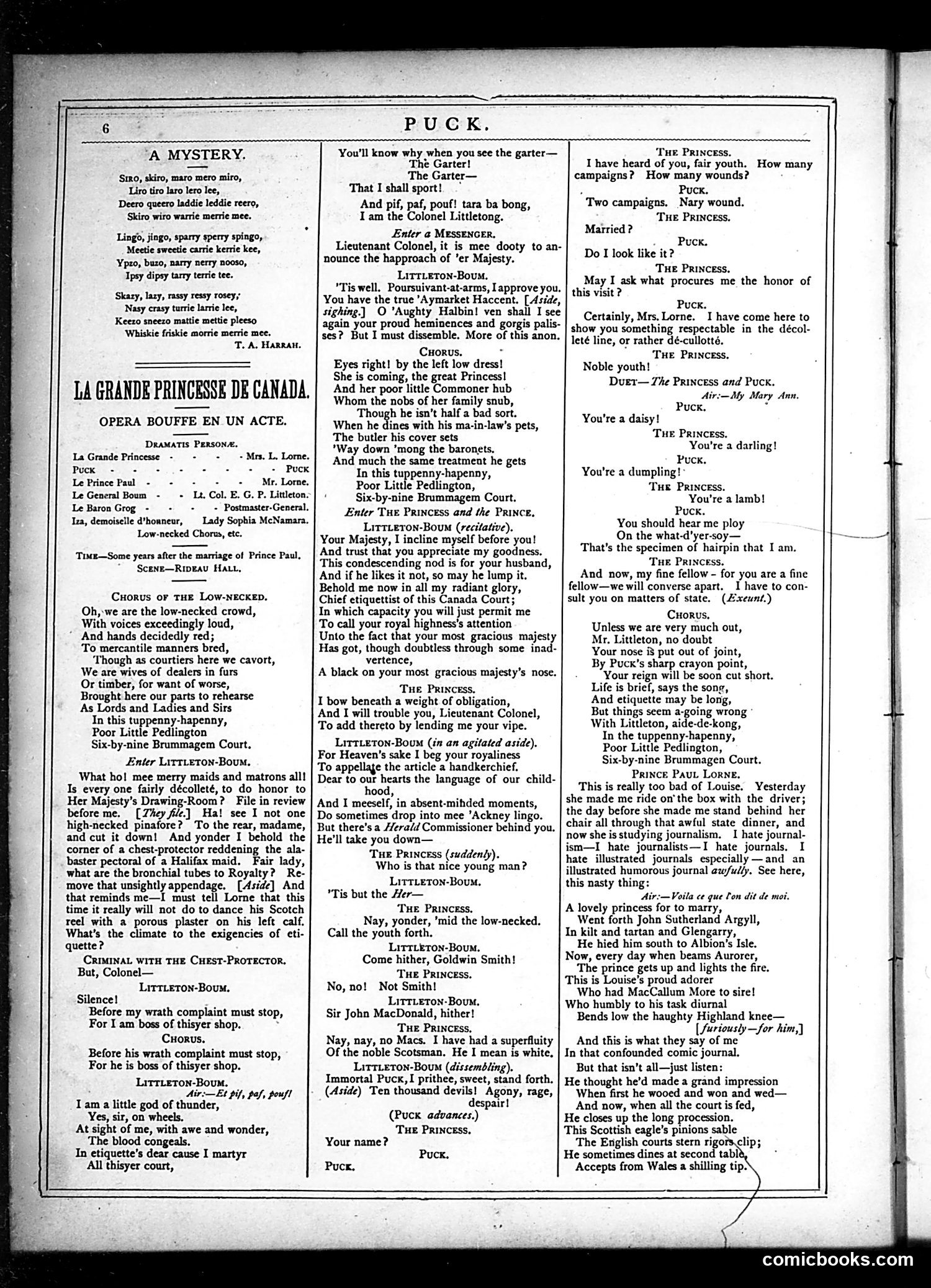
This page appears to be primarily **opera libretto or theatrical script** rather than political satire. It presents "La Grande Princesse de Canada" (The Grand Princess of Canada), a one-act opera bouffé (comic opera). The text shows dialogue between characters including a Princess, Prince, and various military/noble figures like "Littleton-Boum" and "General Boum." The script includes musical numbers and comic exchanges about military campaigns, marriage proposals, and social pretensions. While the Canadian setting and military references suggest possible political satire about Canadian governance or British-colonial relations, the theatrical format obscures any specific contemporary political targets. Without additional visual context or historical documentation identifying the original publication date and specific references, the precise satirical intent remains unclear.
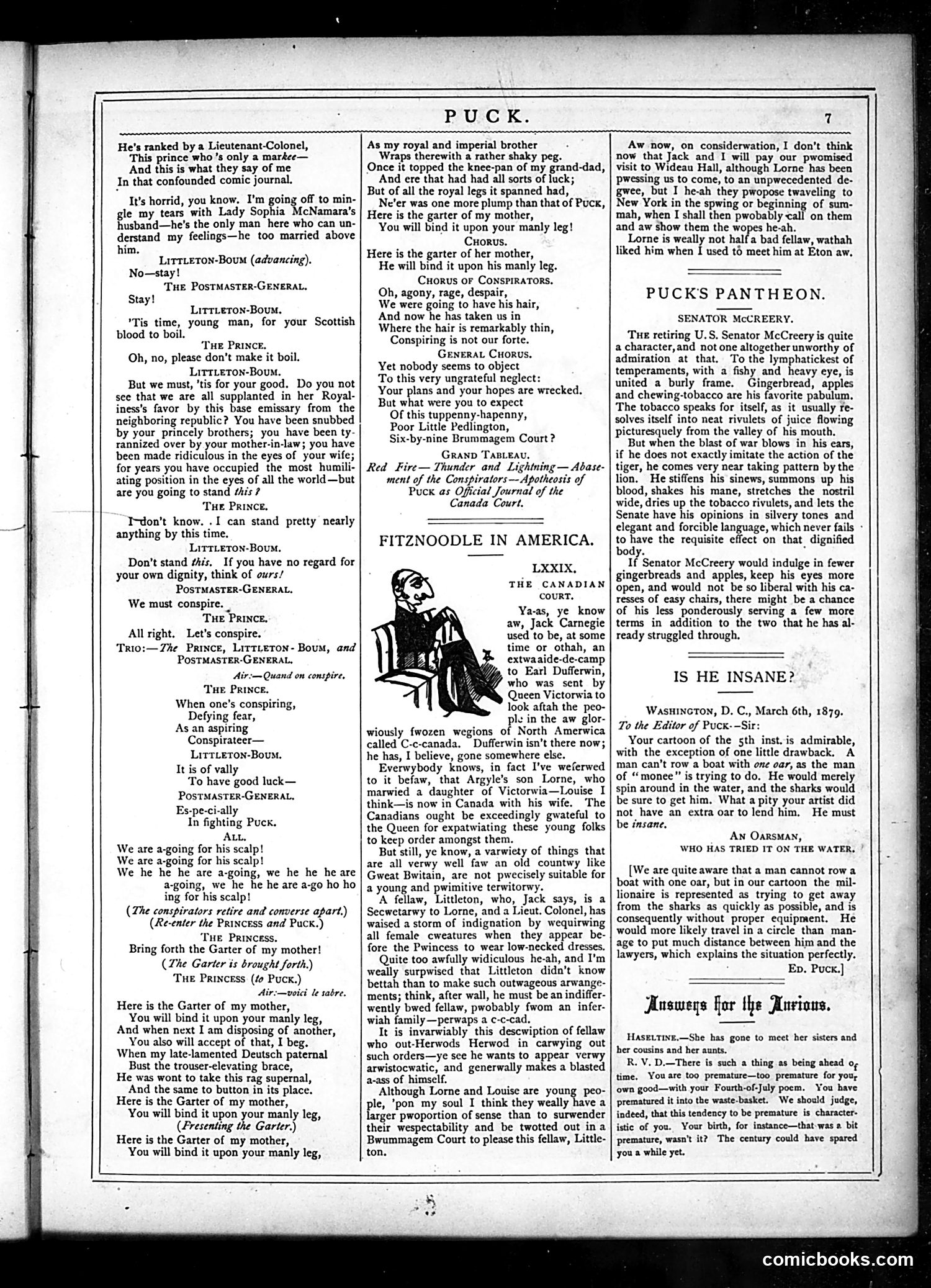
This page contains satirical theatrical dialogue and commentary rather than traditional political cartoons. The main content appears to be a play or dramatic piece mocking Canadian political figures during what seems to be the 1870s-80s period. The text references "Little Puck" and involves conspiratorial plotting, with characters including a Lieutenant-Colonel, Postmaster-General, and Prince engaging in mock-serious banter about Scottish blood and ungrateful neglect. A small illustration shows a caricatured figure labeled as relating to Canadian affairs. The piece satirizes Canadian political corruption and incompetence, though specific figure identifications are unclear from this page alone. The satirical tone ridicules what Puck viewed as incompetent or corrupt Canadian governance of the era.
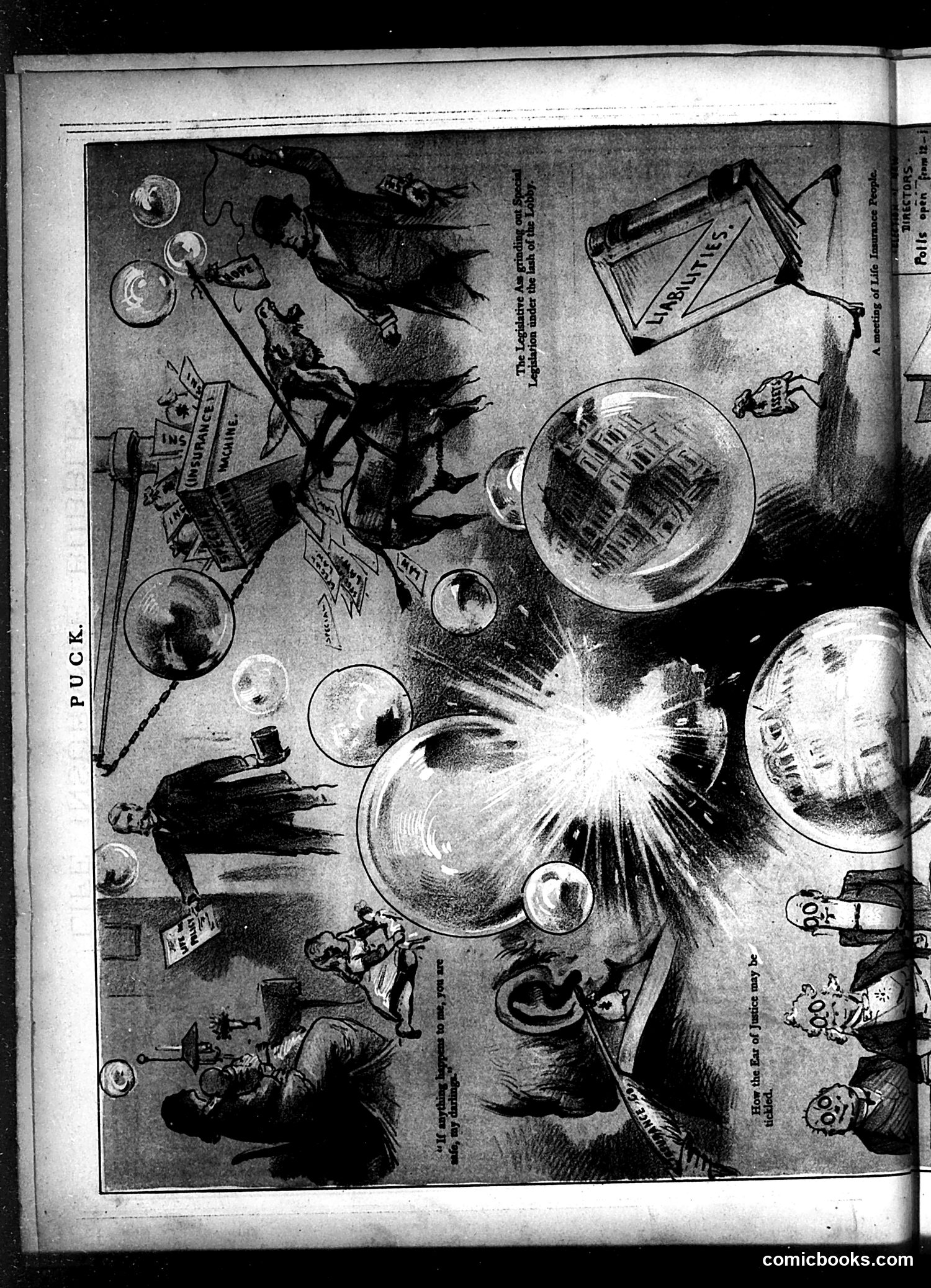
This Puck magazine page appears to be a satirical cartoon about financial speculation or economic bubbles. The image shows multiple large spherical bubbles of varying sizes floating across the composition, with small human figures depicted around and within them. The word "PUCK" appears on the left margin. The bubbles likely represent speculative financial schemes or inflated economic ventures. The tiny figures gesturing, falling, or struggling suggest ordinary people caught up in or victimized by these schemes. The visual metaphor of bubbles—which inevitably burst—indicates the cartoonist's cynical view of such ventures as temporary illusions destined to collapse. Without clearer OCR text or visible date/labels, I cannot identify the specific financial scheme or historical moment referenced, though the imagery suggests commentary on market manipulation or economic fraud affecting common citizens.
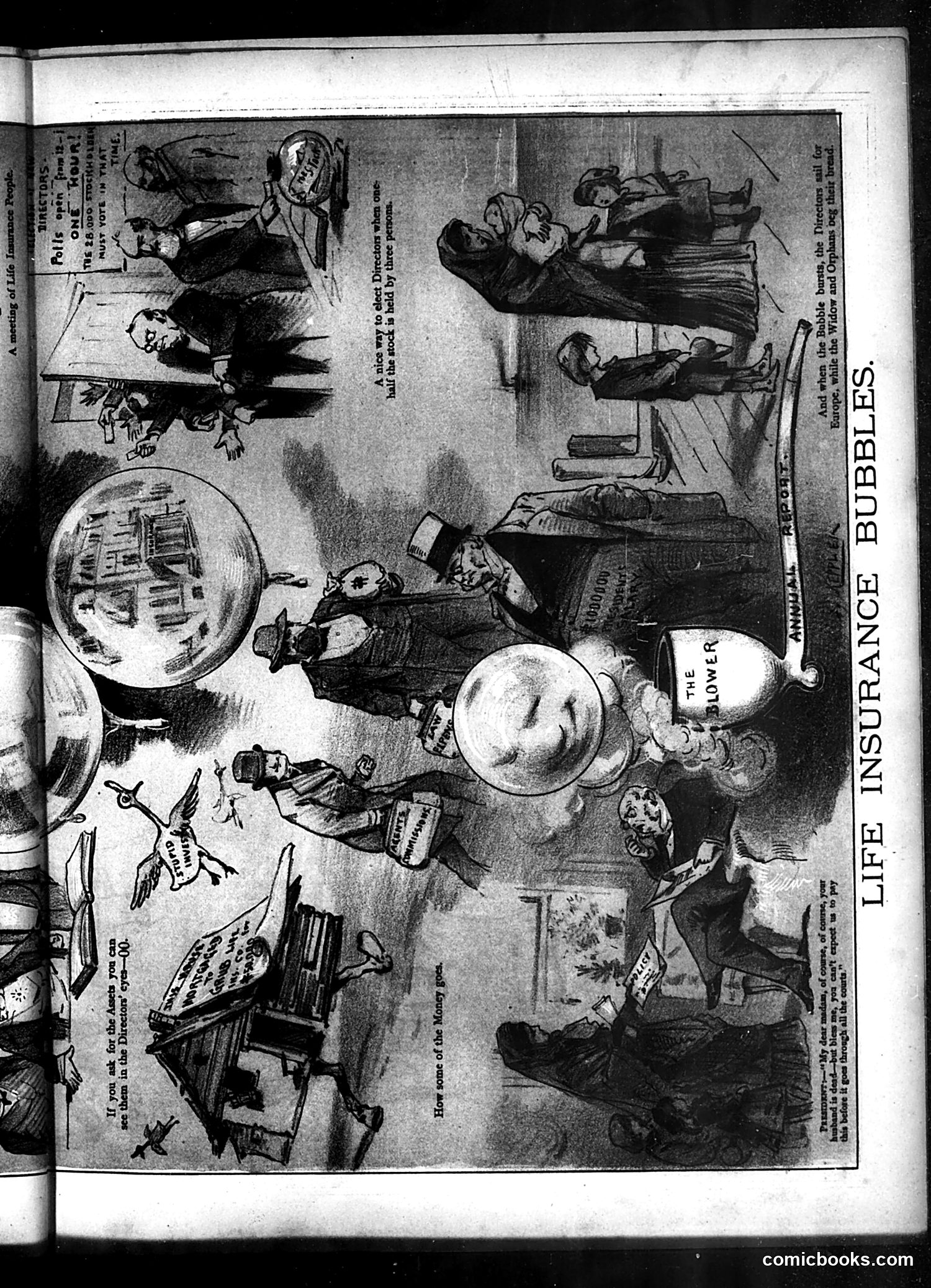
This satirical cartoon critiques life insurance as a fraudulent scheme. The central figures appear to be insurance company operators or salesmen—labeled caricatures with exaggerated features typical of Puck's style—presenting inflated promises to customers. The magnifying glasses revealing hollow interiors of the figures' heads suggest the operators lack substance or intelligence. The scattered papers and documents at bottom indicate fine print or deceptive contracts. Customers appear to be accepting worthless policies represented as valuable bubbles. The satire warns readers that life insurance companies are essentially empty propositions—their agents are charlatans peddling inflated promises to unsuspecting buyers. This reflects late 19th/early 20th-century skepticism about emerging insurance industries and their aggressive sales tactics.
This page from Puck magazine is primarily devoted to literary and theatrical reviews rather than political satire or cartoons. The main content includes: 1. **"Puck's Reviews"** section discussing Henry Ward Beecher's autobiography "My Life," examining his religious influence and controversial career as a prominent preacher. 2. **"The Theatres"** section reviewing contemporary Broadway productions including "The Black Crook" at Ninto's and various other plays. The page contains no visible political cartoons or caricatures. It represents Puck's literary criticism function—the magazine functioned as both a humor publication and a serious arts reviewer. The theatrical reviews discuss plot, performance quality, and artistic merit of stage productions of the era.
This page contains the text of an article titled "Red, Yellow, and Green: ('An Old Bohemian,' in Tinsley's Magazine.)" The article is a narrative essay—not a political cartoon—recounting the author's experiences in Lyon, France, where he befriended a wine merchant named M. Peyrade. The piece humorously describes M. Peyrade's passion for wine production and his various schemes to create exceptional vintages through scientific blending. The narrative satirizes pretentious wine culture and the absurdity of elaborate methods for producing supposedly superior wines. There are no identifiable political figures or social commentary visible; this appears to be entertainment literature rather than satirical commentary.
This page from Puck magazine contains primarily humor columns and brief satirical items rather than political cartoons. The main feature is "Puck's Persiflage," a section of short jokes and witty observations on current events and social situations. The "Therenody" poem humorously depicts a domestic squabble between spouses named Mary Ann, playing on repetitive comic dialogue. Other items mock topics like bank failures, railroad management, Senate incompetence regarding camphor supplies, and various social absurdities of the era. The brief anecdotes target institutional incompetence and human folly rather than specific political figures. Without visible caricatures on this page, the satire relies on written commentary to mock contemporary American social and economic conditions in an accessible, comedic format typical of Puck's approach.
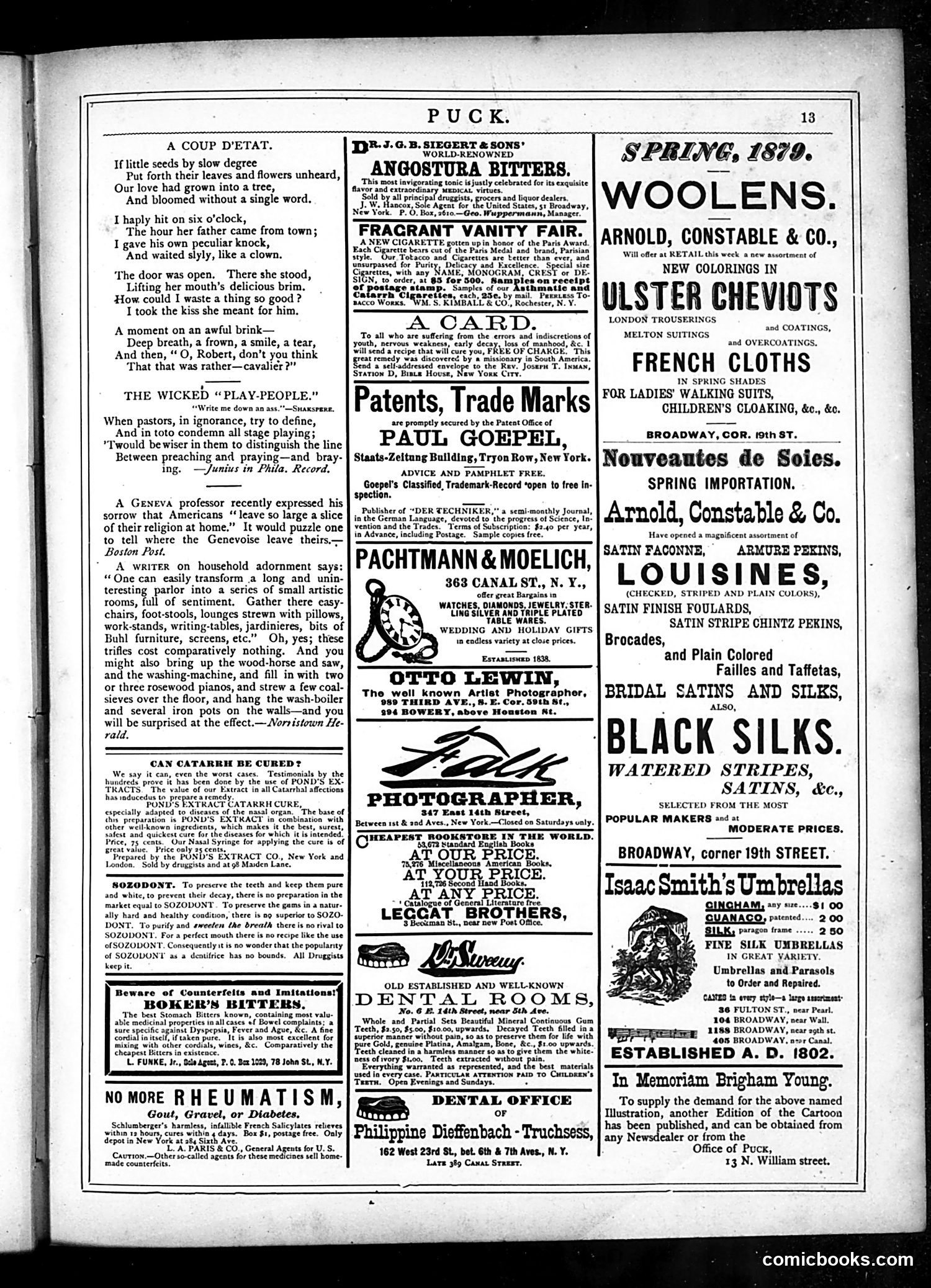
This page is **primarily advertising** rather than satirical content. It's from Puck magazine's Spring 1879 issue and consists almost entirely of commercial advertisements for products and services including: - Woolens and textiles (Arnold, Constable & Co.) - Photographs (Otto Lewin) - Patent services (Paul Goepel) - Dental work (Philippine Dieffenbach-Truchsess) - Umbrellas (Isaac Smith's) - Various medicinal products The only actual editorial content visible includes short humorous poems titled "A Coup d'Etat" and "The Wicked 'Play-People,'" but these are minor text elements dwarfed by the advertisements. This layout reflects how 19th-century magazines subsidized content through extensive advertising.
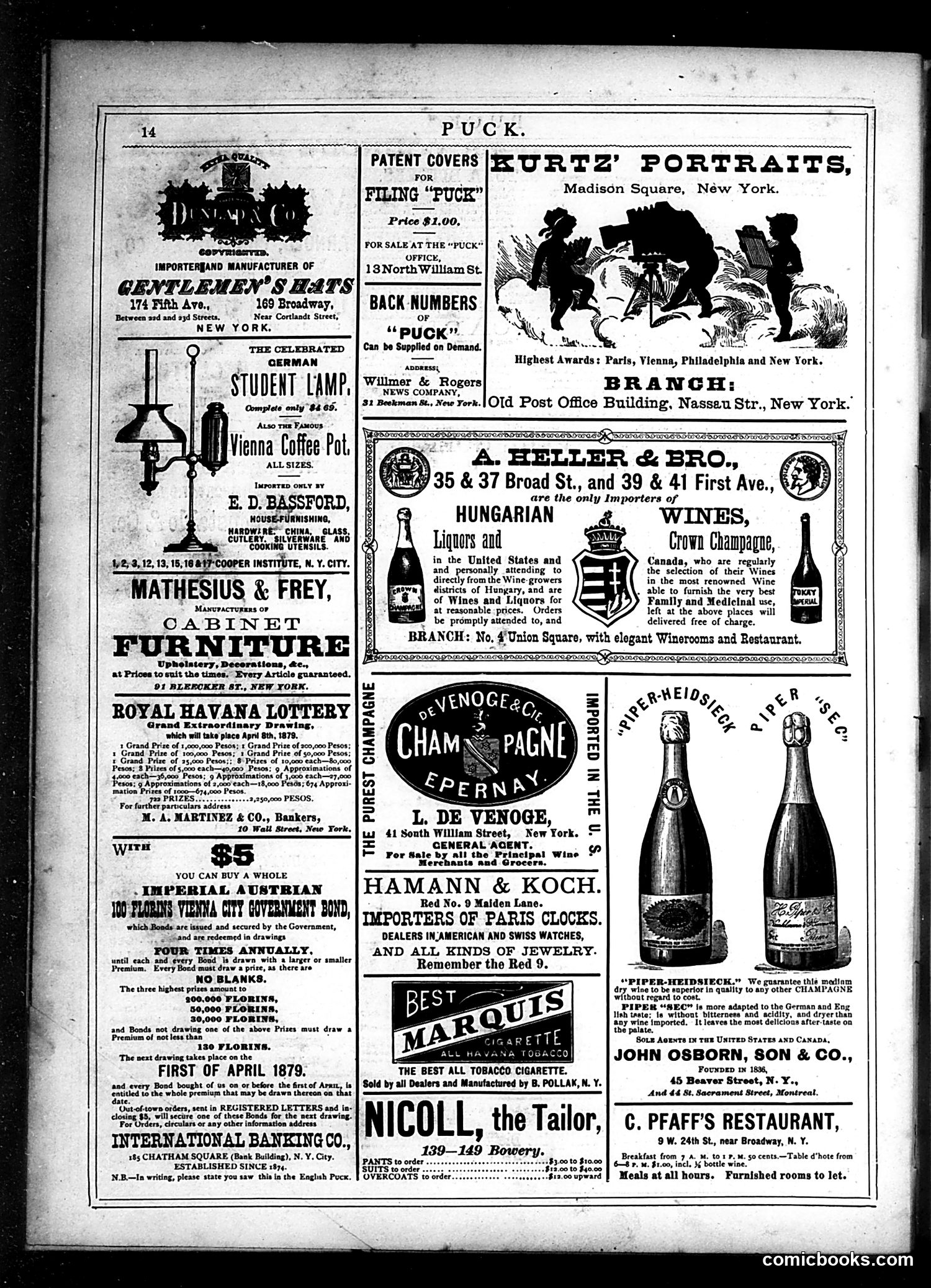
This page is predominantly **advertisements** rather than political satire or editorial cartoons. The visible content includes: **Main Advertisement**: "Kurtz's Portraits" (Madison Square, New York) features silhouettes of children in various poses—likely promoting portrait photography services, with "Branch" locations listed. **Other Ads**: Vienna Coffee Pots, Hungarian wines, champagne, Paris clocks, watches, jewelry, cigarettes, tailoring services, and restaurants occupy the remainder of the page. The small illustration at the top right of Kurtz's ad shows playful child silhouettes, but appears decorative rather than satirical. This page represents typical 1870s magazine monetization through paid advertisements rather than editorial content aimed at social or political commentary.
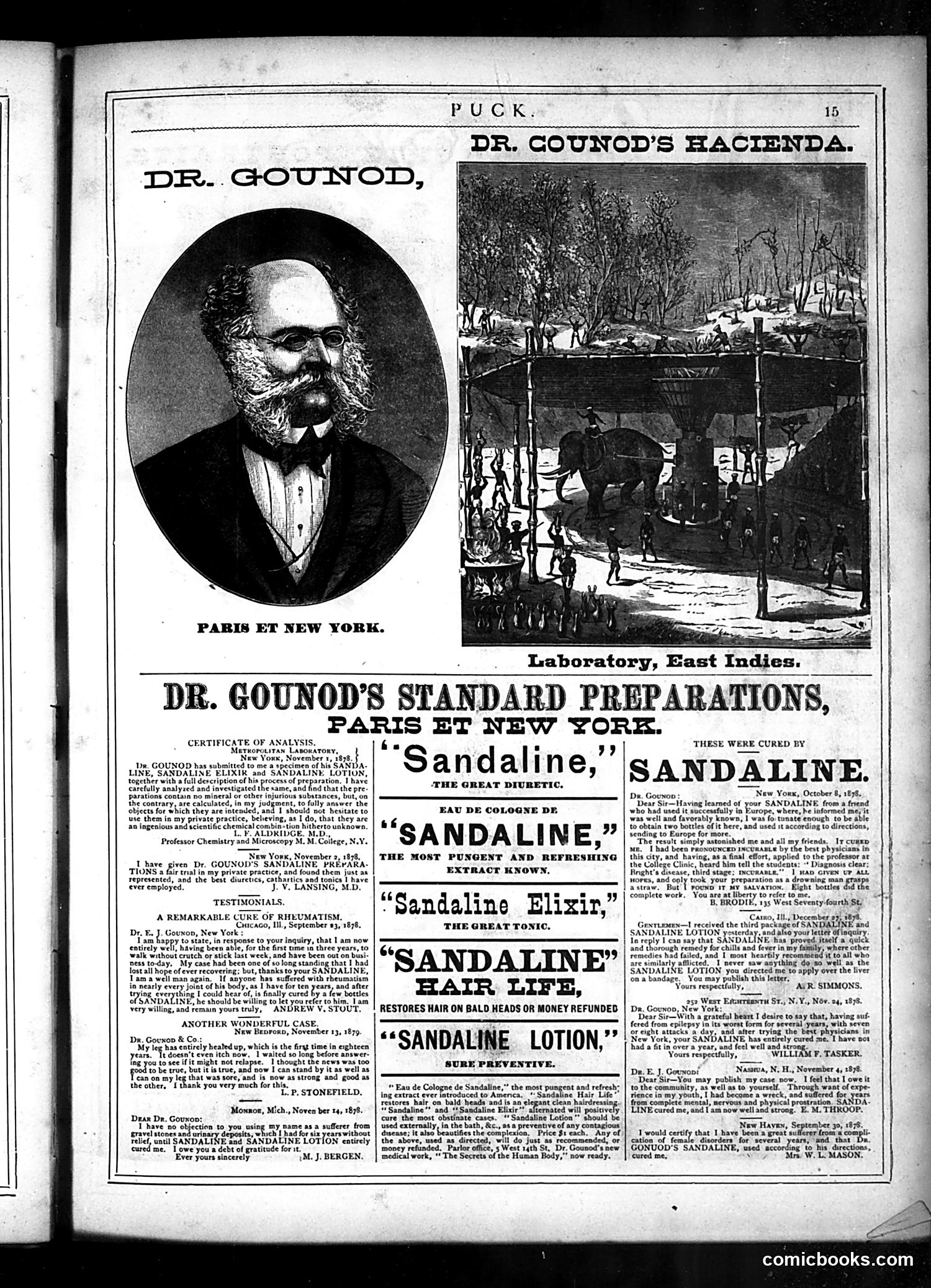
This page is primarily **Dr. Gounod's Standard Preparations advertising**, not political commentary. It features a portrait of Dr. Gounod (Paris and New York) and an image of his "Laboratory, East Indies." The advertisements promote various "Sandaline" products—tonics, elixirs, hair treatments, and lotions—claiming to cure ailments from rheumatism to baldness. The testimonials from satisfied customers support the products' effectiveness. This represents **late 19th-century patent medicine marketing**, when such publications accepted extensive advertising with minimal regulation. The claims would be illegal today. While Puck was known for satire, this particular page is a straightforward (if now-dubious) commercial advertisement exploiting consumer health concerns.
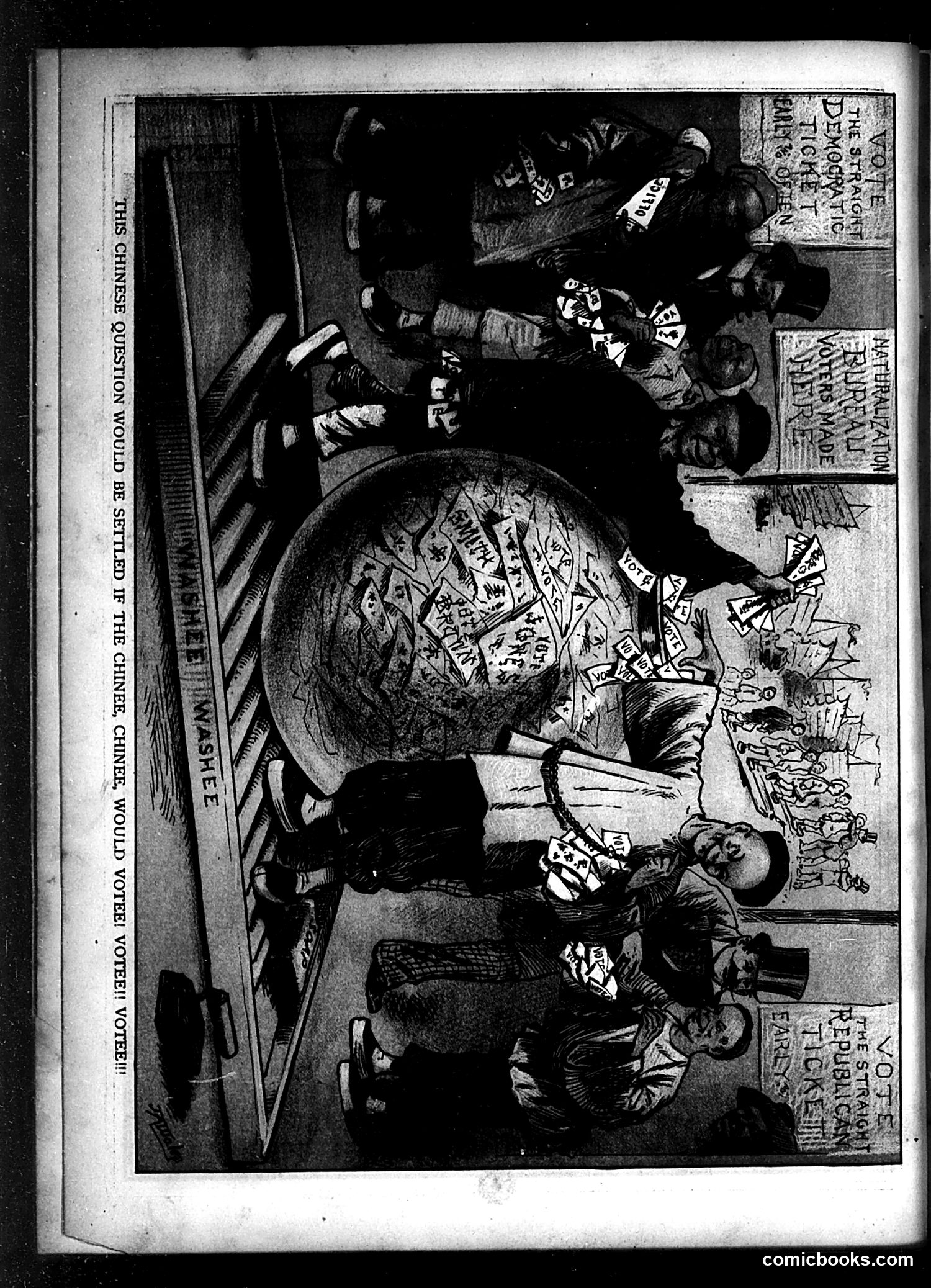
This page appears to be from Puck magazine and contains multiple satirical cartoons. The image shows what appears to be a large globe or spherical object covered with various labels and sketches, with figures arranged around it in a scene suggesting political chaos or disorder. The OCR text is too fragmented for me to read specific captions clearly enough to identify particular political figures or events with confidence. **I cannot reliably identify:** the specific politicians or historical events referenced, the exact date of publication, or the precise satirical point being made. To properly explain this cartoon's meaning to a modern reader, I would need clearer text or additional context about when this was published and what political/social issues were current then. The visual style suggests early-to-mid 20th century American political satire, but specifics remain unclear from this reproduction.