
Puck, 1879-03-12 · page 3 of 16
Puck — March 12, 1879 — page 3: what you’re looking at
What you’re looking at
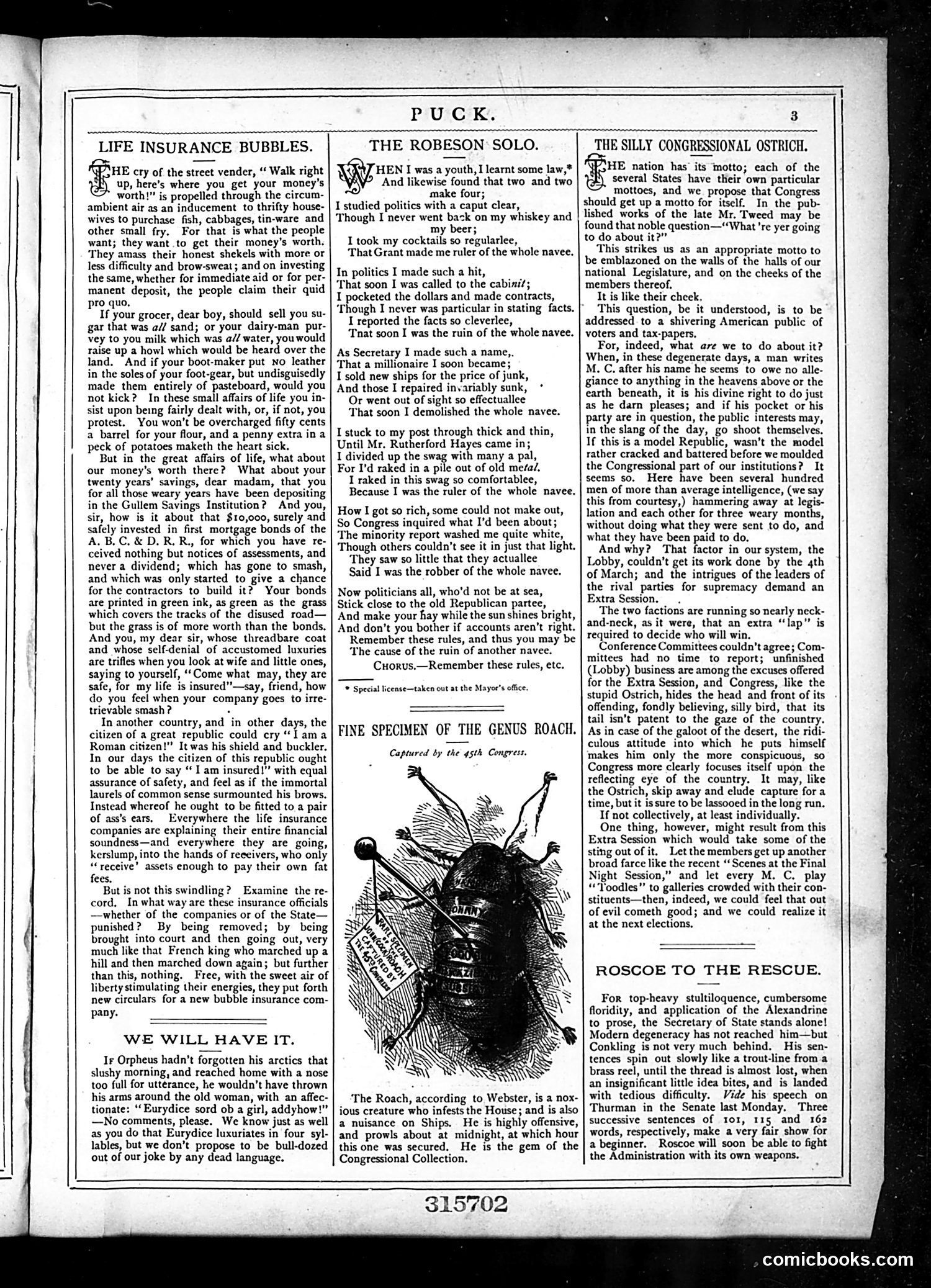
This page contains three distinct satirical pieces: 1. **"Life Insurance Bubbles"**: Mocks life insurance companies' deceptive practices, comparing them to financial schemes that collapse, leaving citizens defrauded of savings. 2. **"The Robeson Solo"**: A poem satirizing a politician (appears to be named Robeson) who rose through corrupt practices—accepting bribes, manipulating politics, and enriching himself while claiming democratic service. 3. **"The Silly Congressional Ostrich"**: Critiques Congress for avoiding a contentious national question about state mottos, with members burying their heads like ostriches rather than addressing the issue directly. The accompanying roach illustration represents the unwanted pest Congress ignores. **"Roscoe to the Rescue"**: Brief item mocking Secretary of State Gresham's ineffectual diplomatic efforts. All target governmental and institutional corruption and incompetence.
📄 Transcribed text from this page (OCR, searchable)
Machine-transcribed from the original scan — historical spelling and the odd misread are preserved.
PUCK. 3 LIFE INSURANCE BUBBLES. HE cry of the street vender, “ Walk right up, here's where you get your money's worth!” is propelled through the circum- ambient air as an inducement to thrifty house- wives to purchase fish, cabbages, tin-ware and other small fry. For that is what the people want; they want to get their money’s worth. ‘They amass their honest shekels with more or less difficulty and brow-sweat; and on investing the same, whether for immediate aid or for manent deposit, the people claim their quid pro quo, If your grocer, dear boy, should sell you su- gar that was a// sand; or your dairy-man pur- vey to you milk which was a// water, you would raise up a howl which would be heard over the land. And if your boot-maker put No leather in the soles of your foot-gear, but undisguisedly made them entirely of pasteboard, would you not kick? In these small affairs of life you in- sist upon being fairly dealt with, or, if not, you protest. You won’t be overcharged fifty cents a barrel for your flour, and a penny extra in a peck of potatoes maketh the heart sick. But in the great affairs of life, what about our money's worth there? What about your twenty years’ savings, dear madam, that you for all those weary years have been depositing in the Gullem Savings Institution? And you, sir, how is it about that $10,000, surely and safely invested in first mortgage bonds of the A. B,C, & D. R. R., for which you have re- ceived nothing but notices of assessments, and never a dividend; which has gone to smash, and which was only started to give a chance for the contractors to build it? Your bonds are printed in green ink, as green as the grass which covers the tracks of the disused road— but the grass is of more worth than the bonds, And you, my dear sir, whose threadbare coat and whose self-denial of accustomed luxuries are trifles when you look at wife and little ones, saying to yourself, “Come what may, they are safe, for my life is insured”—say, friend, how do you feel when your company goes to irre- trievable smash ? . In another country, and in other days, the citizen of a great republic could cry “lama Roman citizen!” It was his shield and buckler. In our days the citizen of this republic ought to be able to say “1 am insured!” with equal assurance of safety, and feel as if the immortal laurels of common sense surmounted his brows. Instead whereof he ought to be fitted to a pair of ass’s ears, Everywhere the life insurance companies are explaining their entire financial soundness—and everywhere they are going, kerslump, into the hands of reeeivers, who only “‘receive’ assets enough to pay their own fat fees. But is not this swindling? Examine the re- cord, In what way are these insurance officials —whether of the companies or of the State— punished? By being removed; by being brought into court and then going out, very much like that French king who marched up a hill and then marched down again; but further than this, nothing. Free, with the sweet air of liberty stimulating their energies, they put forth new circulars for a new bubble insurance com- pany. WE WILL HAVE IT. Ir Orpheus hadn’t forgotten his arctics that slushy morning, and reached home with a nose too full for utterance, he wouldn’t have thrown his arms around the old woman, with an affec- tionate: “Eurydice sord ob a girl, addyhow!” —No comments, please. We know just as well as you do that Eurydice luxuriates in four syl- THE ROBESON: SOLO. HEN I was a youth, I learnt some law,* And likewise found that two and two make four; I studied politics with a caput clear, ‘Though I never went back on my whiskey and my beer; I took my cocktails so regularlee, ‘That Grant made me ruler of the whole navee. In politics I made such a hit, ‘That soon I was called to the cabinit; I pocketed the dollars and made contracts, ‘Though I never was particular in stating facts. I reported the facts so cleverlee, Tnat soon I was the ruin of the whole navee. As Secretary I made such a name,. That a millionaire I soon became; I sold new ships for the price of junk, And those I repaired invariably sunk, Or went out of sight so effectuallee That soon I demolished the whole navee. I stuck to my post through thick and thin, Until Mr. Rutherford Hayes came in; I divided up the swag with many a pal, For I'd raked in a pile out of old mefa/, I raked in this swag so comfortablee, Because I was the ruler of the whole navee. How I got so rich, some could not make out, So Congress inquired what I’d been about; The minority report washed me quite white, Though others couldn’t see it in just that light. They saw so little that they actuallee Said I was the robber of the whole navee. should get up a motto for itself. lished works of the late Mr. Tweed may be Now politicians all, who'd not be at sea, Stick close to the old Republican partee, And make your hay while the sun shines bright, And don’t you bother if accounts aren't right. Remember these rules, and thus you may be ‘The cause of the ruin of another navee. Cuorus.—Remember these rules, etc, © Special license—taken out at the Mayor's office. FINE SPECIMEN OF THE GENUS ROACH. Captured by the 45th Congress. ‘The Roach, according to Webster, is a nox- ious creature who infests the House; and is also a nuisance on Ships. He is highly offensive, and prowls about at midnight, at which hour lables, but we don’t propose to be bull-dozed out of our joke by any dead language. this one was secured. He is the gem of the Congressional Collection. THE SILLY CONGRESSIONAL OSTRICH. HE nation has its motto; each of the several States have their own particular mottoes, and we propose that Congress In the pub- found that noble question—‘What ’re yer going to do about it?” This strikes us as an appropriate motto to be emblazoned on the walls of the halls of our national Legislature, and on the cheeks of the members thereof. It is like their cheek. This question, be it understood, is to be addressed to a shivering American public of voters and tax-papers. For, indeed, what are we to do about it? When, in these degenerate days, a man writes M. C. after his name he seems to owe no alle- giance to anything in the heavens above or the earth beneath, it is his divine right to do just as he darn pleases; and if his pocket or his party are in question, the public interests may, in the slang of the day, go shoot themselves, If this is a model Republic, wasn’t the model rather cracked and battered before we moulded the Congressional part of our institutions? It seems so. Here have been several hundred men of more than average intelligence, (we say this from courtesy,) hammering away at legis- lation and each other for three weary months, without doing what they were sent to do, and what they have been paid to do. And why? That factor in our system, the Lobby, couldn’t get its work done by the 4th of March; and the intrigues of the leaders of the rival parties for supremacy demand an Extra Session. The two factions are running so nearly neck- and-neck, as it were, that an extra “lap” is required to decide who will win. Conference Committees couldn't agree; Com- mittees had no time to report; unfinished (Lobby) business are among the excuses offered for the Extra Session, and Congress, like the stupid Ostrich, hides the head and front of its offending, fondly believing, silly bird, that its tail isn’t patent to the gaze of the country. As in case of the galoot of the desert, the ridi- culous attitude into which he puts himself makes him only the more conspicuous, so Congress more clearly focuses itself upon’ the reflecting eye of the country. It may, like the Ostrich, skip away and elude capture fora time, but it is sure to be lassooed in the long run. If not collectively, at least individually. One thing, however, might result from this Extra Session which would take some of the sting out of it. Let the members get up another broad farce like the recent ‘Scenes at the Final Night Session,” and let every M. C. play “Toodles” to galleries crowded with their con- stituents—then, indeed, we could feel that out of evil cometh good; and we could realize it at the next elections, ROSCOE TO THE RESCUE. For top-heavy stultiloquence, cumbersome floridity, and application of the Alexandrine to prose, the Secretary of State stands alone! Modern degeneracy has not reached him—but Conkling is not very much behind. His sen- tences spin out slowly like a trout-line from a brass reel, until the thread is almost lost, when an insignificant little idea bites, and is landed with tedious difficulty. Vide his speech on Thurman in the Senate last Monday. Three successive sentences of rox, 115 and 162 words, respectively, make a very fair show for a beginner. Roscoe will soon be able to fight the Administration with its own weapons. 315702 comicbooks.com