
Puck, 1879-03-12 · page 4 of 16
Puck — March 12, 1879 — page 4: what you’re looking at
What you’re looking at
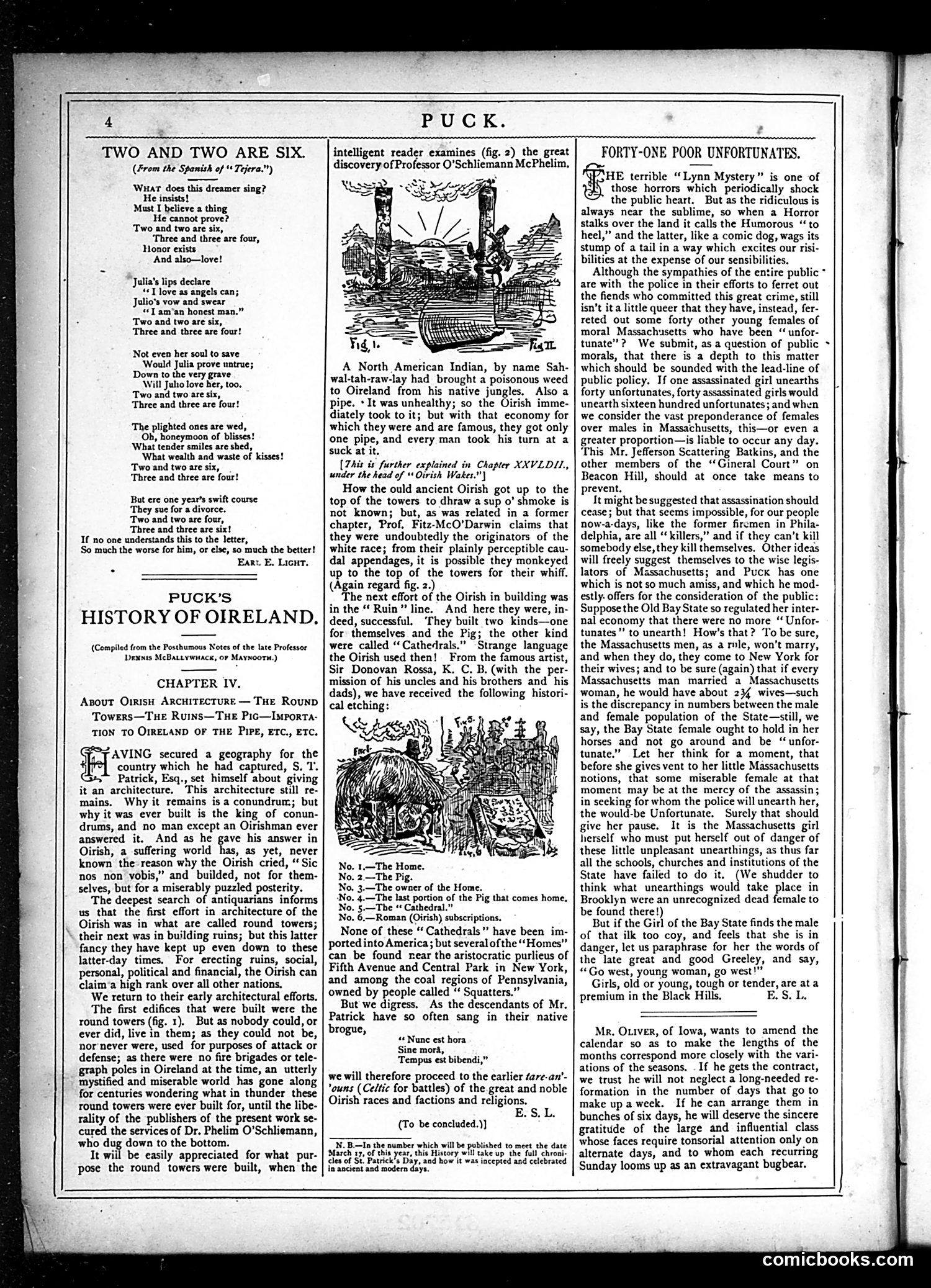
This page contains three distinct sections: 1. **"Two and Two Are Six"** - A poem (from Spanish) about mathematical absurdity and romantic declarations, with no apparent political content. 2. **"Forty-One Poor Unfortunates"** - A satirical editorial criticizing the inadequate response to the "Lynn Mystery"—apparently the deaths of forty-one young women in Massachusetts. The piece attacks authorities and suggests the state failed its female population. It appears to advocate for better investigation and protection of vulnerable women, using sarcastic language ("Unfortunate"?) to mock official indifference. 3. **"Puck's History of Oireland"** - The opening of a serialized history of Irish architecture, featuring illustrations of round towers and Oirish (stereotyped Irish) figures and dialect, typical of period ethnic humor. The page mixes literary content with social criticism and entertainment.
📄 Transcribed text from this page (OCR, searchable)
Machine-transcribed from the original scan — historical spelling and the odd misread are preserved.
PUCK. TWO AND TWO ARE SIX. (From the Spanish of “ Tejera.) Wuat does this dreamer sing? He insists! Must I believe a thing He cannot prove? ‘Two and two are six, ‘Three and three are four, Honor exists ‘And also—love! Julia's lips declare “Tove as angels can; jalio's vow and swear «T am‘an honest man.” Two and two are six, Three and three are four! Not even her soul to save Would Julia prove untrue; Down to the very grave Will Julio love her, too, Two and two are six, Three and three are four! ‘The plighted ones are wed, Oh, honeymoon of blisses ‘What tender smiles are shed, ‘What wealth and waste of kisses! Two and two are six, ‘Three and three are four! Bat ere one year’s swift course ‘They sue for a divorce. Two and two are four, Three and three are six! If no one understands this to the letter, So much the worse for him, or else, so much the better! Eart. E. Licut. PUCK’S HISTORY OF OIRELAND. (Compiled from the Posthumous Notes of the late Professor Drants MeBaLtywnack, 7 Maynoorn.) CHAPTER Iv. Apout Ornish ARCHITECTURE — THE Rounp Towers—Tue Ruins—Tue Pic—Importa- TION TO OIRELAND OF THE Pipe, ETC., ETC. AVING secured a geography for the country which he had captured, S. ‘1. Patrick, Esq., set himself about giving it an architecture. This architecture still re- mains. Why it remains is a conundrum; but why it was ever built is the king of conun- drums, and no man except an Oirishman ever answered it. And as he pve his answer in Oirish, a suffering world » as yet, never known the-reason why the Oirish cried, “Sic nos non vobis,” and builded, not for them- selves, but for a miserably puzzled posterity. The deepest search of antiquarians informs us that the first effort in architecture of the Oirish was in what are called round towers; \. their next was in building ruins; but this latter fancy they have kept up even down to these latter-day times. For erecting ruins, social, personal, political and financial, the Oirish can claim’a high rank over all other nations. We return to their early architectural efforts, The first edifices that were built were the round towers (6g. 1). But as nobody could, or ever did, live in them; as they could not be, nor'never were, used for purposes of attack or defense; as there were no fire brigades or tele- graph poles in Oireland at the time, an utterly mystified and miserable world has gone along for centuries wondering what in thunder these round towers were ever built for, until the libe- rality of the publishers of the present work se- cured the services of Dr. Phelim O’Schliemann, who dug down to the bottom. It will be easily appreciated for what pur- pose the round towers were built, when the intelligent reader examines (fig. 2) the great discovery of Professor O’Schliemann McPhelim. A North American Indian, by name Sah- wal-tah-raw-lay had brought a poisonous weed to Oireland from his native jungles. Also a Pipe. + It was unhealthy; so the Oirish imme- diately took to it; but with that economy for which they were and are famous, they got only one pipe, and every man took his turn at a suck at it. [This is further explained in Chapter XXVLDII., under the head of Oirish Wakes.” How the ould ancient Oirish got up to the top of the towers to dhraw a sup o’ shmoke is not known; but, as was related in a former chapter, Prof. Fitz-McO’Darwin claims that they were undoubtedly the originators of the white race; from their plainly perceptible cau- dal appendages, it is possible they monkeyed up to the top of the towers for their whiff. (Again regard fig. 2.) The next effort of the Oirish in building was in the “Ruin” line. And here they were, in- deed, successful. ‘They built two kinds—one for themselves and the Pig; the other kind were called “Cathedrals.” Strange language the Oirish used then! From the famous artist, Sir Donovan Rossa, K. C, B. (with the per- mission of his uncles and his brothers and his dads), we have received the following histori- cal etching: No, 1,—The Home, No. 2 —The Pig. No, -The owner of the Home. -The last portion of the Pig that comes home, The * Cathedral.” Roman (Oirish) subscriptions. None of these “Cathedrals” have been im- ported into America; but several ofthe “Homes” can be found near the aristocratic purlieus of Fifth Avenue and Central Park in New York, and among the coal regions of Pennsylvania, owned by people called “ Squatters.”” But we digress, As the descendants of Mr. Patrick have so often sang in their native brogue, «Nunc est hora Sine mora, ‘Tempus est bibendi,” we will therefore proceed to the earlier ¢are-an'- "ouns (Celtic for battles) of the.great and noble Oirish races and factions and religions. E.S.L. (To be concluded.)} 'N. B—In the number which will be published to meet the date March 17, of this year, this History will take up the full chroni- cles of St: Patrick’s Day, and how it was incepted and celebrated in ancient and modern days. FORTY-ONE POOR UNFORTUNATES. HE terrible “Lynn Mystery” is one of those horrors which periodically shock the public heart. But as the ridiculous is always near the sublime, so when a Horror stalks over the land it calls the Humorous “to heel,” and the latter, like a comic dog, wags its stump of a tail in a way which excites our risi- bilities at the expense of our sensibilities, Although the sympathies of the entire public * are with the police in their efforts to ferret out the fiends who committed this great crime, still isn’t it a little queer that they have, instead, fer- reted out some forty other young females of moral Massachusetts who have been “ unfor- tunate’? We submit, as a question of public morals, that there is a depth to this matter which should be sounded with the lead-line of public policy. If one assassinated girl unearths forty unfortunates, forty assassinated girls would unearth sixteen hundred unfortunates; and when we consider the vast preponderance of females over males in Massachusetts, this—or even a greater proportion—is liable to occur any day. ‘This Mr. Jefferson Scattering Batkins, and the other members of the ‘‘Gineral Court” on Beacon Hill, should at once take means to prevent. It might be suggested that assassination should cease; but that seems impossible, for our people now-a-days, like the former firemen in Phila- delphia, are all “killers,” and if they can’t kill somebody else, they kill themselves. Other ideas will freely suggest themselves to the wise legis- lators of Massachusetts; and Puck has one which is not so much amiss, and which he mod- estly: offers for the consideration of the public: Suppose the Old Bay State so regulated her inter- nal economy that there were no more “ Unfor- tunates”’ to unearth! How’s that? To be sure, the Massachusetts men, as a rule, won't marry, and when they do, they come to New York for their wives; and to be sure (again) that if every Massachusetts man married a Massachusetts woman, he would have about 234 wives—such is the discrepancy in numbers between the male and female population of the State—still, we say, the Bay State female ought to hold in her horses and not go around and be “unfor- tunate.” Let her think for a moment, that before she gives vent to her little Massachusetts notions, that some miserable female at that moment may be at the mercy of the assassin; in seeking for whom the police will unearth her, the would-be Unfortunate, Surely that should give her pause. It is the Massachusetts girl herself who must put herself out of danger of these little unpleasant unearthings, as thus far all the schools, churches and institutions of the State have failed to do it. (We shudder to think what unearthings would take place in Brooklyn were an unrecognized dead female to be found there!) But if the Girl of the Bay State finds the male of that ilk too coy, and feels that she is in danger, let us paraphrase for her the words of the late great and good Greeley, and say, “Go west, young woman, go west!” Girls, old or young, tough or tender, are ata premium in the Black Hills. E. S. L. Mr. Oniver, of Iowa, wants to amend the calendar so as to make the lengths of the months correspond more closely with the vari- ations of the seasons. . If he gets the contract, we trust he will not neglect a long-needed re- formation in the number of days that go to make upa week. If he can arrange them in bunches of six days, he will deserve the sincere gratitude of the large and influential class whose faces require tonsorial attention only on alternate days, and to whom each recurring Sunday looms up as an extravagant bugbear. comicbooks.com