
Puck, 1879-03-12 · page 10 of 16
Puck — March 12, 1879 — page 10: what you’re looking at
What you’re looking at
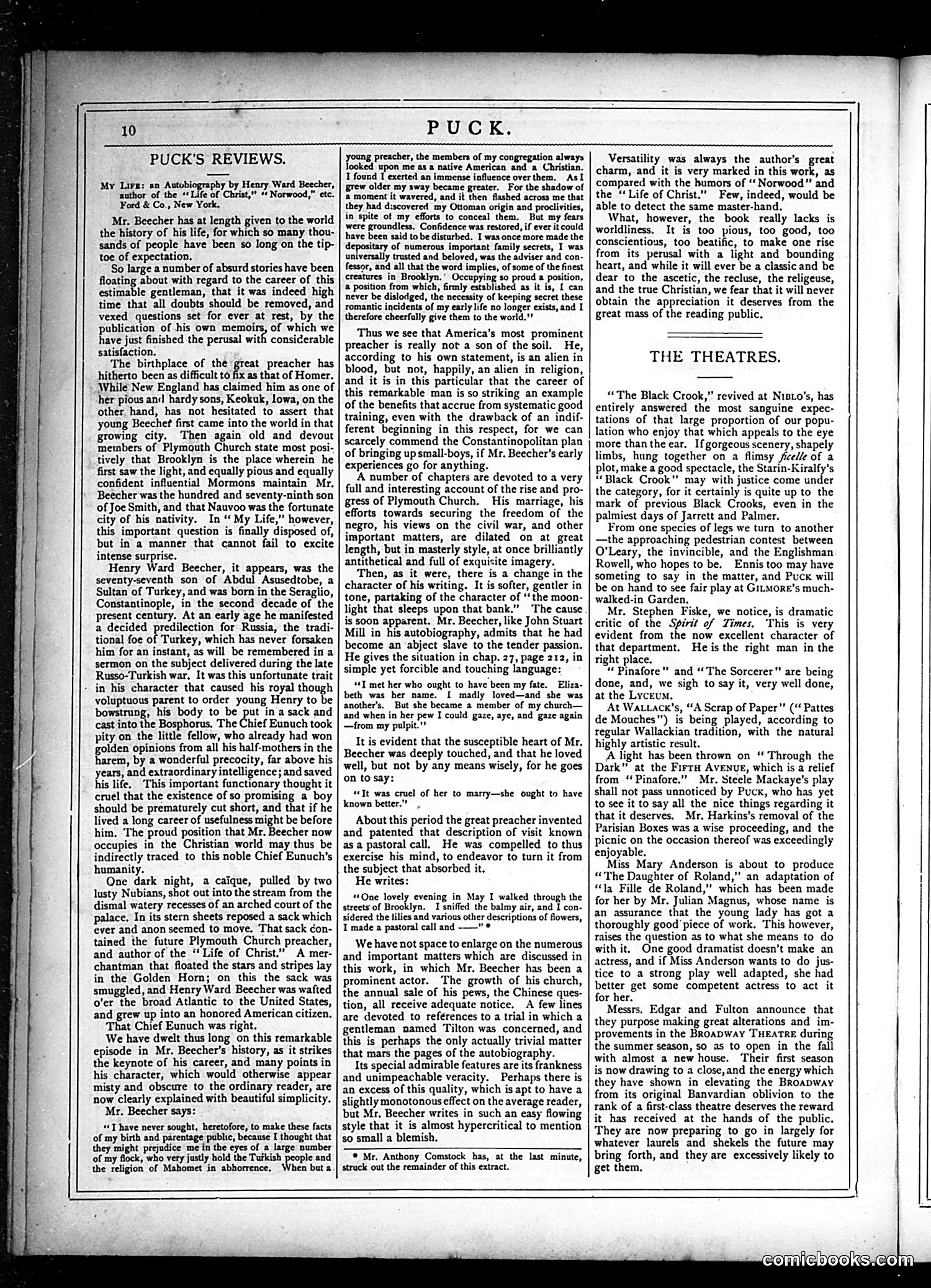
This page from Puck magazine is primarily devoted to literary and theatrical reviews rather than political satire or cartoons. The main content includes: 1. **"Puck's Reviews"** section discussing Henry Ward Beecher's autobiography "My Life," examining his religious influence and controversial career as a prominent preacher. 2. **"The Theatres"** section reviewing contemporary Broadway productions including "The Black Crook" at Ninto's and various other plays. The page contains no visible political cartoons or caricatures. It represents Puck's literary criticism function—the magazine functioned as both a humor publication and a serious arts reviewer. The theatrical reviews discuss plot, performance quality, and artistic merit of stage productions of the era.
📄 Transcribed text from this page (OCR, searchable)
Machine-transcribed from the original scan — historical spelling and the odd misread are preserved.
PUCK. PUCK'S REVIEWS. My Lire: an Autobiography by Henry Ward Beecher, author of the ‘Life of Christ,” “ Norwood,” etc. Ford & Co., New York. Mr. Beecher has at length given to the world the history of his life, for which so many thou- sands of people have been so long on the tip- toe of expectation. So large a number of absurd stories have been floating about with regard to the career of this estimable gentleman, that it was indeed high time that all doubts should be removed, and vexed questions set for ever at rest, by the publication of his own memoirs, of which we have just finished the perusal with considerable satisfaction. ‘The birthplace of thé «great preacher has hitherto been as difficult to fe as that of Homer. While New England has claimed him as one of her pious and hardy sons, Keokuk, Iowa, on the other. hand, has not hesitated to assert that young Beechef first came into the world in that growing city. Then again old and devout members of Plymouth Church state most posi- tively that Brooklyn is the place wherein he first saw the light, and equally pious and equally confident influential Mormons maintain Mr. Beecher was the hundred and seventy-ninth son of Joe Smith, and that Nauvoo was the fortunate city of his nativity. In “ My Life,” however, this important question is finally disposed of, but in a manner that cannot fail to excite intense surprise. Henry Ward Beecher, it appears, was the seventy-seventh son of Abdul Asusedtobe, a Sultan of Turkey, and was born in the Seraglio, Constantinople, in the second decade of the present century. At an early age he manifested a decided predilection for Russia, the tradi- tional foe of Turkey, which has never forsaken him for an instant, as will be remembered in a sermon on the subject delivered during the late Russo-Turkish war, It was this unfortunate trait + in his character that caused his royal though voluptuous parent to order young Henry to be bowsrine his body to Despat in a sack and cast into the Bosphorus. The Chief Eunuch took pity on the little fellow, who already had won olden opinions from all his half-mothers in the em, by a wonderful precocity, far above his years, and extraordinary intelligence; and saved his life. ‘This important functionary thought it cruel that the existence of so promising a boy should be prematurely cut short, and that if he lived a long career of usefulness might be before him, The proud position that Mr. Beecher now occupies in the Christian world may thus be indirectly traced to this noble Chief Eunuch’s humanity. Qne dark night, a caique, pulled by two lusty Nubians, shot out into the stream from the dismal watery recesses of an arched court of the palace. In its stern sheets reposed a sack which ever and anon seemed to move. That sack con- tained the future Plymouth Church preacher, and author of the ‘Life of Christ.” A mer- chantman that floated the stars and stripes lay in the Golden Horn; on this the sack was smuggled, and Henry Ward Beecher was wafted o’er the broad Atlantic to the United States, and grew up into an honored American citizen. That Chief Eunuch was right. We have dwelt thus long on this remarkable episode in Mr. Beecher’s history, as it strikes the keynote of his career, and many points in his character, which would otherwise appear misty and obscure to the ordinary reader, are now clearly explained with beautiful simplicity. Mr. Beecher says: “Thave never sought, heretofore, to make these facts of my birth and parentage public, because 1 thought that they might prejudice me in the eyes of a large number of my flock, who very justly hold the Turkish people and the religion of Mahomet in abhorrence. fhen but a young preacher, the members of my congregation always looked upon me asa native American and a Christian. I found I exerted an immense influence overthem. AsI grew older my sway became greater. For the shadow of @ moment it wavered, and it then flashed across me that they had d:scovered my Ottoman origin and proclivities, in spite ot my efforts to conceal them. But my fears were groundless. Confidence was restored, if ever it could have been said to be disturbed. I was once more made the depositary of numerous important family secrets, I was universally trusted and beloved, was the adviser and con- fessor, and all that the word implies, of some of the finest creatures in Brooklyn.’ Occupying so proud a position, ‘@ position from which, firmly established as it is, { can never be dislodged, the necessity of keeping secret these romantic incidents of my early life no longer exists, and I therefore cheerfully give them to the world.'” Thus we see that America’s most prominent preacher is really not a son of the soil. He, according to his own statement, is an alien in blood, but not, happily, an alien in religion, and it is in this particular that the career of this remarkable man is so striking an example of the benefits that accrue from systematic good training, even with the drawback of an indif- ferent beginning in this respect, for we can scarcely commend the Constantinopolitan plan of bringing up small-boys, if Mr. Beecher’s early experiences go for anything. A number of chapters are devoted to a very full and interesting account of the rise and pro- gress of Plymouth Church. His marriage, his efforts towards securing the freedom of the negro, his views on the civil war, and other important matters, are dilated on at great length, but in masterly style, at once brilliantly antithetical and full of exquisite imagery. Then, as it were, there is a change in the character of his writing. It is softer, gentler in tone, partaking of the character of ‘‘the moon- light that sleeps upon that bank.” The cause is soon apparent. Mr. Beecher, like John Stuart Mill in his autobiography, admits that he had become an abject slave to the tender passion. He gives the situation in chap. 27, page 212, in simple yet forcible and touching language: “«T met her who ought to have been my fate. Eliza- beth was her name. { madly loved—and she was another’s. But she became a member of my church— and when in her pew I could gaze, aye, and gaze again —from my pulpit.”” It is evident that the susceptible heart of Mr. Beecher was deeply touched, and that he loved well, but not by any means wisely, for he goes on to say: “Tt was cruel of her to marry—she ought to have known better.” About this period the great preacher invented and patented that description of visit known asa pastoral call. He was compelled to thus exercise his mind, to endeavor to turn it from the subject that absorbed it. He writes: “One lovely evening in May I walked through the streets of Brooklyn. I sniffed the balmy air, and I con- sidered the lilies and various other descriptions of flowers, I made a pastoral call and -——" * We have not space to enlarge on the numerous and important matters which are discussed in this work, in which Mr. Beecher has been a prominent actor. The growth of his church, the annual sale of his pews, the Chinese ques- tion, all receive adequate notice. A few lines are devoted to references to a trial in which a gentleman named Tilton was concerned, and this is perhaps the only actually trivial matter that mars the pages of the autobiography. Its special admirable features are its frankness and unimpeachable veracity, Perhaps there is an excess of this quality, which is apt to have a slightly monotonous effect on the average reader, but Mr. Beecher writes in such an easy flowing style that it is almost hypercritical to mention so small a blemish. * Mr. Anthony Comstock has, at the last minute, struck out the remainder of this extract. Versatility was always the author’s great charm, and it is very marked in this work, as compared with the humors of “ Norwood” and the “Life of Christ.” Few, indeed, would be able to detect the same master-hand. What, however, the book really lacks is worldliness. It is too pious, too good, too conscientious, too beatific, to make one rise from its perusal with a light and bounding heart, and while it will ever be a classic and be dear to the ascetic, the recluse, the religeuse, and the true Christian, we fear that it will never obtain the appreciation it deserves from the great mass of the reading public. THE THEATRES. “The Black Crook,” revived at Nipto's, has entirely answered the most sanguine expec- tations of that large proportion of our popu- lation who enjoy that which appeals to the eye more than the ear. Ifgorgeous scenery, shapely limbs, hung together on a flimsy jicedle of a plot, make a good spectacle, the Starin-Kiralfy’s “Black Crook" may with justice come under the category, for it certainly is quite up to the mark of previous Black Crooks, even in the palmiest days of Jarrett and Palmer. From one species of legs we turn to another —the approaching pedestrian contest between O'Leary, the invincible, and the Englishman Rowell, who hopes to be. Ennis too may have someting to say in the matter, and Puck will be on hand to see fair play at Ginmore’s much- walked-in Garden. Mr. Stephen Fiske, we notice, is dramatic critic of the Spirit of Times, This is very evident from the now excellent character of that department. He is the right man in the right place. “Pinafore” and ‘The Sorcerer” are being done, and, we sigh to say it, very well done, at the Lyceum. At WALLACcK’s, “A Scrap of Paper” (“Pattes de Mouches”) is being played, according to regular Wallackian tradition, with the natural highly artistic result. A light has been thrown on ‘“ Through the Dark” at the Firra AveNvE, which is a relief from “Pinafore.” Mr. Steele Mackaye’s play shall not pass unnoticed by Puck, who has yet to see it to say all the nice things regarding it that it deserves. Mr, Harkins’s removal of the Parisian Boxes was a wise proceeding, and the picnic on the occasion thereof was exceedingly enjoyable, Miss Mary Anderson is about to produce “The Daughter of Roland,” an adaptation of “la Fille de Roland,” which has been made for her by Mr. Julian Magnus, whose name is an assurance that the young lady has got a thoroughly good’ piece of work. ‘This however, raises the question as to what she means to do with it. One good dramatist doesn’t make an actress, and if Miss Anderson wants to do jus- tice to a strong play well adapted, she had better get some competent actress to act it for her. Messrs. Edgar and Fulton announce that they purpose making great alterations and im- provements in the BRoapway THEATRE during the summer season, so as to open in the fall with almost a new house. Their first season is now drawing to a close, and the energy which they have shown in elevating the BRoapway from its original Banvardian oblivion to the rank of a first-class theatre deserves the reward it has received at the hands of the public. They are now preparing to go in largely for whatever laurels and shekels the future may bring forth, and they are excessively likely to get them. Comicbooks*com