
Puck, 1879-03-12 · page 11 of 16
Puck — March 12, 1879 — page 11: what you’re looking at
What you’re looking at
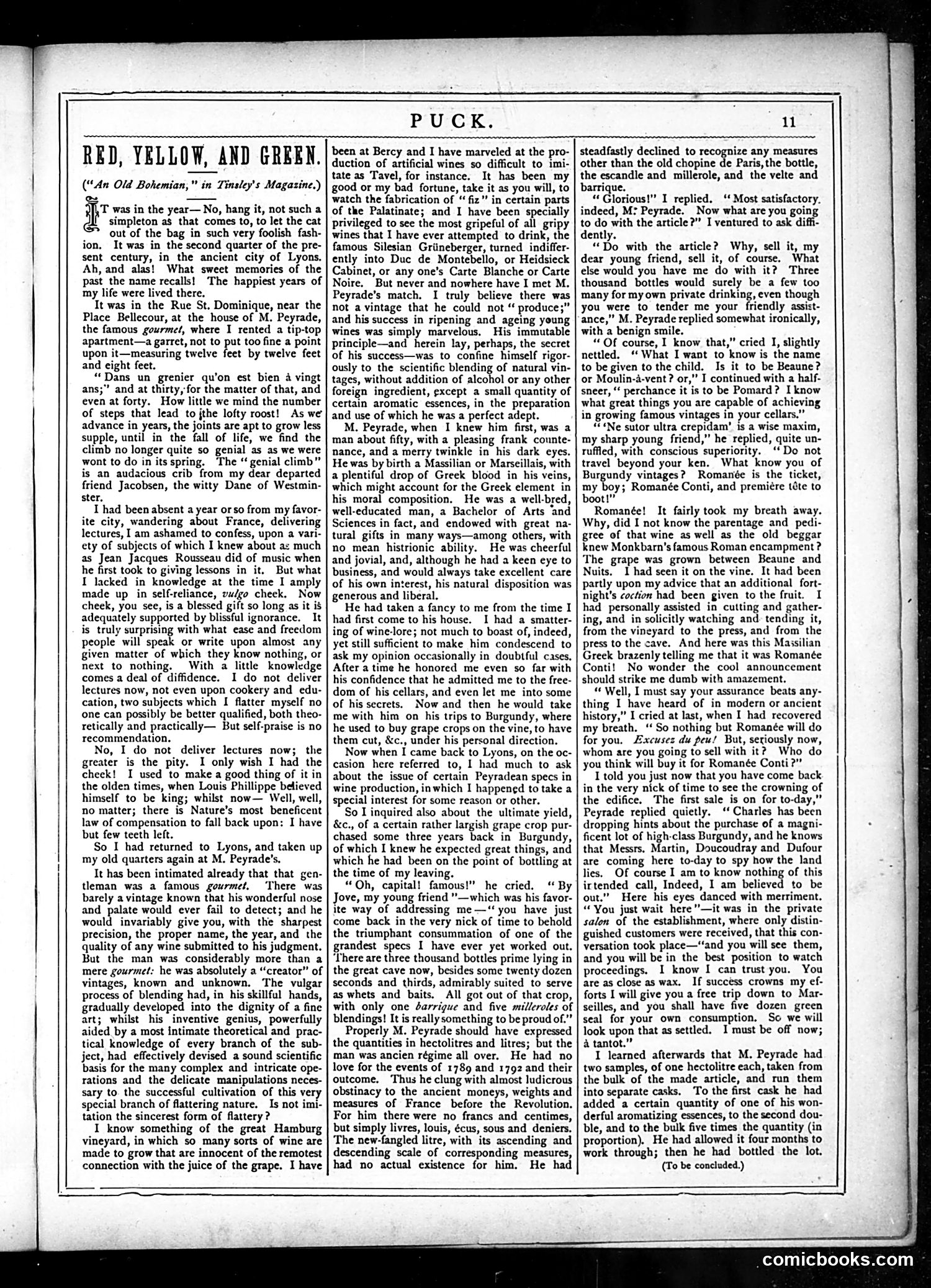
This page contains the text of an article titled "Red, Yellow, and Green: ('An Old Bohemian,' in Tinsley's Magazine.)" The article is a narrative essay—not a political cartoon—recounting the author's experiences in Lyon, France, where he befriended a wine merchant named M. Peyrade. The piece humorously describes M. Peyrade's passion for wine production and his various schemes to create exceptional vintages through scientific blending. The narrative satirizes pretentious wine culture and the absurdity of elaborate methods for producing supposedly superior wines. There are no identifiable political figures or social commentary visible; this appears to be entertainment literature rather than satirical commentary.
📄 Transcribed text from this page (OCR, searchable)
Machine-transcribed from the original scan — historical spelling and the odd misread are preserved.
PUCK. RED, YELLOW, AND GREEN. (“An Old Bohemian," in Tinsley's Magasine,) ii was in the year— No, hang it, not such a simpleton a8 that comes to, to let the cat out of the bag in such very foolish fash- ion, It was in the second quarter of the pre- sent century, in the ancient city of Lyons. Ah, and alas! What sweet memories of the past the name recalls! The happiest years of my life were lived there. It was in the Rue St. Dominique, near the Place Bellecour, at the house of M. Peyrade, the famous gourmet, where I rented a tip-top apartment—a garret, not to put too fine a point upon it—measuring twelve feet by twelve feet and eight feet. “Dans un grenier qu’on est bien A vingt ans;” and at thirty, for the matter of that, and even at forty. How little we mind the number of steps that lead to jthe lofty roost! As we advance in years, the joints are apt to grow less supple, until in the fall of life, we find the climb no longer quite so genial as as we were wont to do in its spring. The “ genial climb” is an audacious crib from my dear departed friend Jacobsen, the witty Dane of Westmin- ster. Thad been absent a year orso from my favor- ite city, wandering about France, delivering lectures, 1 am ashamed to confess, upon a vari- ety of subjects of which I knew about az much as Jean Jacques Rousseau did of music when he first took to giving lessons in it, But what I lacked in knowledge at the time I amply made up in self-reliance, vu/go cheek. Now cheek, you see, is a blessed gift so long as it i8 adequately supported by blissful ignorance. It is truly surprising with what ease and freedom people will speak or write upon almost any given matter of which they know nothing, or next to nothing. With a little knowledge comes a deal of diffidence. I do not deliver lectures now, not even upon cookery and edu- cation, two subjects which I flatter myself no one can possibly be better qualified, both theo- retically and practically— But self-praise is no recommendation. No, I do not deliver lectures now; the greater is the pity. I only wish I had the check! I used to make a good thing of it in the olden times, when Louis Phillippe believed himself to be king; whilst now— Well, well, no matter; there is Nature’s most beneficent law of compensation to fall back upon: I have but few teeth left. So I had returned to Lyons, and taken up my old quarters again at M. Peyrade'’s, It has been intimated already that that gen- tleman was a famous gourmet, ‘There was barely a vintage known that his wonderful nose and palate would ever fail to detect; and he would invariably give you, with the sharpest precision, the proper name, the year, and the quality of any wine submitted to his judgment. But the man was considerably more than a mere gourmet: he was absolutely a “creator” of vintages, known and unknown, The vulgar process of blending had, in his skillful hands, gradually developed into the dignity of a fine art; whilst his inventive genius, powerfully aided by a most intimate theoretical and prac- tical knowledge of every branch of the sub- ject, had effectively devised a sound scientific basis for the many complex and intricate ope- rations and the delicate manipulations neces- sary to. the successful cultivation of this ver special branch of flattering nature. Is not imi- tation the sincerest form of flattery? 1 know something of the great Hamburg vineyard, in which so many sorts of wine are made to grow that are innocent of the remotest connection with the juice of the grape. I have been at Bercy and I have marveled at the pro- duction of artificial wines so difficult to imi- tate as Tavel, for instance. It has been my good or my bad fortune, take it as you will, to watch the fabrication of “ fiz’’ in certain parts of the Palatinate; and I have been specially Privileged to see the most gripeful of all gripy wines that I have ever attempted to drink, the famous Silesian Griineberger, turned indiffer- ently into Duc de Montebello, or Heidsieck Cabinet, or any one’s Carte Blanche or Carte Noire, But never and nowhere have I met M. Peyrade’s match. I truly believe there was not a vintage that he could not “ produce;” and his success in ripening and ageing young wines was simply marvelous. His immutable principle—and herein lay, perhaps, the secret of his success—was to confine himself rigor- ously to the scientific blending of natural tages, without addition of alcohol or any other foreign ingredient, ¢xcept a small quantity of certain aromatic essences, in the preparation and use of which he was a perfect adept. M. Peyrade, when I knew him first, was a man about fifty, with a pleasing frank counte- nance, and a merry twinkle in his dark eyes. He was by birth a Massilian or Marseillais, with a plentiful drop of Greek blood in his veins, which might account for the Greek element in his moral composition. He was a well-bred, well-educated man, a Bachelor of Arts ‘and Sciences in fact, and endowed with great na- tural gifts in many ways—among others, with no mean histrionic ability. He was cheerful and jovial, and, although he had a keen eye to business, and would always take excellent care of his own interest, his natural disposition was generous and liberal. He had taken a fancy to me from the time I had first come to his house. I had a smatter- ing of wine-lore; not much to boast of, indeed, yet still sufficient to make him condescend to ask my opinion occasionally in doubtful cases, After a time he honored me even so far with his confidence that he admitted me to the free- dom of his cellars, and even let me into some of his secrets. Now and then he would take me with him on his trips to Burgundy, where he used to buy grape crops on the vine, to have them cut, &c., under his personal direction. Now when I came back to Lyons, on the oc- casion here referred to, 1 had much to ask about the issue of certain Peyradean specs in wine production, inwhich I happened to take a special interest for some reason or other. So I inquired also about the ultimate yield, &c., of a certain rather largish grape crop pur- chased some three years back in Burgundy, of which I knew he expected great things, and which he had been on the point of bottling at the time of my leaving. “Oh, capital! famous!” he cried, “ By Jove, my young friend "—which was his favor- ite way of addressing me—‘ you have just come back in the very nick of time to behold the triumphant consummation of one of the grandest specs I have ever yet worked out. ‘There are three thousand bottles prime lying in the great cave now, besides some twenty dozen seconds and thirds, admirably suited to serve as whets and baits. All got out of that crop, with only one darrigue and five milleroles of blendings! It is really something to be proud of.”” Properly M. Peyrade should have expressed the quantities in hectolitres and litres; but the man was ancien régime all over. He had no love for the events of 1789 and 1792 and their outcome, Thus he clung with almost ludicrous obstinacy to the ancient moneys, weights and measures of France before the Revolution. For him there were no francs and centimes, but simply livres, louis, écus, sous and deniers. The new-fangled litre, with its ascending and descending scale of corresponding measures, had no actual existence for him. He had = steadfastly declined to recognize any measures other than the old chopine de Paris, the bottle, the escandle and millerole, and the velte and barrique. “Glorious!” I replied. “Most satisfactory. indeed, Mz Peyrade. Now what are you goin to do with the article?” I ventured to ask diffi- dently. “Do with the article? Why, sell it, my dear young friend, sell it, of course. What else would you have me do with it? Three thousand bottles would surely be a few too many for my own private drinking, even though you were to tender me your friendly assist- ance,” M. Peyrade replied somewhat ironically, with a benign smile, “ Of course, I know that,” cried I, slightly nettled. ‘ What I want to know is the name to be given to the child. Is it to be Beaune? or Moulin-a-vent? or,” I continued with a half- sneer, “‘ perchance it is to be Pomard? I know what great things you are capable of achieving in growing famous vintages in your cellars.” ‘Ne sutor ultra crepidam’ is a wise maxim, my sharp young friend,” he replied, quite un- ruffled, with conscious superiority. ‘Do not travel ‘beyond your ken. What know you of Burgundy vintages? Romanée is the ticket, my boy; Romanée Conti, and premiere téte to boot!” Romanée! It fairly took my breath away, Why, did I not know the parentage and pedi- gree of that wine as well as the old beggar knew Monkbarn’s famous Roman encampment? The grape was grown between Beaune and Nuits. I had seen it on the vine. It had been partly upon my advice that an additional fort- night's coction had been given to the fruit. I had personally assisted in cutting and gather- ing, and in solicitly watching and. tending it, from the vineyard to the press, and from the press to the cave. And here was this Maisilian Greek brazenly telling me that it was Romanée Conti! No wonder the cool announcement should strike me dumb with amazement. “ Well, I must say your assurance beats any- thing I have heard of in modern or ancient history,” I cried at last, when I had recovered my breath. ‘So nothing but Romanée will do for you. Excuses du peu! But, seriously now, whom are you going to sell with it? Who do you think will buy it for Romanée Conti?" I told you just now that you have come back. in the very nick of time to see the crowning of the edifice. The first sale is on for to-day,” Peyrade replied quietly. Charles has been dropping hints about the purchase of a magni- ficent lot of high-class Burgundy, and he knows that Messrs. Martin, Doucoudray and Dufour are coming here to-day to spy how the land lies. Of course I am to know nothing of this irtended call, Indeed, I am believed to be out.” Here his eyes danced with merriment. “You just wait here’—it was in the private salon of the establishment, where only distin- guished customers were received, that this con- versation took place—‘‘and you will see them, and you will be in the best position to watch proceedings. I know I can trust you. You are as close as wax. If success crowns my ef- forts I will give you a free trip down to Mar- seilles, and you shall have five dozen green seal for your own consumption. So we will look upon that as settled. I must be off now; & tantot.”” I learned afterwards that M. Peyrade had two samples, of one hectolitre each, taken from the bulk of the made article, and run them into separate casks. To the first cask he had added a certain quantity of one of his won- derful aromatizing essences, to the second dou- ble, and to the bulk five times the quantity (in proportion). He had allowed it four months to work through; then he had bottled the lot. (To be concluded.) _comicbooks.com