
A complete issue · 16 pages · 1879
Puck — February 26, 1879
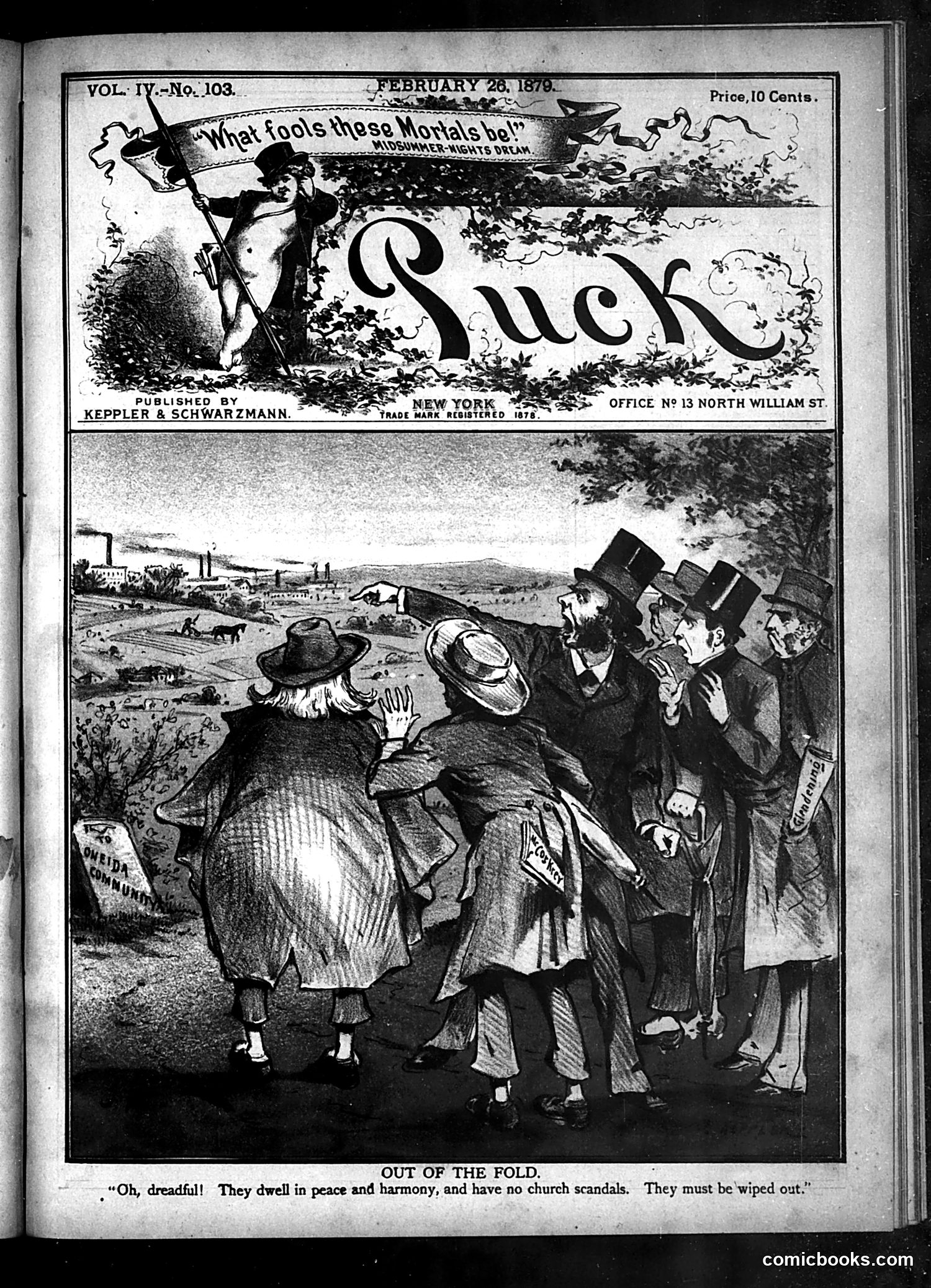
This cartoon satirizes religious intolerance toward a peaceful community. Well-dressed gentlemen in top hats appear alarmed by a distant settlement with factories and farmland. The caption reveals their concern: a community exists "in peace and harmony" without "church scandals" and must be "wiped out." The satire mocks the hypocrisy of religious institutions—suggesting they see communities functioning harmoniously *without* organized religion as a threat requiring elimination. The gentlemen's formal dress and distressed expressions emphasize how threatening they find social order independent of ecclesiastical control. The headline "What fools these Mortals be!" reinforces mockery of their bigotry and fear of alternatives to church authority during an era of religious skepticism and debate about secularism's role in society.
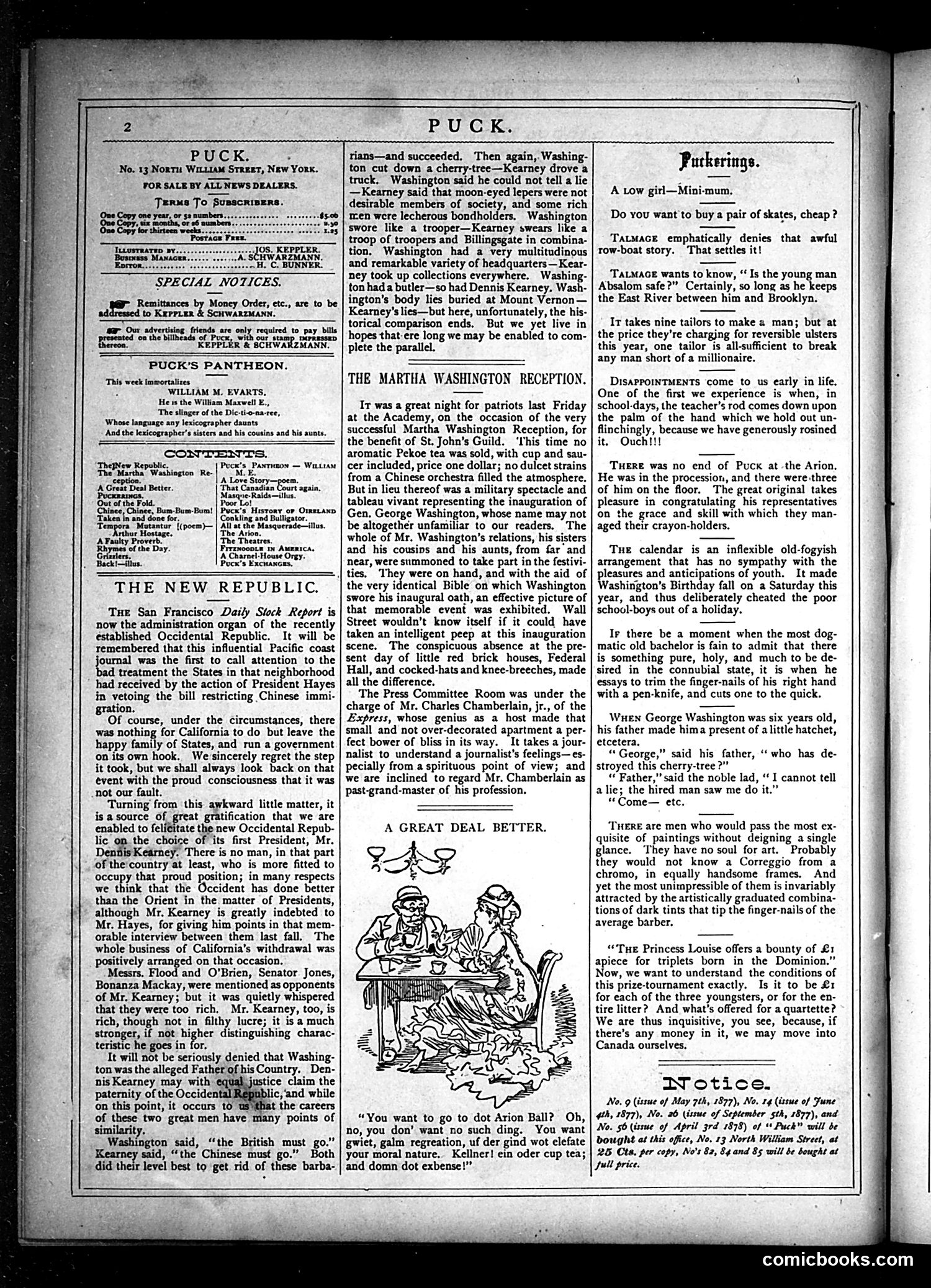
The main cartoon, titled "A GREAT DEAL BETTER," depicts two figures in 19th-century dress sitting together. Based on the page's content discussing Dennis Kearney and Chinese immigration, this likely satirizes the anti-Chinese sentiment of the era. The figures appear to be caricatured in a way suggesting working-class or labor movement characters. The surrounding text discusses Kearney (likely the Workingmen's Party leader) and contemporary debates about Chinese laborers, immigration policy, and class conflict in California. The cartoon presumably mocks either Kearney's positions or the anti-Chinese movement itself, though the specific satirical angle—whether supporting or opposing these views—is unclear from the image alone. The page includes various other articles and advertisements typical of 1870s satirical journalism.
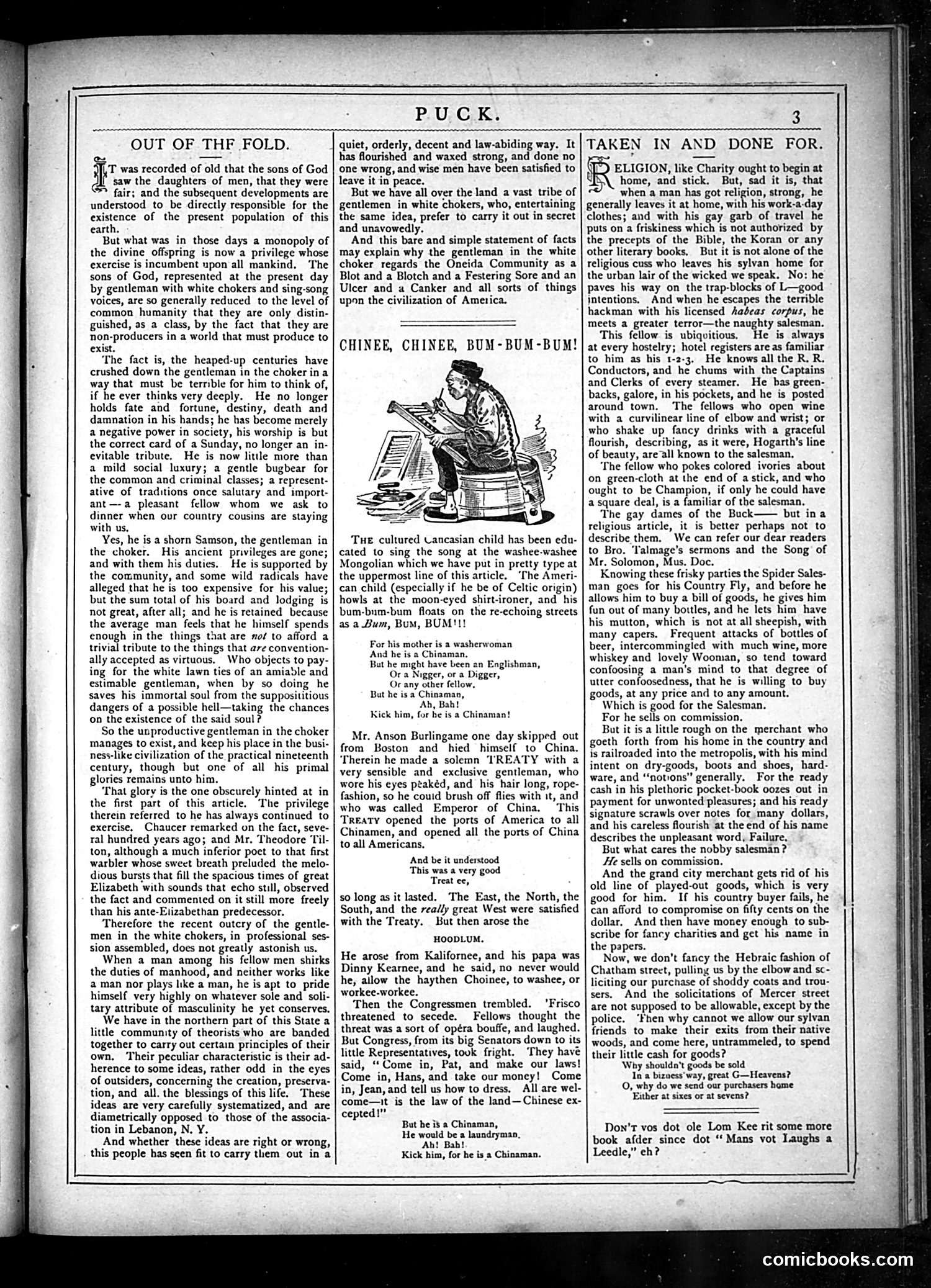
The page contains three distinct satirical pieces: **"Out of the Fold"** critiques gentlemen in white chokers who exploit their social status. The satire targets how privileged men leverage their position for unearned respect, comparing them unfavorably to common laborers. **"Chinee, Chinee, Bum-Bum-Bum!"** features a caricatured Chinese figure and mocks Chinese immigration and cultural practices. The accompanying poem ridicules Chinese people, reflecting the xenophobic attitudes prevalent in late 19th-century America. **"Taken In and Done For"** satirizes a religious gentleman who abandons his wife and workday clothes, adopting a hypocritical pious lifestyle while traveling to avoid responsibility—critiquing selective morality among the upper classes. All pieces employ Puck's characteristic satire targeting social hypocrisy and class pretension.
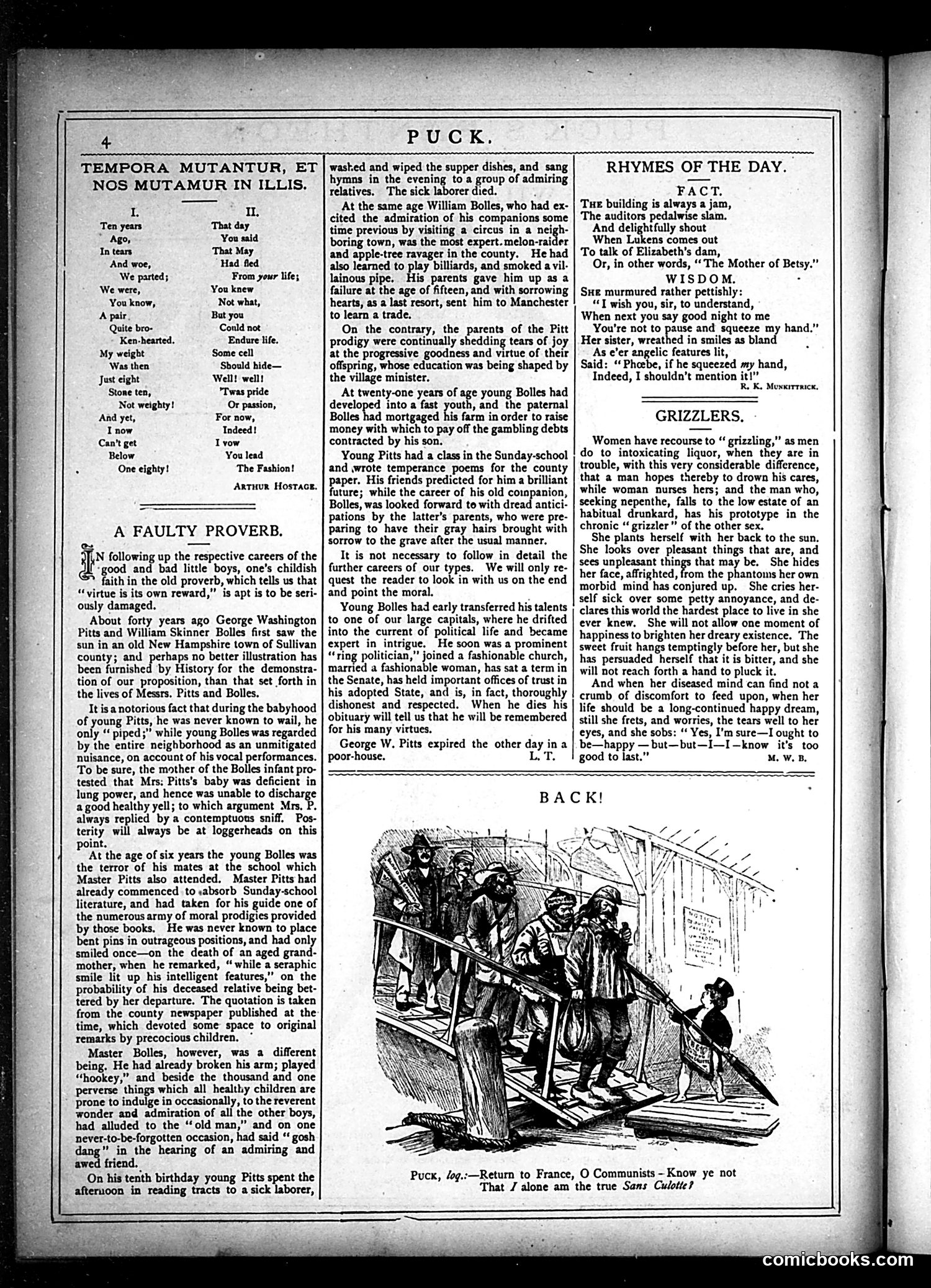
The page contains several distinct sections rather than a single cohesive cartoon: **"A Faulty Proverb"** discusses George Washington Pitts and William Bolles from New Hampshire—apparently contrasting their childhood reputations ("bad") with adult success. The piece satirizes the proverb that virtue in youth predicts good character, using these men as counterexamples. **"Back!"** shows an illustration (unclear without caption context) depicting what appears to be figures on stairs or a slope, with a caption referencing Puck and France returning to "true Saint Gaudete" (OCR likely garbled). The page also includes "Rhymes of the Day" and "Grizzlers" sections—brief humorous verses about women and intoxication. **Overall**: This appears to be a miscellaneous collection of short satirical pieces rather than unified political commentary on a specific event.
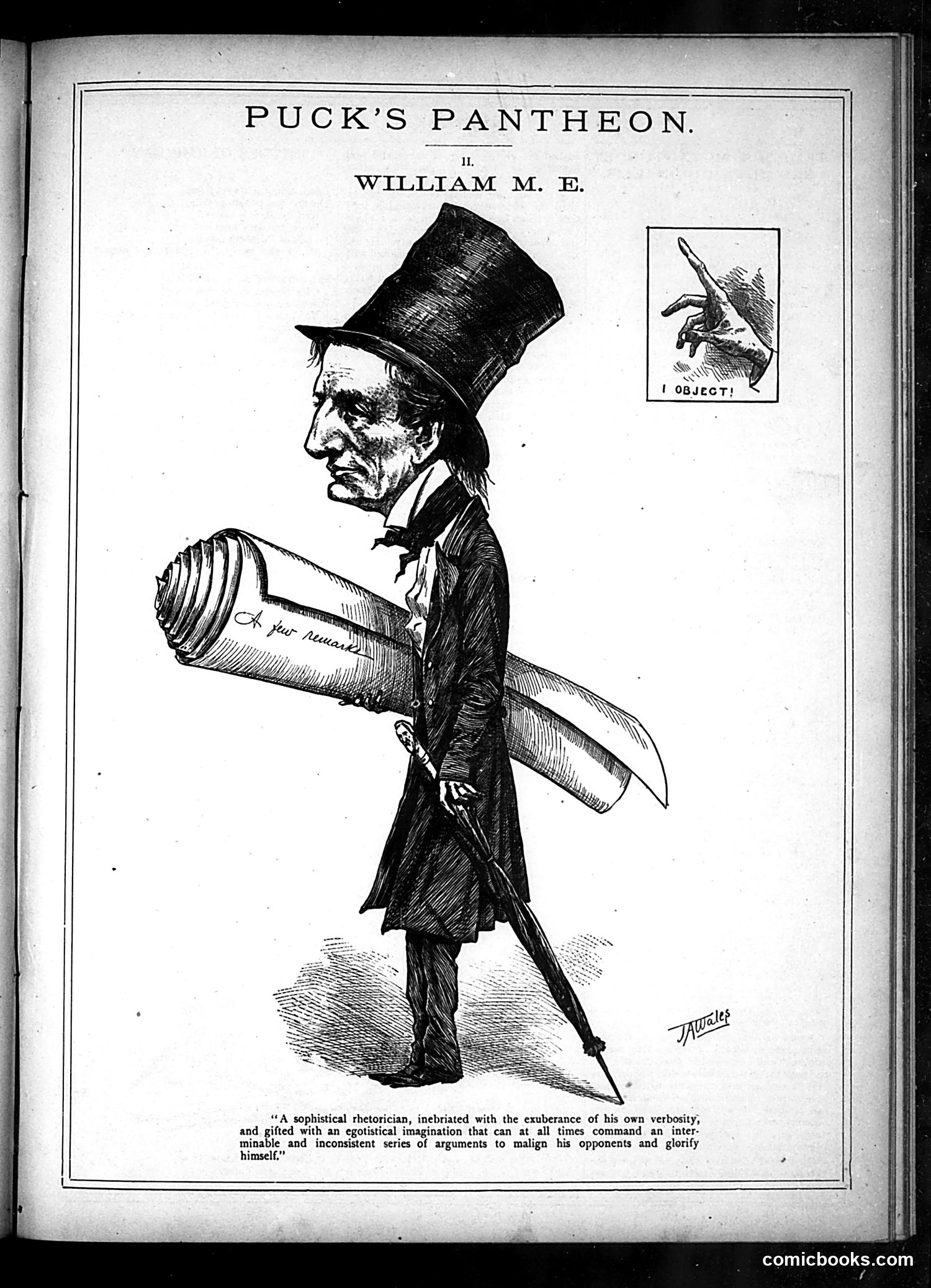
This is a caricature of William M.E. (likely a prominent figure of the era, though specific identity is unclear from the text alone). The figure wears a tall top hat and formal dress while carrying a large scroll or document labeled "for your perusal," suggesting he deals in rhetoric or proposals. The small inset shows a cherub saying "I object!"—a visual pun referencing the figure's apparent role as someone who presents arguments or positions that invite criticism. The caption describes a "sophistic rhetorician" skilled at making contradictory arguments seem consistent and at manipulating opponents through clever speech. This satirizes someone known for verbal gymnastics and rhetorical prowess used to obscure truth or advance self-interest.
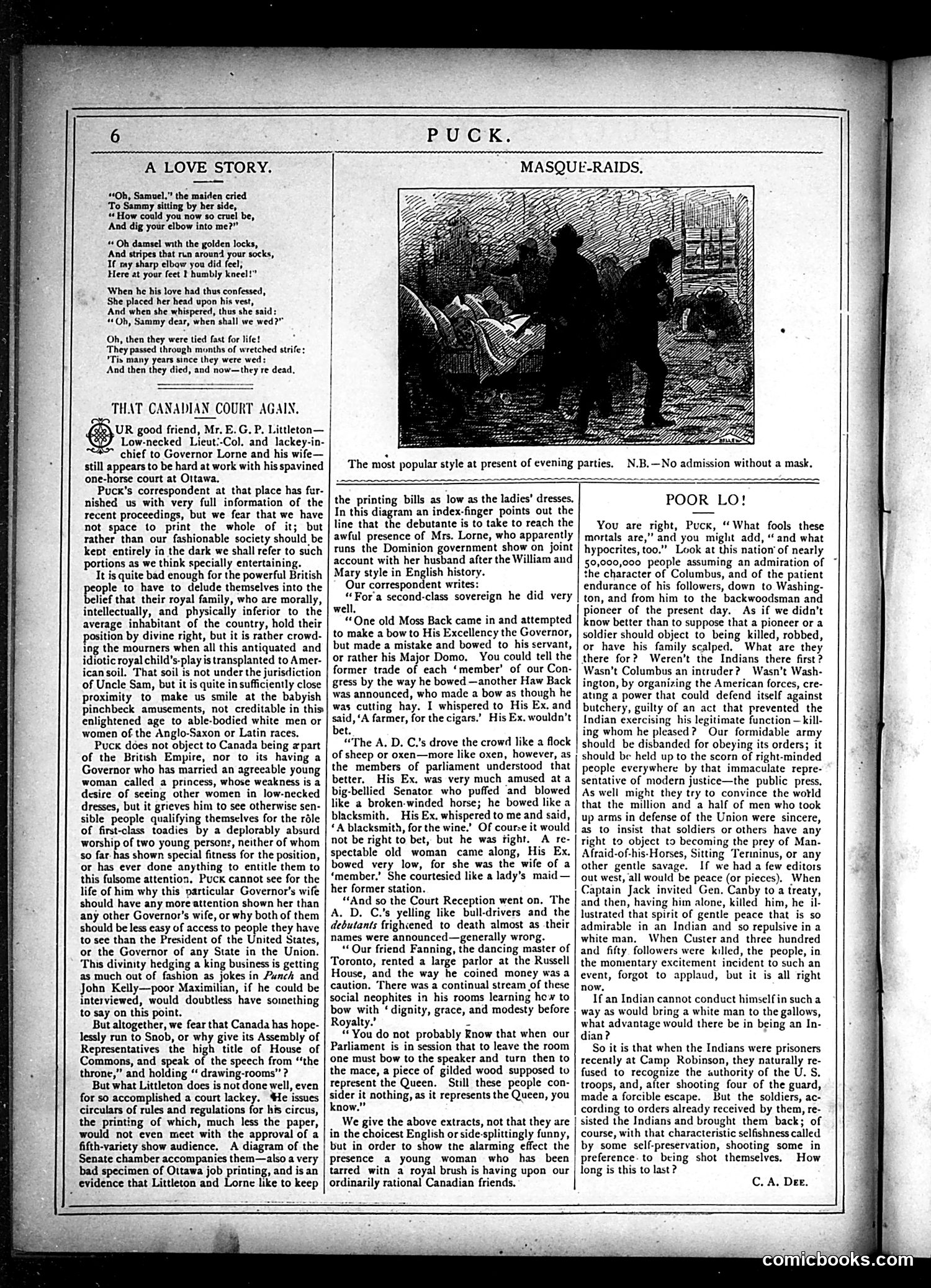
The illustration depicts a masked ball scene with silhouetted figures in formal attire. The caption notes "No admission without a mask," referencing the fashionable masquerade parties of the era. The accompanying article "Poor Lo!" discusses Canadian Indigenous affairs, specifically criticizing Ottawa's social elite for their hypocrisy. The text argues that prominent citizens who attend high-society events (represented by the masquerade) display moral inconsistency regarding treatment of Indigenous peoples ("Lo" being a period term for Native Americans/First Nations). The satire suggests that Ottawa's fashionable society wears literal masks at parties while metaphorically hiding their complicity in or indifference to colonial injustices. The piece critiques the contradiction between genteel civility and actual policy impacts on Indigenous populations.
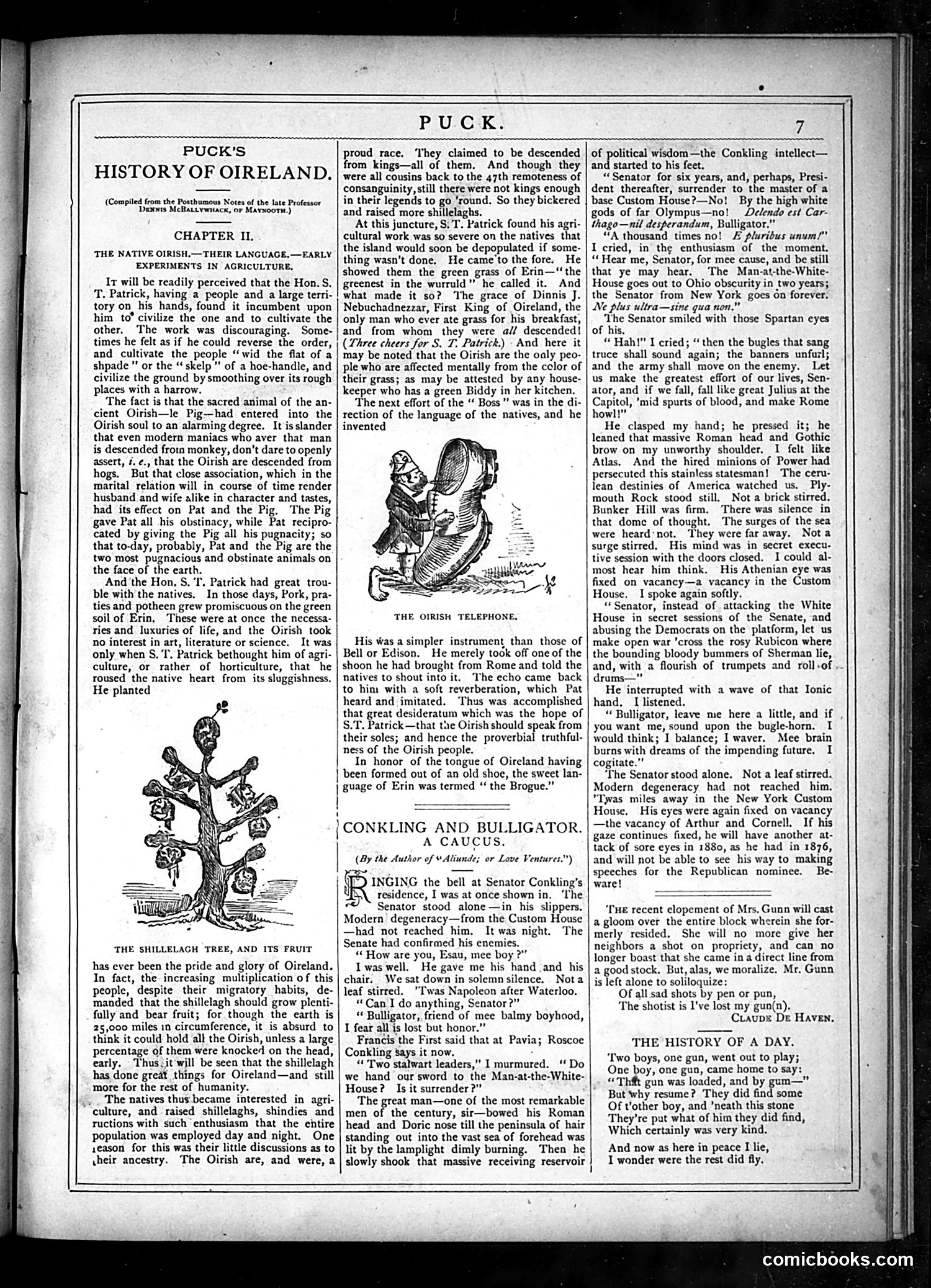
This page contains two satirical sections: **"The Orrish Telephone"** (top illustration): A cartoon depicting Irish people using a primitive "telephone" made from a shoe and string—mocking Irish stereotypes about technological backwardness and cultural primitiveness. The shoe reference plays on period Irish caricatures. **"Conkling and Bulligator: A Caucus"** (bottom): Political satire involving Senator Conkling (a real Gilded Age Republican politician). The text suggests he's manipulating political processes from behind the scenes, with references to controlling Republican nominations. The "Bulligator" figure appears to represent aggressive political pressure tactics. Both pieces use exaggerated caricature to satirize their subjects—Irish immigrants as ignorant, and Republican power brokers as corrupt manipulators—reflecting Puck's tendency toward harsh ethnic and political mockery typical of 1880s-era American satire.
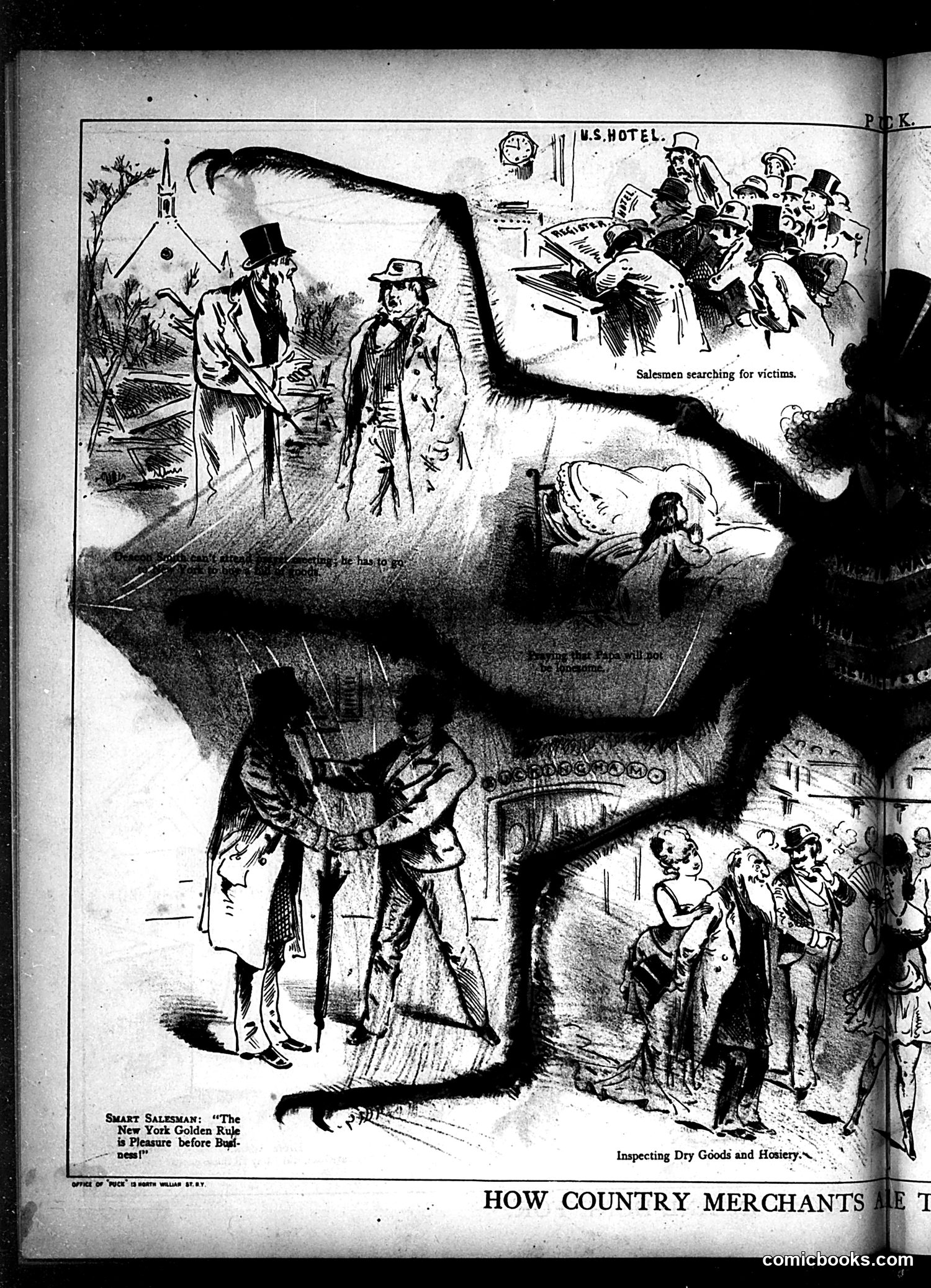
This satirical illustration depicts "How Country Merchants [are] Tr[eated]" (title cut off). The cartoon shows a grotesque figure—apparently representing unscrupulous salesmen or traveling merchants—preying on rural shopkeepers. The sequential scenes illustrate their schemes: the top panel shows "Salesmen searching for victims" at a U.S. Hotel; middle panels depict deceptive transactions; the bottom shows "Inspecting Dry Goods and Hosiery." One caption reads: "Sweet Salesman: 'The New York Golden Rule is Pleasure before Business!'" The satire targets dishonest urban merchants exploiting naive country store owners through smooth talk and fraudulent sales practices. The grotesque monster-like figure embodies the predatory nature of these con artists. This reflects late-19th-century anxieties about urban commercial deception victimizing rural America.
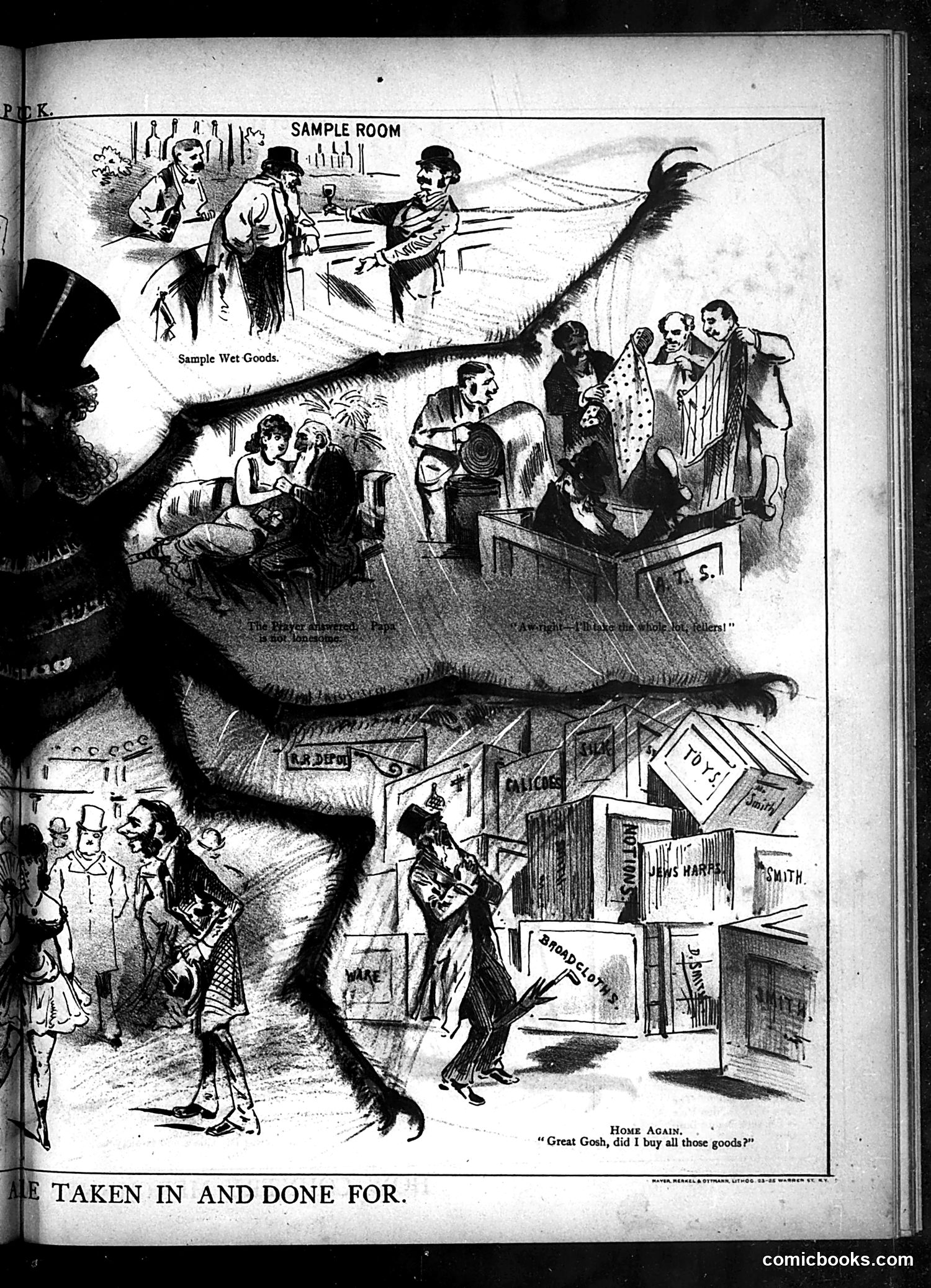
This Puck cartoon satirizes consumer shopping behavior, likely from the early 20th century. The upper panel labeled "Sample Room" shows salesmen displaying "Sample Wet Goods" to eager buyers. The lower panel, "Home Again," depicts a husband returning home saying "Great Goah, did I buy all those goods?"—revealing he's been duped into purchasing excessive merchandise. The giant hand manipulating the scene suggests commercial forces controlling consumers. Store signs (visible but partially legible) indicate various merchants. The satire mocks both aggressive sales tactics and consumer gullibility—how shoppers, particularly men, can be persuaded to buy far more than needed through sample displays and salesmanship. It's commentary on emerging consumer culture and marketplace manipulation.
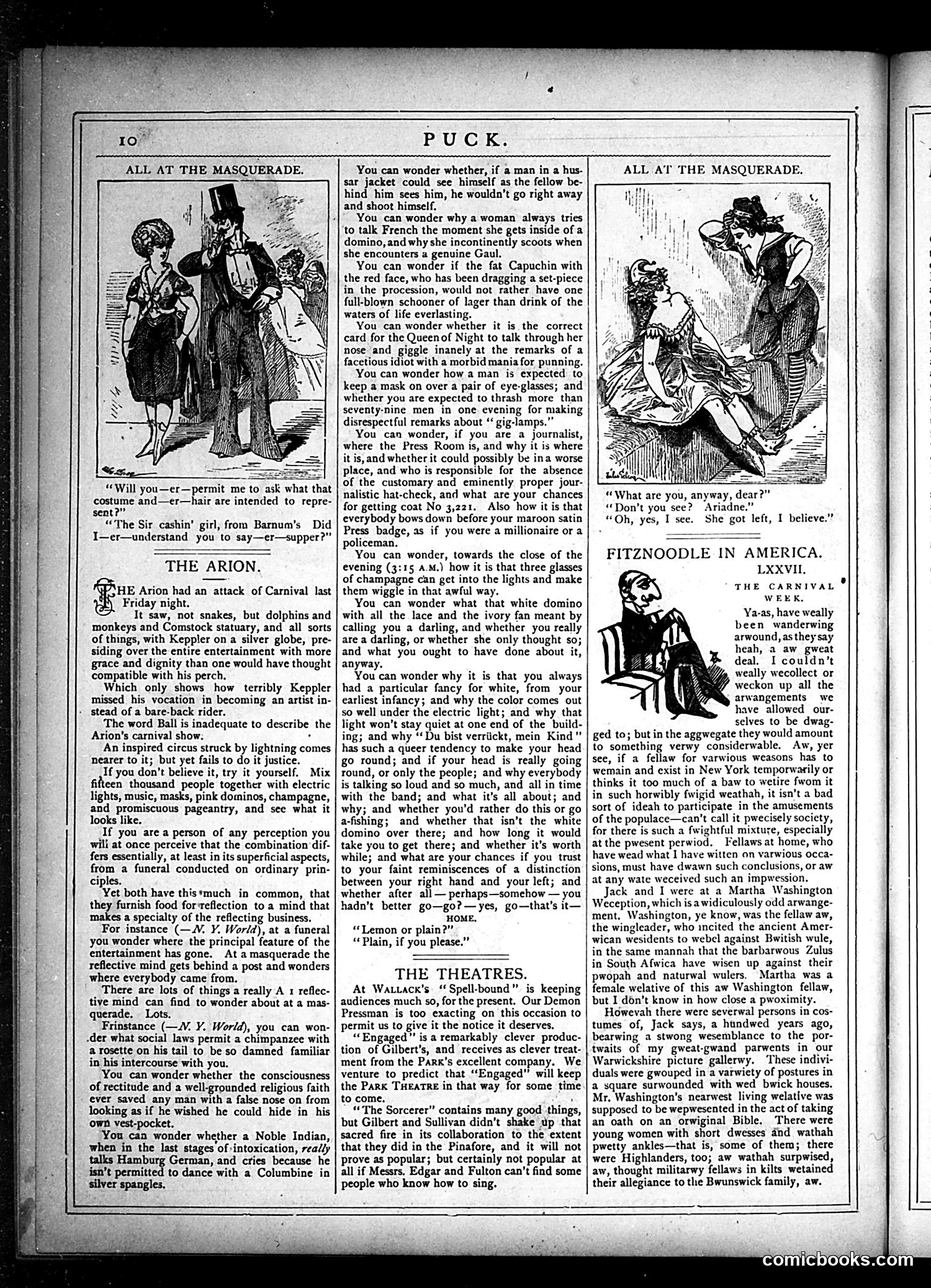
This page contains two main sections: **Left cartoon ("Will you—er—permit me to ask..."):** Shows a formally-dressed man at a masquerade ball addressing a woman. The caption suggests he's asking intrusive personal questions while wearing a mask—the satire being that masquerade costumes don't excuse rude social behavior. The joke mocks men who use anonymity to make inappropriately personal inquiries. **Right cartoon ("What are you, anyway, dear?"):** Similarly depicts a masquerade encounter where identities remain obscured, with the woman responding "Ardane" and the man expressing disbelief. Both cartoons satirize how masquerade balls—popular social events—create situations where masked anonymity supposedly permits social transgressions that would normally be unacceptable. The humor targets poor etiquette disguised by costume.
This page consists entirely of text—a long essay titled "A Charnel-House Orgy: James Pawn in 'Belgravia,'" with no visible cartoons or illustrations. The piece discusses Charles Dickens's literary legacy and influence, comparing his work to that of contemporary writers. It mentions visits to Dickensian locations like Barnaby Rudge's settings and the Maypole Inn, critiquing American visitors' enthusiasm for these sites. The essay also discusses "Belgravia," a publication, and references Dickens's impact on English literature and culture. The author argues Dickens remains unmatched in capturing authentic English life and character. This appears to be a literary criticism piece rather than satirical commentary, occupying space that would typically feature Puck's signature political cartoons.
This page contains **no political cartoons**—it's primarily miscellaneous satirical commentary and advertisements typical of Puck's format. The left column features "Puck's Persiflage," a humor section with brief jokes and observations on contemporary social life. Topics include matrimony, theater parties, winter weather, and newspaper circulation. The writing mocks various American habits and pretensions through short anecdotes. The right side includes longer commentary pieces and what appears to be an advertisement for "Catarrhe" (a medicinal product), which was common in period magazines. The humor relies on recognizing contemporary references—theater productions, social customs, weather patterns—rather than political satire. This reflects Puck's mixed editorial approach combining social observation with product promotion.
This page is primarily **advertising**, not editorial content or political cartoons. It contains commercial advertisements for various products and services typical of the era: furniture by Thonet Brothers, jewelry and watches from Pachtmann & Moelich, clocks from Hamann & Koch, a German student lamp, coffee pots, umbrellas from Isaac Smith, dental services, photography, banjos, and cigarettes. The only quasi-editorial element is a small notice "In Memoriam Brigham Young" at bottom right, referencing the deceased Mormon leader, offering a reprinted cartoon illustration. This appears to be a back page or interior advertising section of Puck magazine, reflecting late 19th-century commercial culture rather than satirical commentary.
This page is primarily **advertising** rather than satirical cartoon content. It showcases various New York businesses from what appears to be the 1870s era, including: - Wine and champagne importers (De Venoge, Piper-Heidsieck, Aheller & Bro.) - A tailor (Nicoll) - Restaurant (C. Pfaff's) - Furniture manufacturer (Mathesius & Frey) - Book dealers and binders The only notable illustrated content is **"Kurtz' Portraits"** at top right—silhouettes of figures in various poses, advertised as having won "Highest Awards" in multiple cities. The page demonstrates how 19th-century magazines monetized space through dense advertising while maintaining minimal editorial content, reflecting the publication's business model rather than satirical intent.
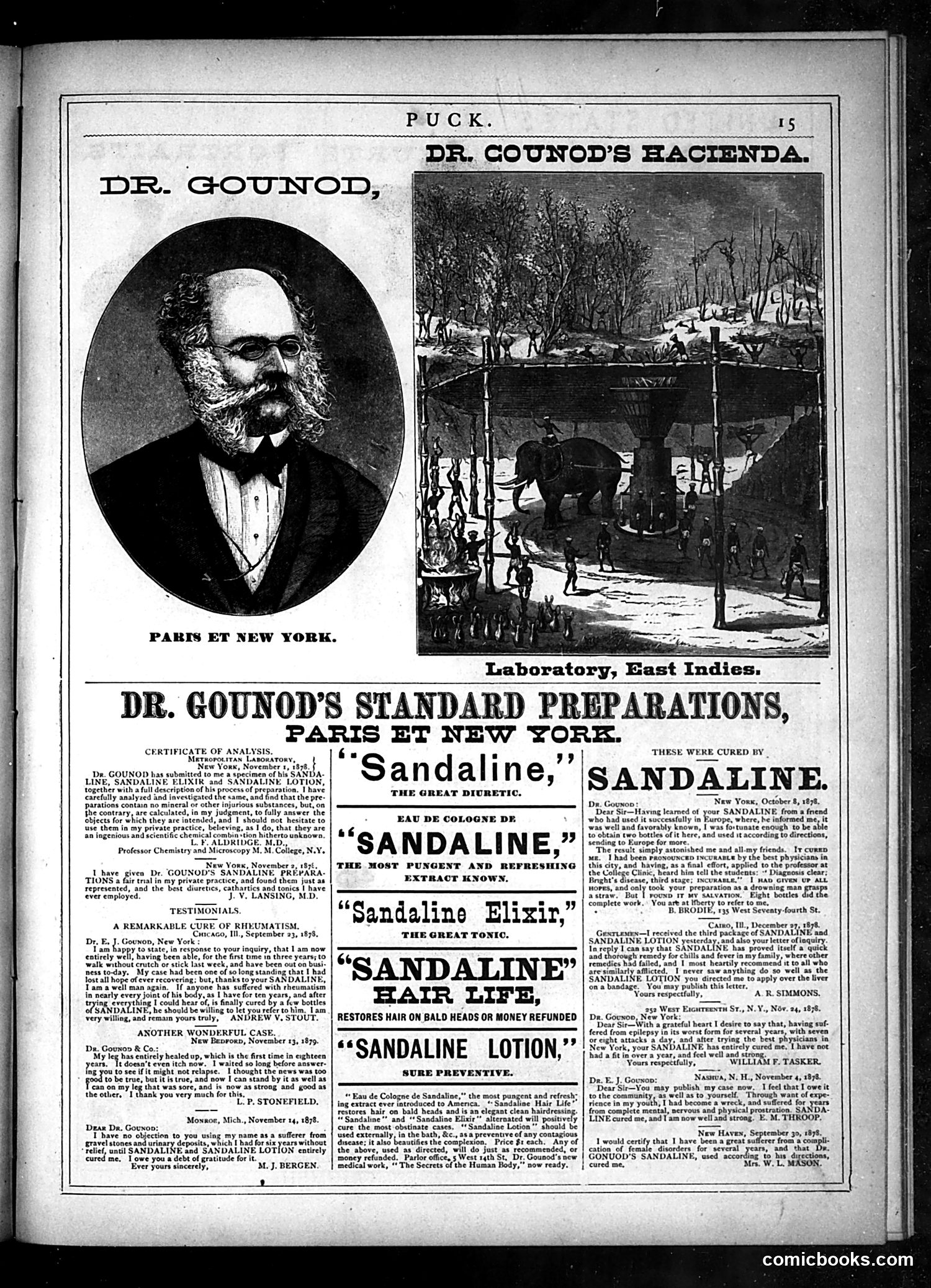
This is primarily **a medical advertisement page**, not a political cartoon. It features Dr. Gounod, a medical practitioner with offices in Paris and New York, promoting "Sandaline" — a patent medicine marketed as a cure for diabetes, rheumatism, and various other ailments. The page includes: - A portrait of Dr. Gounod - An engraving of his laboratory in the East Indies - Multiple testimonial letters from satisfied patients - Various product forms (elixir, lotion, hair tonic) The "satire" element typical of Puck appears minimal here; this reads as a straightforward medical advertisement using period conventions: physician credentials, patient testimonials, and exotic ingredient sourcing to establish credibility and appeal to readers seeking treatments for chronic diseases.
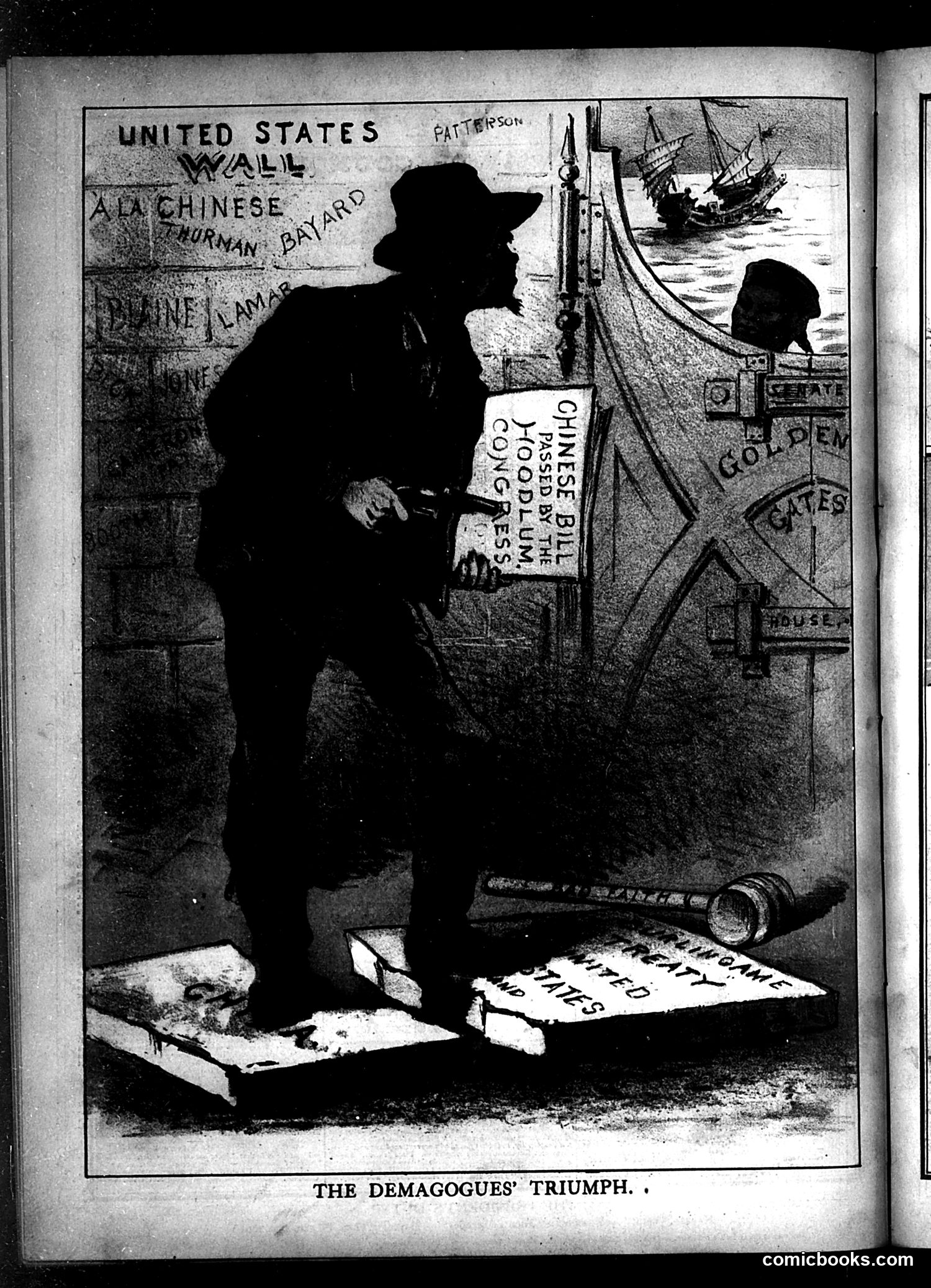
This Puck cartoon satirizes political demagoguery through a silhouetted figure standing amid debris labeled with references to exclusionary policies. Visible text includes "UNITED STATES WALL," "CHINESE," "THURMAN BAYARD," and mentions of "PASSED BY THE GOOD CONGRESS." The figure appears to represent a demagogue triumphantly displaying inflammatory political rhetoric—likely referencing late 19th-century anti-Chinese sentiment and restrictive immigration legislation. The scattered papers and debris suggest the wreckage of democratic principle caused by appealing to prejudice rather than reason. The ship and harbor setting emphasizes America's immigrant history, contrasting sharply with the exclusionary policies being mocked. The cartoon critiques politicians who gain power by demonizing vulnerable groups, particularly Chinese immigrants.