
Puck, 1879-02-26 · page 4 of 16
Puck — February 26, 1879 — page 4: what you’re looking at
What you’re looking at
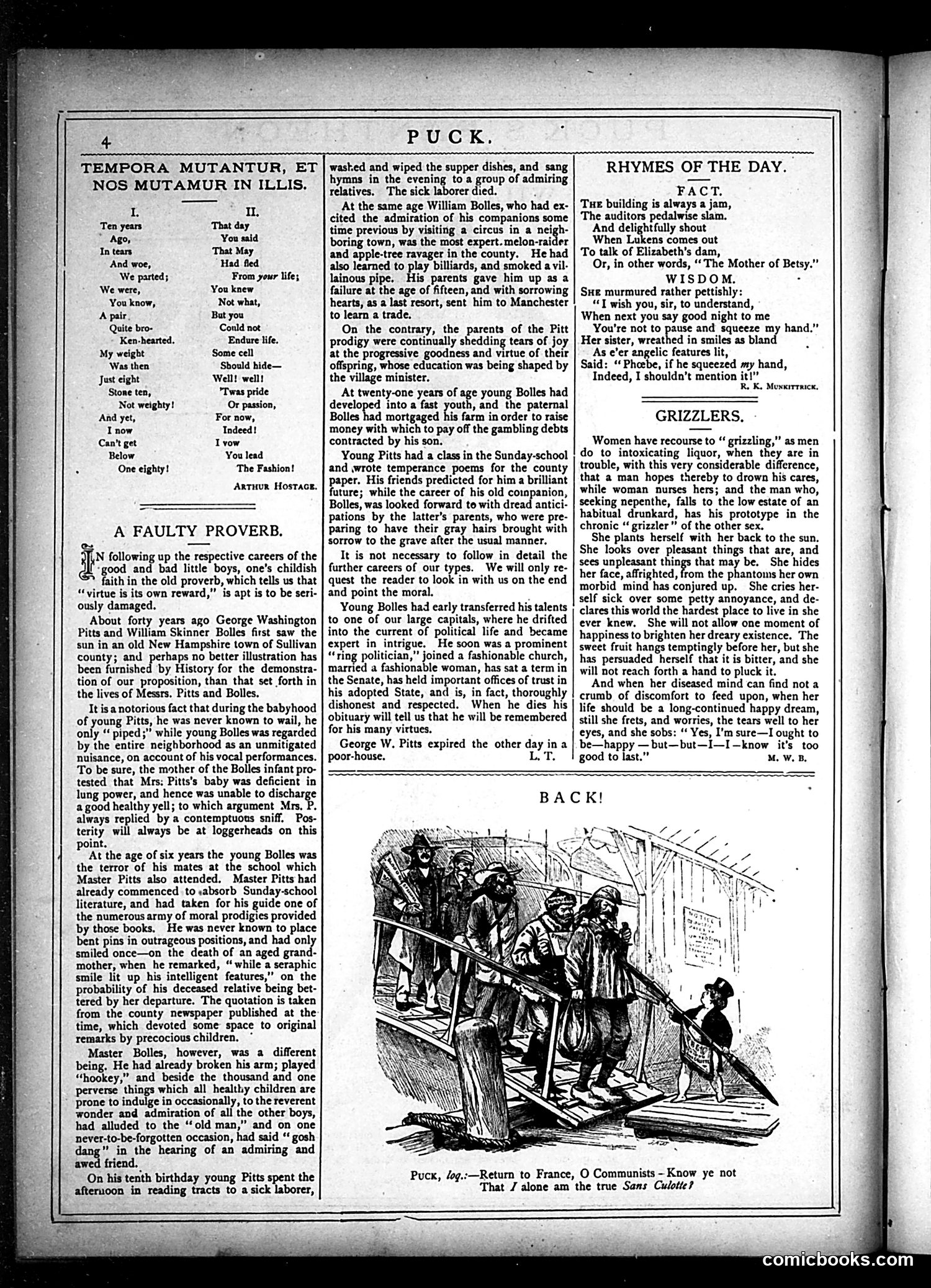
The page contains several distinct sections rather than a single cohesive cartoon: **"A Faulty Proverb"** discusses George Washington Pitts and William Bolles from New Hampshire—apparently contrasting their childhood reputations ("bad") with adult success. The piece satirizes the proverb that virtue in youth predicts good character, using these men as counterexamples. **"Back!"** shows an illustration (unclear without caption context) depicting what appears to be figures on stairs or a slope, with a caption referencing Puck and France returning to "true Saint Gaudete" (OCR likely garbled). The page also includes "Rhymes of the Day" and "Grizzlers" sections—brief humorous verses about women and intoxication. **Overall**: This appears to be a miscellaneous collection of short satirical pieces rather than unified political commentary on a specific event.
📄 Transcribed text from this page (OCR, searchable)
Machine-transcribed from the original scan — historical spelling and the odd misread are preserved.
PUCK. TEMPORA MUTANTUR, ET NOS MUTAMUR IN ILLIS. I. Il, Ten years ‘That day * Ago, ‘You said In tears That May And woe, Had fied We parted; From your life; We were, You knew ‘You know, Not what, A pair, But you Quite bro- Contd not Ken-hearted. Endure life. My weight Some cell ‘Was then Should hide— Just eight ‘Well! well! Stone ten, "Twas pride Not weighty! Or passion, And yet, For now, Inow Indeed! Can't get T vow Below You lead One eighty! ‘The Fashion! AxtTHUR Hostacs. A FAULTY PROVERB. N following up the respective careers of the -good and bad little boys, one's childish faith in the old proverb, which tells us that “virtue is its own reward," is apt is to be seri- ously damaged. About forty years ago George Washington Pitts and William Skinner Bolles first saw the sun in an old New Hampshire town of Sullivan county; and peta no better illustration has been furnished by History for the demonstra- tion of our proposition, than that set forth in the lives of Messrs. Pitts and Bolles. It is a notorious fact that during the babyhood of young Pitts, he was never known to wail, he only “ piped;” while young Bolles was regarded by the entire neighborhood as an unmitigated nuisance, on account of his vocal performances. To be sure, the mother of the Bolles infant pro- tested that Mrs: Pitts’s baby was deficient in lung power, and hence was unable to discharge a good healthy yell; to which argument Mrs, P. always replied by a contemptuous sniff. Pos- terity will always be at loggerheads on this int. At the age of six years the young Bolles was the terror of his mates at the school which Master Pitts also attended. Master Pitts had already commenced to absorb Sunday-school literature, and had taken for his guide one of the numerous army of moral prodigies provided by those books. He was never known to place bent pins in outrageous positions, and had onl; smiled once—on the death of an aged grand- mother, when he remarked, “while a seraphic smile lit up his intelligent features,” on the probability of his deceased relative being bet- tered by her departure. The quotation is taken from the county newspaper published at the time, which devoted some space to original remarks by precocious children. * Master Bolles, however, was a different being. He had already broken his arm; played “hookey,” and beside the thousand and one perverse things which all healthy children are prone to indulge in occasionally, to the reverent wonder and admiration of all the other boys, had alluded to the ‘‘old man,” and on one never-to-be-forgotten occasion, had said “‘ gosh dang” in the hearing of an admiring and awed friend. On his tenth birthday young Pitts spent the afternoon in reading tracts to a sick laborer, washed and wiped the supper dishes, and sang hymns in the evening toa group of admiring relatives. The sick laborer died. r At the same age William Bolles, who had ex- cited the admiration of his companions some time previous by visiting a circus in a neigh- boring town, was the most expert. melon-raider and apple-tree ravager in the county. He had also learned to play billiards, and smoked a vil- lainous pipe. His parents gave him up as a failure at the age of fifteen, and with sorrowing hearts, as a last resort, sent him to Manchester to learn a trade. On the contrary, the parents of the Pitt prodigy were continually shedding tears of joy at the progressive goodness and virtue of their offspring, whose education was being shaped by the village minister. At twenty-one years of age young Bolles had developed into a fast youth, and the paternal Bolles Rad mortgaged his farm in order to raise money with which to pay off the gambling debts contracted by his son. Young Pitts had a class in the Sunday-school and wrote temperance poems for the county paper. His friends predicted for him a brilliant future; while the career of his old companion, Bolles, was looked forward to with dread antici- pations by the latter’s parents, who were pre- paring to have their gray hairs brought with sorrow to the grave after the usual manner. It is not necessary to follow in detail the further careers of our types. We will only re- quest the reader to look in with us on the end and point the moral. Young Bolles had early transferred his talents to one of our large capitals, where he drifted into the current of political life and became expert in intrigue. He soon was a prominent “ring politician,” joined a fashionable church, married a fashionable woman, has sat a term in the Senate, has held important offices of trust in his adopted State, and is, in fact, thoroughly dishonest and respected. When he dies his obituary will tell us that he will be remembered for his many virtues. George W. Pitts expired the other day in a Tt RHYMES OF THE DAY.» FACT. Tue building is always a jam, The auditors pedalwise slam. And delightfully shout When Lukens comes out To talk of Elizabeth’s dam, Or, in other words, ‘The Mother of Betsy.” WISDOM. Se murmured rather pettishly: “T wish you, sir, to understand, When next you say good night to me You're not to pause and squeeze my hand.” Her sister, wreathed in smiles as blan As e’er angelic features lit, Said: ‘Phoebe, if he squeezed my hand, Indeed, I shouldn’t mention it!” R. K, Muwxrrtricn, GRIZZLERS. Women have recourse to “ grizzling,” as men do to intoxicating liquor, when they are in trouble, with this very considerable difference, that a man hopes thereby to drown his cares, while woman nurses hers; and the man who, seeking nepenthe, falls to the low estate of an habitual drunkard, has his prototype in the chronic “ grizzler” of the other sex. She plants herself with her back to the sun. She looks over pleasant things that are, and sees unpleasant things that may be. She hides her face, affrighted, from the phantoms her own morbid mind has conjured up. She cries her- self sick over some petty annoyance, and de- clares this world the hardest place to live in she ever knew. She will not allow one moment of happiness to brighten her dreary existence. The sweet fruit hangs temptingly before her, but she has persuaded herself that it is bitter, and she will not reach forth a hand to pluck it. And when her diseased mind can find not a crumb of discomfort to feed upon, when her life should be a long-continued happy dream, still she frets, and worries, the tears well to her eyes, and she sobs: ‘‘ Yes, I'm sure—I ought to be—happy — but—but—I—I —know it's too poor-house. L. Puck, /og.:—Return to France, O Communists - Know ye not That / alone am the true Sans Culotte?