
Puck, 1879-02-26 · page 3 of 16
Puck — February 26, 1879 — page 3: what you’re looking at
What you’re looking at
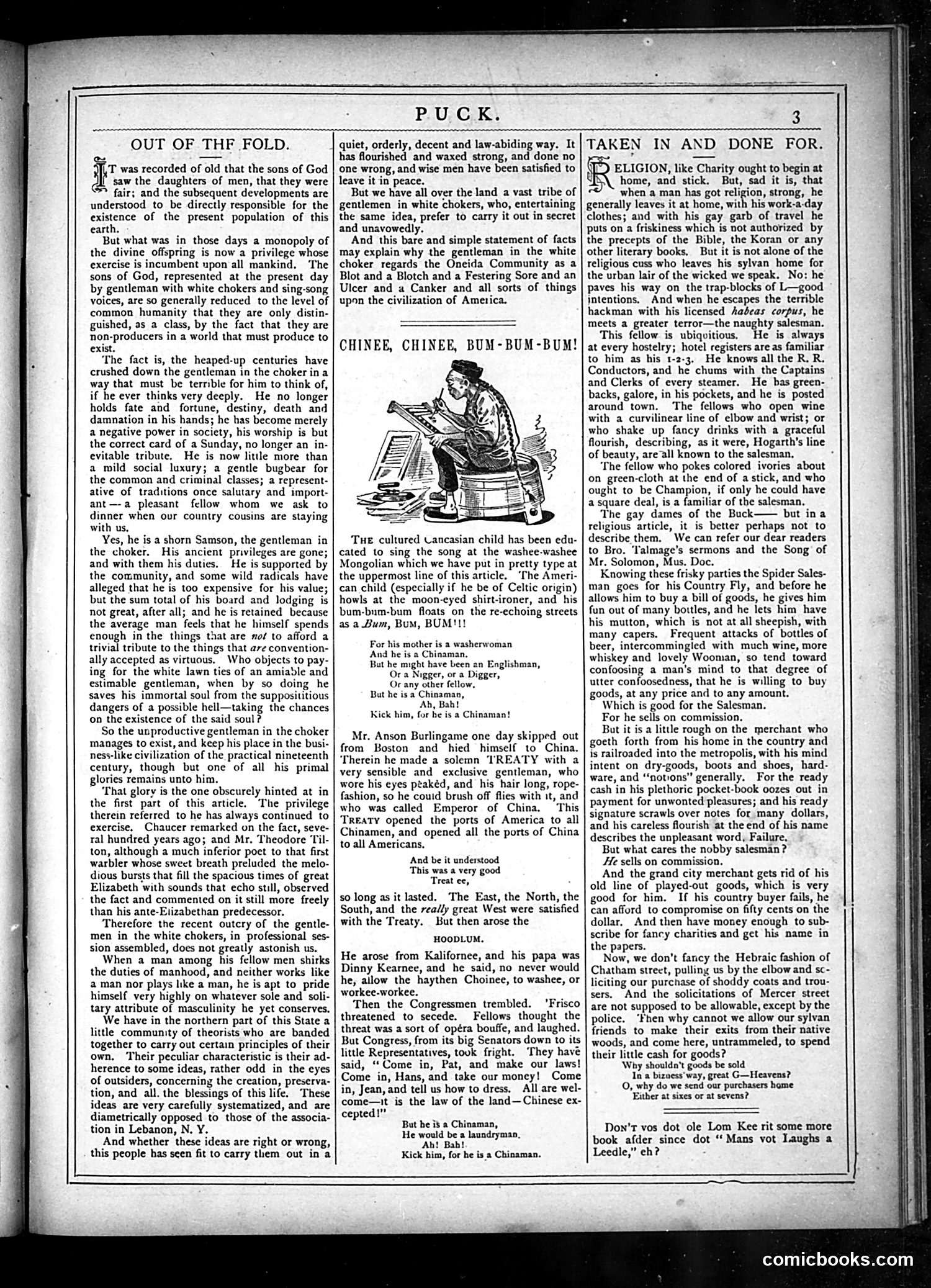
The page contains three distinct satirical pieces: **"Out of the Fold"** critiques gentlemen in white chokers who exploit their social status. The satire targets how privileged men leverage their position for unearned respect, comparing them unfavorably to common laborers. **"Chinee, Chinee, Bum-Bum-Bum!"** features a caricatured Chinese figure and mocks Chinese immigration and cultural practices. The accompanying poem ridicules Chinese people, reflecting the xenophobic attitudes prevalent in late 19th-century America. **"Taken In and Done For"** satirizes a religious gentleman who abandons his wife and workday clothes, adopting a hypocritical pious lifestyle while traveling to avoid responsibility—critiquing selective morality among the upper classes. All pieces employ Puck's characteristic satire targeting social hypocrisy and class pretension.
📄 Transcribed text from this page (OCR, searchable)
Machine-transcribed from the original scan — historical spelling and the odd misread are preserved.
PUCK. OUT OF THF FOLD. (i was recorded of old that the sons of God saw the daughters of men, that they were fair; and the subsequent developments are understood to be directly responsible for the existence of the present population of this earth, But what was in those days a monopoly of the divine offspring is now a privilege whose exercise is incumbent upon all mankind. The sons of God, represented at the present day by gentleman with white chokers and sing-song voices, are so generally reduced to the level of common humanity that they are only distin- guished, as a class, by the fact that they are non-producers in a world that must produce to exist. The fact is, the heaped-up centuries have crushed down the gentleman in the choker ina way that must be terrible for him to think of, if he ever thinks very deeply. He no longer holds fate and fortune, destiny, death and damnation in his hands; he has become merely a negative power in society, his worship is but the correct card of a Sunday, no longer an in- evitable tribute. He is now little more than a mild social luxury; a gentle bugbear for the common and criminal classes; a represent- ative of traditions once salutary and import- ant—-a pleasant fellow whom we ask to dinner when our country cousins are staying with us, Yes, he is a shorn Samson, the gentleman in the choker. His ancient privileges are gone; and with them his duties. He is supported by the community, and some wild radicals have alleged that he is too expensive for his value; but the sum total of his board and lodging is not great, after all; and he is retained because the average man feels that he himself spends enough in the things that are nof to afford a trivial tribute to the things that ave convention- ally accepted as virtuous. Who objects to pay- ing for the white lawn ties of an amiable and estimable gentleman, when by so doing he saves his immortal soul from the supposititious dangers of a possible hell—taking the chances on the existence of the said soul? So the unproductive gentleman in the choker manages to exist, and keep his place in the busi- ness-like civilization of the practical nineteenth century, though but one of all his primal glories remains unto him. ‘That glory is the one obscurely hinted at in the first part of this article. The privilege therein referred to he has always continued to exercise. Chaucer remarked on the fact, seve- ral hundred years ago; and Mr. Theodore Til- ton, although a much inferior poet to that first warbler whose sweet breath preluded the melo- dious bursts that fill the spacious times of great Elizabeth with sounds that echo still, observed the fact and commented on it still more freely than his ante-Elizabethan predecessor. Therefore the recent outcry of the gentle- men in the white chokers, in professional ses- sion assembled, does not greatly astonish us. When a man among his fellow men shirks the duties of manhood, and neither works like a man nor plays like a man, he is apt to pride himself very highly on whatever sole and soli- tary attribute of masculinity he yet conserves, We have in the northern part of this State a little community of theorists who are banded together to carry out certain principles of their own, Their peculiar characteristic is their ad- herence to some ideas, rather odd in the eyes of outsiders, concerning the creation, preserva- tion, and all. the blessings of this life. These ideas are very carefully systematized, and are diametrically opposed to those of the associa- tion in Lebanon, N. Y. And whether these ideas are right or wrong, this people has seen fit to carry them out in a oA quiet, orderly, decent and law-abiding way. It has flourished and waxed strong, and done no one wrong, and wise men have been satisfied to leave it in peace. But we have all over the land a vast tribe of gentlemen in white chokers, who, entertaining the same idea, prefer to carry it out in secret and unavowedly. And this bare and simple statement of facts may explain why the gentleman in the white choker regards the Oneida Community as a Blot and a Blotch and a Festering Sore and an Ulcer and a Canker and all sorts of things upon the civilization of America. CHINEE, CHINEE, BUM-BUM-BUM! Tue cultured Cancasian child has been edu- cated to sing the song at the washee-washee Mongolian which we have put in pretty type at the uppermost line of this article. ‘The Ameri- can child (especially if he be of Celtic origin) howls at the moon-eyed shirt-ironer, and his bum-bum-bum floats on the re-echoing streets as a.Bum, Bum, BUM!!! For his mother is a washerwoman And he is a Chinaman, But he might have been an Englishman, Ora Nigger, or a Digger, Or any other fellow, But he is a Chinaman, Ah, Bah! Kick him, for he is a Chinaman! Mr. Anson Burlingame one day skipped out from Boston and hied himself to China. ‘Therein he made a solemn ‘TREATY with a very sensible and exclusive gentleman, who wore his eyes ptakéd, and his hair long, rope- fashion, so he couid brush off flies with it, and who was called Emperor of China. “This TREATY opened the ports of America to all Chinamen, and opened all the ports of China to all Americans, And be it understood ‘This was a very good Treat ee, so long as it lasted. The East, the North, the South, and the rea/ly great West were satisfied with the Treaty. But then arose the HOODLUM. He arose from Kalifornee, and his papa was Dinny Kearnee, and he said, no never would he, allow the haythen Choinee, to washee, or workee-workee. Then the Congressmen trembled. ‘Frisco threatened to secede. Fellows thought the threat was a sort of opéra bouffe, and laughed. But Congress, from its big Senators down to its little Representatives, took fright. ‘They have said, “Come in, Pat, and make our laws! Come in, Hans, and take our money! Come in, Jean, and tell us how to dress, All are wel- come—it is the law of the land—Chinese ex- cepted!” But he is a Chinaman, He would be a laundryman, ‘Ab! Bab! Kick him, for he is a Chinaman, TAKEN IN AND DONE FOR. \[ ELIGION, like Charity ought to begin at US| home, and stick. But, sad it is, that when a man has got religion, strong, he generally leaves it at home, with his work-a-day clothes; and with his gay garb of travel he puts on a friskiness which is not authorized by the precepts of the Bible, the Koran or any other literary books, But it is not alone of the religious cuss who leaves his sylvan home for the urban lair of the wicked we speak. No: he paves his way on the trap-blocks of L—good intentions. And when he escapes the terrible hackman with his licensed habeas corpus, he meets a greater terror—the naughty salesman. This fellow is ubiqvitious. He is always at every hostelry; hotel registers are as familiar to him as his 1-2-3. He knows all the R, R. Conductors, and he chums with the Captains and Clerks of every steamer. He bas green- backs, galore, in his pockets, and he is posted around town, The fellows who open wine with a curvilinear line of elbow and wrist; or who shake up fancy drinks with a graceful flourish, describing, as it were, Hogarth’s line of beauty, are all known to the salesman, Y ‘The fellow who pokes colored ivories about on green-cloth at the end of astick, and who ought to be Champion, if only he could have a square deal, is a familiar of the salesman. The gay dames of the Buck—— but ina religious article, it is better perhaps not to describe them. We can refer our dear readers to Bro. ‘lalmage’s sermons and the Song’ of Mr. Solomon, Mus. Doc. Knowing these frisky parties the Spider Sales- man goes for his Country Fly, and before he allows him to buy a bill of goods, he gives him fun out of many bottles, and he lets him have his mutton, which is not at all sheepish, with many capers. Frequent attacks of bottles of beer, intercommingled with much wine, more whiskey and lovely Wooman, so tend toward confoosing a man’s mind to that degree of utter confoosedness, that he is willing to buy goods, at any price and to any amount. Which is good for the Salesman. For he sells on commission. But it is a little rough on the merchant who goeth forth from his home in the country and is railroaded into the metropolis, with his mind intent on dry-goods, boots and shoes, hard- ware, and ‘‘notions” generally, For the ready cash in his plethoric pocket-book oozes out in payment for unwonted pleasures; and his ready signature scrawls over notes for many dollars, and his careless flourish at the end of his name describes the unpleasant word, Failure, But what cares the nobby salesman? He sells on commission. And the grand city merchant gets rid of his old line of played-out goods, which is very good for him. If his country buyer fails, he can afford to compromise on fifty cents on the dollar, And then have money enough to sub- scribe for fancy charities and get his name in the papers. Now, we don’t fancy the Hebraic fashion of Chatham street, pulling us by the elbow and sc- liciting our purchase of shoddy coats and trou- sers. And the solicitations of Mercer street are not supposed to be allowable, except by the police. ‘Fhen why cannot we allow our sylvan friends to make their exits from their native woods, and come here, untrammeled, to spend their little cash for goods? ‘Why shouldn't goods be sold In a bizness'way, great G—Heavens? O, why do we send our purchasers home Either at sixes or at sevens? Don’t vos dot ole Lom Kee rit some more book afder since dot ‘‘ Mans vot Laughs a Leedle,” eh? comicbooks.com