
Puck, 1879-02-26 · page 7 of 16
Puck — February 26, 1879 — page 7: what you’re looking at
What you’re looking at
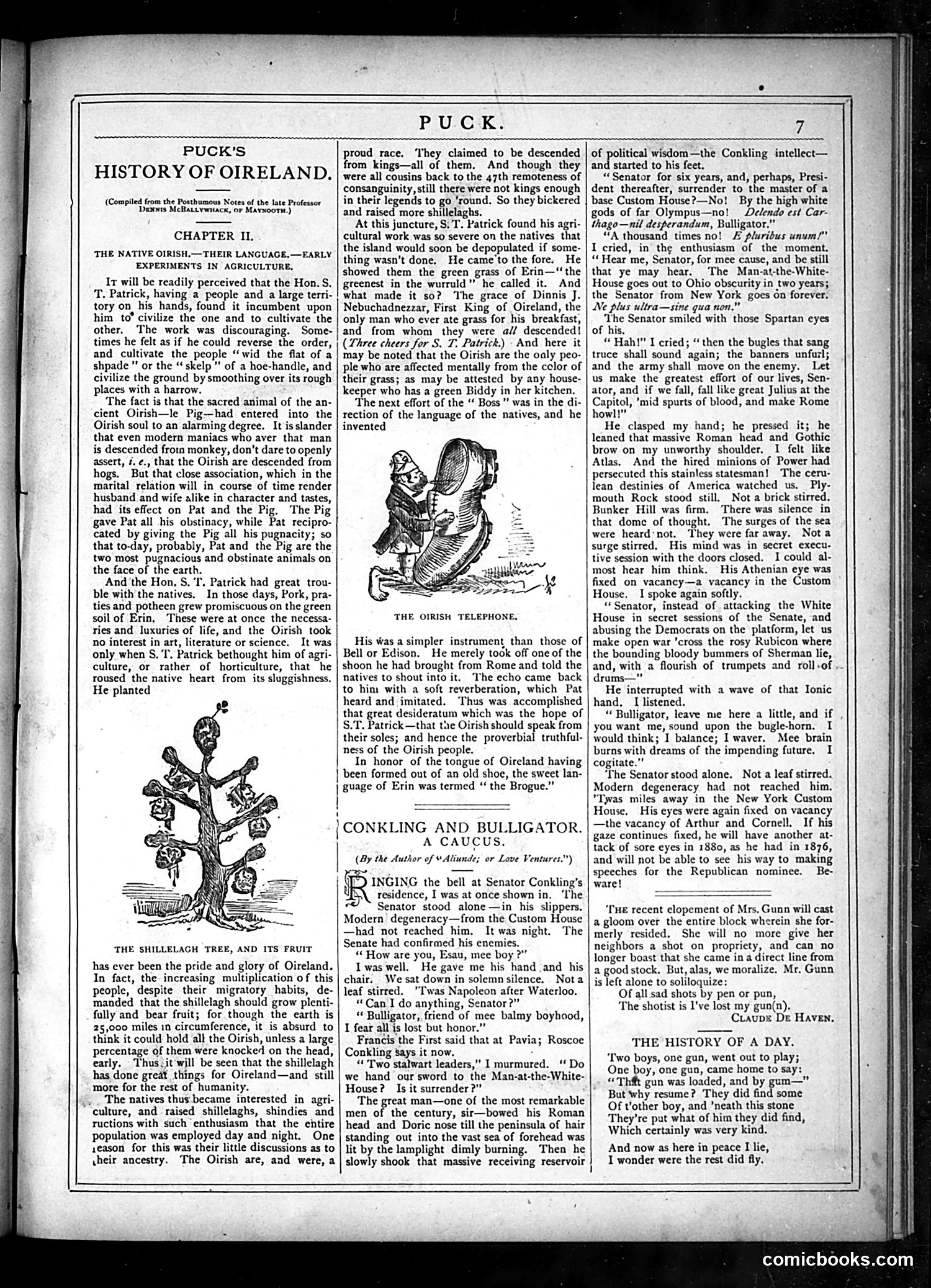
This page contains two satirical sections: **"The Orrish Telephone"** (top illustration): A cartoon depicting Irish people using a primitive "telephone" made from a shoe and string—mocking Irish stereotypes about technological backwardness and cultural primitiveness. The shoe reference plays on period Irish caricatures. **"Conkling and Bulligator: A Caucus"** (bottom): Political satire involving Senator Conkling (a real Gilded Age Republican politician). The text suggests he's manipulating political processes from behind the scenes, with references to controlling Republican nominations. The "Bulligator" figure appears to represent aggressive political pressure tactics. Both pieces use exaggerated caricature to satirize their subjects—Irish immigrants as ignorant, and Republican power brokers as corrupt manipulators—reflecting Puck's tendency toward harsh ethnic and political mockery typical of 1880s-era American satire.
📄 Transcribed text from this page (OCR, searchable)
Machine-transcribed from the original scan — historical spelling and the odd misread are preserved.
PUCK. PUCK’S HISTORY OF OIRELAND. (Compited from the Posthumous Notes of the late Professor Daxwts McBALLywitack, or Maynoorn.) CHAPTER II. THE NATIVE OIRISH.—THEIR LANGUAGE.—EARLY EXPERIMENTS IN AGRICULTURE, Ir will be readily perceived that the Hon. S. T. Patrick, having a people and a large terri- tory on his hands, found it incumbent upon him to’ civilize the one and to cultivate the other. The work was discouraging. Some- times he felt as if he could reverse the order, and cultivate the people “wid the flat of a shpade ” or the ‘‘ skelp ” of a hoe-handle, and civilize the ground by smoothing over its rough places with a harrow. The fact is that the sacred animal of the an- cient Oirish—le Pig—had entered into the Oirish soul to an alarming degree. It is slander that even modern maniacs who aver that man is descended froin monkey, don’t dare to openly assert, #. ¢., that the Oirish are descended from hogs. But that close association, which in the marital relation will in course of time render husband and wife alike in character and tastes, had its effect on Pat and the Pig. The Pig gave Pat all his obstinacy, while Pat recipro- cated by giving the Pig all his pugnacity; so that to-day, probably, Pat and the Pig are the two most pugnacious and obstinate animals on the face of the earth. And the Hon, S. ‘I, Patrick had great trou- ble with the natives. In those days, Pork, pra- ties and potheen grew promiscuous on the green soil of Erin, These were at once the necessa- ries and luxuries of life, and the Oirish took no interest in art, literature or science. It was only when S. I’. Patrick bethought him of agri- culture, or rather of horticulture, that he roused the native heart from its sluggishness. He planted THE SHILLELAGH TREE, AND ITS FRUIT has ever been the pride and glory of Oireland. In fact, the increasing multiplication of this people, despite their migratory habits, de- manded that the shillelagh should grow plenti- fully and bear fruit; for though the earth is 25,000 miles in circumference, it is absurd to think it could hold all the Oirish, unless a large percentage of them were knocked on the head, early. Thus ;it will be seen that the shillelagh has done great things for Oireland—and still more for the rest of humanity. .. . The natives thus became interested in agri- culture, and raised shillelaghs, shindies and ructions with such enthusiasm that the ehtire population was employed day and night. One season for this was their little discussions as to wheir ancestry. The Oirish are, and were, a proud race. ‘They claimed to be descended from kings—all of them. And though they were all cousins back to the 47th remoteness of consanguinity, still there were not kings enough in their legends to go ‘round. So they bickered and raised more shillelaghs. At this juncture, S,T. Patrick found his agri- cultural work was so severe on the natives that the island would soon be depopulated if some- thing wasn’t done. He came’to the fore. He showed them the green grass of Erin—“the greenest in the wurruld” he called it. And what made it so? ‘he grace of Dinnis J. Nebuchadnezzar, First King of Oireland, the only man who ever ate grass for his breakfast, and from whom they were aé/ descended! (Three cheers for S. T. Patrick.) - And here it may be noted that the Oirish are the oaly peo- ple who are affected mentally from the color of their grass; as may be attested by any house- keeper who has a green Biddy in her kitchen, The next effort of the “ Boss ” was in the di- rection of the language of the natives, and he invented THE OIRISH TELEPHONE. His was a simpler instrument than those of Bell or Edison, He merely took off one of the shoon he had brought from Rome and told the natives to shout into it. The echo came back to him with a soft reverberation, which Pat heard and imitated. Thus was accomplished that great desideratum which was the hope of S.T. Patrick —that the Oirish should speak from their soles; and hence the proverbial truthful- ness of the Oirish people. In honor of the tongue of Oireland having been formed out of an old shoe, the sweet lan- guage of Erin was termed “ the Brogue.” (CONKLING AND BULLIGATOR. A CAUCUS. (By the Author of “Aliunde; or Love Ventures.”) 4 INGING the bell at Senator Conkling’s residence, I was at once shown in. ‘Ihe «© * Senator stood alone —in_ his slippers. Modern’ degeneracy—from the Custom House —had not reached him, It was night. The Senate had confirmed his enemies. “How are you, Esau, mee boy ?” I was well. He gave me his hand .and his chair. We sat down in solemn silence. Nota leaf stirred. ’I'was Napoleon after Waterloo. “Can I do anything, Senator?” “ Bulligator, friend of mee balmy boyhood, I fear all is lost but honor.” Francis the First said that at Pavia; Roscoe Conkling Says it now. “ Two stalwart leaders,” I murmured. ‘ Do we hand our sword to the Man-at-the-White- House? Is it surrender?” The Ereat man—one of the most remarkable men of the century, sir—bowed his Roman head and Doric nose till the peninsula of hair standing out into the vast sea of forehead was lit by the lamplight dimly burning. Then he slowly shook that massive receiving reservoir { of political wisdom—the Conkling intellect— and started to his feet, “Senator for six years, and, perhaps, Presi- dent thereafter, surrender to the master of a base Custom House?—No! By the high white gods of far Olympus—no! Delendo est Car- thago—nil desperandum, Bulligator.” “A thousand times no! £ pluribus unum/” I cried, in the enthusiasm of the moment, “Hear me, Senator, for mee cause, and be still that ye may hear, The Man-at-the-White- House goes out to Ohio obscurity in two years; the Senator from New York goes On forever. Ne plus ultra—sine qua non.” ‘The Senator smiled with those Spartan eyes of his. “ Hah!” I cried; “then the bugles that sang truce shall sound again; the banners unfurl; and the army shall move on the enemy. Let us make the greatest effort of our lives, Sen- ator, and if we fall, fall like great Julius at the Capitol, ’mid spurts of blood, and make Rome howl!"” He clasped my hand; he pressed it; he leaned that massive Roman head and Gothic brow on my unworthy shoulder, I felt like Atlas. And the hired minions of Power had persecuted this stainless statesman! The ceru- lean destinies of America watched us. Ply- mouth Rock stood still. Not a brick stirred, Bunker Hill was firm, ‘There was silence in that dome of thought. The surges of the sea were heard'not. They were far away. Nota surge stirred, His mind was in secret execu- tive session with the doors closed. I could al- most hear him think. His Athenian eye was fixed on vacancy—a vacancy in the Custom House. I spoke again softly. “Senator, instead of attacking the White House in secret sessions of the Senate, and abusing the Democrats on the platform, let us make open war ‘cross the rosy Rubicon where the bounding bloody bummers of Sherman lie, and, with a flourish of trumpets and roll-of - drums—" He interrupted with a wave of that Ionic hand, 1 listened. “ Bulligator, leave me here a little, and if , you want me, sound upon the bugle-horn. I would think; I balance; I waver. Mee brain burns with dreams of the impending future. I cogitate.”” ‘The Senator stood alone. Not a leaf stirred. Modern degeneracy had not reached him. "Twas miles away in the New York Custom House. His eyes were again fixed on vacancy —the vacancy of Arthur and Cornell. If his gaze continues fixed, he will have another at- tack of sore eyes in 1880, as he had in 1876, and will not be able to see his way to making speeches for the Republican nominee. Be- ware! ‘Tue recent elopement of Mrs, Gunn will cast a gloom over the entire block wherein she for- merly resided, She will no more give her neighbors a shot on propriety, and can no longer boast that she came in a direct line from a good stock. But, alas, we moralize. Mr. Gunn is left alone to soliloquize: Of all sad shots by pen or pun, ‘The shotist is I've lost my gun(n). Craupe De Haven. THE HISTORY OF A DAY. ‘Two boys, one gun, went out to play; One boy, one gun, came home to say: “That gun was loaded, and by gum—” But why resume? They did find some Of t’other boy, and ’neath this stone They’re put what of him they did find, Which certainly was very kind. And now as here in peace I lie, I wonder were the rest did fly. comicbooks.com