
Puck, 1879-02-26 · page 6 of 16
Puck — February 26, 1879 — page 6: what you’re looking at
What you’re looking at
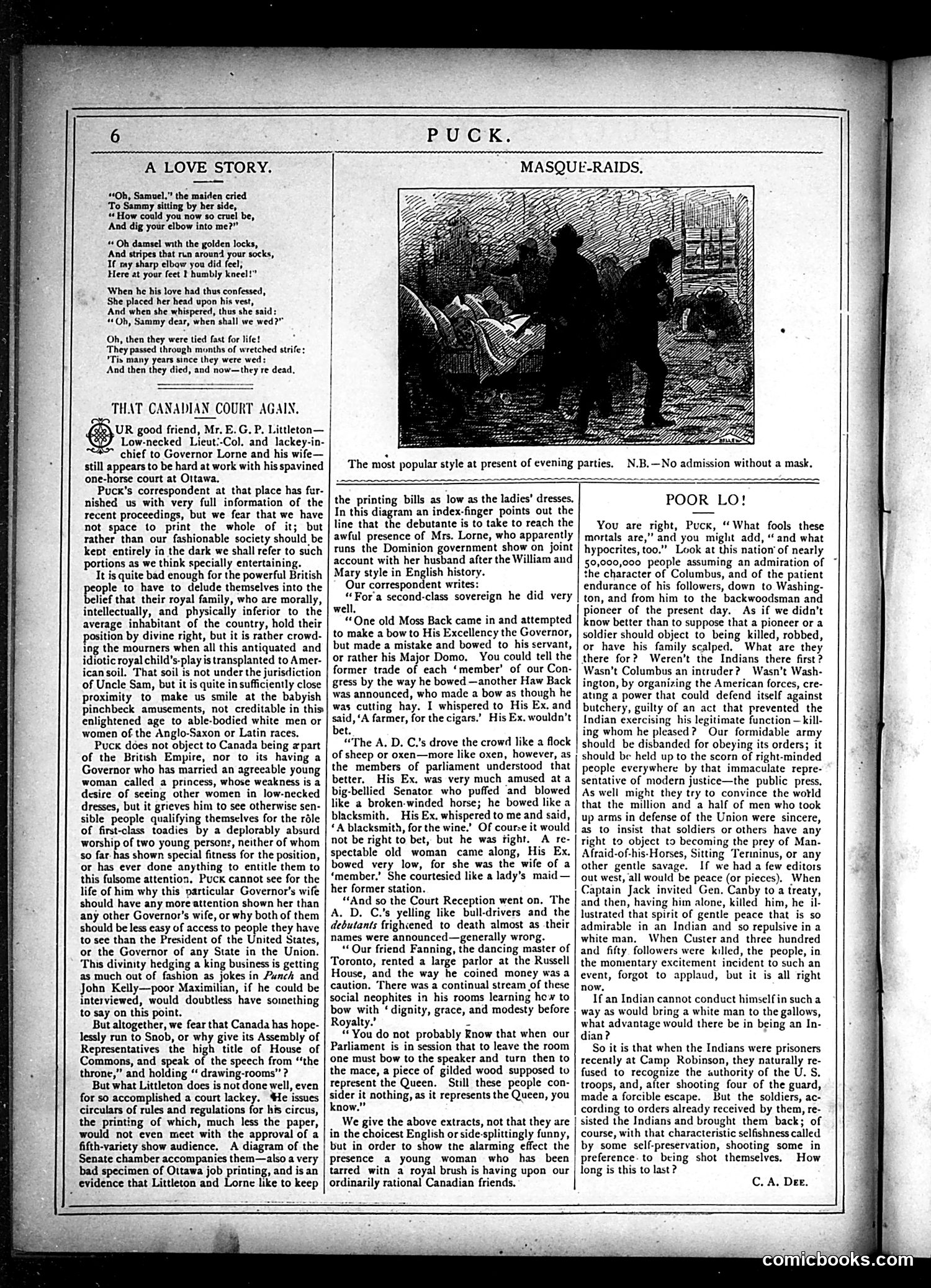
The illustration depicts a masked ball scene with silhouetted figures in formal attire. The caption notes "No admission without a mask," referencing the fashionable masquerade parties of the era. The accompanying article "Poor Lo!" discusses Canadian Indigenous affairs, specifically criticizing Ottawa's social elite for their hypocrisy. The text argues that prominent citizens who attend high-society events (represented by the masquerade) display moral inconsistency regarding treatment of Indigenous peoples ("Lo" being a period term for Native Americans/First Nations). The satire suggests that Ottawa's fashionable society wears literal masks at parties while metaphorically hiding their complicity in or indifference to colonial injustices. The piece critiques the contradiction between genteel civility and actual policy impacts on Indigenous populations.
📄 Transcribed text from this page (OCR, searchable)
Machine-transcribed from the original scan — historical spelling and the odd misread are preserved.
A LOVE STORY. “Oh, Samuel,” the maiden cried To Sammy sitting by her side, “How could you now so cruel be, And dig your elbow into me?” «Oh damsel with the golden locks, And stripes that run around your socks, If my sharp elbow you did feel, Here at your feet t humbly kneel!” When he his love had thus confessed, She placed her head upon his vest, ‘And when she whispered, thus she said: “Oh, Sammy dear, when shall we wed?” Oh, then they were tied fast for life! They passed through months of wretched strife: ‘Tis many years since they were wed: And then they died, and now—they re dead, THAT CANADIAN COURT AGAIN. UR good friend, Mr. E.G. P. Littleton— Low-necked Lieut:-Col. and lackey-in- chief to Governor Lorne and his wife— still appears to be hard at work with his spavined one-horse court at Ottawa. Puck's correspondent at that place has fur- nished us with very full information of the recent proceedings, but we fear that we have not space to print the whole of it; but rather than our fashionable society should be kept entirely in the dark we shall refer to such portions as we think specially entertaining. Tt is quite bad enough for the powerful British ople to have to delude themselves into the lief that their royal family, who are morally, intellectually, and physically inferior to the average inhabitant of the country, hold their position by divine right, but it is rather crowd- ing the mourners when all this antiquated and idiotic royal child’s-play is transplanted to Amer- ican soil. That soil is not under the jurisdiction of Uncle Sam, but it is quite in sufficiently close proximity to make us smile at the babyish pinchbeck amusements, not creditable in this enlightened age to able-bodied white men or women of the Anglo-Saxon or Latin races. Puck does not object to Canada being apart of the British Empire, nor to its having a Governor who has married an agreeable young woman called a princess, whose weakness is a desire of seeing other women in low-necked dresses, but it grieves him to see otherwise sen- sible people qualifying themselves for the rdle of first-class toadies by a deplorably absurd worship of two young persons, neither of whom so far-has shown special fitness for the position, or has ever done anything to entitle them to this fulsome attention, Puck cannot see for the life of him why this particular Governor's wife should have any more attention shown her than any other Governor's wife, or why both of them should be less easy of access to people they have to see than the President of the United States, or the Governor of any State in the Union. This divinity hedging a king business is getting as much out of fashion as jokes in Punch and john Kelly—poor Maximilian, if he could be interviewed, would doubtless have something to say on this point. But altogether, we fear that Canada has hope- lessly run to Snob, or why give its Assembly of Representatives the high title of House of Commons, and speak of the speech from “the throne,” and holding ‘‘ drawing-rooms” ? But what Littleton does is not done well, even for so accomplished a court lackey. He issues circulars of rules and regulations for his circus, the printing of which, much less the paper, would not even meet with the approval of a fifth-variety show audience, A diagram of the Senate chamber accompanies them—also a very bad specimen of Ottawa job printing, and is an evidence that Littleton and Lorne like to keep The most popular style at present of evening parties. N.B.—No admission without a mask, the printing bills as low as the ladies’ dresses, In this diagram an index-finger points out the line that the debutante is to take to reach the awful presence of Mrs. Lorne, who apparently tuns the Dominion government show on joint account with her husband after the William and Mary style in English history. Our correspondent writes: “For'a second-class sovereign he did very well, “One old Moss Back came in and attempted to make a bow to His Excellency the Governor, but made a mistake and bowed to his servant, or rather his Major Domo. You could tell the former trade of each ‘member’ of our Con- gress by the way he bowed —another Haw Back was announced, who made a bow as though he was cutting hay. I whispered to His Ex. and said, ‘A farmer, for the cigars.’ His Ex. wouldn’t bet. “The A. D. C.’s drove the crowd like a flock of sheep or oxen—more like oxen, however, as the members of parliament understood that better. His Ex. was very much amused at a big-bellied Senator who puffed and blowed like a broken-winded horse; he bowed like a blacksmith. His Ex. whispered to me and said, ‘A blacksmith, for the wine.’ Of course it would not be right to bet, but he was fight. A re- spectable old woman came along, His Ex. bowed very low, for she was the wife of a ‘member.’ She courtesied like a lady’s maid — her former station. “And so the Court Reception went on, The A. D. C.'s yelling like bull-drivers and the debutants frighcened to death almost as their names were announced—generally wrong. “Our friend Fanning, the dancing master of Toronto, rented a large parlor at the Russell House, and the way he coined money was a caution. There was a continual stream of these social neophites in his rooms learning hew to bow with “dignity, grace, and modesty before Royalty.’ = “You do not probably Know that when our Parliament is in session that to leave the room one must bow to the speaker and turn then to the mace, a piece of gilded wood supposed to represent the Queen. Still these people con- sider it nothing, as it represents the Queen, you know.” We give the above extracts, not that they are in the choicest English or side-splittingly funny, but in order to show the alarming effect the presence a young woman who has been tarred witn a royal brush is having upon our ordinarily rational Canadian friends. POOR LO! You are right, Puck, ‘ What fools these mortals are,” and you might add, “ and what hypocrites, too.” Look at this nation’ of nearly 50,000,000 people assuming an admiration of the character of Columbus, and of the patient endurance of his followers, down to Washing- ton, and from him to the backwoodsman and pioneer of the present day. As if we didn’t know better than to suppose that a pioneer or a soldier should object to being killed, robbed, or have his family scalped. What are they there for? Weren’t the Indians there first ? Wasn't Columbus an intruder? Wasn't Wash- ington, by organizing the American forces, cre- ating a power that could defend itself against butchery, guilty of an act that prevented the Indian exercising his legitimate function — kill- ing whom he pleased? Our formidable army should be disbanded for obeying its orders; it should be held up to the scorn of right-minded people everywhere by that immaculate repre- sentative of modern justice—the public press, As well might they try to convince the wotld that the million and a half of men who took up arms in defense of the Union were sincere, as to insist that soldiers or others have any tight to object to becoming the prey of Man- Afraid-of-his-Horses, Sitting Terminus, or any other gentle savage. If we had a few editors out west, all would be peace (or pieces). When Captain Jack invited Gen, Canby to a treaty, and then, having him alone, killed him, he il- lustrated that spirit of gentle peace that is so admirable in an Indian and so repulsive in a white man, When Custer and three hundred and fifty followers were killed, the people, in the momentary excitement incident to such an event, forgot to applaud, but it is all right now, If an Indian cannot conduct himselfin sucha way as would bring a white man to the gallows, what advantage would there be in being an In- dian? So it is that when the Indians were prisoners recently at Camp Robinson, they naturally re- fused to recognize the authority of the U.S. troops, and, after shooting four of the guard, made a forcible escape. But the soldiers, ac- cording to orders already received by them, re- sisted the Indians and brought them back; of course, with that characteristic selfishness called by some self-preservation, shooting some in | preference. to being shot themselves, How | long is this to last ? icbooks.com