
Puck, 1879-02-26 · page 10 of 16
Puck — February 26, 1879 — page 10: what you’re looking at
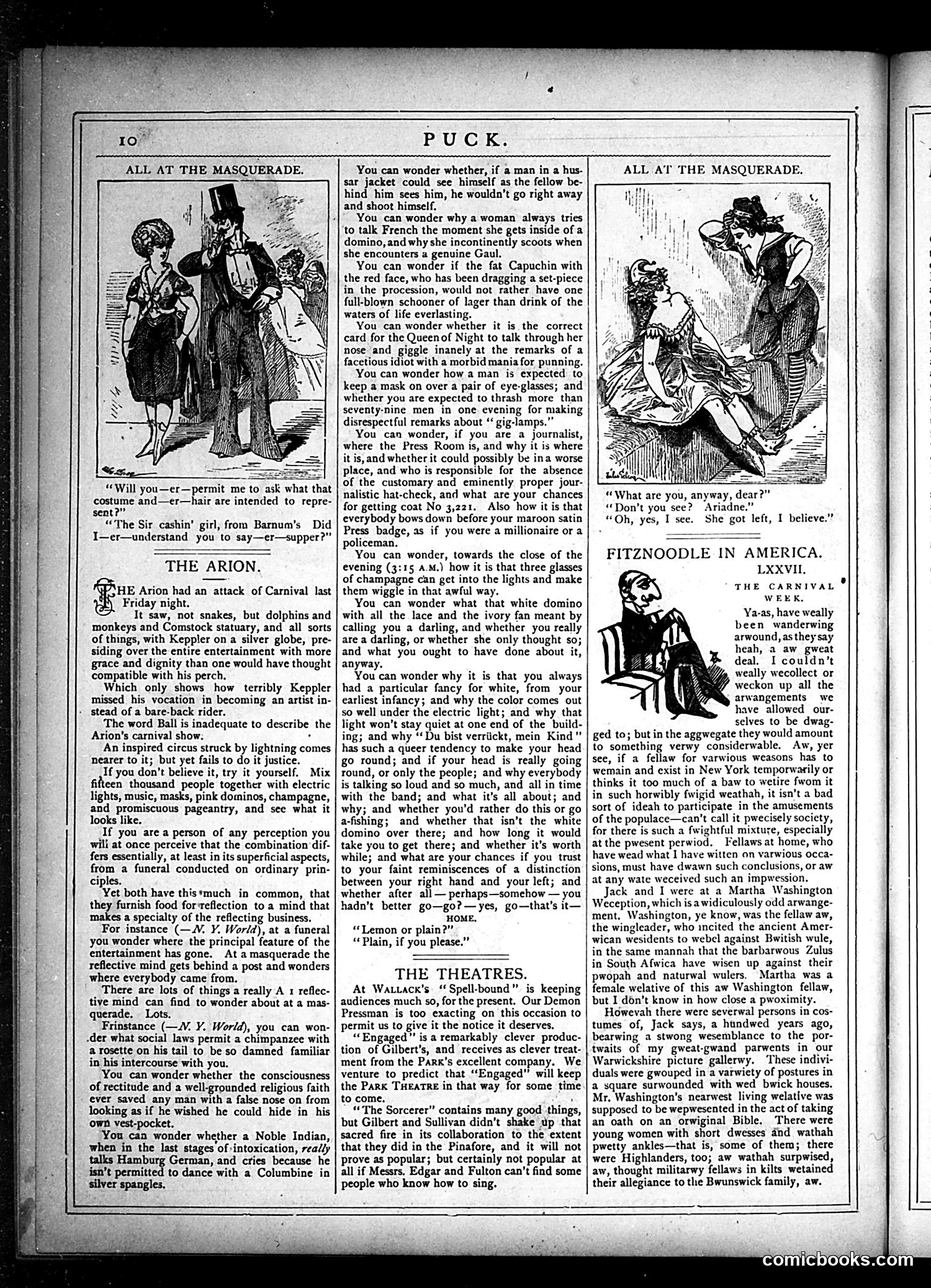
What you’re looking at
This page contains two main sections: **Left cartoon ("Will you—er—permit me to ask..."):** Shows a formally-dressed man at a masquerade ball addressing a woman. The caption suggests he's asking intrusive personal questions while wearing a mask—the satire being that masquerade costumes don't excuse rude social behavior. The joke mocks men who use anonymity to make inappropriately personal inquiries. **Right cartoon ("What are you, anyway, dear?"):** Similarly depicts a masquerade encounter where identities remain obscured, with the woman responding "Ardane" and the man expressing disbelief. Both cartoons satirize how masquerade balls—popular social events—create situations where masked anonymity supposedly permits social transgressions that would normally be unacceptable. The humor targets poor etiquette disguised by costume.
📄 Transcribed text from this page (OCR, searchable)
Machine-transcribed from the original scan — historical spelling and the odd misread are preserved.
PUCK. SE Sieg —— = See “Will you—er—permit me to ask what that costume and—er—hair are intended to repre- sent?” The Sir cashin’ girl, from Barnum’s Did I—er—understand you to say—er—supper?” THE ARION. ee Arion had an attack of Carnival last Friday night. It saw, not snakes, but dolphins and monkeys and Comstock statuary, and all sorts of things, with Keppler on a silver globe, pre- siding over the entire entertainment with more grace and dignity than one would have thought compatible with his perch. Which only shows how terribly Keppler missed his vocation in becoming an artist in- + stead of a bare-back rider. The word Ball is inadequate to describe the Arion’s carnival show: $ An inspired circus struck by lightning comes nearer to it; but yet fails to do it justice. If you don’t believe it, try it yourself. Mix fifteen thousand people together with electric lights, music, masks, pink dominos, champagne, and promiscuous pageantry, and see what it looks like. If you are a person of any perception you wili at once perceive that the combination dif- fers essentially, at least in its superficial aspects, cap a funeral conducted on ordinary prin- ciples, Yet both have this*much in common, that they furnish food forreflection to a mind that es a specialty of the reflecting business. For instance (—J. ¥. World), at a funeral you wonder where the principal feature of the entertainment has gone. At a masquerade the reflective mind gets behind a post and wonders where everybody came from. There are lots of things a really A 1 reflec- tive mind can find to wonder about at a mas- querade. Lots. Frinstance (—W. Y. World), you can won- -der what social laws permit a chimpanzee with a rosette on his tail to be so damned familiar in his intercourse with you. You can wonder whether the consciousness of rectitude and a well-grounded religious faith ever saved any man with a false nose on from looking as if he wished he could hide in his ‘own vest-pocket. You can wonder whether a Noble Indian, when in the last stages of-intoxication, really talks Hamburg German, and cries because he isn’t permitted to dance with a Columbine in silver spangles. You can wonder whether, if a man in a hus- sar jacket could see himself as the fellow be- hind him sees him, he wouldn’t go right away and shoot himself. You can wonder why a woman always tries to talk French the moment she gets inside of a domino, and why she incontinently scoots when she encounters a genuine Gaul. You can wonder if the fat Capuchin with the red face, who has been dragging a set-piece in the procession, would not rather have one full-blown schooner of lager than drink of the waters of life everlasting. You can wonder whether it is the correct card for the Queenof Night to talk through her nose and giggle inanely at the remarks of a facetious idiot with a morbid mania for punning. You can wonder how a man is expected to keep a mask on over a pair of eye-glasses; and whether you are expected to thrash more’ than seventy-nine men in one evening for making disrespectful remarks about ‘ gig-lamps.”” You can wonder, if you are a journalist, where the Press Room is, and why it is where it is, and whether it could possibly be ina worse place, and who is responsible for the absence of the customary and eminently proper jour- nalistic hat-check, and what are your chances for getting coat No 3,221. Also how it is that everybody bows down before your maroon satin Press badge, as if you were a millionaire or a policeman. You can wonder, towards the close of the evening (3:15 A.M.) how it is that three glasses of champagne can get into the lights and make them wiggle in that awful way. You can wonder what that white domino with all the lace and the ivory fan meant by calling you a darling, and whether you really are a darling, or whether she only thought so; and what you ought to have done about it, anyway. You can wonder why it is that you always had a particular fancy for white, from your earliest infancy; and why the color comes out so well under the electric light; and why that light won't stay quiet at one end of the build- ing; and why “Du bist verriickt, mein Kind” has such a queer tendency to make your head go round; and if your head is really going round, or only the people; and why everybody is talking so loud and so much, and all in time with the band; and what it’s all about; and why; and whether you'd rather do this or go a-fishing; and whether that isn’t the white domino over there; and how long it would take you to get there; and whether it’s worth while; and what are your chances if you trust to your faint reminiscences of a distinction between your right hand and your left; and whether after ali— perhaps—somehow — you hadn't better go—go?—yes, go—that’s it— HOME. “Lemon or plain?” “Plain, if you please.” THE THEATRES. At Wattack's. “Spell-bound” is keeping audiences much so, for the present. Our Demon Pressman is too exacting on this occasion to permit us to give it the notice it deserves, “Engaged”’ is a remarkably clever produc- tion of Gilbert’s, and receives as clever treat- ment from the Park’s excellent company. We. venture to predict that ‘‘Engaged” will keep the Park THEATRE in that way for some time to come. : “The Sorcerer” contains many good things, but Gilbert and Sullivan didn’t shake up that sacred fire in its collaboration to the extent that they did in the Pinafore, and it will not prove as popular; but certainly not popular at all if Messrs, Edgar and Fulton can’t find some people who know how to sing. Ariadne.” She got left, I believe.” FITZNOODLE IN AMERICA. LXXVII. THE CARNIVAL WEEK, Ya-as, have weally been wanderwing arwound, asthey say heah, a aw gweat deal. I couldn't weally wecollect or weckon up all the arwangements we have allowed our- selves to be dwag- ged to; but in the aggwegate they would amount to something verwy considerwable. Aw, yer see, if a fellaw for varwious weasons has to wemain and exist in New York temporwarily or thinks it too much of a baw to wetire fwom it in such horwibly fwigid weathah, it isn’t a bad sort of ideah to participate in the amusements of the populace—can’t call it pwecisely society, for there is such a fwightful mixtuze, especially at the pwesent perwiod. Fellaws at home, who have wead what I have witten on varwious occa- sions, must have dwawn such conclusions, or aw at any wate weceived such an impwession. Jack and I were at a Martha Washington Weception, which isa widiculously odd arwange- ment, Washington, ye know, was the fellaw aw, | the wingleader, who incited the ancient Amer- wican wesidents to webel against Bwitish wule, in the same mannah that the barbarwous Zulus in South Afwica have wisen up against their pwopah and naturwal wulers. Martha was a female welative of this aw Washington fellaw, but I don’t know in how close a pwoximity. Howevah there were severwal persons in cos- tumes of, Jack says, a hundwed years ago, bearwing a stwong wesemblance to the por- twaits of my gweat-gwand parwents in our Warwickshire picture gallerwy. ‘These indivi- duals were gwouped in a varwiety of postures in a square surwounded with wed bwick houses. Mr. Washington’s nearwest living welative was supposed to be wepwesented in the act of taking an oath on an orwiginal Bible, There were young women with short dwesses and wathah pwetty ankles—that is, some of them; there were Highlanders, too; aw wathah surpwised, aw, thought militarwy fellaws in kilts wetained their allegiance to the Bwunswick family, aw.