
A complete issue · 16 pages · 1879
Puck — January 1, 1879
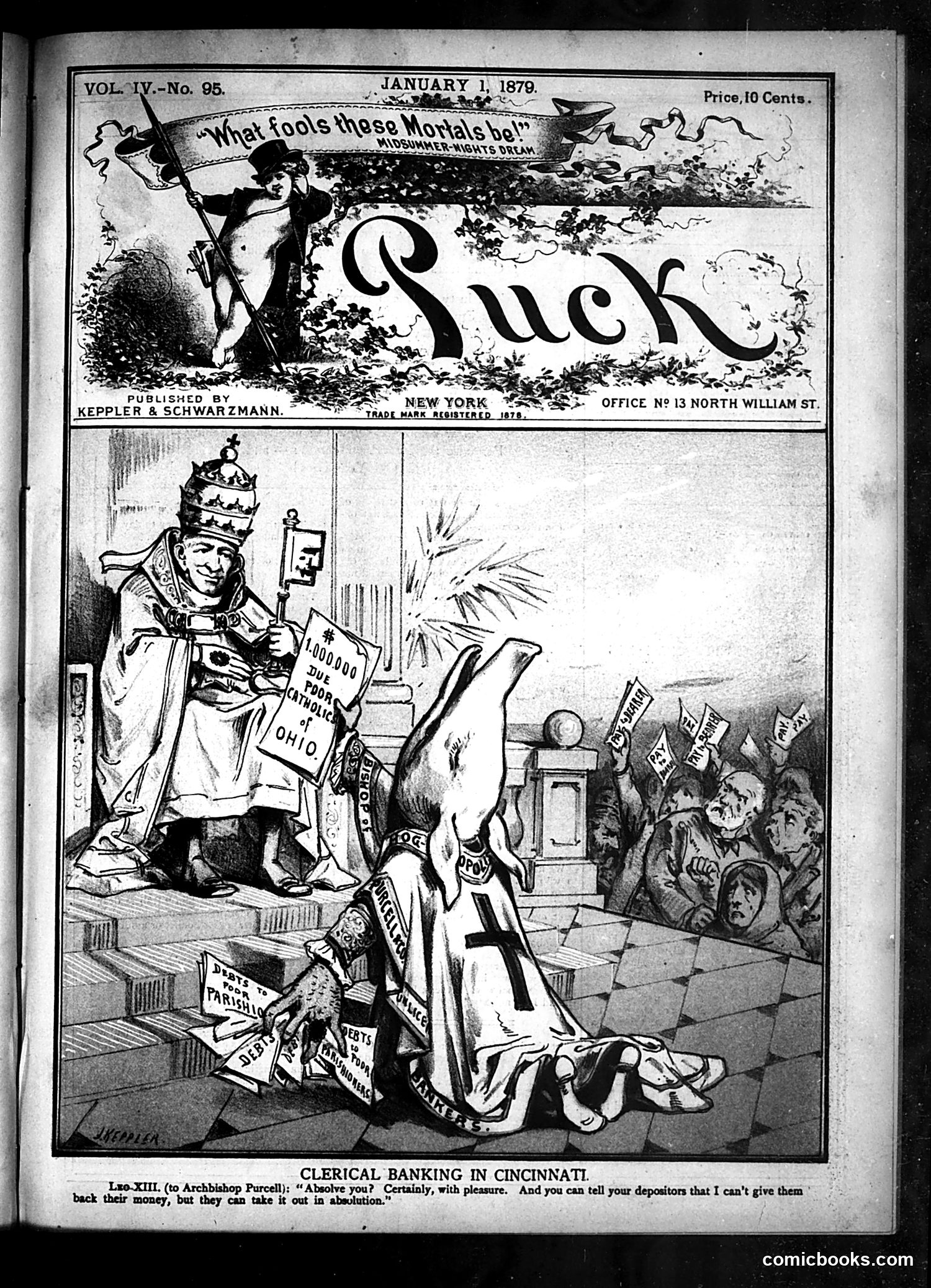
This 1879 *Puck* cartoon satirizes corrupt banking practices involving clergy in Cincinnati. A crowned bishop or religious authority figure presides over a scene where depositors kneel before him, apparently surrendering their money. Documents labeled with various states and financial terms litter the floor. The caption quotes Leo XIII (to Archbishop Purcell): "I beg you? Certainly, with pleasure. And you can tell your depositors that I can't give them back their money, but they can take it out in absolution." The satire attacks the Catholic Church's financial malfeasance—specifically, appears to reference Archbishop Purcell's involvement in a major Cincinnati banking scandal where church funds were lost. The cartoon mocks how religious authority was exploited to manipulate depositors into accepting spiritual consolation instead of financial restitution.
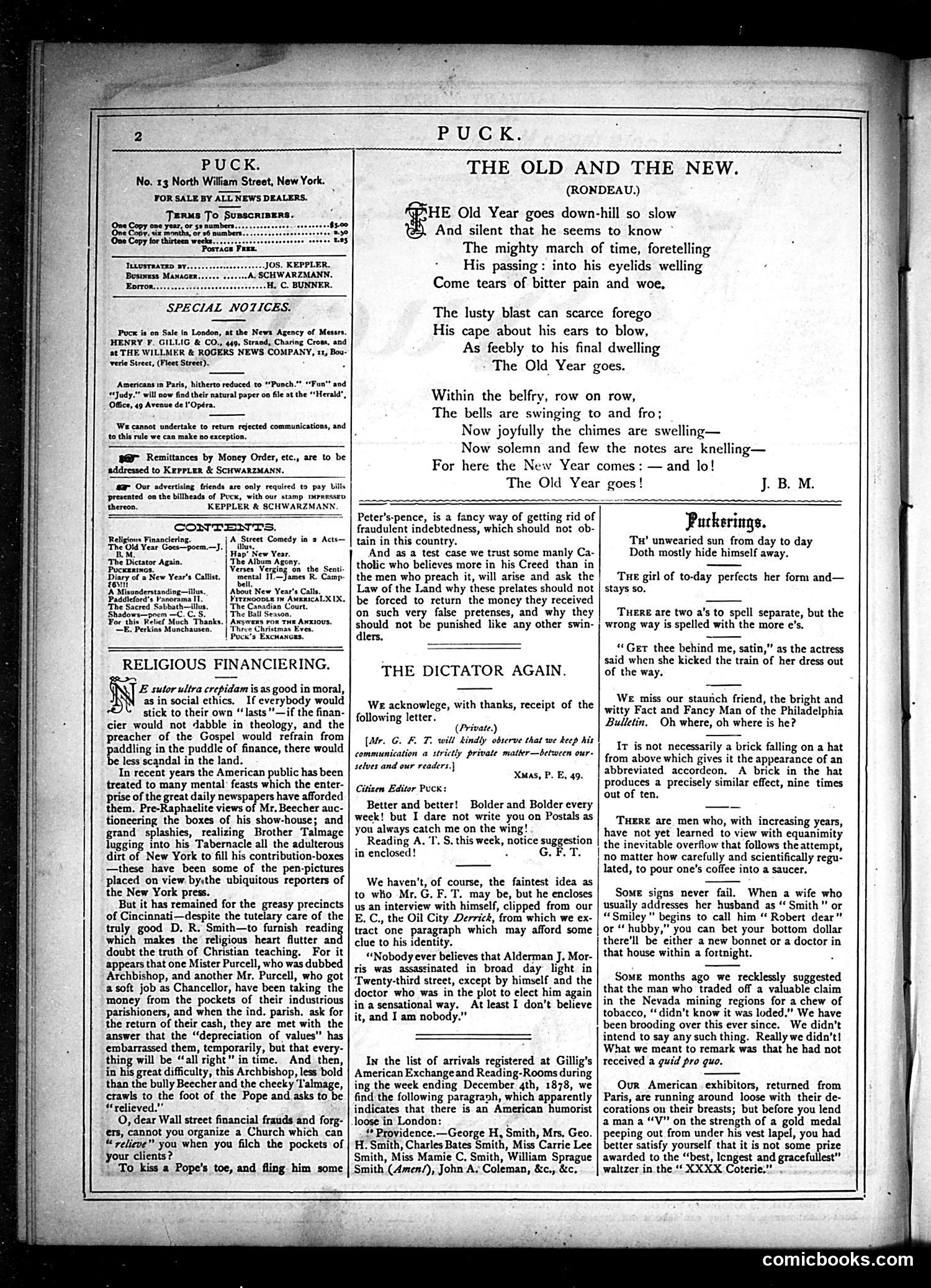
This page contains **no political cartoons**—it's primarily **advertising and editorial content** from Puck magazine. The main illustrated piece is "The Old and the New" (Rondeau), a sentimental poem about the passing of the Old Year and arrival of the New Year, accompanied by decorative typography. It's **seasonal New Year's content**, not satire. Below that are several short pieces: "Puckerings" (brief humor items), "The Dictator Again" (which references a previous article about someone nicknamed "the Dictator," but context is unclear without prior issues), and "Religious Financing" (social commentary on church finances and clerical scandals). The bulk of the page consists of **subscription information, business notices, and classified advertising**—typical of magazine layouts from this era.
This page is primarily **text content** — a satirical diary column titled "Diary of a New Year's Callist" rather than a political cartoon. The diary format mocks social climbers and their New Year's calling etiquette in high society. The satire targets: - **Social pretension**: Characters obsessed with visiting the "right" people and maintaining appearances - **Gender stereotypes**: Women described as vain, superficial, and obsessed with fashion and gossip - **Class anxiety**: References to politicians, journalists, and nouveau-riche attempting to gain social status The tone is dismissive of both the callers seeking acceptance and their hosts. While specific individuals aren't clearly identified as caricatures in the visible text, the satire ridicules turn-of-the-century New York society's performative rituals.
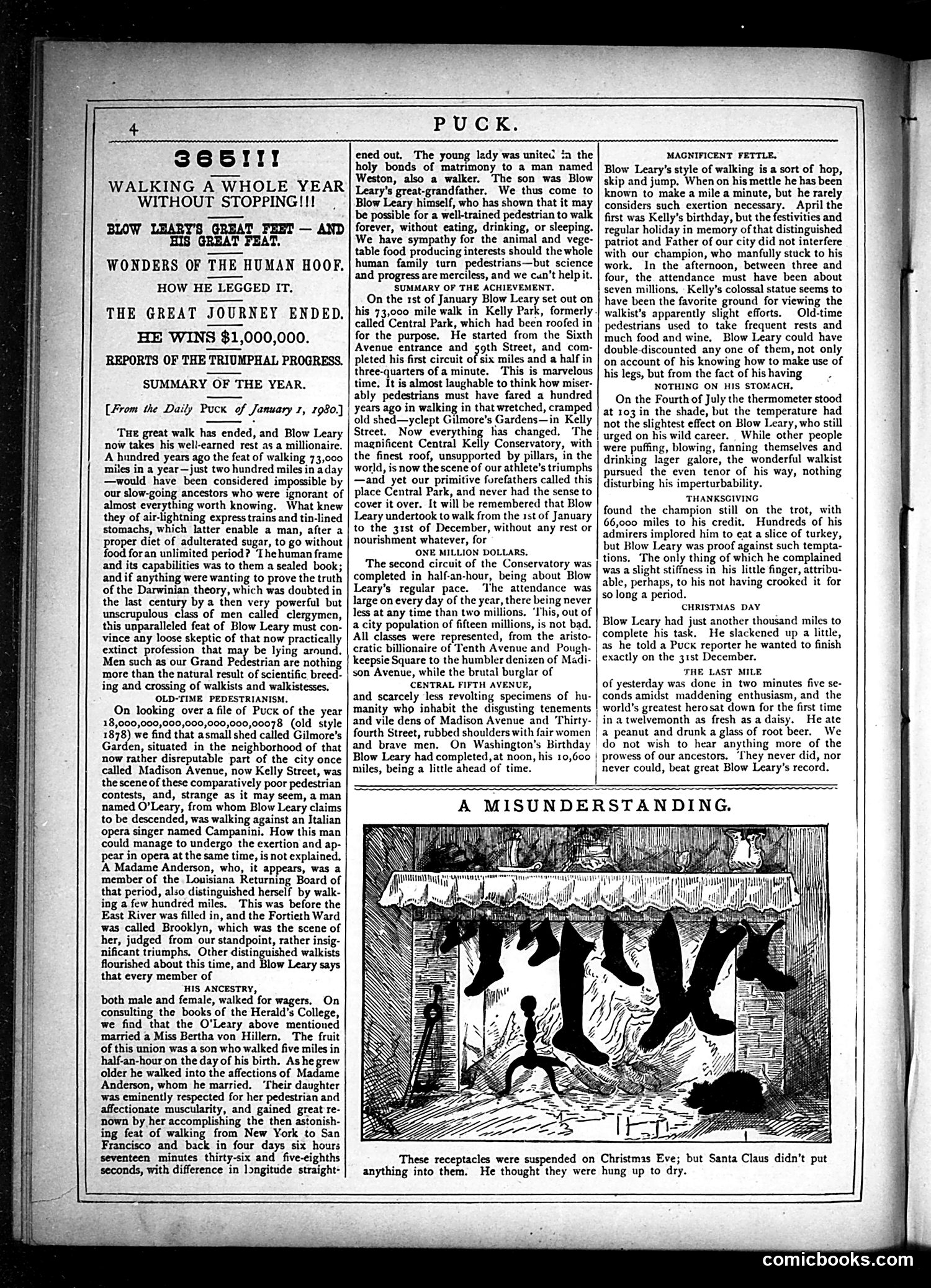
The cartoon depicts a cow and a man in apparent conflict. Based on the caption—"These receptacles were suspended on Christmas Eve; but Santa Claus didn't put anything into them. He thought they were hung up to dry"—the joke relies on a visual pun. The man has hung stockings (the traditional Christmas receptacles for gifts) to dry, likely after washing them. Santa Claus, seeing them hung by the fireplace in the conventional manner, assumes they're Christmas stockings awaiting gifts and therefore leaves them empty, thinking they're simply drying. The cow's presence suggests confusion or the absurdity of the situation. The humor targets the misunderstanding between practical household needs and Christmas tradition.
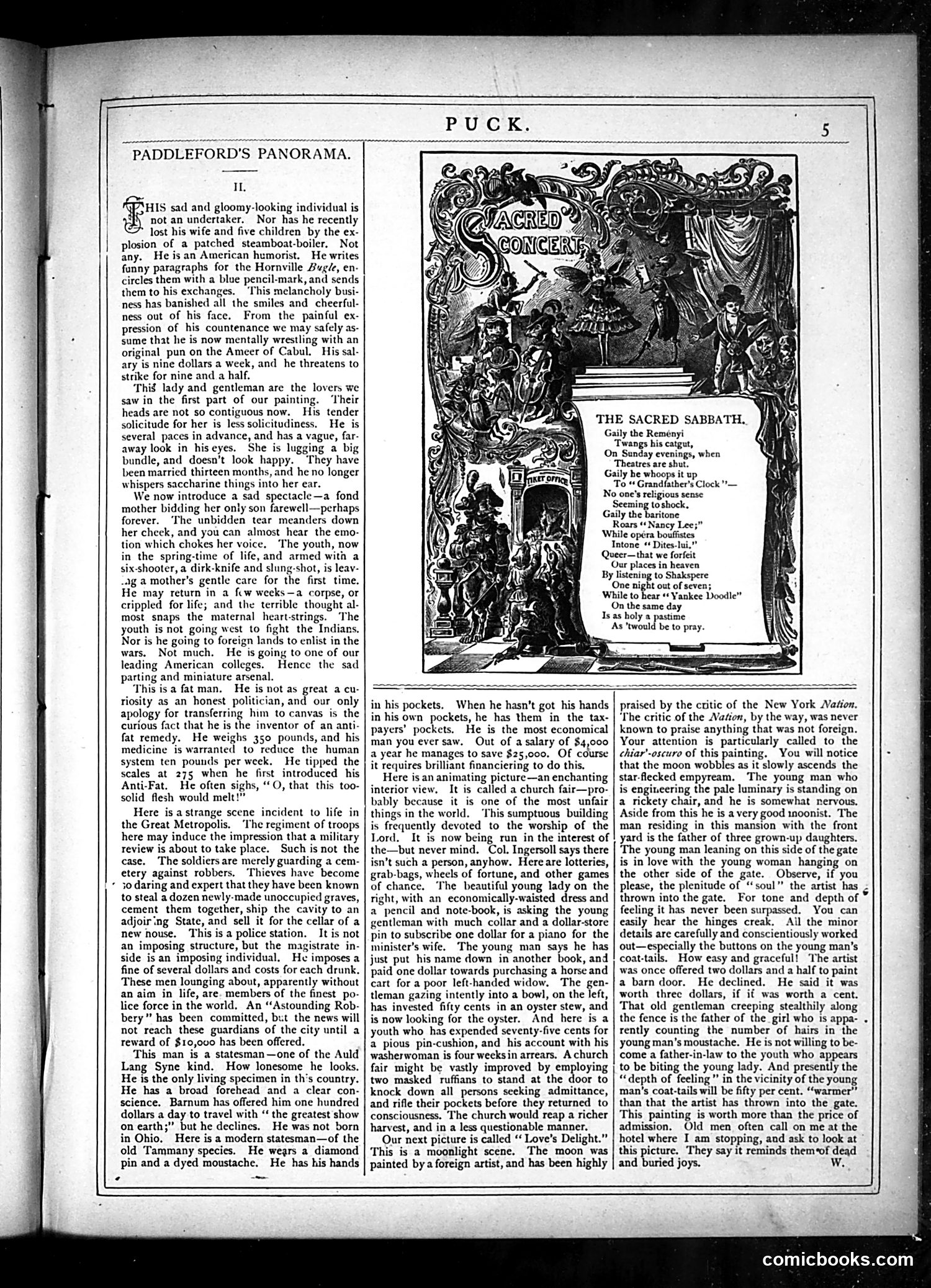
This page contains two main sections: **Left Column ("Paddleford's Panorama II"):** A satirical character sketch of a melancholy American humorist who has lost his wife and children. The text describes him as mentally wrestling with "an original pun on the Ameer of Cabul," suggesting he's obsessed with wordplay despite personal tragedy. He's depicted as economical (weighing 350 pounds, reducing intake), working at a military college, and involved in various social schemes—a satirical portrait of a struggling writer/performer from the era. **Right Column ("The Sacred Sabbath"):** A decorative illustrated scene depicting church activities, with accompanying humorous verse mocking Sunday observances and religious hypocrisy. The poem references Shakespeare, opera, and other entertainments people enjoyed instead of proper worship. The satire targets both individual foibles and broader religious/social pretense of the period.
This page contains primarily **letters to the editor** rather than political cartoons. The header "SHADOWS" features a poem, followed by editor responses to correspondence. The main content addresses a dispute over an anecdote about **Benjamin Franklin** and a kite experiment on Sunday. Readers debated whether Franklin actually flew his kite on the Sabbath, with one correspondent claiming it occurred on Sunday. The Puck editors acknowledge this "unnecessary reflection and morality" but attempt to clarify the historical record. Additional letters discuss **Dr. Johnson**, London locations like Craven Street and Fleet Street, and the British Museum. The page concludes with a note about a typographical error in a previous dispatch. This represents reader engagement with factual historical claims rather than satirical content.
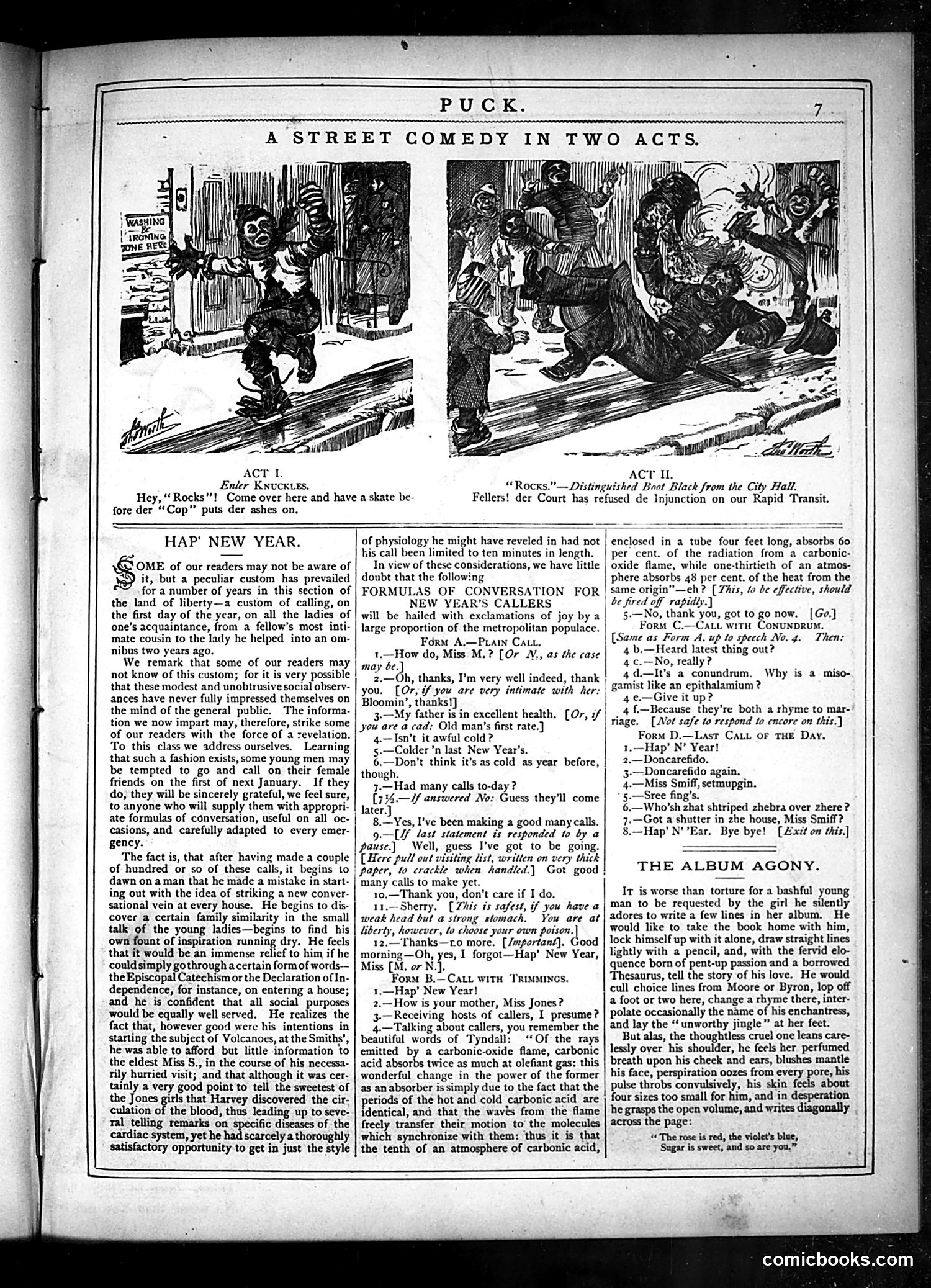
**The Cartoons:** Two street scenes depict what appears to be a skating accident or dispute. The left panel shows a figure being confronted by a policeman near storefronts; the right panel shows a chaotic street scene with multiple figures gathered around someone on the ground. The captions reference "Rocks," a "Boot Black," and disputes involving a "Rapid Transit" court injunction—suggesting urban class conflict between working-class street vendors and city authorities. **"Hap' New Year" Section:** This satirizes the New Year's calling custom where wealthy visitors would exchange cards. The text mocks this ritualistic social obligation as exhausting and superficial, suggesting the practice wastes time on insincere pleasantries among the metropolitan elite. The humor targets upper-class social pretension and the mechanical nature of fashionable etiquette.
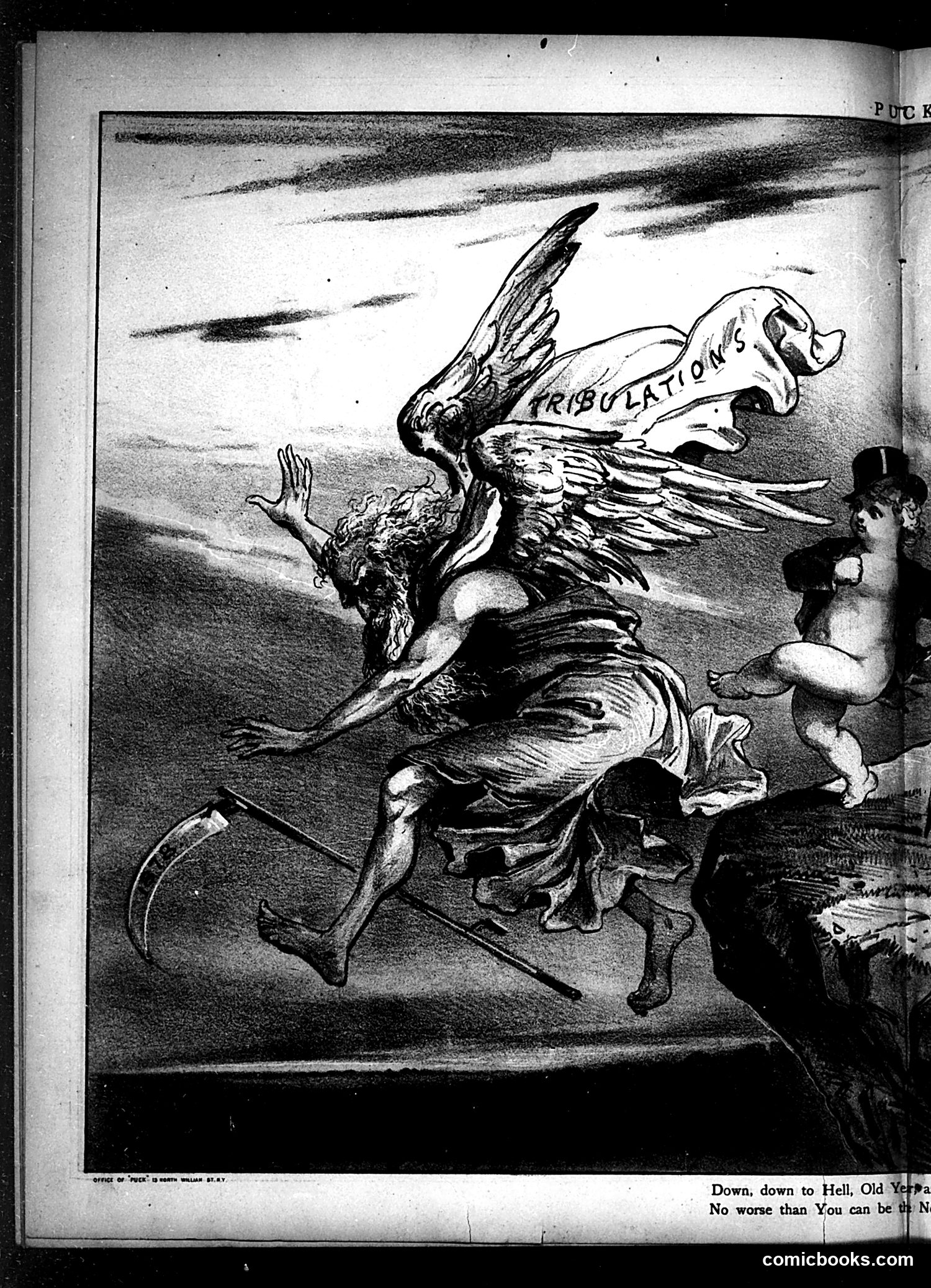
This Puck magazine cartoon depicts a winged female figure labeled "TRIBULATIONS" descending toward Hell, accompanied by a cherub wearing a top hat. The caption reads "Down, down to Hell, Old Ye—a / No worse than You can be o N—" The text appears partially obscured, but the imagery suggests this is a satirical commentary on a specific political figure or public person of the era, condemning them to damnation. The winged "Tribulations" personification suggests the subject has caused widespread suffering. The cherub's formal attire adds sardonic humor to the damnation scene. Without seeing the complete caption or publication date, I cannot definitively identify which political figure is targeted, but the allegory clearly expresses harsh moral condemnation through classical artistic imagery common to Puck's satirical style.
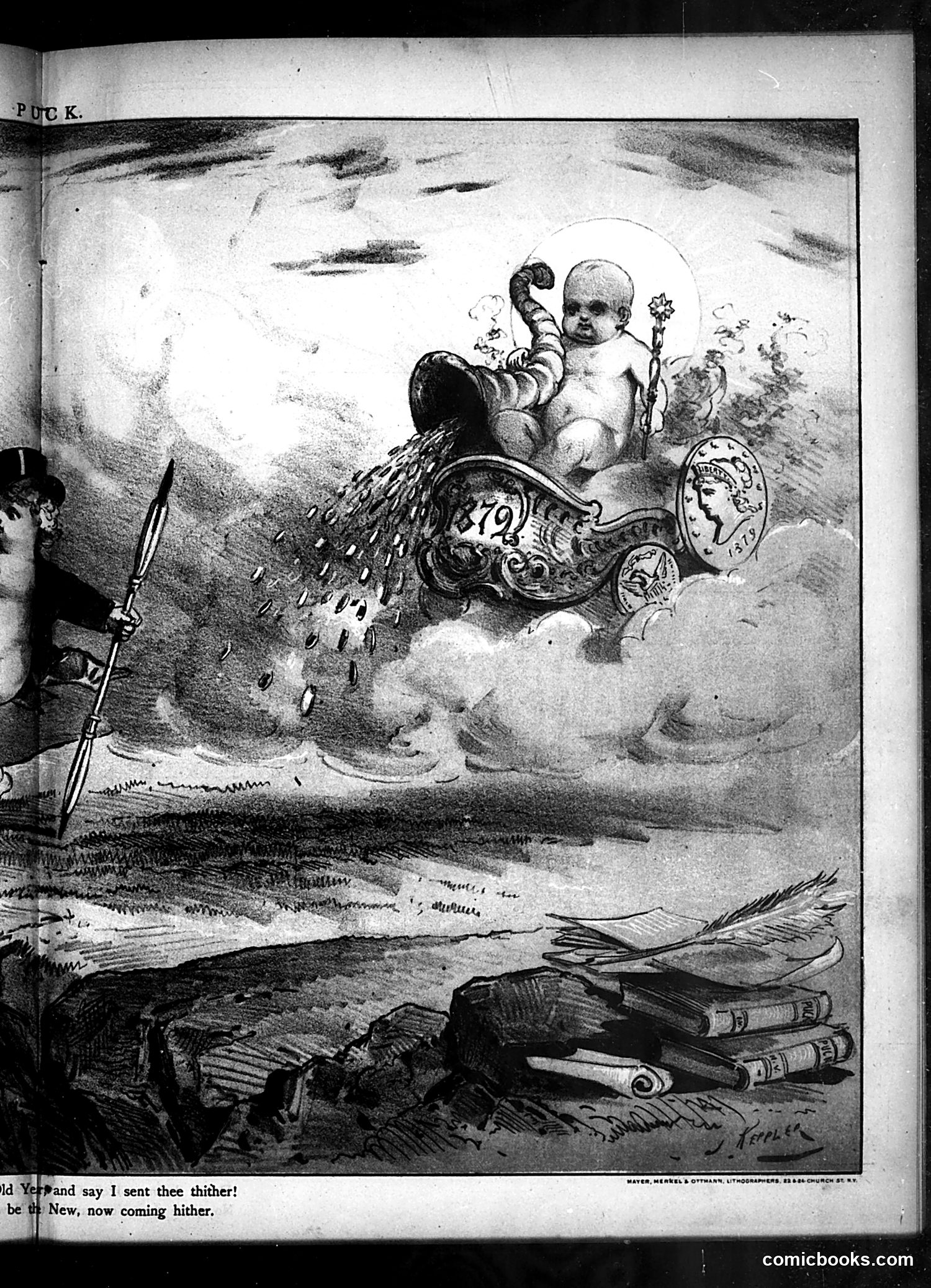
This Puck magazine cartoon depicts a cherub or cupid figure in the clouds, surrounded by military insignia and decorative shields bearing what appear to be imperial or royal emblems. The cherub holds weapons and a staff, positioned above an earthly landscape scattered with military implements, scrolls, and documents. The partial text reads: "Old Ye—and say I sent thee hither!" and "be th New, now coming hither." This appears to be **Cold War or imperial-era satire** about divine intervention in military or political affairs—likely mocking how powers justify aggressive actions through appeals to higher authority or destiny. The cherub as messenger suggests heavenly sanction for earthly conflict, satirizing the rhetoric used to legitimize military campaigns or imperial expansion. Without full text or date, the specific conflict referenced remains unclear.
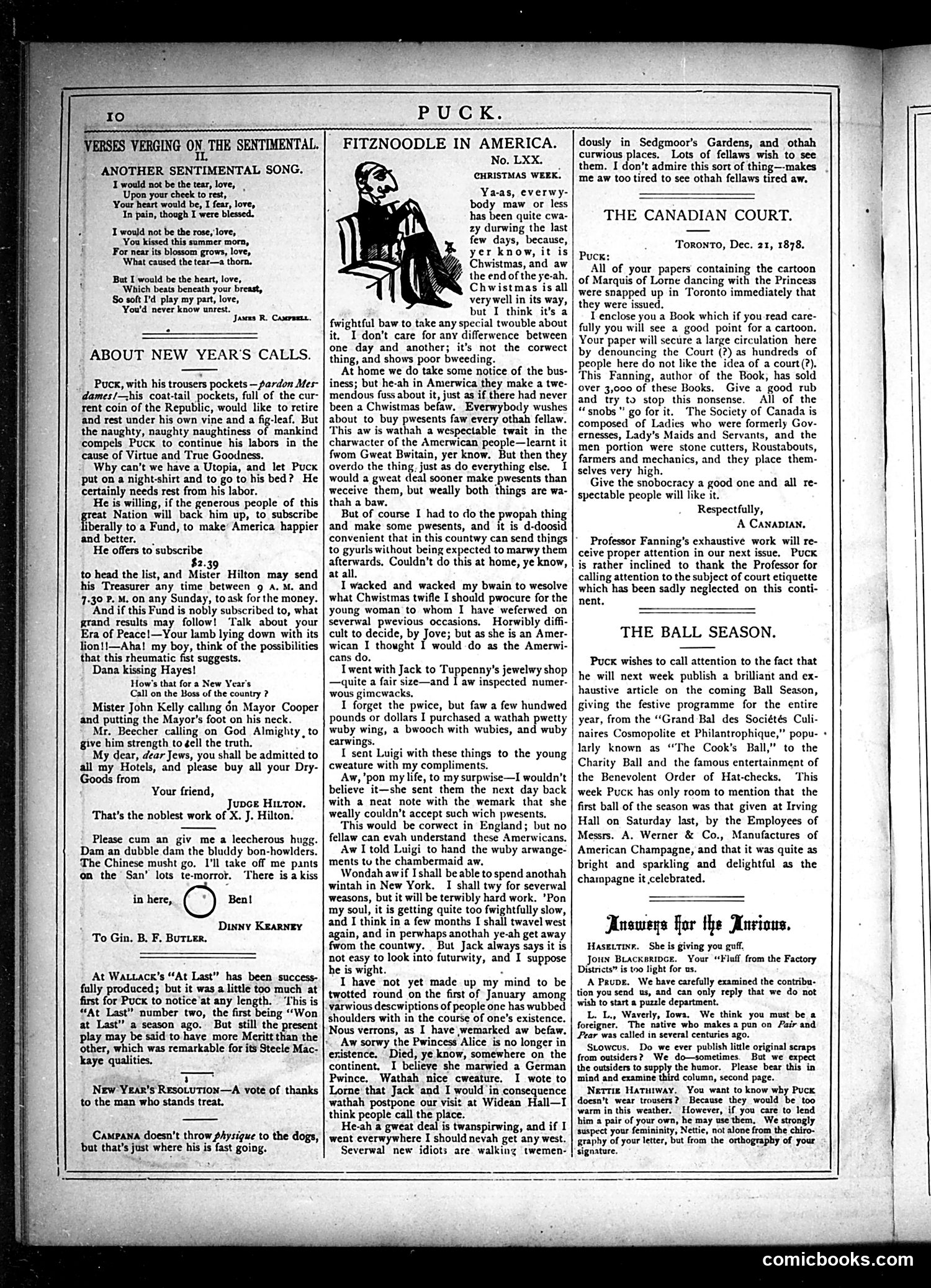
This page contains several short satirical pieces and reader letters rather than a major political cartoon. The main illustrated item is "Fitznoodle in America No. LXX: Christmas Week," showing a character in a chair—likely a recurring comic figure from Puck's serialized humor. The text pieces mock American customs (New Year's calls, Christmas gift-giving excess) through fictional letters and commentary. One letter from "A Canadian" criticizes American court etiquette and Canadian society's supposed superiority. The bottom section advertises upcoming content, including "The Ball Season" and a piece on "Amusages for the Anxious." Overall, this page represents Puck's typical format: light social satire targeting American middle-class conventions, particularly around holidays and social rituals, with gentle ribbing of Canadian pretension.
This page contains text from "Three Christmas-Eves," a serialized story from Tinsley's Magazine (as noted in the header). It appears to be the conclusion of one section and the beginning of Chapter IV. The content is a Gothic-tinged narrative about mysterious deaths and supernatural occurrences—specifically dealing with a dead body discovered in a chamber, discussions of the cat's involvement in strange events, and Christmas Eve gatherings. The text references séances, transmigration of souls, and possession by evil spirits. **This is not a political cartoon or satire.** It's a serialized fiction piece typical of Victorian-era magazine content, blending melodrama, mystery, and supernatural elements—popular entertainment of the period rather than satirical commentary on current events or politics.
This page is primarily **text-based fiction** rather than political satire. It presents a serialized story titled "Puck's Exchanges" featuring characters named Sidney, Nellie, Maggie, and Dainton in a domestic drama involving a cat and various personal conflicts. The right column contains **"Puck's" characteristic brief satirical commentary** on contemporary topics, offering pointed one-liners on subjects like: - Christmas traditions - Love and marriage - Political candidates (Thurman for Governor) - Butter quality and Thanksgiving food - Military/foreign affairs (Afghanistan, Yakoop Khan) These quips represent typical **turn-of-century American social criticism**—light, topical jabs at politics, manners, and current events. The overall page reflects Puck's mixed format: serialized humor alongside satirical commentary on public affairs.
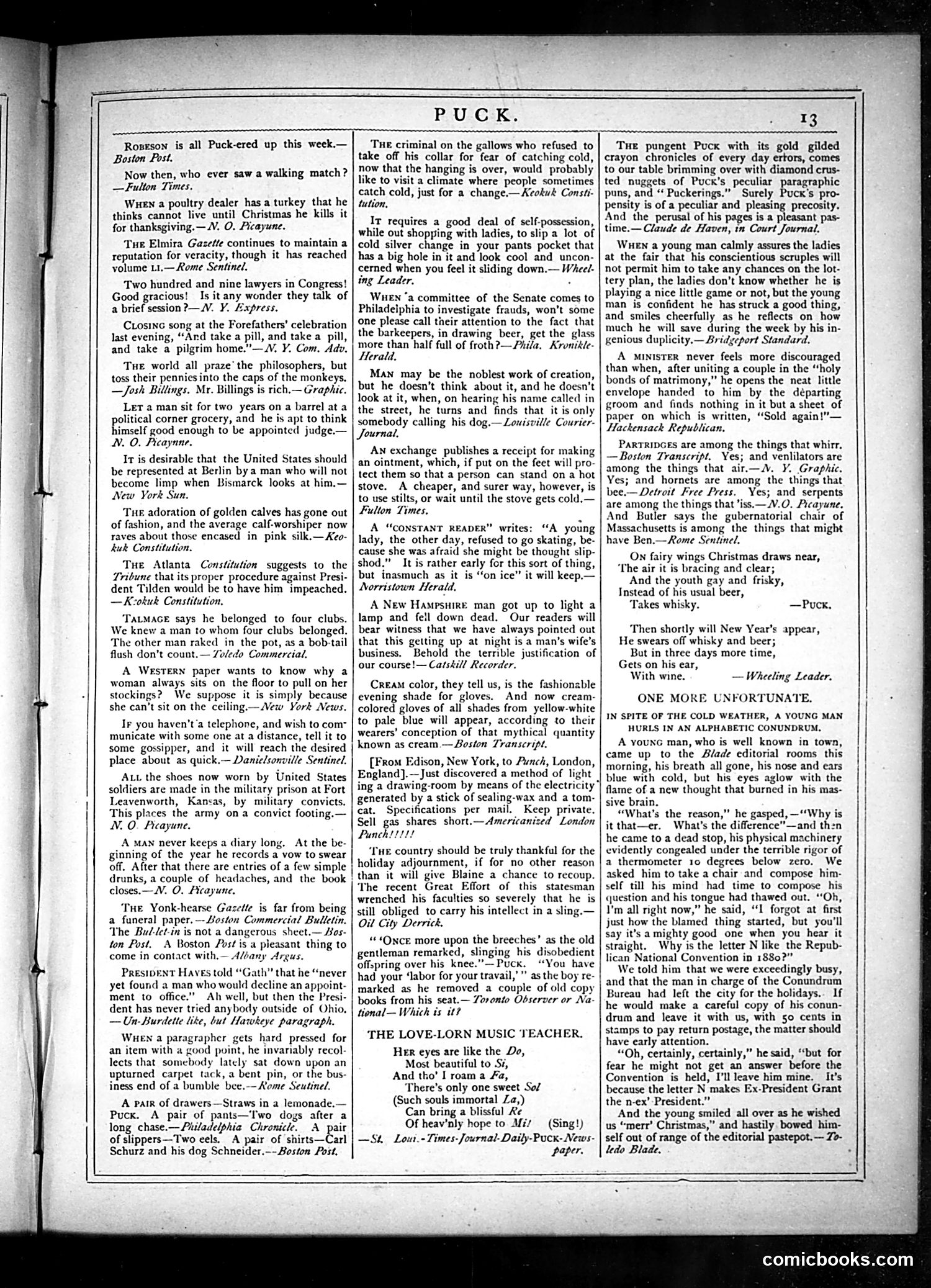
This page is primarily **text-based content** rather than illustrated cartoons—it consists of short satirical pieces, jokes, and commentary typical of Puck's format. The content includes: - Observations on contemporary social behavior (poultry dealers, senators, philosophical pretensions) - Political commentary (references to Bismarck and Berlin procedures) - Social satire about fashion, manners, and relationships - A poem titled "The Love-Lorn Music Teacher" at bottom The pieces lack accompanying illustrations, making specific identification of satirized figures difficult. References to "Blaine" and Senate investigations appear topical to the 1880s-90s era, but without clear visual caricatures, the exact targets remain unclear from this page alone. The humor relies on witty wordplay and social observation rather than political cartooning.
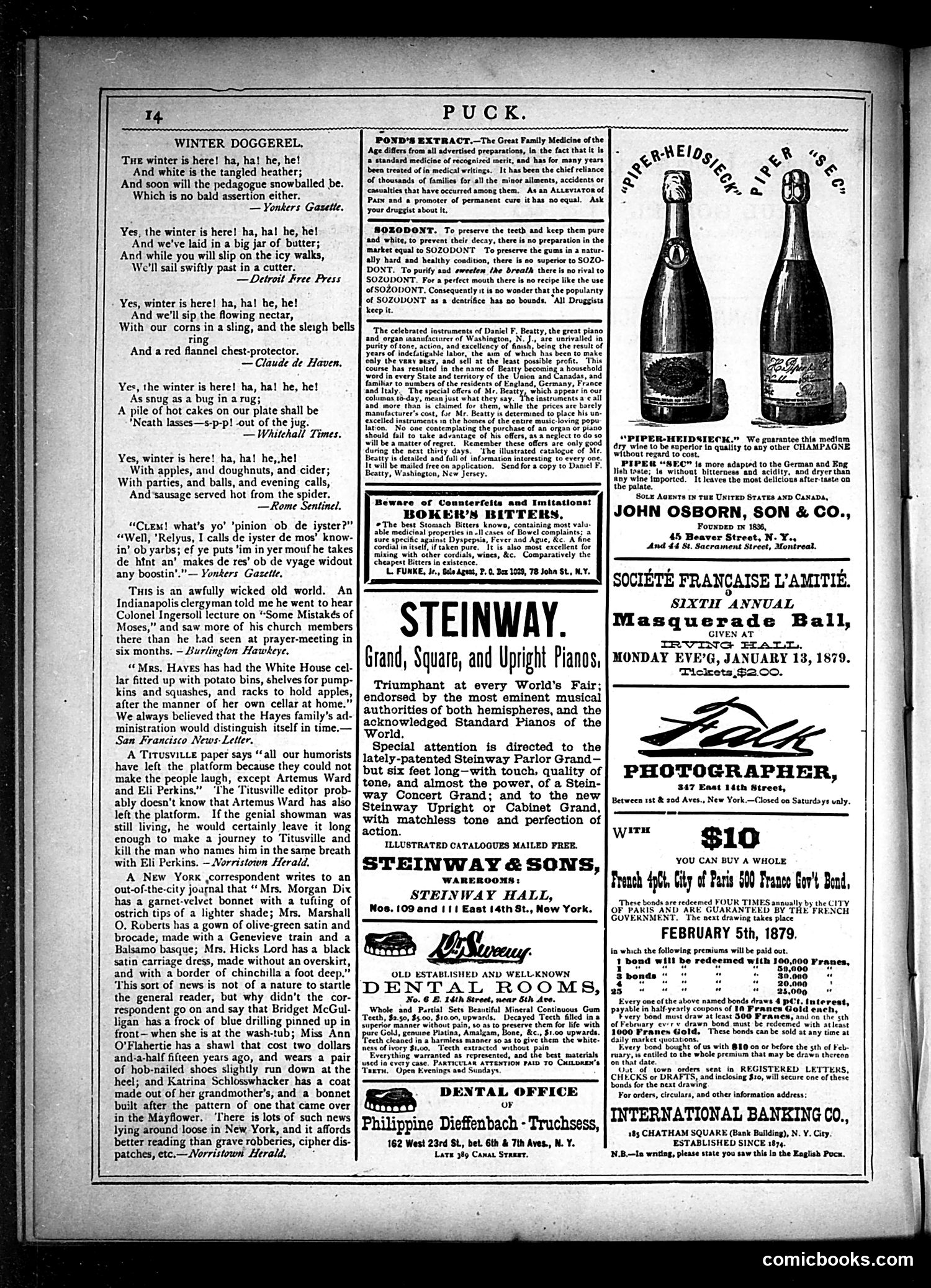
This page is primarily **advertising**, not political satire. The dominant content includes: - **Steinway pianos** advertisement (large center section) promoting their instruments' success at "every World's Fair" - **Boker's Bitters** patent medicine ad - **Photographer** services (347 East 14th Street) - **Dental offices** and **dental rooms** advertisements - **International Banking Company** notice - A **Masquerade Ball** announcement for January 13, 1879 The top portion contains brief humorous winter-themed verses about cold weather, typical of Puck's lighter content filler. The page also features two champagne bottle illustrations advertising "Piper-Heidsieck" wine. This appears to be a standard magazine issue page mixing entertainment content with commercial advertisements rather than sustained political or social satire.
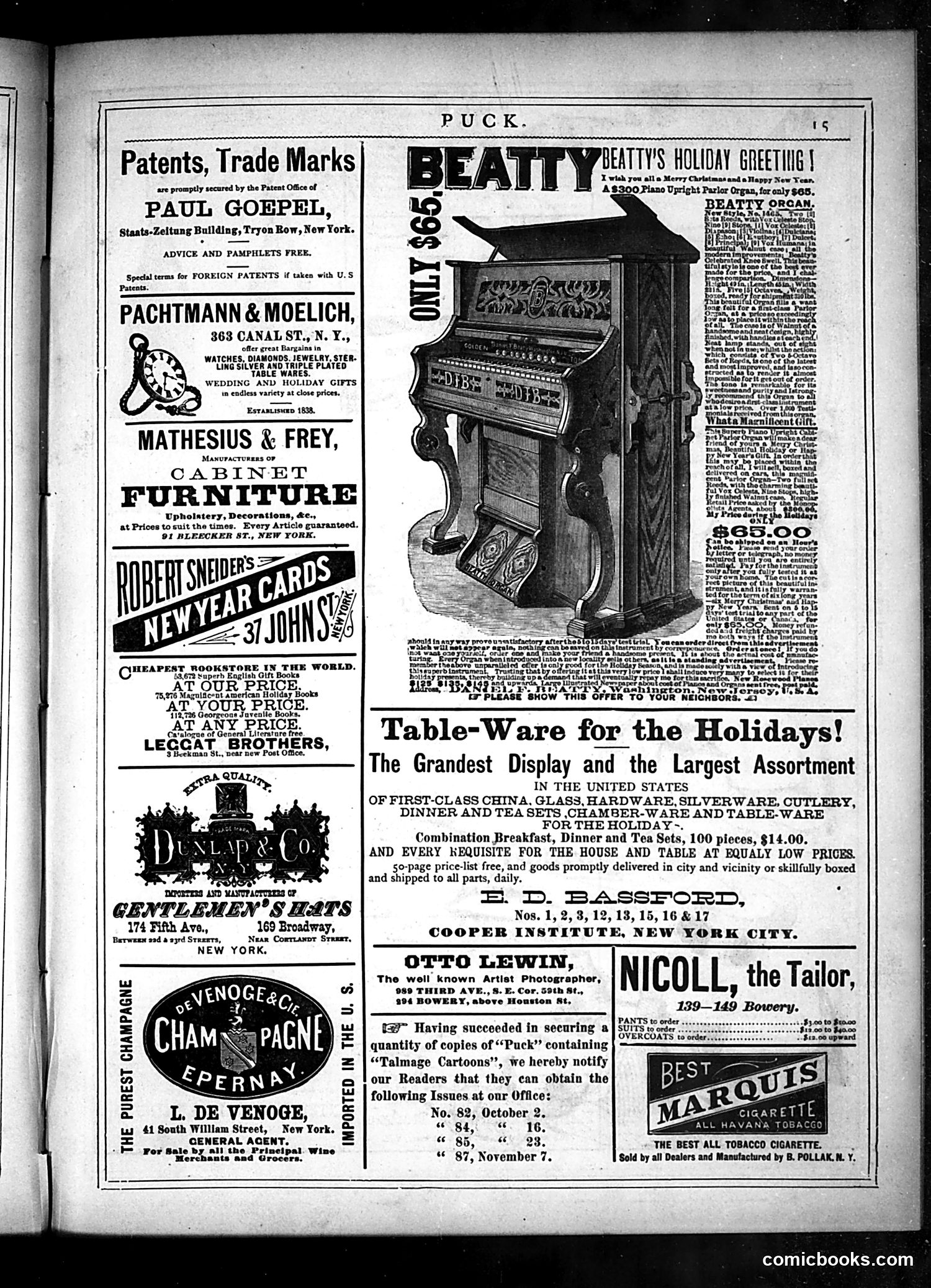
This is primarily an **advertising page** from Puck magazine, not a satirical cartoon page. The dominant feature is a large advertisement for a **Beatty organ** (a musical instrument), priced at $365, positioned as a "holiday greeting" gift suggestion. The page is filled with various commercial advertisements for luxury goods appropriate to the wealthy readership: patent services, furniture, jewelry, fine dining tableware, champagne, cigars, and tailoring services. The only editorial content is a **small notice from Otto Lewin** announcing that back issues of Puck containing "Talmage Cartoons" are available for purchase, listing specific issue numbers. This represents typical late-19th-century magazine publishing, where advertising subsidized publication and occupied significant space throughout.
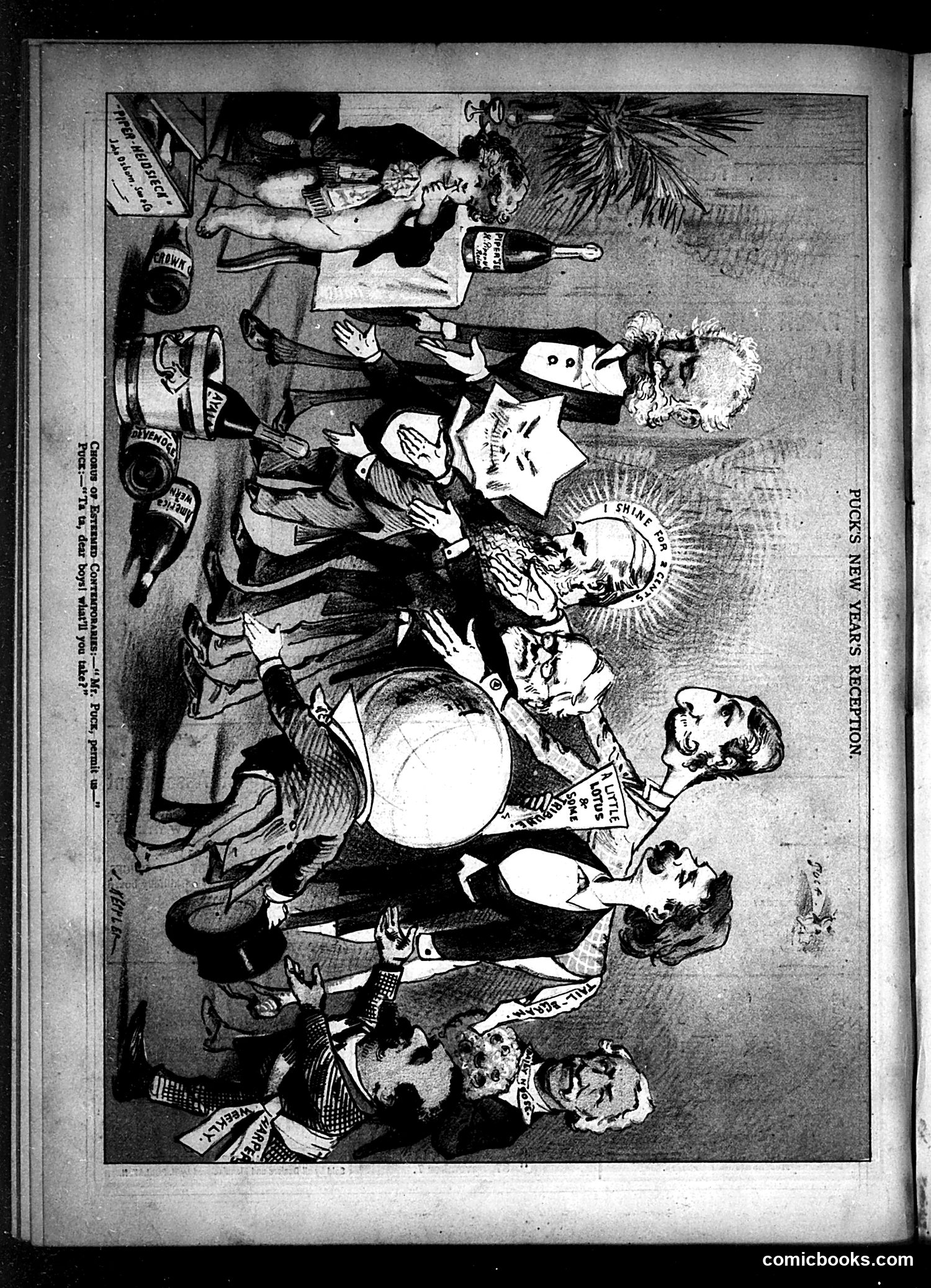
This appears to be a satirical illustration titled "Puck's New Year's Reception" depicting a chaotic New Year's celebration scene. The cartoon shows multiple figures in formal dress gathered around what appears to be a large globe or spherical object, with bottles (likely alcohol) visible on the left side. The satire likely comments on excessive New Year's indulgence and debauchery among the wealthy or politically connected classes. The crowded, disorderly composition—with figures in various states of inebriation and revelry—suggests mockery of upper-class hedonism or the social disorder of the period. Without clearer identification of specific caricatured figures or visible name labels, I cannot definitively identify individual subjects or pinpoint the exact political references intended, though the overall tone is clearly critical of contemporary social excess.