
Puck, 1879-01-01 · page 5 of 16
Puck — January 1, 1879 — page 5: what you’re looking at
What you’re looking at
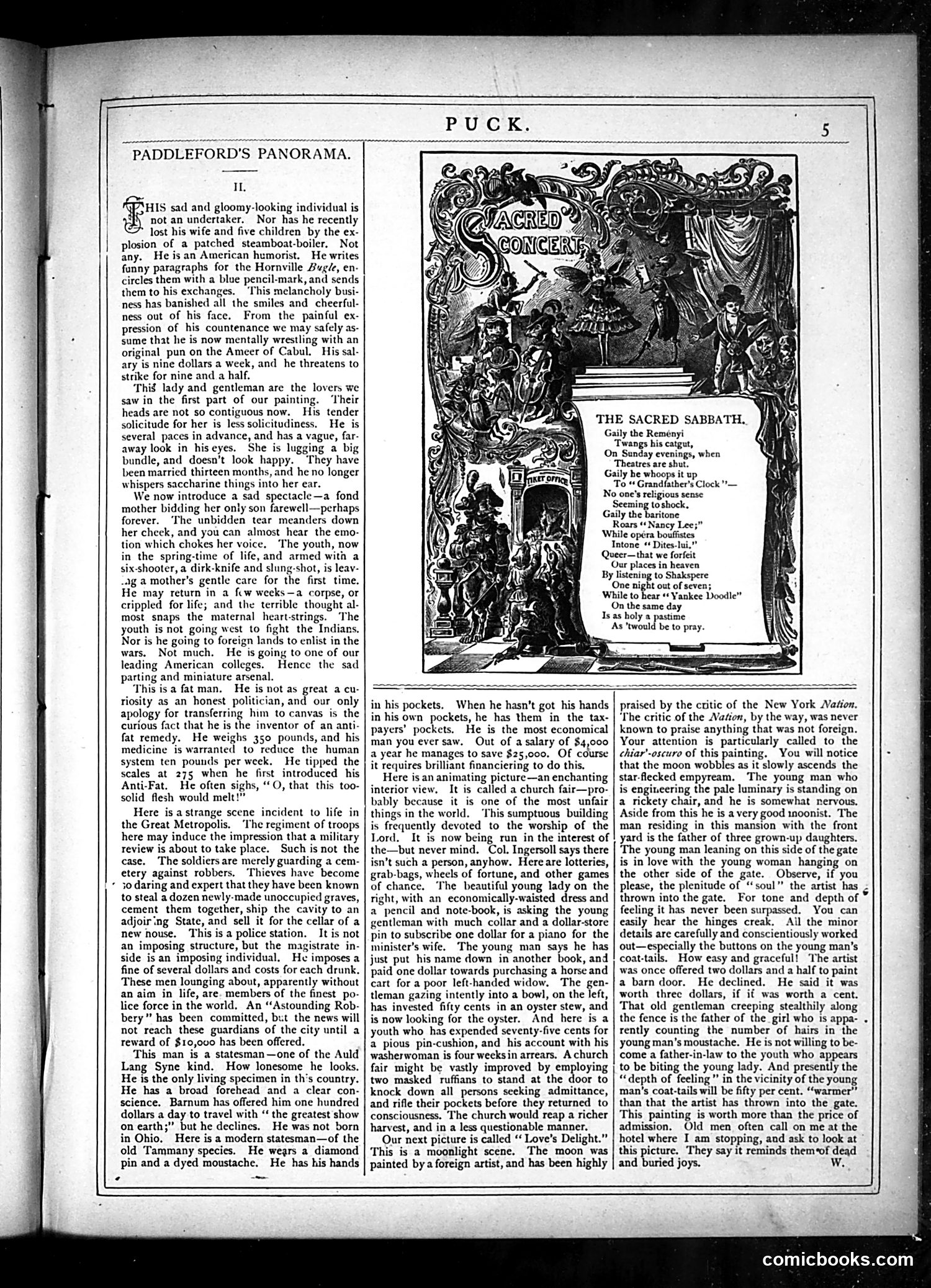
This page contains two main sections: **Left Column ("Paddleford's Panorama II"):** A satirical character sketch of a melancholy American humorist who has lost his wife and children. The text describes him as mentally wrestling with "an original pun on the Ameer of Cabul," suggesting he's obsessed with wordplay despite personal tragedy. He's depicted as economical (weighing 350 pounds, reducing intake), working at a military college, and involved in various social schemes—a satirical portrait of a struggling writer/performer from the era. **Right Column ("The Sacred Sabbath"):** A decorative illustrated scene depicting church activities, with accompanying humorous verse mocking Sunday observances and religious hypocrisy. The poem references Shakespeare, opera, and other entertainments people enjoyed instead of proper worship. The satire targets both individual foibles and broader religious/social pretense of the period.
📄 Transcribed text from this page (OCR, searchable)
Machine-transcribed from the original scan — historical spelling and the odd misread are preserved.
PADDLEFO RD'S PANORAMA. IL HIS sad and gloomy-looking individual is not an undertaker. Nor has he recently lost his wife and five children by the ex- plosion of a patched steamboat-boiler. Not any. He isan American humorist. He writes fanny paragraphs for the Hornville Bugie, en- circles them with a blue pencil-mark, and sends them to his exchanges. ‘This melancholy busi- ness has banished all the smiles and cheerful- ness out of his face. From the painful ex- pression of his countenance we may safely as- sume that he is now mentally wrestling with an original pun on the Ameer of Cabul. His sal- ary is nine dollars a week, and he threatens to strike for nine and a half. Thi lady and gentleman are the lovers we saw in the first part of our painting. ‘Their heads are not so contiguous now. His tender solicitude for her is less solicitudiness. He is several paces in advance, and has a vague, far- away look in his eyes. She is lugging a big bundle, and doesn’t look happy. They have been married thirteen months, and he no longer whispers saccharine things into her ear. We now introduce a sad spectacle—a fond mother bidding her only son farewell—perhaps forever. ‘The unbidden tear meanders down her cheek, and you can almost hear the emo- tion which chokes her voice. The youth, now in the spring-time of life, and armed with a six-shooter, a dirk-knife and slung-shot, is leav- -ag a mother’s gentle care for the first time. He may return in a fw weeks—a corpse, or crippled for life; and the terrible thought al- most snaps the maternal heart-strings. The THE SACRED SABBATH. Gaily the Reményi ‘Twangs his catgut, On Sunday evenings, when Theatres are shut. Gaily he whoops it up To * Grandfather's Clock ""— No one’s religious sense Sceming to shock. Gaily the baritone Roars «Nancy Lee;” While opéra boufiistes Intone * Dites-lui.” Queer—that we forfeit Our places in heaven By listening to Shakspere One night out of seven; While to hear “Yankee Doodle” ‘On the same day Is as holy a pastime As "twould be to pray. youth is not going west to fight the Indians, Nor is he going to foreign lands to enlist in the wars. Not much, He is going to one of our leading American colleges. Hence the sad parting and miniature arsenal. This isa fat man. He is not as riosity as an honest politician, an great acu dour only apology for transferring him to canvas is the curious fact that he is the inventor of an anti- fat remedy. He weighs 350 pounds, and his medicine is warranted to reduce the human system ten pounds per week. He tipped the scales at 275 when he first introduced his Anti-Fat. He often sighs, ‘O, that this too- solid flesh would melt!" Here is a strange scene incident to life in the Great Metropolis. ‘I'he regiment of troops here may induce the impression that a military review is about to take place. Such is not the case. The soldiers are merely guarding a cem- etery against robbers. Thieves have become + 30 daring and expert that they have been known to steal a dozen newly-made unoccupied graves, cement them together, ship the cavity to an adjoiring State, and sell it for the cellar of a new nouse. This is a police station. It is not an imposing structure, but the magistrate in- side is an imposing individual. He imposes a fine of several dollars and costs for each drunk. These men lounging about, apparently without an aim in life, are. members of the finest_po- lice force in the world, An ‘Astounding Rob- bery” has been committed, but the news will not reach these guardians of the city until a reward of $10,000 has been offered. This man is a statesman—one of the Auld Lang Syne kind. How lonesome he looks. He is the only living specimen in th’s country. He has a broad forehead and a clear con- science. Barnum has offered him one hundred dollars a day to travel with “ the greatest show on earth;” but he declines. He was not born in Ohio, Here is a modern statesman—of the old Tammany species. He wears a diamond pin and a dyed moustache. He has his hands in his pockets. When he hasn't got his hands in his own pockets, he has them in the tax- payers’ pockets. He is the most economical man you ever saw. Out of a salary of $4,000 a year he manages to save $25,000. Of course it requires brilliant financiering to do this, Here is an animating picture—an enchanting interior view, It is called a church fair—pro- bably because it is one of the most unfair things in the world. ‘This sumptuous building is frequently devoted to the worship of the Lord. It is now being run in the interest of the—but never mind. Col. Ingersoll says there isn’t such a person, anyhow. Here are lotteries, grab-bags, wheels of fortune, and other games of chance. ‘The beautiful young lady on the right, with an economically-waisted dress and a pencil and note-book, is asking the young gentleman with much collar and a dollar-store pin to subscribe one dollar for a piano for the minister’s wife. The young man says he has just put his name down in another book, and paid one dollar towards purchasing a horse and cart for a poor left-handed widow. The gen- tleman gazing intently into a bowl, on the left, has invested fifty cents in an oyster stew, and is now looking for the oyster. And here is a youth who has expended seventy-five cents for a pious pin-cushion, and his account with his washerwoman is four weeks in arrears, A church fair might be vastly improved by employing two masked ruffians to stand at the door to knock down all persons seeking admittance, and rifle their pockets before they returned to consciousness. The church would reap a richer harvest, and in a less questionable manner. Our next picture is called “ Love's Delight.” This is a moonlight scene. The moon was painted by a foreign artist, and has been highly praised by the critic of the New York Nation. ‘The critic of the Nation, by the way, was never known to praise anything that was not foreign. Your attention is particularly called to the chiar'-oscuro of this painting. You will notice that the moon wobbles as it slowly ascends the star-flecked empyream. The young man who is engineering the pale luminary is standing on a rickety chair, and he is somewhat nervous. Aside from this he is avery good inoonist. The man residing in this mansion with the front yard is the father of three grown-up daughters. The young man leaning on this side of the gate is in love with the young woman hanging on the other side of the gate. Observe, if you please, the plenitude of “soul” the artist has < thrown into the gate. For tone and depth of ” feeling it has never been surpassed. You can easily hear the hinges creak. Ail the minor details are carefully and conscientiously worked out—especially the buttons on the young man’s coat-tails. How easy and graceful! ‘The artist was once offered two dollars and a half to paint a barn door. He declined. He said it was worth three dollars, if if was worth a cent. That old gentleman creeping stealthily along the fence is the father of the girl who is appa- . rently counting the number of hairs in the young man’s moustache. He is not willing to be- come a father-in-law to the youth who appears to be biting the young lady. And presently the “depth of feeling” in the vicinity of the young man's coat-tails will be fifty per cent. “warmer” than that the artist has thrown into the gate. This painting is worth more than the price of admission. Old men often call on me at the hotel where I am stopping, and ask to look at this picture. They say it reminds themsof dead and buried joys. Ww. comicbooks.com ~~