
Puck, 1879-01-01 · page 6 of 16
Puck — January 1, 1879 — page 6: what you’re looking at
What you’re looking at
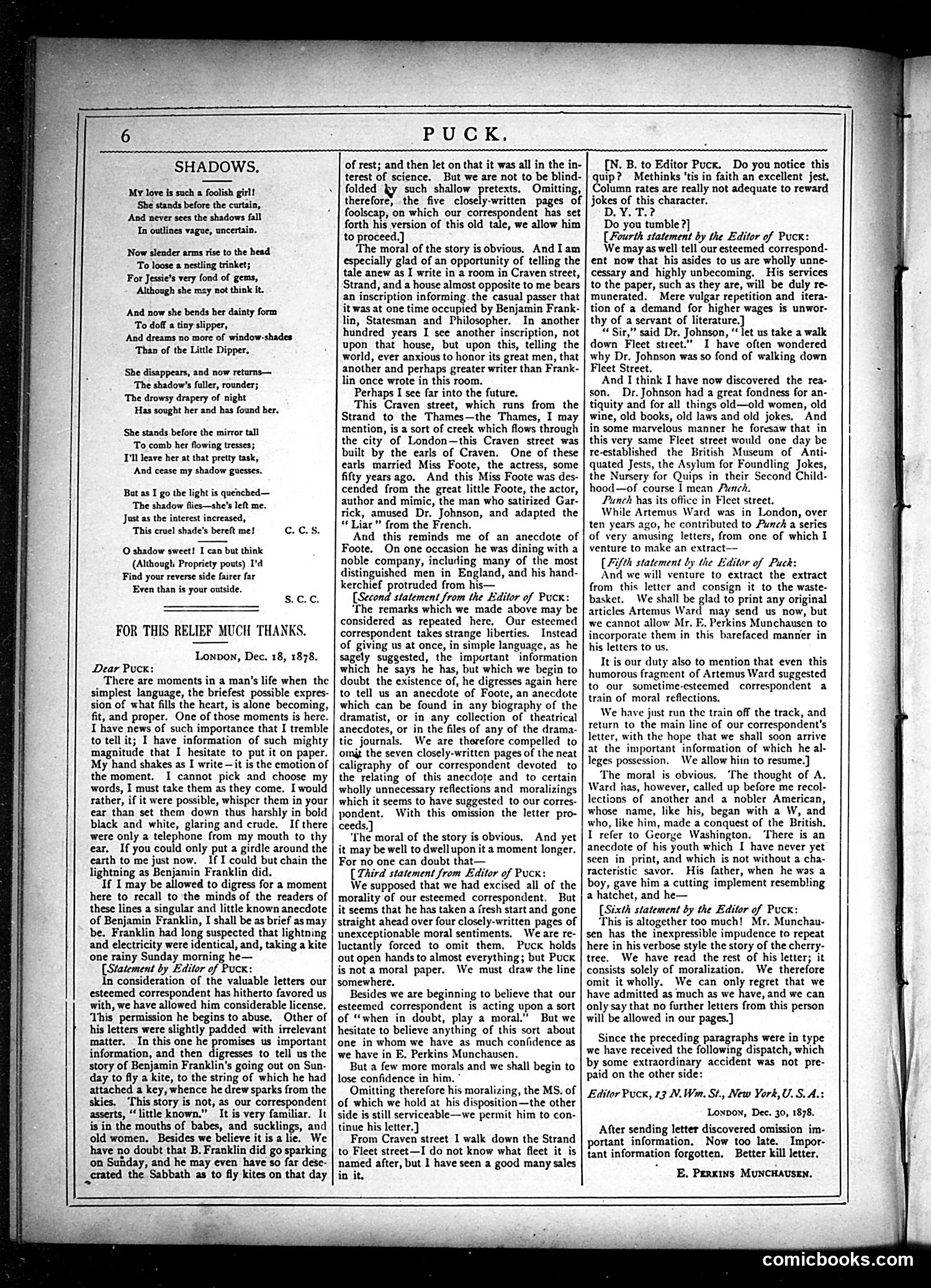
This page contains primarily **letters to the editor** rather than political cartoons. The header "SHADOWS" features a poem, followed by editor responses to correspondence. The main content addresses a dispute over an anecdote about **Benjamin Franklin** and a kite experiment on Sunday. Readers debated whether Franklin actually flew his kite on the Sabbath, with one correspondent claiming it occurred on Sunday. The Puck editors acknowledge this "unnecessary reflection and morality" but attempt to clarify the historical record. Additional letters discuss **Dr. Johnson**, London locations like Craven Street and Fleet Street, and the British Museum. The page concludes with a note about a typographical error in a previous dispatch. This represents reader engagement with factual historical claims rather than satirical content.
📄 Transcribed text from this page (OCR, searchable)
Machine-transcribed from the original scan — historical spelling and the odd misread are preserved.
PUCK, SHADOWS. My love is such a foolish girl! She stands before the curtain, And never sees the shadows fall In outlines vague, uncertain. ‘Now slender arms rise to the head To loose a nestling trinket For Jessie's very fond of gems, Although she my not think it, ‘And now she bends her dainty form To doff a tiny slipper, ‘And dreams no more of window-shades ‘Than of the Little Dipper. She disappears, and now returns— The shadows fuller, rounder; The drowsy drapery of night Has sought her and has found her. She stands before the mirror tall To comb her flowing tresses; I'll leave her at that pretty task, And cease my shadow guesses. Bat as I go the light is quenched— The shadow flies—she’s left me. Just as the interest increased, This cruel shade’s bereft me! shadow sweet! I can but think (Although Propriety pouts) I'd Find your reverse side fairer far Even than is your outside. 8.C.C. FOR THIS RELIEF MUCH THANKS. Lonpon, Dec. 18, 1878. Dear Puck: There are moments in a man’s life when the simplest language, the briefest possible expres- sion of what fills the heart, is alone becoming, fit, and proper. One of those moments is here. I have news of such importance that I tremble to tell it; I have information of such mighty magnitude that I hesitate to put it on paper. My hand shakes as I write —it is the emotion of the moment. I cannot pick and choose my words, I must take them as they come. I would rather, if it were possible, whisper them in your ear than set them down thus harshly in bold black and white, glaring and crude. If there were only a telephone from my mouth to thy ear. If you could only put a girdle around the earth to me just now. If I could but chain the lightning as Benjamin Franklin did. If I may be allowed to digress for a moment here to recall to the minds of the readers of these lines a singular and little known anecdote of Benjamin Franklin, I shall be as brief as may be. Franklin had long suspected that lightning and electricity were identical, and, taking a kite one rainy Sunday morning he— [Statement by Editor of Puck: In consideration of the valuable letters our esteemed correspondent has hitherto favored us with, we have allowed him considerable license, ‘This permission he begins to abuse. Other of his letters were slightly padded with irrelevant matter. In this one he promises us important information, and then digresses to tell us the story of Benjamin Franklin’s going out on Sun- day to fly a kite, to the string of which he had attached a key, whence he drew sparks from the skies. This story is not, as our correspondent asserts, ‘little known.” It is very familiar. It is in the mouths of babes, and sucklings, and old women. Besides we believe it is a lie. We have no doubt that B. Franklin did go sparking ‘on Sunday, and he may even have so far dese- crated the Sabbath as to fly kites on that day of rest; and then let on that it was all in the in- terest of science. But we are not to be blind- folded such shallow pretexts, Omitting, therefore, the five closely-written pages of foolscap, on which our correspondent has set forth his version of this old tale, we allow him to proceed.] The moral of the story is obvious, AndIam especially glad of an opportunity of telling the tale anew as I write in a room in Craven street, Strand, and a house almost opposite to me bears an inscription informing. the casual passer that it was at one time occupied by Benjamin Frank- lin, Statesman and Philosopher. In another hundred years I see another inscription, not upon that house, but upon this, telling the world, ever anxious to honor its great men, that another and perhaps greater writer than Frank- lin once wrote in this room. Perhaps I see far into the future. This Craven street, which runs from the Strand to the Thames—the Thames, I may mention, is a sort of creek which flows through the city of London—this Craven street was built by the earls of Craven. One of these earls married Miss Foote, the actress, some fifty years ago. And this Miss Foote was des- cended from the great little Foote, the actor, author and mimic, the man who satirized Gar- rick, amused Dr. Johnson, and adapted the “Liae” from the French. And this reminds me of an anecdote of Foote. On one occasion he was dining with a noble company, including many of the most distinguished men in England, and his hand- kerchief protruded from his. [Second statement from the Editor of Puck: ‘The remarks which we made above may be considered as repeated here, Our esteemed correspondent takes strange liberties. Instead of giving us at once, in simple language, as he sagely suggested, the important information which he says he has, but which we begin to doubt the existence of, he digresses again here to tell us an anecdote of Foote, an anecdote which can be found in any biography of the dramatist, or in any collection of theatrical anecdotes, or in the files of any of the drama- tic journals. We are therefore compelled to omg the seven closely-written pages of the neat caligraphy of our correspondent devoted to the relating of this anecdote and to certain wholly unnecessary reflections and moralizings which it seems to have suggested to our corres- pondent. With this omission the letter pro- ceeds] ‘The moral of the story is obvious. And yet it may be well to dwell upon it a moment longer. For no one can doubt that— [Third statement from Editor of Puck: We supposed that we had excised all of the morality of our esteemed correspondent. But it seems that he has taken a fresh start and gone straight ahead over four closely-written pages of unexceptionable moral sentiments. We are re- luctantly forced to omit them. Puck holds out open hands to almost everything; but Puck is not a moral paper. We must draw the line somewhere, Besides we are beginning to believe that our esteemed correspondent is acting upon a sort of “when in doubt, play a moral.” But we hesitate to believe anything of this sort about one in whom we have as much confidence as we have in E, Perkins Munchausen. But a few more morals and we shall begin to lose confidence in him. * Omitting therefore his moralizing, the MS. of of which we hold at his disposition—the other side is still serviceable—we permit him to con- tinue his letter.) From Craven street I walk down the Strand to Fleet street—I do not know what flect it is named after, but I have seen a good many sales in it. (N. B. to Editor Puck. Do you notice this quip? Methinks ’tis in faith an excellent jest, Column rates are really not adequate to reward jokes of this character. D.Y. T.? Do you tumble 2] [Fourth statement by the Editor of Puck: We may as well tell our esteemed correspond- ent now that his asides to us are wholly unne- cessary and highly unbecoming. His services to the paper, such as they are, will be duly re- munerated. Mere vulgar repetition and itera- tion of a demand for higher wages is unwor- thy of a servant of literature.) “Sir,” said Dr. Johnson, “let us take a walk down Fleet street.” I have often wondered why Dr. Johnson was so fond of walking down Fleet Street. And I think I have now discovered the rea- son. Dr. Johnson had a great fondness for an- tiquity and for all things old—old women, old wine, old books, old laws and old jokes. And in some marvelous manner he foresaw that in this very same Fleet street would one day be re-established the British Museum of Anti- quated Jests, the Asylum for Foundling Jokes, the Nursery for Quips in their Second Child- hood—of course I mean Punch, Punch has its office in Fleet street. While Artemus Ward was in London, over ten years ago, he contributed to Punch a series of very amusing letters, from one of which I venture to make an extract—— [Fifth statement by the Editor of Puck: And we will venture to extract the extract from this letter and consign it to the waste- basket. We shall be glad to print any original articles Artemus Ward may send us now, but we cannot allow Mr. E. Perkins Munchausen to incorporate them in this barefaced manner in his letters to us, It is our duty also to mention that even this humorous fragment of Artemus Ward suggested to our sometime-esteemed correspondent a train of moral reflections. We have just run the train off the track, and return to the main line of our correspondent's letter, with the hope that we shall soon arrive at the important information of which he al- leges possession. We allow hitn to resume.) The moral is obvious. ‘The thought of A. Ward has, however, called up before me recol- lections of another and a nobler American, whose name, like his, began with a W, and who, like him, made a conquest of the British. I refer to George Washington, There is an anecdote of his youth which I have never yet seen in print, and which is not without a cha- racteristic savor. His father, when he was a boy, gave him a cutting implement resembling a hatchet, and he— [Sixth statement by the Editor of Puck: ‘This is altogether too much! Mr. Munchau- sen has the inexpressible impudence to repeat here in his verbose style the story of the cherry- tree. We have read the rest of his letter; it consists solely of moralization, We therefore omit it wholly, We can only regret that we have admitted as much as we have, and we can only say that no further letters from this person will be allowed in our pages.) Since the preceding paragraphs were in type we have received the following dispatch, which by some extraordinary accident was not pre- paid on the other side: Editor Puck, 13 V.Wm. St., New York,U.S.A.: Lonpon, Dec. 30, 1878. After sending letter discovered omission im- portant information. Now too late. Impor- tant information forgotten. Better kill letter. "_E, Perkins MuNCHAUSEN. comicbooks.com