
Puck, 1879-01-01 · page 12 of 16
Puck — January 1, 1879 — page 12: what you’re looking at
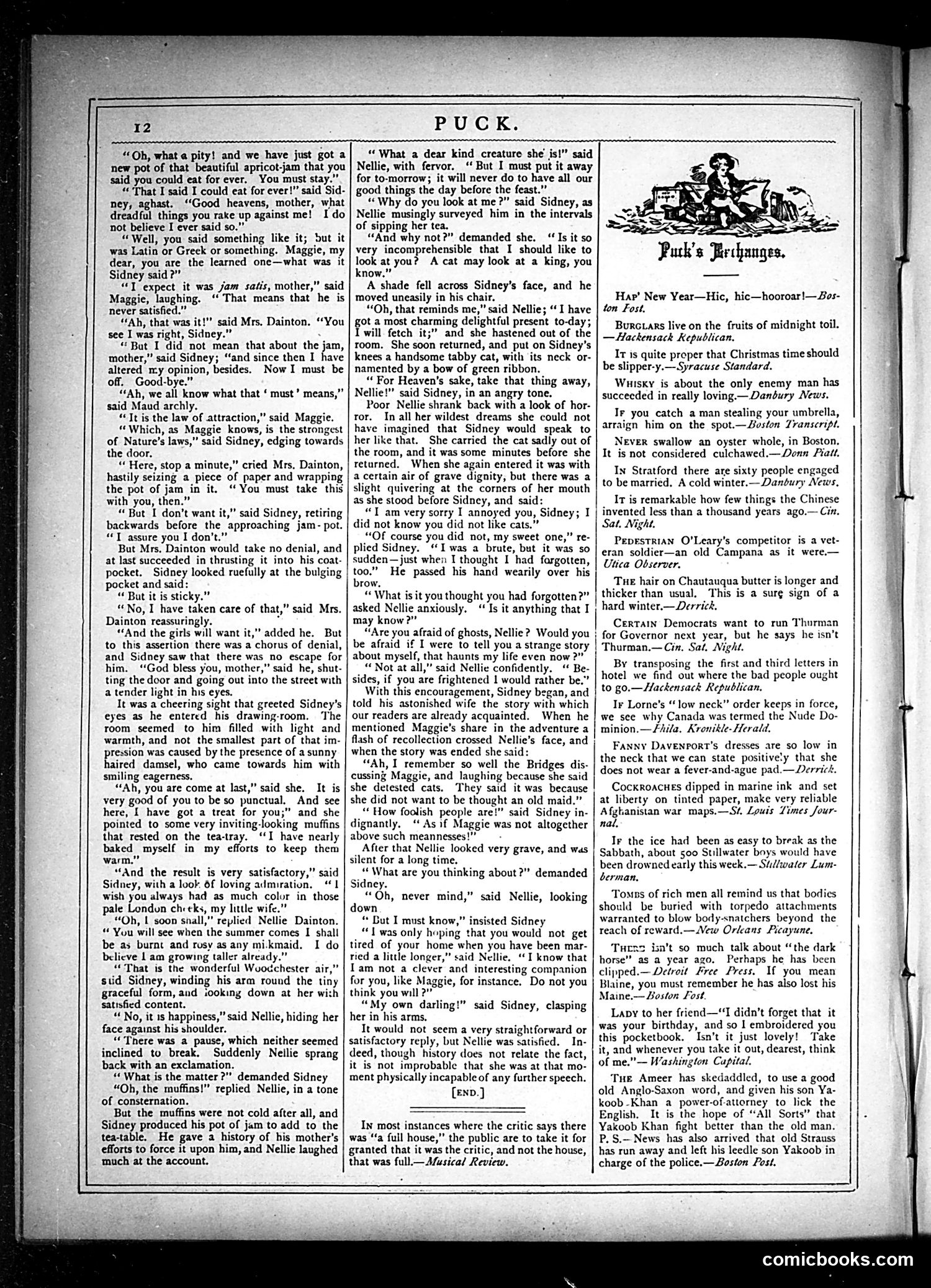
What you’re looking at
This page is primarily **text-based fiction** rather than political satire. It presents a serialized story titled "Puck's Exchanges" featuring characters named Sidney, Nellie, Maggie, and Dainton in a domestic drama involving a cat and various personal conflicts. The right column contains **"Puck's" characteristic brief satirical commentary** on contemporary topics, offering pointed one-liners on subjects like: - Christmas traditions - Love and marriage - Political candidates (Thurman for Governor) - Butter quality and Thanksgiving food - Military/foreign affairs (Afghanistan, Yakoop Khan) These quips represent typical **turn-of-century American social criticism**—light, topical jabs at politics, manners, and current events. The overall page reflects Puck's mixed format: serialized humor alongside satirical commentary on public affairs.
📄 Transcribed text from this page (OCR, searchable)
Machine-transcribed from the original scan — historical spelling and the odd misread are preserved.
12 PUCK. «Oh, what a pity! and we have just got a new pot of that beautiful apricot-jam that you said you could eat for ever. You must stay.” “That I said I could eat for ever!” said Sid- ney, aghast. ‘Good heavens, mother, what dreadful things you rake up against me! Ido not believe I ever said so.” “Well, you said something like it; but it was Latin or Greek or something. Maggie, my dear, you are the learned one—what was it Sidney said?” i “T expect it was jam satis, mother,” said Maggie, laughing. ‘ That means that he is never satisfied.” “Ah, that was it!" said Mrs. Dainton. “You see I was right, Sidney.” 2 “ But I did not mean that about the jam, mother,” said Sidney; ‘‘and since then I have altered’ my opinion, besides. Now I must be off. Good-bye.” “Ah, we all know what that ‘ must’ means,” said Maud archly. “Te is the law of attraction,” said Maggie. “Which, as Maggie knows, is the strongest of Nature’s laws,” said Sidney, edging towards the door. “ Here, stop a minute,” cried Mrs. Dainton, hastily seizing a piece of paper and wrapping the pot of jam in it. ‘ You must take this with you, then.” “But I don’t want it,” said Sidney, retiring backwards before the approaching jam- pot. “T assure you I don’t.” But Mrs. Dainton would take no denial, and at last succeeded in thrusting it into his coat- pocket. Sidney looked ruefully at the bulging | pocket and said: “ But it is sticky.” “No, I have taken care of that,” said Mrs. Dainton reassuringly. ; “And the girls will want it,” added he. But to this assertion there was a chorus of denial, and Sidney saw that there was no escape for him. “God bless you, mother,” said he, shut- ting the door and going out into the street with a tender light in his eyes. It was a cheering sight that greeted Sidney’s eyes as he entered his drawing-room. The room seemed to him filled with light and warmth, and not the smallest part of that im- pression was caused by the presence of a sunny haired damsel, who came towards him with smiling eagerness. “Ah, you are come at last,” said she. It is very good of you to be so punctual. And see here, I have got a treat for you;” and she pointed to some very inviting-looking muffins that rested on the tea-tray. ‘I have nearly baked myself in my efforts to keep them warm.” “And the result is very satisfactory,” said Sidney, with a look. Of loving admiration, “1 wish you always had as much color in those pale London ch: eks, my little wife.”” “Oh, | soon shall,” replied Nellie Dainton. “ You will see when the summer comes I shall be as burnt and rosy as any mi-kmaid. I do believe L am growing taller already.” “That is the wonderful Woodchester air,” stid Sidney, winding his arm round the tiny graceful form, and iooking down at her with satisfied content. “No, it 1s happiness,” said Nellie, hiding her face against his shoulder. “There was a pause, which neither seemed inclined to break. Suddenly Nellie sprang back with an exclamation. «« What is the matter?” demanded Sidney “Oh, the muffins!” replied Nellie, in a tone of consternation. But the muffins were not cold after all, and Sidney produced his pot of jam to add to the tea-table. He gave a history of his mother’s efforts to force it upon him, and Nellie laughed much at the account. “What a dear kind creature she’ is!" said Nellie, with fervor. ‘“ But I must put it away for to-morrow; it will never do to have all our good things the day before the feast.” “Why do you look at me?” said Sidney, as Nellie musingly surveyed him in the intervals of sipping her tea. “And why not?” demanded she. ‘Is it so very incomprehensible that I should like to look at you? A cat may look at a king, you know.” A shade fell across Sidney’s face, and he moved uneasily in his chair. “Oh, that reminds me," said Nellie; “I have got a most charming delightful present to-day; I will fetch it;” and she hastened out of the room. She soon returned, and put on Sidney’s knees a handsome tabby cat, with its neck or- namented by a bow of green ribbon. “ For Heaven's sake, take that thing away, Nellie!” said Sidney, in an angry tone. Poor Nellie shrank back with a look of hor- ror. In all her wildest dreams she could not have imagined that Sidney would speak to her like that. She carried the cat sadly out of the room, and it was some minutes before she returned. When she again entered it was with acertain air of grave dignity, but there was a slight quivering at the corners of her mouth as she stood before Sidney, and said: “Tam very sorry I annoyed you, Sidney; I did not know you did not like cats.”” “Of course you did not, my sweet one,” re- plied Sidney. I was a brute, but it was so sudden—just when I thought I had fargotten, too.” He passed his hand wearily over his brow. “What is it you thought you had forgotten?” asked Nellie anxiously. ‘Is it anything that I may know?" “Are you afraid of ghosts, Nellie? Would you | be afraid if I were to tell you a strange story about myself, that haunts my life even now ?” “Not at all,” said Nellie confidently. “ Be- sides, if you are frightened 1 would rather be.” With this encouragement, Sidney began, and told his astonished wife the story with which our readers are already acquainted. When he mentioned Maggie's share in the adventure a flash of recollection crossed Nellie’s face, and j when the story was ended she said: “Ah, I remember so well the Bridges dis- cussing Maggie, and laughing because she said she detested cats. They said it was because she did not want to be thought an old maid.” “How foolish people are!” said Sidney in- dignantly. ‘Asif Maggie was not altogether above such meannesses!"" After that Nellie looked very grave, and was silent for a long time. “What are you thinking about ?” demanded Sidney. “Oh, never mind,” said Nellie, looking down “ But I must know,” insisted Sidney “1 was only hoping that you would not get tired of your home when you have been mar- ried a little longer,” said Nellie, “I know that Iam not a clever and interesting companion for you, like Maggie, for instance. Do not you think you will 2” “My own darling!” said Sidney, clasping her in his arms, It would not seem a very straightforward or satisfactory reply, but Nellie was satisfied. In- deed, though history does not relate the fact, it is not improbable that she was at that mo- ment physically incapable of any further speech. [env.] In most instances where the critic says there was ‘‘a full house,” the public are to take it for granted that it was the critic, and not the house, that was full.—A/usical Review. Har’ New Year—Hic, hic—hooroar!—Bos- ton Fost. Burctars live on the fruits of midnight toil. —Hackensack Republican, Ir is quite proper that Christmas time should be slipper-y.— Syracuse Standard. Wuisky is about the only enemy man has succeeded in really loving.— Danbury News. Ir you catch a man stealing your umbrella, arraign him on the spot.—Boston Transcript. Never swallow an oyster whole, in Boston, It is not considered culchawed.—Donn Piatt, In Stratford there are sixty people engaged to be married, A cold winter.— Danbury News, It is remarkable how few things the Chinese invented less than a thousand years ago.— Cis Sat, Night, Pepestrian O’Leary’s competitor is a vet- eran soldier—an old Campana as it were,— Utica Observer. Tue hair on Chautauqua butter is longer and thicker than usual, This is a surg sign of a hard winter.—Derrick, Certain Democrats want to run Thurman for Governor next year, but he says he isn’t Thurman.— Cin. Sat. Night. By transposing the first and third letters in hotel we find out where the bad people ought to go.— Hackensack Republican, Ir Lorne'’s “low neck” order keeps in force, we see why Canada was termed the Nude Do- minion.—Fii/a. Kronikle- Herald, Fanny Davenport's dresses are so low in the neck that we can state positively that she does not wear a fever-and-ague pad.—Derrick. Cockroacues dipped in marine ink and set at liberty on tinted paper, make very reliable Afghanistan war maps.—S¢. Louis Times Jour- nal, Ir the ice had been as easy to break as the Sabbath, about 500 Stillwater boys would have been drowned early this week.— Stidiwater Lum- berman, Tomps of rich men all remind us that bodies should be buried with torpedo attachments warranted to blow body-snatchers beyond the reach of reward.—New Orleans Picayune, TH isn’t so much talk about “the dark horse” as a year ago. Perhaps he has been clipped.— Detroit Free Press. If you mean Blaine, you must remember he has also lost his Maine.— Boston Fost. Lapy to her friend—‘TI didn’t forget that it was your birthday, and so I embroidered you this pocketbook. Isn’t it just lovely! Take it, and whenever you take it out, dearest, think of me."— Washington Capital. Tue Ameer has skedaddled, to use a good old Anglo-Saxon word, and given his son Ya- koob-Khan a power-of-attorney to lick the English. It is the hope of “All Sorts’ that Yakoob Khan fight better than the old man. P. S.— News has also arrived that old Strauss has run away and left his leedle son Yakoob in charge of the police.—Boston Fost. comicbooks.com couere yt hla» iS