
Puck, 1879-01-01 · page 2 of 16
Puck — January 1, 1879 — page 2: what you’re looking at
What you’re looking at
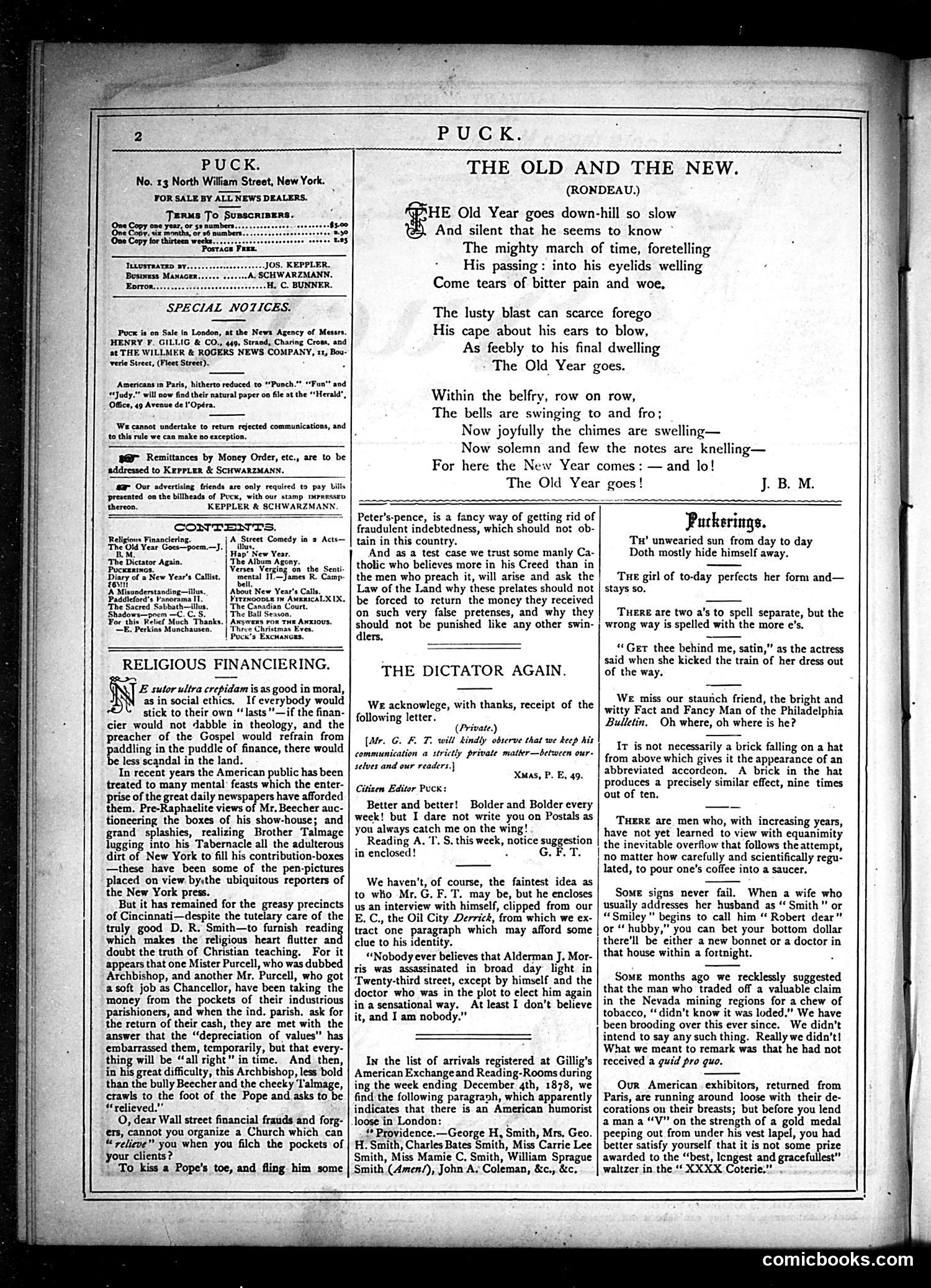
This page contains **no political cartoons**—it's primarily **advertising and editorial content** from Puck magazine. The main illustrated piece is "The Old and the New" (Rondeau), a sentimental poem about the passing of the Old Year and arrival of the New Year, accompanied by decorative typography. It's **seasonal New Year's content**, not satire. Below that are several short pieces: "Puckerings" (brief humor items), "The Dictator Again" (which references a previous article about someone nicknamed "the Dictator," but context is unclear without prior issues), and "Religious Financing" (social commentary on church finances and clerical scandals). The bulk of the page consists of **subscription information, business notices, and classified advertising**—typical of magazine layouts from this era.
📄 Transcribed text from this page (OCR, searchable)
Machine-transcribed from the original scan — historical spelling and the odd misread are preserved.
PUCK. THE OLD AND THE NEW. (RONDEAU.) ee Old Year goes down-hill so slow And silent that he seems to know The mighty march of time, foretelling His passing: into his eyelids welling Come tears of bitter pain and woe, PUCK. No. 13 North William Street, New York. é FOR SALE BY ALL NEWS DEALERS. Tenus To SuBscRiBER’ JOS. KEPPLER. SCHWARZMANN. -H, C. BUNNER. SPECIAL NOVICES. Puck is on Sale in London, at the News Agency of Messrs. HENRY F. GILLIG & CO., 449, Strand, Charing Cross, and at THE WILLMER & ROGERS NEWS COMPANY, 11, Bou- verie Street, (Fleet Street). : Americans in Paris, hitherto reduced to “Punch.” “Fun and *Judy.”* will now find their natural paper on file at the ‘Herald’, Office, 49 Avenue de I'Opéra. ‘We cannot undertake to return rejected communications, and to this rule we can make no exception. 8@- Remittances by Money Order, etc., are to be addressed to Kerrier & SCHWARZMANN. gar Our advertising friends are only required to pay presented on the biltheads of Puck, with our stamp 107 KEPPLER & SCHWARZMAN CONTENTS. A Street Comedy in 2 Acts "Bay en tas @ Album Agony. ‘Verses Verging oo the Scati- ‘mental Ih-—James Re Camp- bait About New Year's Calls, Prrenoopte tw AvnnicaLX 1X, Puck's Excnaxces., — The lusty blast can scarce forego His cape about his ears to blow, As feebly to his final dwelling The Old Year goes. Within the belfry, row on The bells are swinging to row, and fro; Now joyfully the chimes are swelling— Now solemn and few the notes are knelling— For here the New Year comes: — and lo! goes ! The Old Year J. B. M. Peter's-pence, is a fancy way of getting rid of fraudulent indebtedness, which should not ob- tain in this country. And as a test case we trust some manly Ca- tholic who believes more in his Creed than in the men who preach it, will arise and ask the Law of the Land why these prelates should not be forced to return the money they received on such very false pretenses, and why they should not be punished like any other swin- dlers. RELIGIOUS FINANCIERING. E sutor ultra crepidamis as good in moral, as in social ethics. If everybody would stick to their own “lasts ""—if the finan- cier would not dabble in theology, and the preacher of the Gospel would refrain from addling in the puddle of finance, there would Be less scandal in the land. In recent years the American public has been treated to many mental’ feasts which the enter- prise of the great daily newspapers have afforded them, Pre-Raphaelite views of Mr. Beecher auc- tioneering the boxes of his show-house; and grand splashies, realizing Brother Talmage lugging into his Tabernacle all the adulterous dirt of New York to fill his contribution-boxes —these have been some of the pen-pictures placed on view bysthe ubiquitous reporters of the New York press. But it has remained for the greasy precincts of Cincinnati—despite the tutelary care of the truly good D. R. Smith—to furnish readin, which makes the religious heart flutter an doubt the truth of Christian teaching. For it appears that one Mister Purcell, who was dubbed Archbishop, and another Mr. Purcell, who got a soft job as Chancellor, have been taking the money from the pockets of their industrious parishioners, and when the ind. parish. ask for the return of their cash, they are met with the answer that the “depreciation of values’ has embarrassed them, temporarily, but that every- thing will be “all right” in time. And then, in his great difficulty, this Archbishop, less bold than the bully Beecher and the cheeky'I'almage, crawls to the foot of the Pope and asks to be ‘ relieved." O, dear Wall street financial frauds and forg- ers, cannot you organize a Church which can “ relieve” you when you filch the pockets of your clients? ‘| To kiss a Pope’s toe, and fling him some THE DICTATOR AGAIN. WE acknowlege, with thanks, receipt of the following letter. (Private.) [Alr. G. F 7. will kindly observe that we heep his communication a strictly private matter—between our- selves and our readers.) Xmas, P. E, 49. Citizen Editor Puck: Better and better! Bolder and Bolder every week! but I dare not write you on Postals as you always catch me on the wing! Reading A. T. S. this week, notice suggestion in enclosed! . WF, T, We haven't, of course, the faintest idea as to who Mr. G. F. T, may be, but he encloses us an interview with himself, clipped from our E.C., the Oil City Derrick, from which we ex- tract one paragraph which may afford some clue to his identity. “Nobody ever believes that Alderman J. Mor- ris was assassinated in broad day light in ‘Twenty-third street, except by himself and the doctor who was in the plot to elect him again in a sensational way. At least 1 don’t believe it, and I am nobody.” In the list of arrivals registered at Gillig’s American Exchange and Reading-Rooms during ing the week ending December 4th, 1878, we find the following paragraph, which apparently indicates that there is an American humorist loose in London: * {* Providence.—George H, Smith, Mrs, Geo. H. Smith, Charles Bates Smith, Miss Carrie Lee Smith, Miss Mamie C, Smith, William Sprague Smith (Amen/), John A; Coleman, &c., &c, Puckerings. Tw’ unwearied sun from day to day Doth mostly hide himself away. Tue girl of to-day perfects her form and— stays so. ‘THERE are two a's to spell separate, but the wrong way is spelled with the more e's. “Ger thee behind me, satin,” as the actress said when she kicked the train of her dress out of the way. We miss our staurich friend, the bright and witty Fact and Fancy Man of the Philadelphia Bulletin, Oh where, oh where is he? Ir is not necessarily a brick falling on a hat from above which gives it the appearance of an abbreviated accordeon. A brick in the hat produces a precisely similar effect, nine times out of ten, THERE are men who, with increasing years, have not yet learned to view with equanimity the inevitable overflow that follows the attempt, no matter how carefully and scientifically regu- lated, to pour one’s coffee into a saucer. Some signs never fail. When a wife who usuaily addresses her husband as “ Smith” or “Smiley” begins to call him “ Robert dear” or “hubby,” you can bet your bottom dollar there'll be either a new bonnet or a doctor in that house within a fortnight. Some months ago we recklessly suggested that the man who traded off a valuable claim in the Nevada mining regions for a chew of tobacco, “didn’t know it was loded.” We have been brooding over this ever since. We didn't intend to say any such thing. Really we didn't! What we meant to remark was that he had not received a guid pro quo. Our American exhibitors, returned from Paris, are running around loose with their de- corations on their breasts; but before you lend aman a “V” on the strength of a gold medal peeping out from under his vest lapel, you had better satisfy yourself that it is not some prize awarded to the “‘best, longest and gracefullest” waltzer in the “‘ XXXX Coterie.” comicbooks.com