
Puck, 1879-01-01 · page 7 of 16
Puck — January 1, 1879 — page 7: what you’re looking at
What you’re looking at
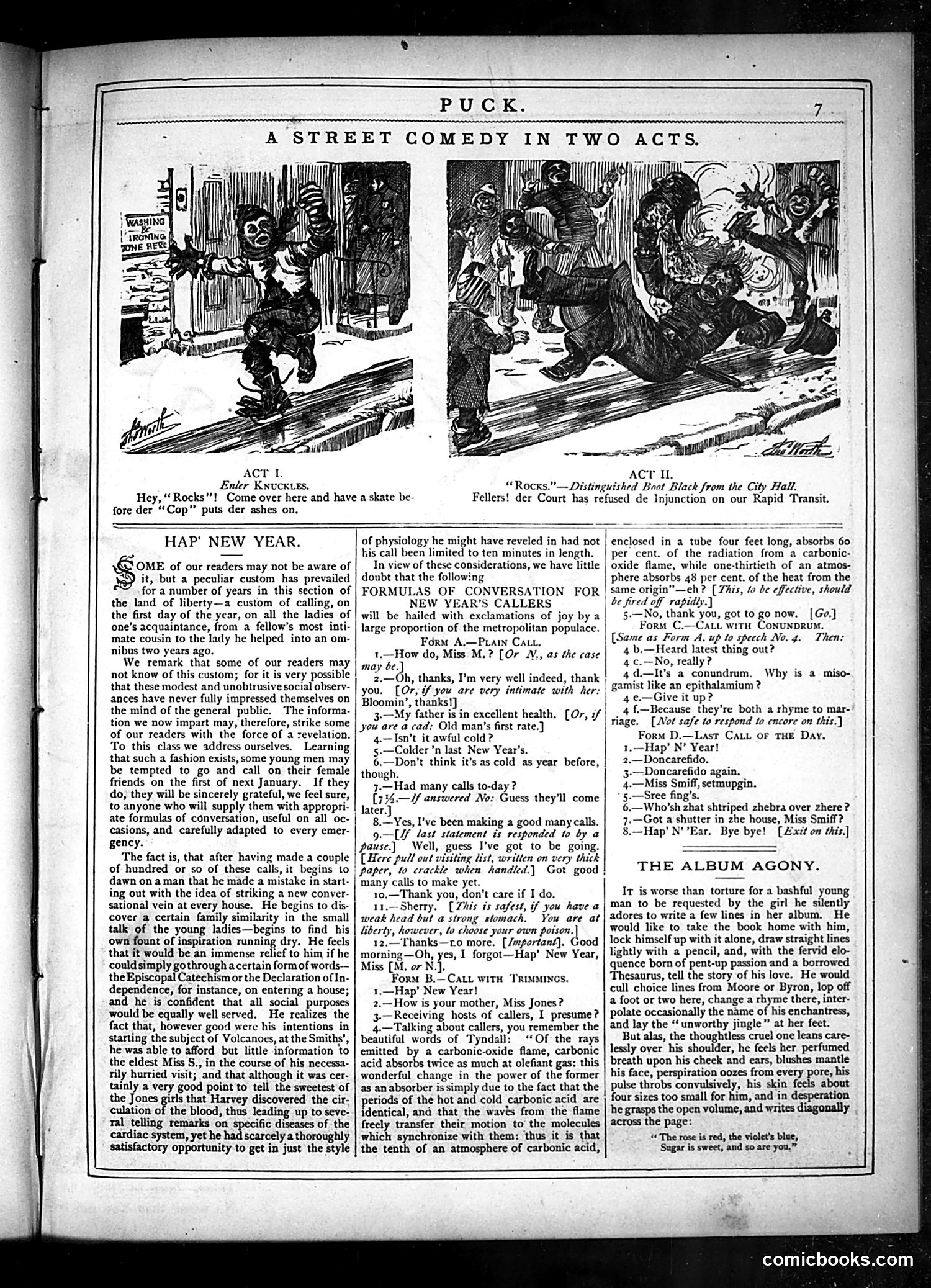
**The Cartoons:** Two street scenes depict what appears to be a skating accident or dispute. The left panel shows a figure being confronted by a policeman near storefronts; the right panel shows a chaotic street scene with multiple figures gathered around someone on the ground. The captions reference "Rocks," a "Boot Black," and disputes involving a "Rapid Transit" court injunction—suggesting urban class conflict between working-class street vendors and city authorities. **"Hap' New Year" Section:** This satirizes the New Year's calling custom where wealthy visitors would exchange cards. The text mocks this ritualistic social obligation as exhausting and superficial, suggesting the practice wastes time on insincere pleasantries among the metropolitan elite. The humor targets upper-class social pretension and the mechanical nature of fashionable etiquette.
📄 Transcribed text from this page (OCR, searchable)
Machine-transcribed from the original scan — historical spelling and the odd misread are preserved.
re Enter KNUCKLES. Hey, “ Rocks”! Come over here and have a skate be- fore der “Cop” puts der ashes on. PUCK. STREET COMEDY IN TWO ACTS. zi pets “Rocks."—Distinguished Boot Black from the City Hall. Fellers! der Court has refused de Injunction on our Rapid Transit. HAP’ NEW YEAR. OME of our readers may not be aware of it, but a peculiar custom has prevailed for a number of years in this section of the land of liberty—a custom of calling, on the first day of the year, on all the ladies of one’s acquaintance, from a fellow’s most inti- mate cousin to the lady he helped into an om- nibus two years ago. We remark that some of our readers may not know of this custom; for it is very possible that these modest and unobtrusive social observ- ances have never fully impressed themselves on the mind of the general public. ‘The informa- tion we now impart may, therefore, strike some of our readers with the force of a revelation, To this class we address ourselves. Learning that such a fashion exists, some young men may be tempted to go and call on their female friends on the first of next January. If they do, they will be sincerely grateful, we feel sure, to anyone who will supply them with appropri- ate formulas of conversation, useful on all oc- casions, and carefully adapted to every emer- gency. The fact is, that after having made a couple of hundred or so of these calls, it begins to dawn on aman that he made a mistake in start- ing out with the idea of striking a new conver- sational vein at every house. He begins to dis- cover a certain family similarity in the small talk of the young ladies—begins to find his own fount of inspiration running dry. He feels that it would be an immense relief to him if he could simply gothrough acertain form of words— the Episcopal Catechism or the Declaration of In- dependence, for instance, on entering a house; and he is confident that all social purposes would be equally well served. He realizes the fact that, however good were his intentions in starting the subject of Volcanoes, at the Smiths’, he was able to afford but little information to the eldest Miss S., in the course of his necessa- rily hurried visit; and that although it was cer- tainly a very good point to tell the sweetest of the eas irls that Harvey discovered the cir- culation of the blood, thus leading up to seve- ral telling remarks on specific diseases of the cardiac system, yet he had scarcely a thoroughly satisfactory opportunity to get in just the style of physiology he might have reveled in had not | | his call been limited to ten minutes in length. In view of these considerations, we have little | doubt that the following FORMULAS OF CONVERSATION NEW YEAR'S CALLERS will be hailed with exclamations of joy by a large proportion of the metropolitan populace. Form A.—Pvatn Catt. 1.—How do, Miss M.? [Or N., as the case may be.) 2.—Oh, thanks, I’m very well indeed, thank you. [Or, if you are very intimate with her: Bloomin’, thanks!] 3-—My father is in excellent health. [Or, if you are a cad: Old man’s first rate.] 4.—Isn’t it awful cold? 5.—Colder 'n last New Year's. 6.—Don’t think it’s as cold as year before, though, 7.—Had many calls to-day ? (714.—/ answered No: Guess they'll come later.] 8.—Yes, I've been making a good many calls. 9-—[/ fast statement is responded to by a pause.) Well, guess I've got to be going. | [Here pull out visiting list, written on very thick | paper, to crackle when handled.) Got good many calls to make yet. 10.—Thank you, don’t care if I do. 11.—Sherry. [This is safest, if you havea weak head but a strong stomach. You are at liberty, however, to choose your own poison. 12.—Thanks—ro more. [/mportant]. Good morning—Oh, yes, I forgot—Hap’ New Year, Miss [M. or N.]. Form B.—Catt with TRimincs. 1.—Hap! New Year! 2.—How is your mother, Miss Jones? 3.—Receiving hosts of callers, I presume? 4 ‘alking about callers, you remember the beautiful words of Tyndall: “Of the rays emitted by a carbonic-oxide flame, carbonic acid absorbs twice as much at olefiant gas: this wonderful change in the power of the former as an absorber is simply due to the fact that the eriods of the hot and cold carbonic acid are FOR identical, and that the waves from the flame freely transfer their motion to’ the molecules which synchronize with them: thus it is that the tenth of an atmosphere of carbonic acid, enclosed in a tube four feet long, absorbs 60 per cent. of the radiation from a carbonic- oxide flame, while one-thirtieth of an atmos- phere absorbs 48 per cent. of the heat from the same origin”—ch ? [Zhis, to be effective, should be fired off rapidly. 5.—No, thank you, got to go now. [Go.] Fora C.—Cat with Conunprum. (Same as Form A. up to speech No.4. Then: 4 b.—Heard latest thing out? 4.¢.—No, really? 4d.—It’s a conundrum. gamist like an epithalamium ? 4 ¢.—Give it up? 4 f.—Because they’re both a rhyme to mar- riage. [Not safe to respond to encore on this.] Form D.—Last Cau or THE Day. 1,—Hap’ N’ Year! 2.—Doncarefido. 3-—Doncarefido again. 4-—Miss Smif, setmupgin. 5.—Sree fing’s. 6.—Who'sh zhat shtriped zhebra over zhere ? 7.—Got a shutter in zhe house, Miss Smiff? 8.—Hap’ N’’Ear. Bye bye! [£xit on this] Why is a miso- THE ALBUM AGONY. It is worse than torture for a bashful young man to be requested by the girl he silently adores to write a few lines in her album. He would like to take the book home with him, lock himself up with it alone, draw straight lines lightly with a pencil, and, with the fervid elo- quence born of pent-up passion and a borrowed Thesaurus, tell the story of his love. He would cull choice lines from Moore or Byron, lop off a foot or two here, change a rhyme there, inter- polate occasionally the name of his enchantress, and lay the “unworthy jingle” at her feet. But alas, the thoughtless cruel one leans care- lessly over his shoulder, he feels her perfumed breath upon his cheek and ears, blushes mantle his face, perspiration oozes from every pore, his pulse throbs convulsively, his skin feels about four sizes too small for him, and in desperation he grasps the open volume, and writes diagonally _ across the page: “« The rose is red, the violet's blue, Sagar is sweet, and so are you,” comicbooks.com