
A complete issue · 16 pages · 1878
Puck — December 11, 1878
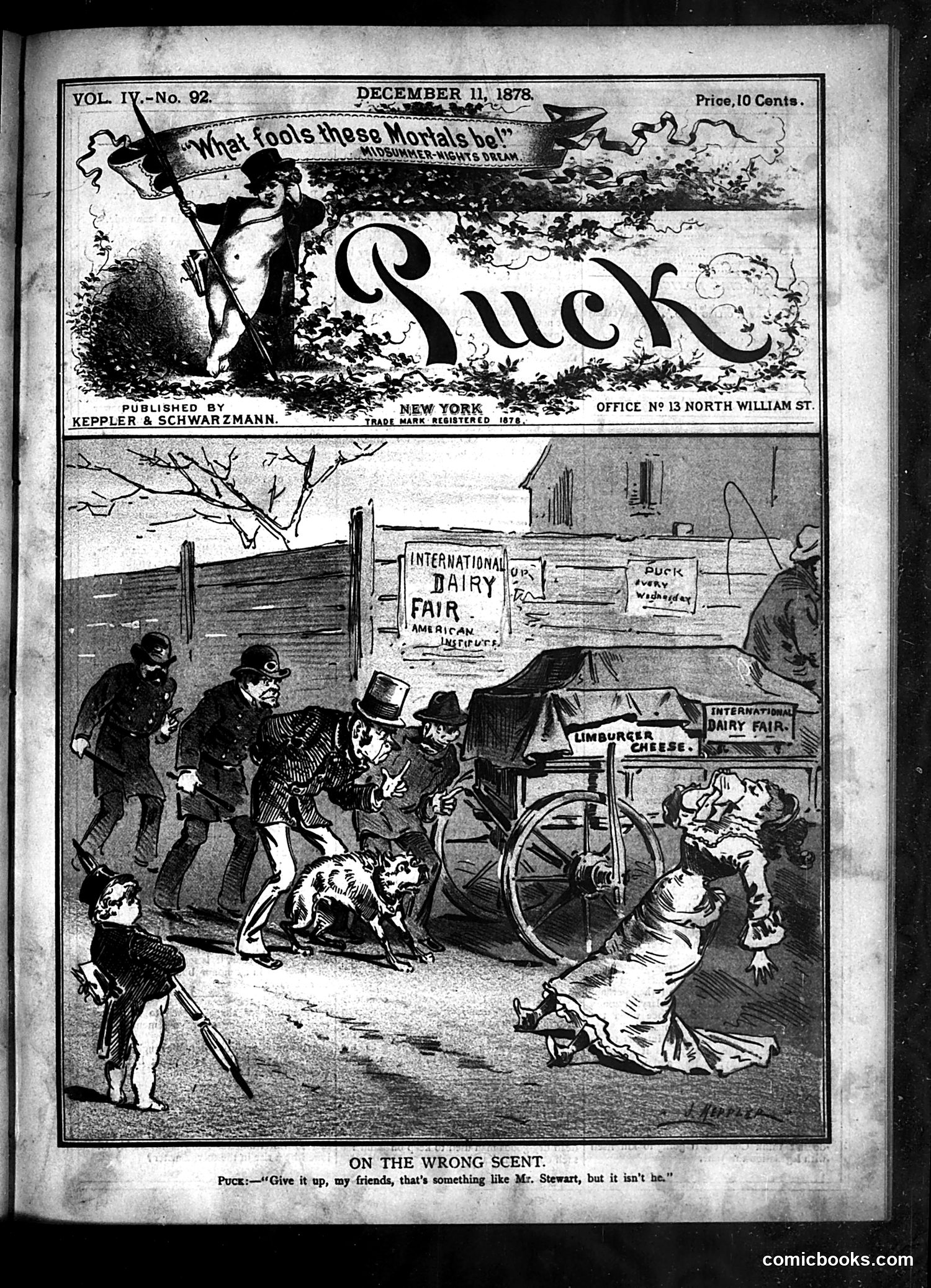
This December 1878 Puck cartoon satirizes what appears to be a famous criminal case or scandal involving someone named Mr. Stewart. Dogs (likely representing detectives or investigators) are following a scent at an "International Dairy Fair," sniffing around items like butter and limburger cheese. The joke plays on "scent" — both the literal smell the dogs follow and the figurative sense of being "on the scent" of a criminal. The dogs have pursued the wrong trail, distracted by the pungent dairy products rather than the actual suspect. Puck is mocking investigators or authorities for pursuing a false lead or mishandling evidence in what was apparently a well-known contemporary case.
This page contains primarily **text content rather than political cartoons**. The main article, "A Good Riddance to Bad Rubbish," satirizes European aristocratic entertainment coming to America. It mocks the idea of bringing European royalty (specifically referencing Bulgaria's "Hiram Ulysses" and various European nobles) to perform in American shows, suggesting such ventures would be absurd. The piece criticizes both European pretension and American fascination with titled foreigners, arguing that authentic American figures like Grant and Robeson would be far more worthy attractions than imported European nobility. The tone is dismissive toward both transatlantic snobbery and American gullibility regarding foreign aristocrats. The right column contains brief satirical observations labeled "Puckerings" on various social topics.
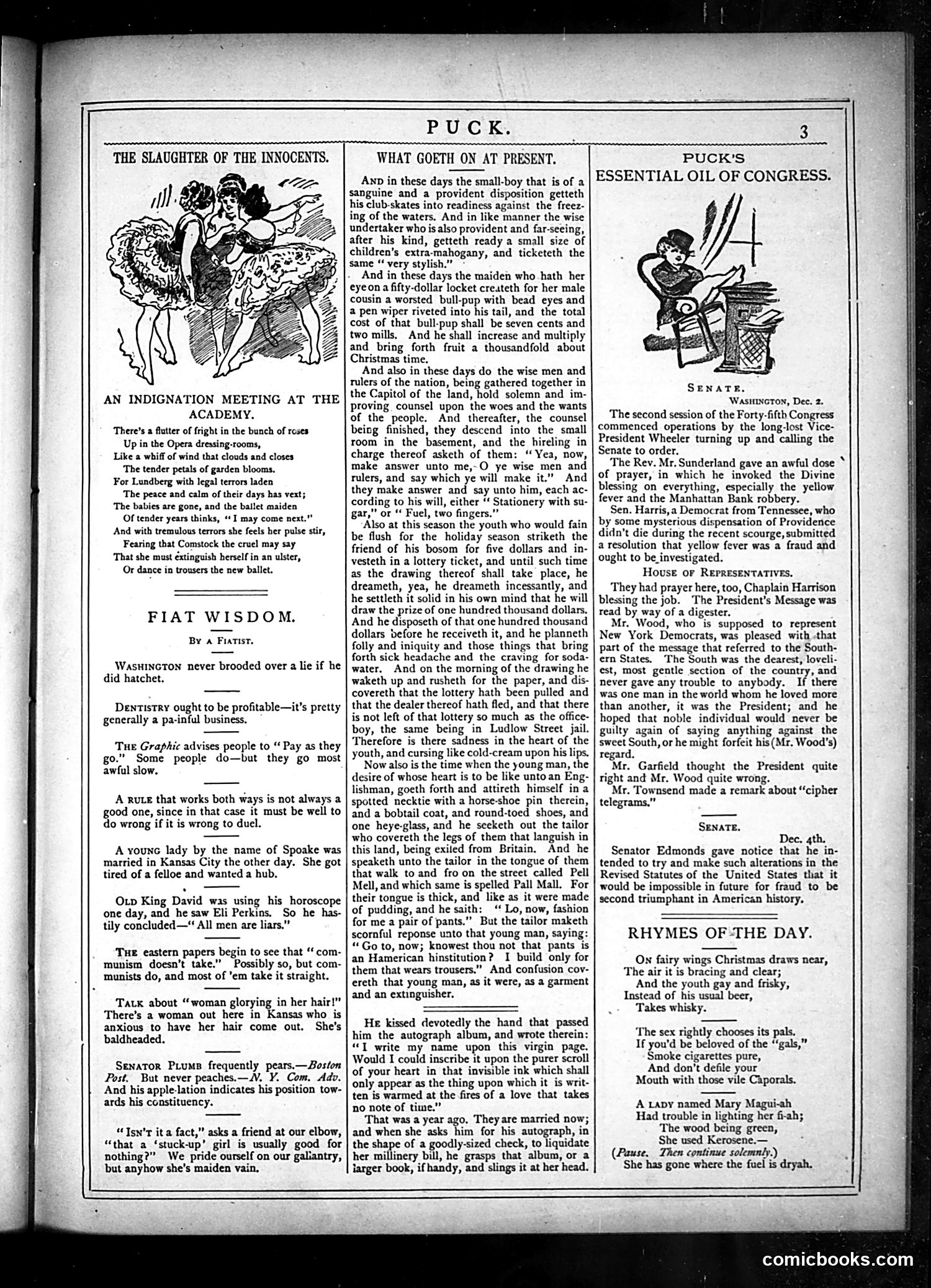
This page contains multiple satirical pieces targeting Congress and political figures of the era. **"The Slaughter of the Innocents"** appears to mock Congressional spending or legislative waste, using the biblical reference ironically to criticize government excess. **"What Goeth On at Present"** satirizes Congressional deliberations, suggesting political figures engage in frivolous debates about trivial matters (like lottery tickets and fashionable clothing) while serious national business waits. **"Puck's Essential Oil of Congress"** presents a condensed commentary on recent Senate proceedings, including references to Senator Edmonds and what appears to be debates over the Revised Statutes. The overall tone suggests frustration with Congress's productivity and priorities—a common Puck theme. The satirical pieces ridicule lawmakers for wasteful time-spending and ineffectual debate rather than substantive governance.
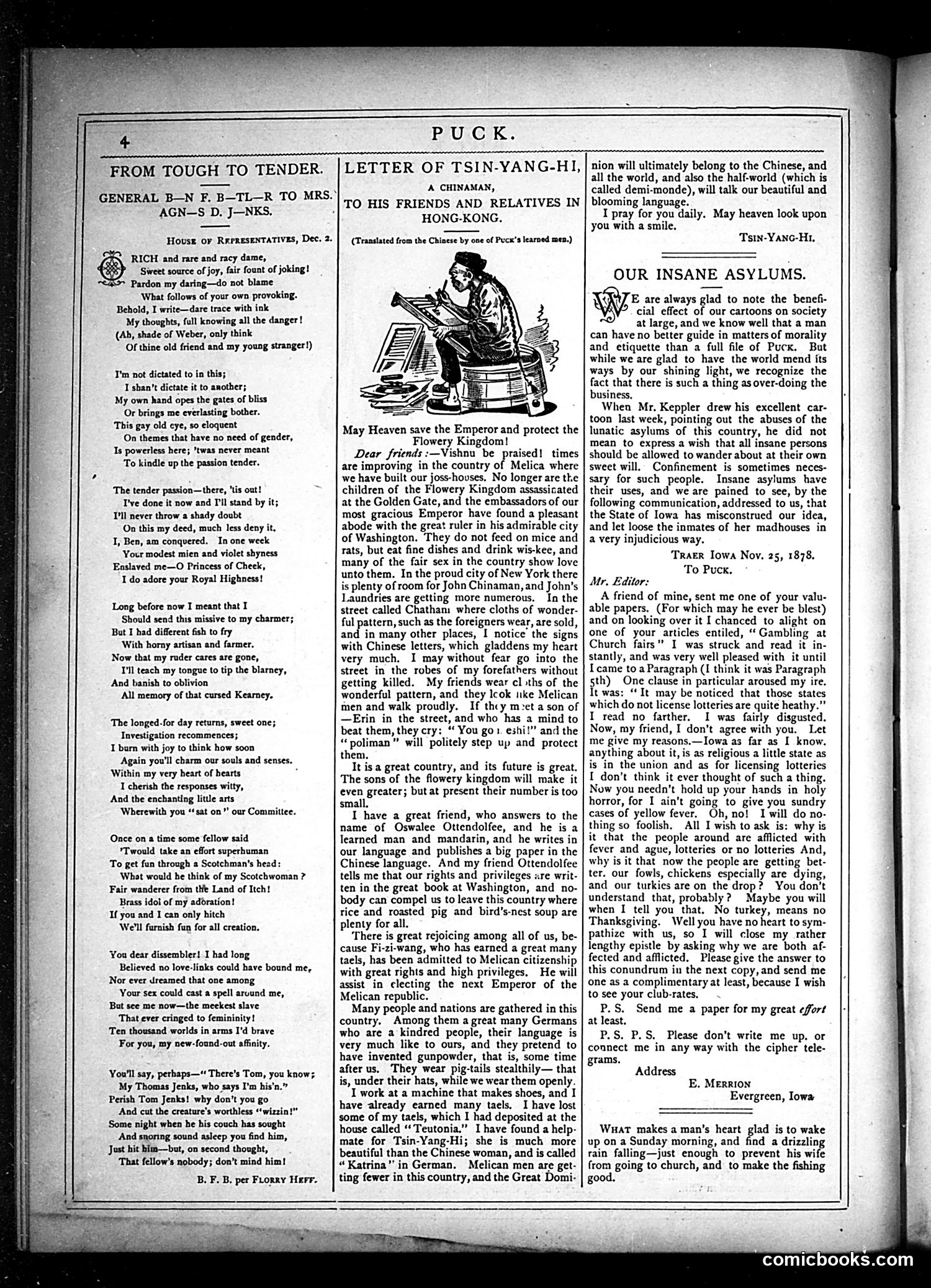
The main cartoon depicts a Chinese man sitting at a desk, writing. The accompanying letter from "Tsin-Yang-Hi, A Chinaman" addresses friends in Hong Kong, describing observations of America—particularly New York's laundries, Chinese immigrants, and their social conditions. The satire appears to target American hypocrisy regarding Chinese workers. Tsin-Yang-Hi describes Chinese laborers as hardworking and dignified, contrasting this with American prejudice against them. He notes that Chinese immigrants, despite contributing to society, face discrimination and are stereotyped. The joke likely critiques how Americans simultaneously exploit Chinese labor while denigrating Chinese people socially—a commentary on late-19th-century anti-Chinese sentiment and discriminatory practices like the Chinese Exclusion Act era.
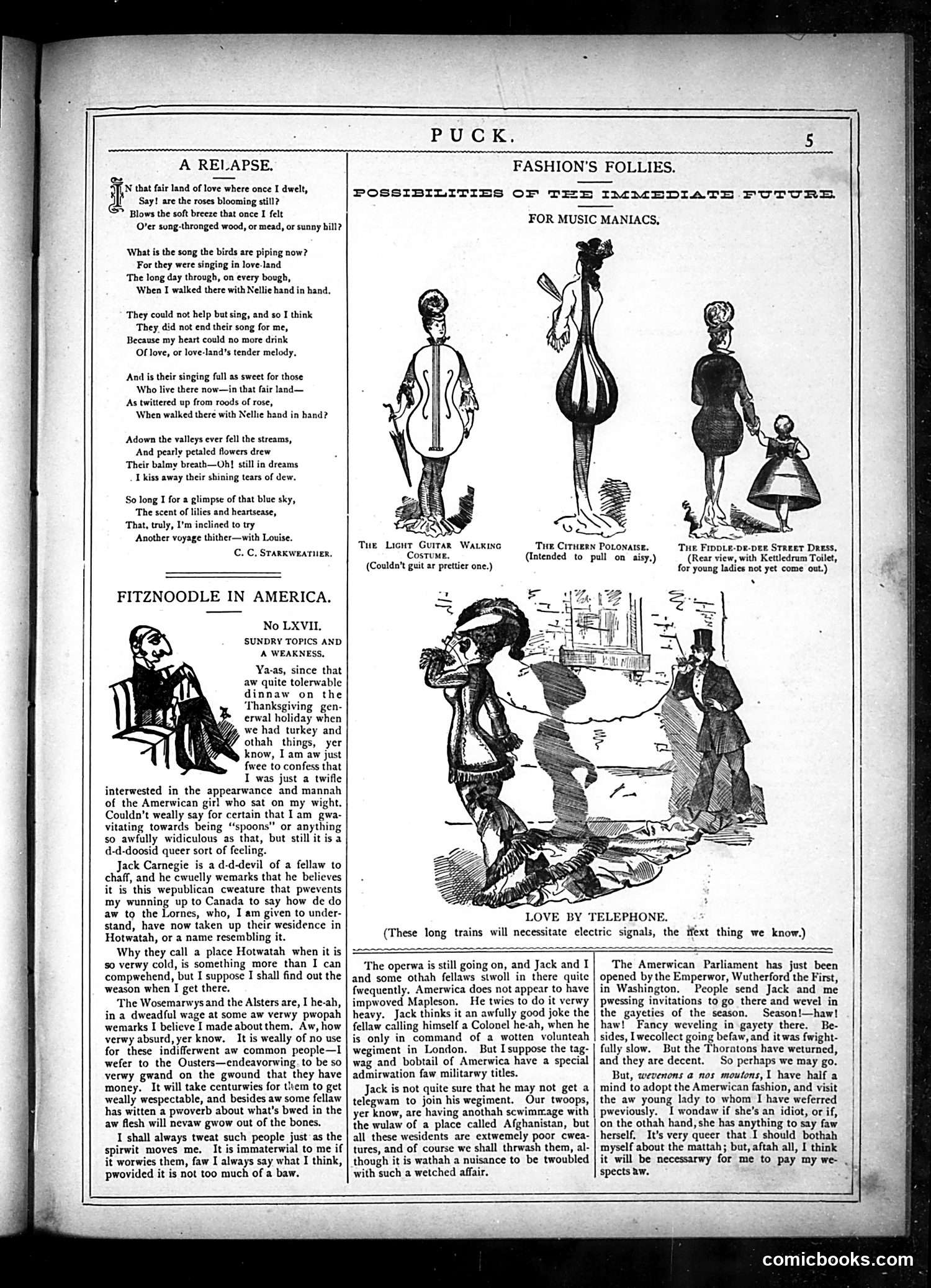
This page contains three distinct satirical pieces: **"A Relapse"** (top left): A sentimental poem about lost love and nature, mocking romantic nostalgia. **"Fashion's Follies"** (top right): Three illustrated fashion mockeries of women's clothing, labeled "Possibilities of the Immediate Future for Music Maniacs"—satirizing absurdly exaggerated musical-themed women's fashion designs (a light guitar costume, a cittern polonaise, and a fiddle-shaped street dress). **"Fitznoodle in America"** (bottom): A narrative piece about an Irish immigrant's confused observations of American Thanksgiving customs and military affairs, poking fun at both Irish immigrant perspectives and American society. **"Love by Telephone"** (bottom right): A cartoon showing two people having a romantic conversation via telephone, satirizing this new technology's social implications—suggesting electricity will enable long-distance romance. The page blends fashion satire, immigrant humor, and technological commentary typical of Puck's social criticism.
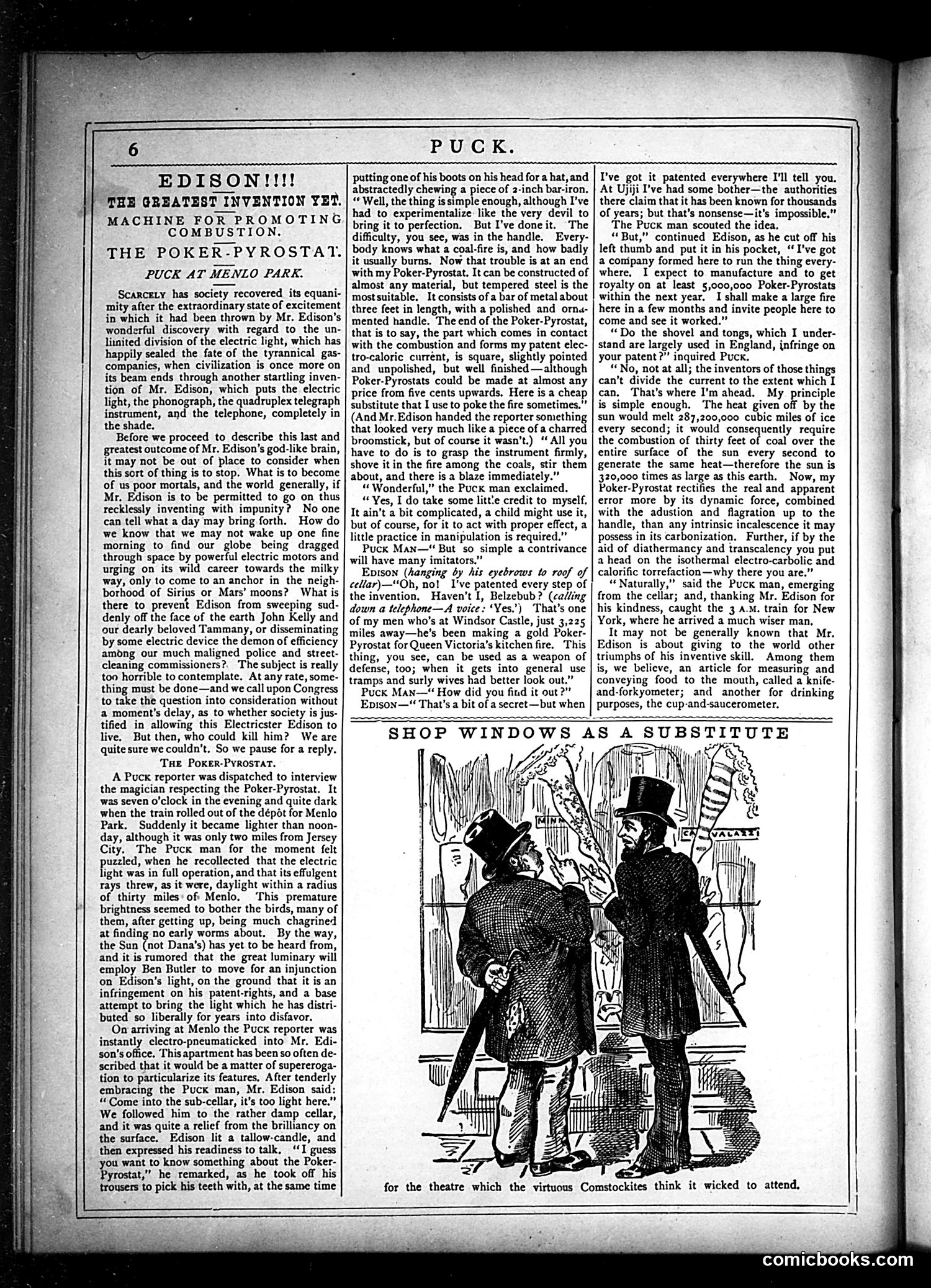
This page satirizes Thomas Edison's "Poker-Pyrostat," a purported fire-starting invention. The left column mocks Edison's claims about the device—a metal bar that supposedly ignites fires by striking it. The satire emphasizes the invention's impracticality and Edison's tendency toward grandiose self-promotion. The cartoon illustrates the joke: a man attempts to use the device as described, but it fails spectacularly, leaving him struggling. The caption "SHOP WINDOWS AS A SUBSTITUTE" suggests people might resort to smashing store windows rather than rely on this useless contraption. The piece parodies Edison's reputation for bold inventive claims while questioning whether his Poker-Pyrostat actually works as advertised—typical Puck-style mockery of technological hype and entrepreneurial overstatement during the industrial era.
This page contains no political cartoons or caricatures. Instead, it features two prose pieces: 1. **"To Mary Ann Flaherty"** - A poem by W.M. Lindsay about cooking and domestic life, with gentle humor about kitchen mishaps and Irish cooking traditions. 2. **"Quite the Cheese"** - An editorial letter discussing a businessman's rise in the cheese industry. The writer describes meeting an old schoolmate who became wealthy manufacturing cheese, detailing their business dealings and the friend's eventual financial success through various ventures. Both pieces are humorous commentaries on everyday American life and commerce, typical of Puck's satirical approach, but they rely on narrative and wit rather than visual caricature or political imagery.
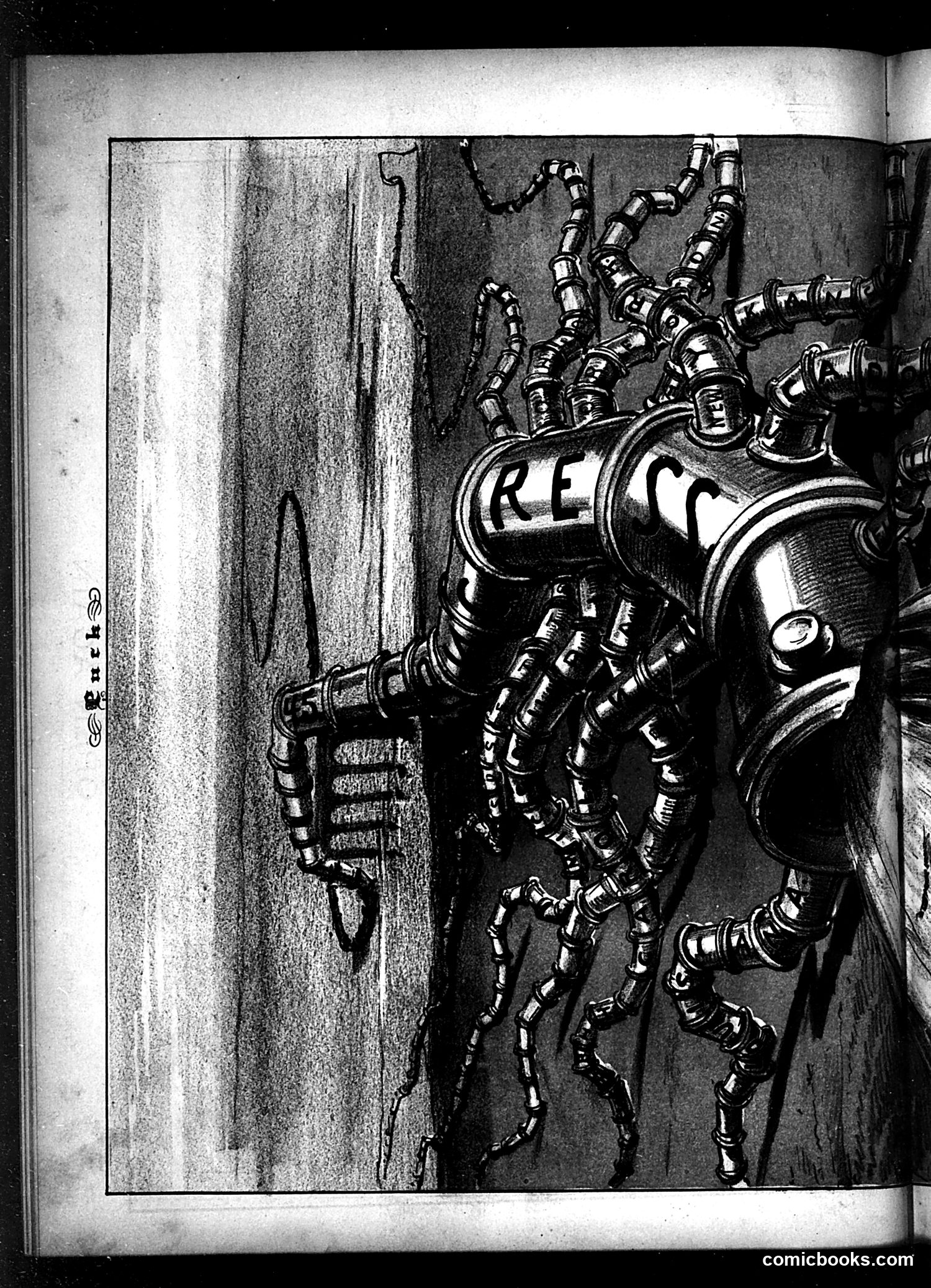
This appears to be a technical illustration rather than a political cartoon. The image shows a detailed mechanical drawing of what looks like an internal combustion engine or motor mechanism, rendered in black and white with careful cross-hatching. The drawing displays cylindrical chambers labeled "R.E." and "C.C." (possibly "Reciprocating Engine" or similar technical abbreviations), connected by various pipes, valves, and mechanical components in a complex arrangement. The signature "Puck" appears on the left side, identifying this as from the satirical magazine, but the content here is technical/mechanical rather than overtly satirical. Without additional context or visible text explaining the illustration's satirical intent, I cannot definitively state what political or social commentary this might represent. It may be criticizing industrial machinery, manufacturing processes, or technological development of the era.
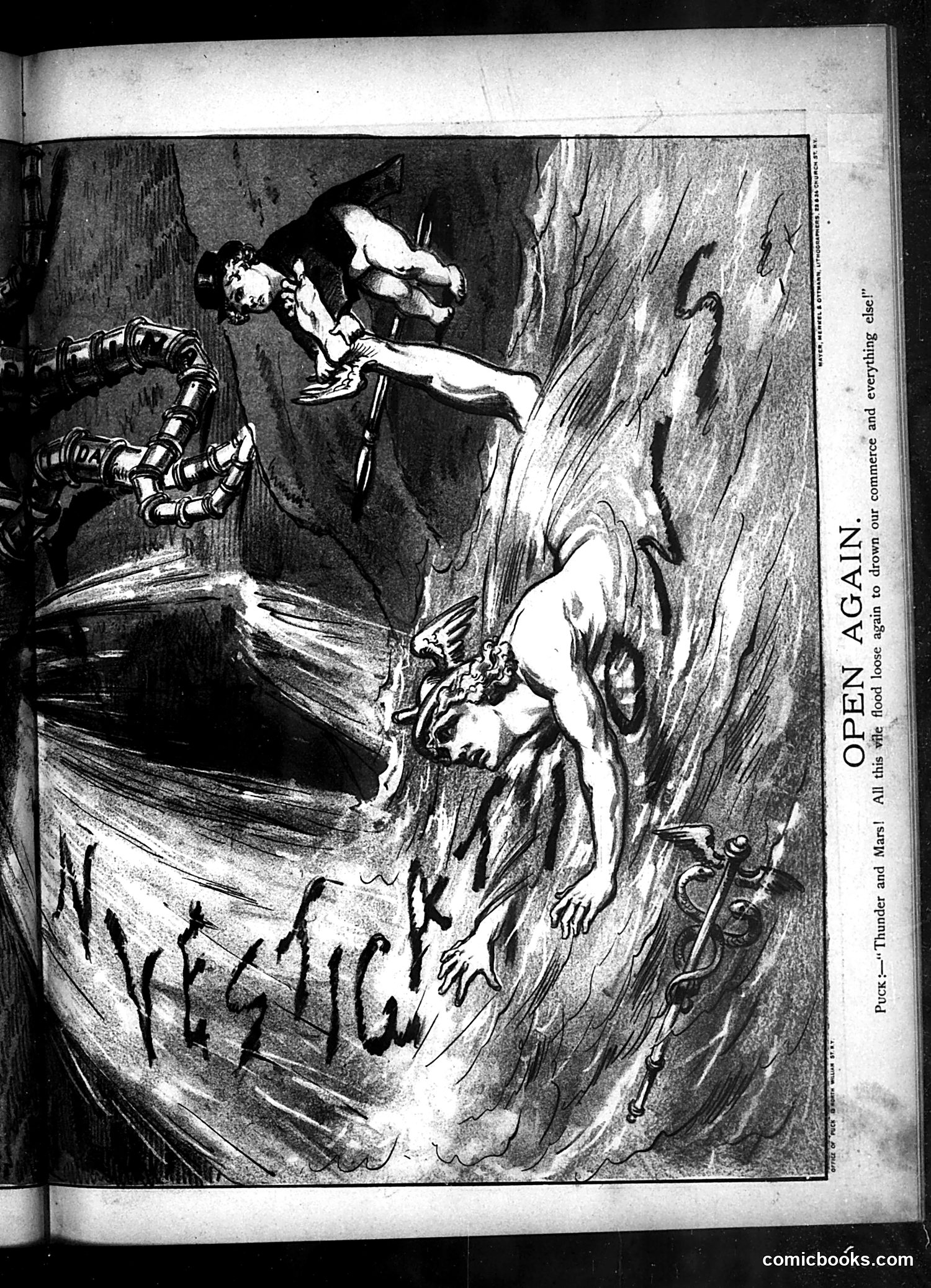
This Puck cartoon appears to depict a financial or commercial crisis being reversed. The title "Open Again" suggests reopening of markets or businesses after a forced closure. Two figures are shown in what appears to be a storefront or business establishment with classical architectural elements (columns visible on left). One figure seems to be breaking through or removing barriers—possibly representing the lifting of restrictions or the resumption of commerce. The subtitle references "Thunder and Mars" opening "the food loose against to drown our commerce and everything else," though the OCR text is unclear. This likely satirizes how war (Mars) or economic disruption forced business closures, and now commerce is resuming. Without the publication date visible, the specific historical context—whether this references Civil War, financial panic, or another crisis—cannot be definitively determined from the image alone.
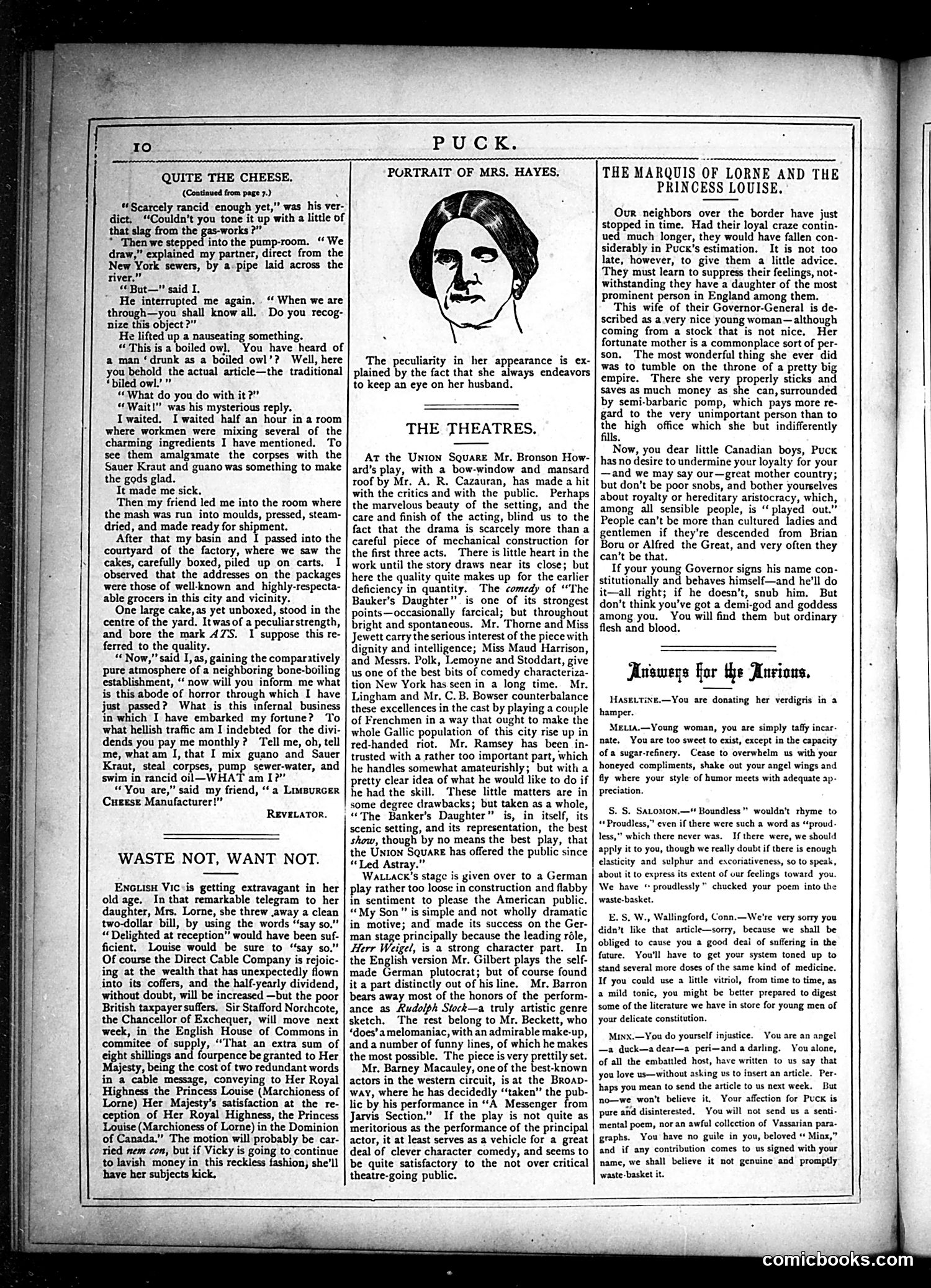
This page contains three distinct sections: **"Quite the Cheese"** (left column): A satirical dialogue mocking pretentious social climbers. The narrator describes encountering someone trying to impress with knowledge of "high art" and refined tastes, exposing their ignorance and affectation. **"Portrait of Mrs. Hayes"** (center): A portrait illustration of a woman identified as Mrs. Hayes, with accompanying text praising her dignity and restraint, particularly regarding her daughter's prominent social position. **"The Theatres"** (right column): Theater reviews discussing productions at Union Square, including Mr. Bronson Howard's play and performances by various actors. The critique evaluates both the mechanical construction of scenes and quality of acting. **"Waste Not, Want Not"** (bottom left): Brief gossip about actress English Vic's extravagant cable communications and theatrical affairs. **"Answers for the Curious"** (bottom right): A reader advice column addressing social etiquette and personal matters.
This page contains the continuation of a dramatic dialogue titled "BIANCA" by W.E. Norris, credited to "Belgravia." It appears to be a serialized fiction piece rather than a political cartoon. The text is a lengthy theatrical conversation between characters, including references to a Marchese, Italian nobility, and matters of honor and marriage. One character discusses the scandal of an Italian marrying a German woman, invoking national pride and family dignity. **This is not satire or political commentary** — it's serialized literature published in Puck magazine. While Puck was known for satirical cartoons, this particular page features only text-based dramatic fiction, likely entertainment content for the magazine's readers rather than social or political commentary.
This page from Puck magazine contains the column "Puck's Persiflage"—a satirical commentary section mixing brief jokes, social observations, and editorial quips. The content addresses various topics including: **Political/Social Commentary:** - References to epidemics being printed in large letters so readers won't miss them - Commentary on Christmas approaching and "fat goodness among the children" - Criticism of newspaper men and the Pullmans (likely the railroad family) - Jabs at Philadelphia citizens and Chinese Embassy incidents **Satirical Themes:** The jokes mock contemporary institutions, government inefficiency, and notable figures' foibles. References to Stewart, Baron de Lehr, and others suggest commentary on wealthy/prominent people of the era. **Overall Purpose:** This is typical Puck humor—irreverent, topical commentary on 1880s-90s American life, using wordplay and brief anecdotes to satirize social pretension and institutional absurdity. The page is primarily text-based commentary rather than illustration-focused satire.
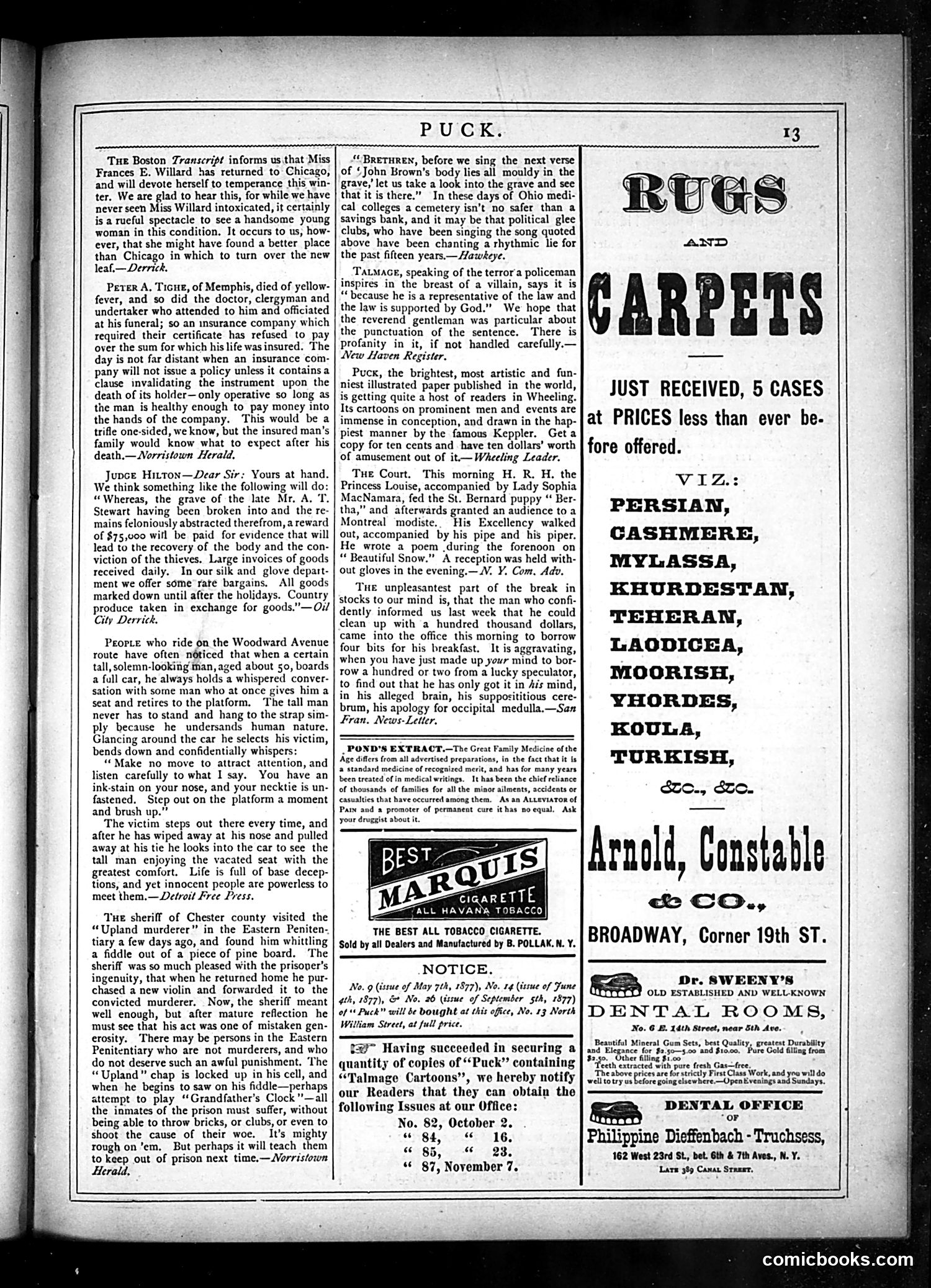
This appears to be primarily a **text and advertising page** rather than a satirical cartoon page. The left column contains brief news items and anecdotes from various newspapers, typical of Puck's "Brethren" section—short humorous or ironic snippets about current events. The right side features advertisements for carpets, cigars, dental services, and other goods, which was standard revenue for 19th-century magazines. **Notable content**: References to a "John Brown's body" song and various local news items, but these are brief commentary rather than visual satire. Without prominent political cartoons visible on this particular page, the satirical intent relies on the curated selection and tone of the news snippets rather than visual caricature or illustration.
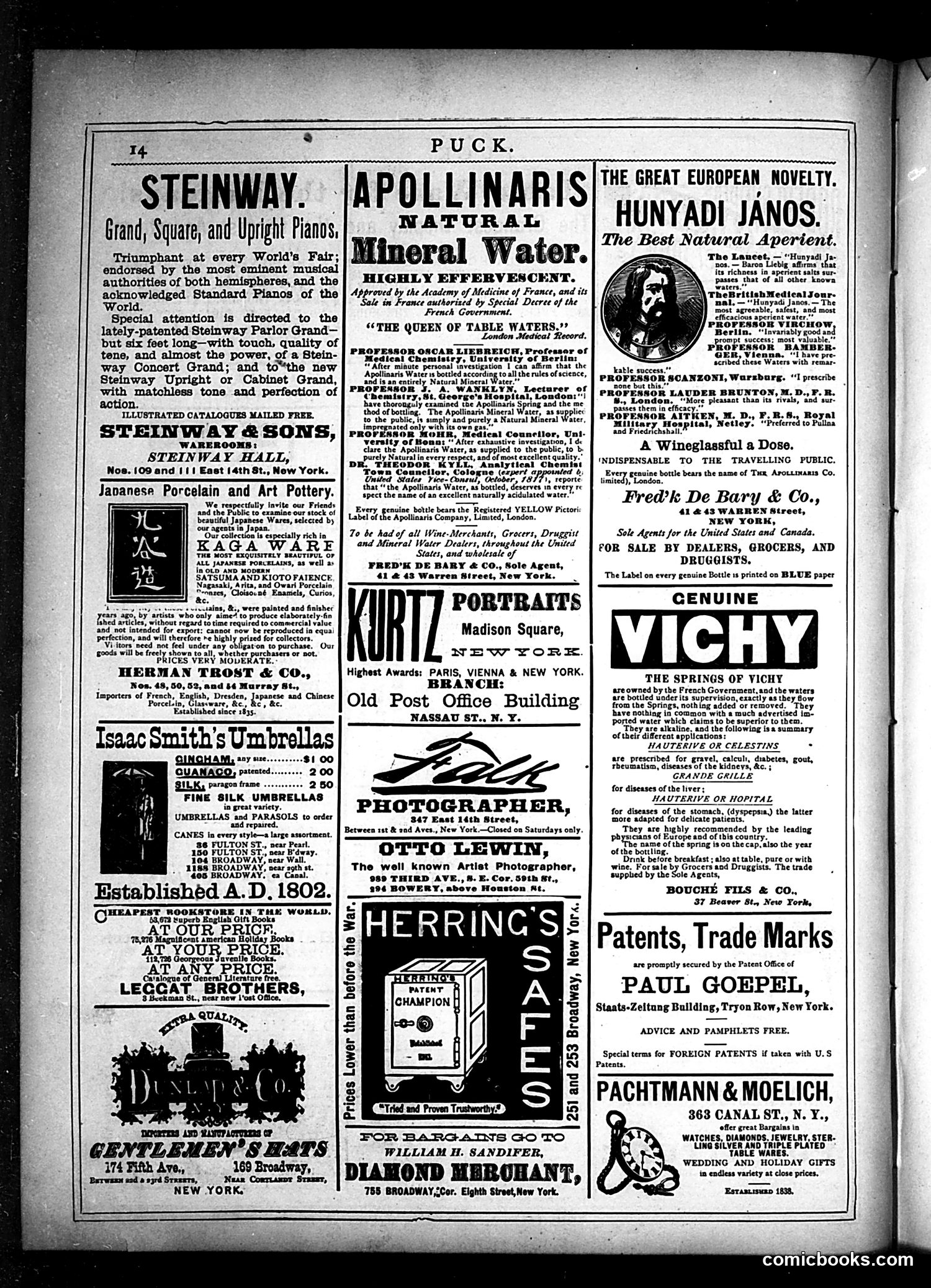
This is primarily an **advertising page** from Puck magazine, not a political cartoon. The page contains numerous commercial advertisements for various products and services, including: - **Steinway pianos** (with text about their World's Fair success) - **Apollinaris mineral water** (endorsed by the French Academy of Medicine) - **Hunyadi János** (a natural aperient/laxative) - **Photography services, umbrellas, porcelain, and other goods** - Various New York businesses and merchants The layout follows typical late 19th-century advertising format, mixing text advertisements with small illustrations. There are **no discernible political cartoons or satirical commentary** visible on this particular page—it functions as Puck's revenue source through paid advertisements rather than editorial content.
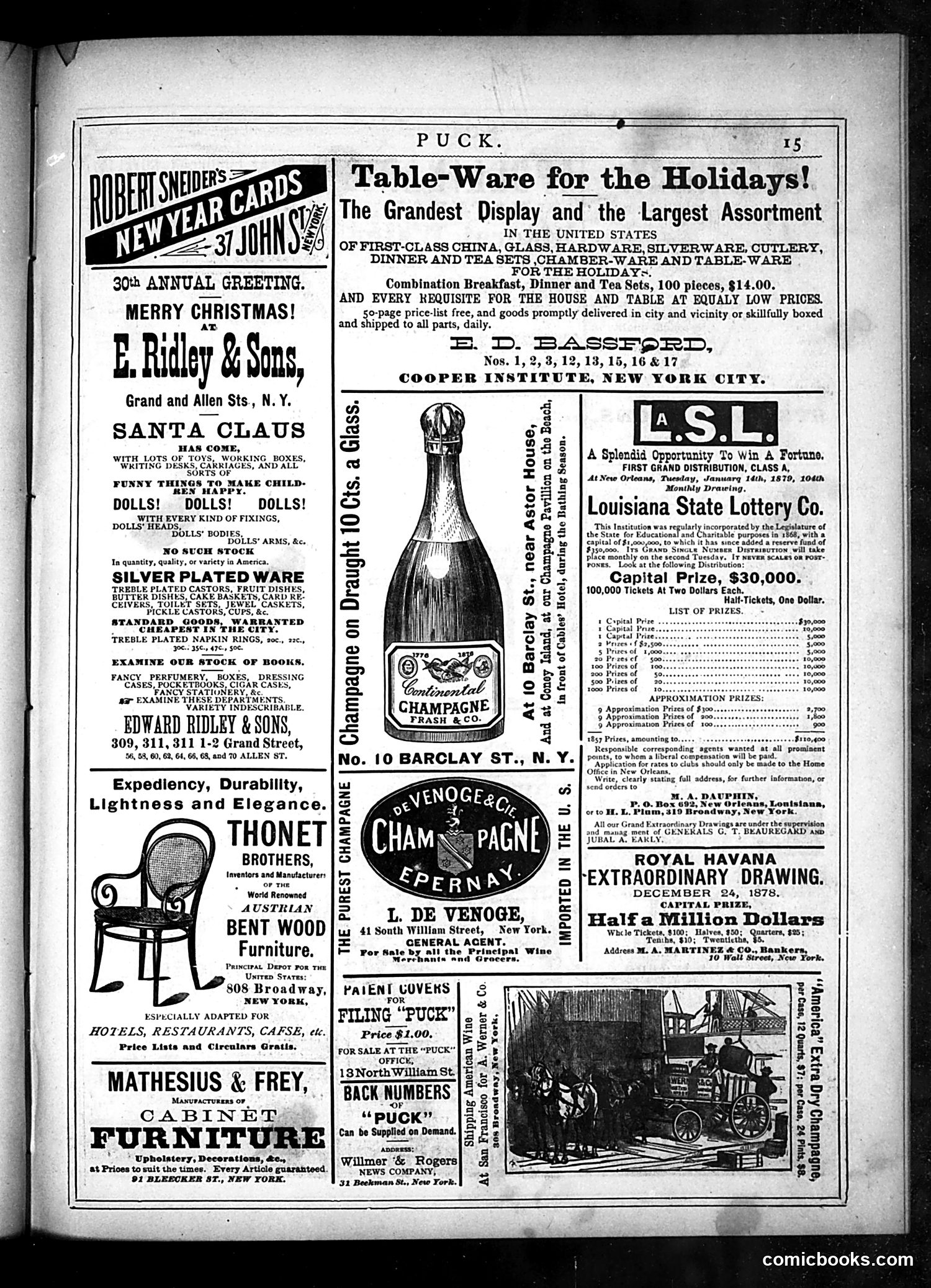
This page is primarily **advertising**, not satirical content. It features holiday-season ads (circa 1890s based on style) for various New York businesses: furniture makers, toy and doll retailers, champagne importers, and notably the Louisiana State Lottery. The only cartoon image visible is a chair design for **Thonet Brothers** furniture, showing their signature bentwood style—not political satire. The lottery ad is notable historically: it advertises an illegal numbers game, reflecting Puck's era when such ads appeared in mainstream publications before federal prohibition. The "Royal Havana" cigar ad and champagne promotions are typical period luxury goods marketing. This represents a **commercial page** rather than editorial satire—common in Puck, which relied on advertising revenue.
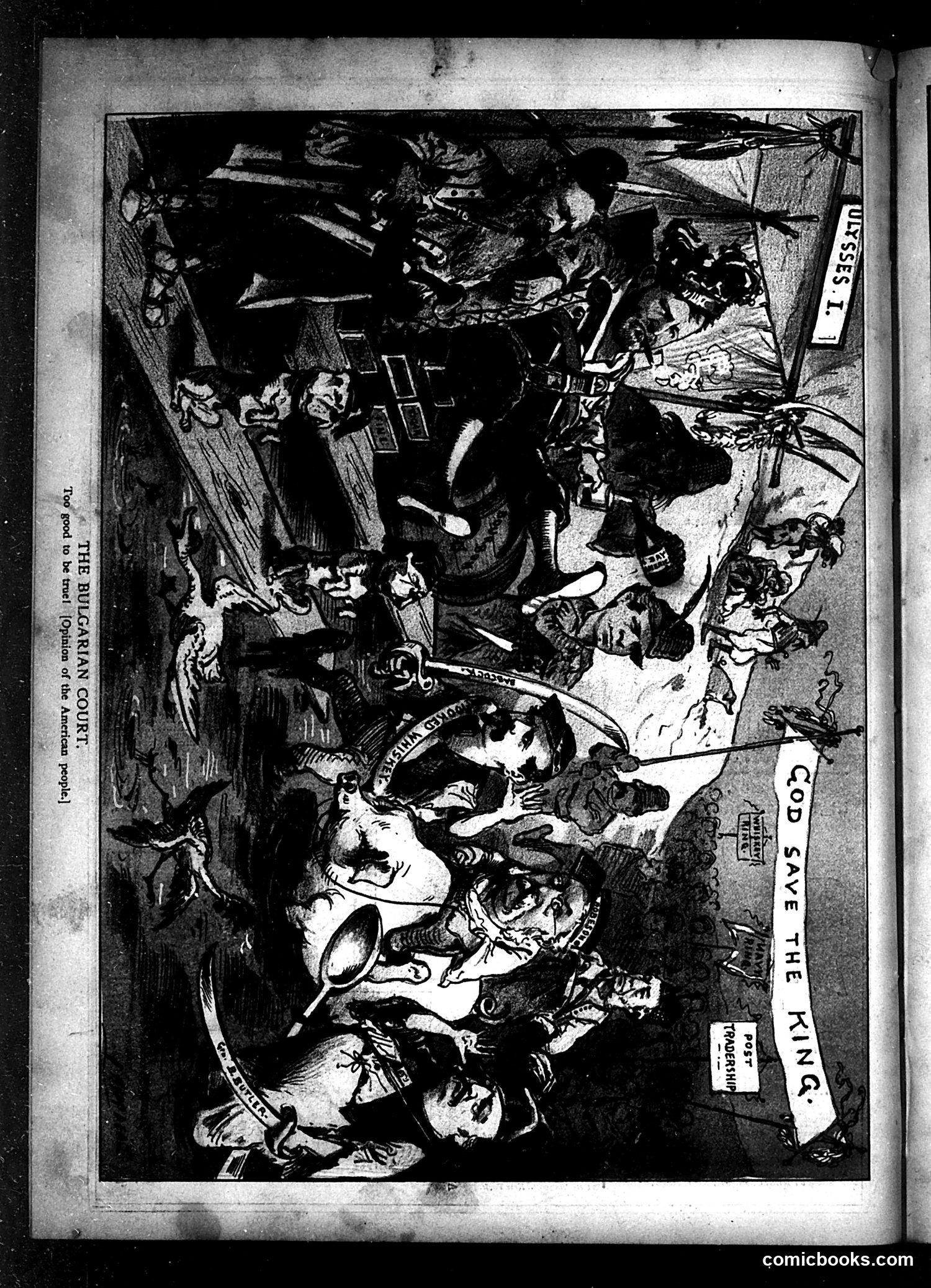
This appears to be a satirical cartoon from *Puck* magazine titled "God Save the King," though the specific historical context requires caution. The image depicts a chaotic, hierarchical scene with numerous figures arranged vertically, suggesting a social or political structure in disarray or moral inversion. The composition and style suggest commentary on monarchy, class structure, or religious authority—common *Puck* targets. The cramped, tumultuous arrangement of bodies and the inverted or disordered presentation likely mock the pretensions of those in power or critique their actual conduct versus their claimed authority. Without clearer date identification or caption text beyond the title, I cannot definitively identify which specific "king" or historical moment is referenced. The ornate, dramatic engraving style is consistent with late 19th-century *Puck* work.