
Puck, 1878-12-11 · page 12 of 16
Puck — December 11, 1878 — page 12: what you’re looking at
What you’re looking at
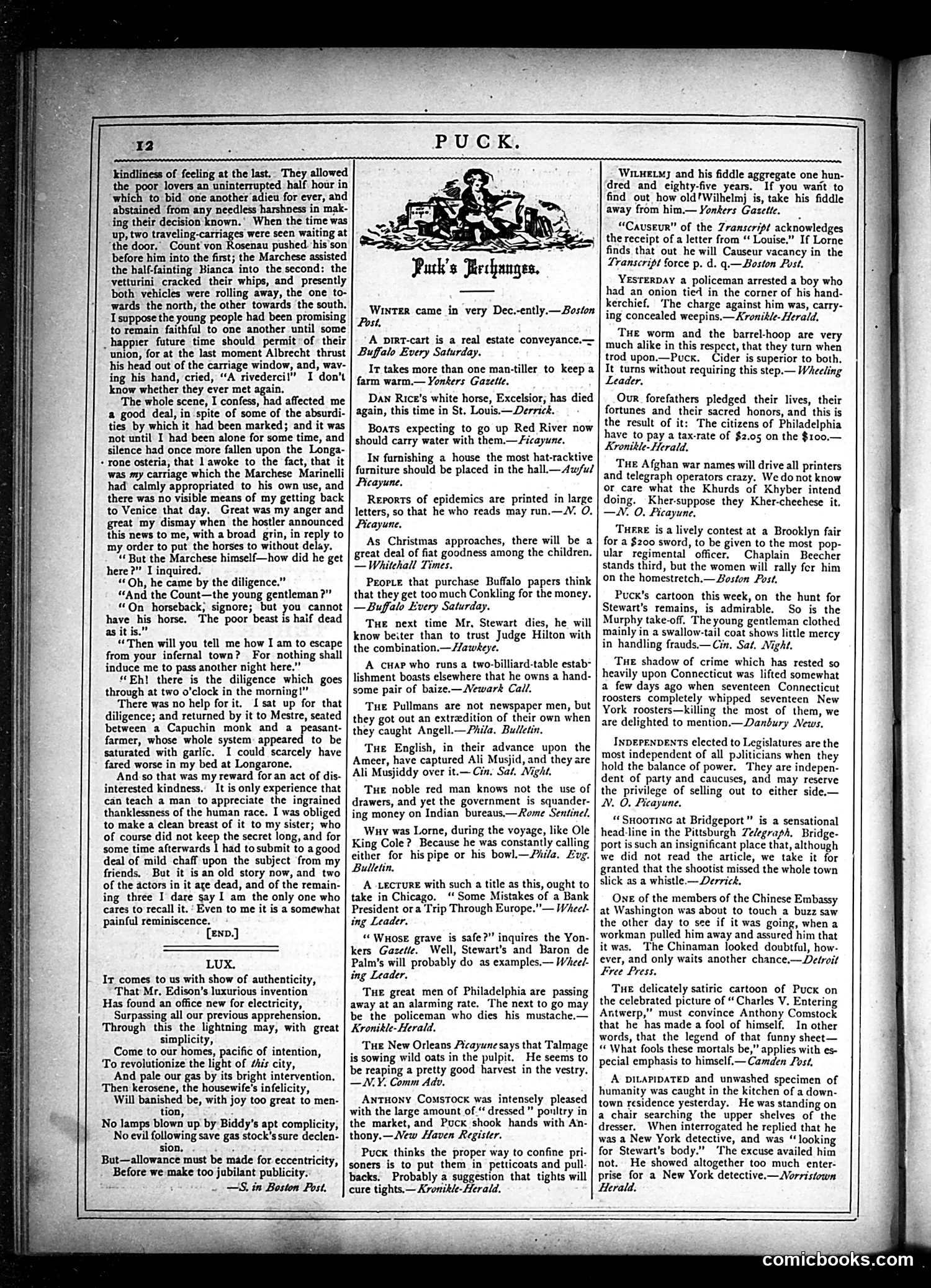
This page from Puck magazine contains the column "Puck's Persiflage"—a satirical commentary section mixing brief jokes, social observations, and editorial quips. The content addresses various topics including: **Political/Social Commentary:** - References to epidemics being printed in large letters so readers won't miss them - Commentary on Christmas approaching and "fat goodness among the children" - Criticism of newspaper men and the Pullmans (likely the railroad family) - Jabs at Philadelphia citizens and Chinese Embassy incidents **Satirical Themes:** The jokes mock contemporary institutions, government inefficiency, and notable figures' foibles. References to Stewart, Baron de Lehr, and others suggest commentary on wealthy/prominent people of the era. **Overall Purpose:** This is typical Puck humor—irreverent, topical commentary on 1880s-90s American life, using wordplay and brief anecdotes to satirize social pretension and institutional absurdity. The page is primarily text-based commentary rather than illustration-focused satire.
📄 Transcribed text from this page (OCR, searchable)
Machine-transcribed from the original scan — historical spelling and the odd misread are preserved.
kindliness of feeling at the last.. They allowed the poor lovers an uninterrupted half hour in which to bid’ one another adieu for ever, and abstained from any needless harshness in mak- ing their decision known.’ When the time was up, two traveling-carriages were seen waiting at “the door, Count’ von Rosenau pushed his’son before him into the first; the Marchese assisted the half-fainting Bianca into the second: the vetturini cracked their whips, and presently both vehicles were rolling away, the one to- wards the north, the other towards the south, I suppose the young people had been promising to remain faithful to one another until some happier future time should permit of their union, for at the last moment Albrecht thrust his head out of the carriage window, and, wav- ing his hand, cried, ‘‘A rivedercil” I don't know whether they ever met again. The whole scene, I confess, had affected me a good deal, in spite of some of the absurdi- ties by which it had been marked; and it was not until I had been alone for some time, and silence had once more fallen upon the Longa- + rone osteria, that 1 awoke to the fact, that it was my carriage which the Marchese Marinelli had calmly appropriated to his own use, and there was no visible means of my getting back to Venice that day. Great was my anger and great my dismay when the hostler announced this news to me, with a broad grin, in reply to my order to put the horses to without delay. “But the Marchese himself—how did he get here?” I inquired. “Oh, he came by the diligence.” “And the Count—the young gentleman?” “On horseback, signore; but you cannot have his horse. The poor beast is half dead as it is. “Then will you tell me how I am to escape from your infernal town? For nothing shall induce me to pass another night here.” Eh! there is the diligence which goes through at two o’clock in the morning!” There was no help for it. Isat up for that diligence; and returned by it to Mestre, seated between a Capuchin monk and a peasant- farmer, whose whole system: appeared to be saturated with garlic. I could scarcely have fared worse in my bed at Longarone. And so that was my reward for an act of dis- interested kindness.’ It is only experience that can teach a man to appreciate the ingrained thanklessness of the human race. I was obliged to make a clean breast of it to my sister; who of course did not keep the secret long, and for some time afterwards 1 had to submit to agood deal of mild chaff upon the subject from my friends. But it is an old story now, and two of the actors in it age dead, and of the remain- ing three I dare say 1 am the only one who cares to recall it. ‘Even to me it is a somewhat painful reminiscence. [env.] LUX. Ir comes to us with show of authenticity, That Mr. Edison’s luxurious invention Has found an office new for electricity, Surpassing all our previous apprehension. Through this the lightning may, with great simplicity, Come to our homes, pacific of intention, To revolutionize the light of sis city, And pale our gas by its bright intervention. Then kerosene, the housewife’s infelicity, Will banished be, with joy too great to men- tion, No lamps blown up by Biddy’s apt complicity, No evil following save gas stock's sure declen- sion, a But—allowance must be made for eccentricity, Before we make too jubilant publicity. - ‘ ~ —S. in Boston Post, Winter came in very Dec.-ently.—Boston Post, A pirt-cart is a real estate conveyance. Buffalo Every Saturday, Ir takes more than one man-tiller to keep a farm warm.— Yonkers Gazette. Dan Rice’s white horse, Excelsior; has died again, this time in St. Louis.—Derrick. Boats expecting to go up Red River now should carry water with them.—Ficayune. In furnishing a house the most hat-racktive furniture should be placed in the hall.—Aw/ul Picayune, Reports of epidemics are printed in large letters, so that he who reads may run.—J. O. Picayune, As Christmas approaches, there will be a great deal of fiat goodness among the children. — Whitehall Times. Peopte that purchase Buffalo papers think that they get too much Conkling for the money. —Buffalo Every Saturday. Tue next time Mr, Stewart dies, he will know beiter than to trust Judge Hilton with the combination.— Hawkeye, A cuap who runs a two-billiard-table estab- lishment boasts elsewhere that he owns a hand- some pair of baize.—ewark Call, Tue Pullmans are not newspaper men, but they got out an extradition of their own when they caught Angell.—Phila. Bulletin, Tue English, in their advance upon the Ameer, have captured Ali Musjid, and they are Ali Musjiddy over it.— Cin. Sat, Night. Tue noble red man knows not the use of drawers, and yet the government is squander- ing money on Indian bureaus.—Rome Sentinel, Wuy was Lorne, during the voyage, like Ole King Cole? Because he was constantly calling either for his pipe or his bowl.—/ii/a. Log. Bulletin, A LECTURE with such a title as this, ought to take in Chicago. ‘‘ Some Mistakes of a Bank President ora Trip Through Europe.” — Waeel- ing Leader, ““ Wuose grave is safe?” inquires the Yon- kers Gazetle. Well, Stewart's and Baron de Palm's will probably do as examples.— Whee/- ing Leader. ‘Tue great men of Philadelphia are passing away at an alarming rate. The next to go may be the policeman who dies his mustache.— Kronikle-Herald. ‘Tue New Orleans Picayune says that Talmage is sowing wild oats in the pulpit. He seems to be reaping a pretty good harvest in the vestry, —N.Y. Comm Adv. AntHony Comstock was intensely pleased with the large amount of. dressed” poultry in the market, and Puck shook hands with An- thony.—New Haven Register. Puck thinks the proper way to confine pri- soners is to put them in petticoats and pull- backs. Probably a suggestion that tights will cure tights.— Kronikle-Herald. ‘Wriweiay and his fiddle aggregate one hun- dred and eighty-five years. If you wart to find out how old!Wilhelmj is, take his fiddle away from him.— Yonkers Gazette. “Causeur” of the Zranscript acknowledges the receipt of a letter from “ Louise.” If Lorne finds that out he will Causeur vacancy in the Transcript force p. d. q.—Boston Post. YESTERDAY a policeman arrested a boy who had an onion tied in the corner of his hand- kerchief, ‘The charge against him was, carry- ing concealed weepins.—Xronikie- Herald, THe worm and the barrel-hoop are very much alike in this respect, that they turn when trod upon.—Puck. Cider is superior to both. It turns without requiring this step.— Wheeling Leader, Our forefathers pledged their lives, their fortunes and their sacred honors, and this is the result of it: The citizens of Philadelphia have to pay a tax-rate of $2.05 on the $100.— Kronikle-Herald, Tue Afghan war names will drive all printers and telegraph operators crazy, We do not know or care what the Khurds of Khyber intend doing. Kher-suppose they Kher-cheehese it. —N. O. Picayune, Tere is a lively contest at a Brooklyn fair for a $200 sword, to be given to the most pop- ular regimental officer. Chaplain Beecher stands third, but the women will rally fer him on the homestretch.— Boston Post, Puck's cartoon this week, on the hunt for Stewart's remains, is admirable. So is the Murphy take-off. The young gentleman clothed mainly in a swallow-tail coat shows little mercy in handling frauds. — Cin. Sat. Night. Tue shadow of crime which has rested so heavily upon Connecticut was lifted somewhat a few days ago when seventeen Connecticut roosters completely whipped seventeen New York roosters—killing the most of them, we are delighted to mention.— Danbury News. INDEPENDENTS elected to Legislatures are the most independent of all politicians when they hold the balance of power. They are indepen- dent of party and caucuses, and may reserve the privilege of selling out to either side.— N. O. Picayune, “SHootinG at Bridgeport” is a sensational head-line in the Pittsburgh Zedegraph. Bridge- port is such an insignificant place that, although we did not read the article, we take it for granted that the shootist missed the whole town slick as a whistle.— Derrick. One of the members of the Chinese Embassy at Washington was about to touch a buzz saw the other day to see if it was going, when a workman pulled him away and assured him that it was, The Chinaman looked doubtful, how- ever, and only waits another chance.—Detroit Free Press, Tue delicately satiric cartoon of Puck on the celebrated picture of “Charles V. Entering Antwerp,” must convince Anthony Comstock that he has made a fool of himself. In other words, that the legend of that funny sheet— “ What fools these mortals be," applies with es pecial emphasis to himself.—Camden Post, A DILAPIDATED and unwashed specimen of humanity was caught in the kitchen of a down- town residence yesterday. He was standing on a chair searching the upper shelves of the dresser, When interrogated he replied that he was a New York detective, and was ‘looking for Stewart's body.” ‘The excuse availed him not. He showed altogether too much enter- prise for a New York detective.—Norristown Herald. 23