
Puck, 1878-12-11 · page 7 of 16
Puck — December 11, 1878 — page 7: what you’re looking at
What you’re looking at
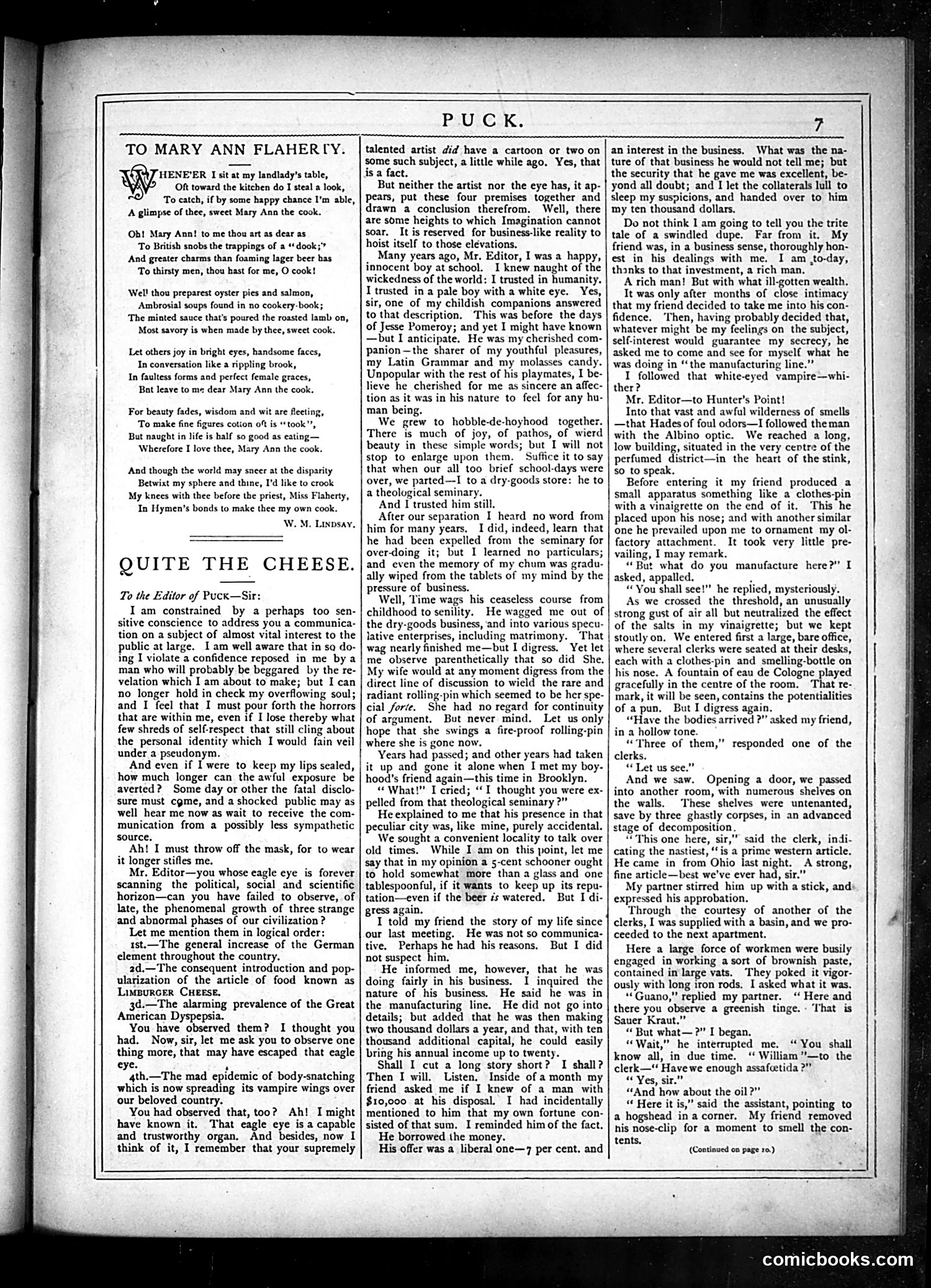
This page contains no political cartoons or caricatures. Instead, it features two prose pieces: 1. **"To Mary Ann Flaherty"** - A poem by W.M. Lindsay about cooking and domestic life, with gentle humor about kitchen mishaps and Irish cooking traditions. 2. **"Quite the Cheese"** - An editorial letter discussing a businessman's rise in the cheese industry. The writer describes meeting an old schoolmate who became wealthy manufacturing cheese, detailing their business dealings and the friend's eventual financial success through various ventures. Both pieces are humorous commentaries on everyday American life and commerce, typical of Puck's satirical approach, but they rely on narrative and wit rather than visual caricature or political imagery.
📄 Transcribed text from this page (OCR, searchable)
Machine-transcribed from the original scan — historical spelling and the odd misread are preserved.
PUCK. 7 TO MARY ANN FLAHERTY. HENE'ER I sit at my landlady’s table, Oft toward the kitchen do I steal a look, To catch, if by some happy chance I'm able, ‘A glimpse of thee, sweet Mary Ann the cook. Ob! Mary Ann! to me thou art as dear as To British snobs the trappings of a “dook;” ‘And greater charms than foaming lager beer bas To thirsty men, thou hast for me, O cook! Wel! thou preparest oyster pies and salmon, Ambrosial soups found in no cookery-book; ‘The minted sauce that’s poured the roasted lamb on, Most savory is when made by thee, sweet cook. Let others joy in bright eyes, handsome faces, In conversation like a rippling brook, In faultess forms and perfect female graces, Bat leave to me dear Mary Ann the cook. For beauty fades, wisdom and wit are fleeting, To make fine figures cotion oft is “took”, But naught in life is half so good as eating— Wherefore I love thee, Mary Ann the cook. And though the world may sneer at the disparity Betwist my sphere and thine, I'd like to crook My knees with thee before the priest, Miss Flaherty, In Hymen’s bonds to make thee my own cook. W. M. Linpsay. QUITE THE CHEESE. To the Editor of Puck—Sir: I am constrained by a perhaps too sen- sitive conscience to address you a communica- tion on a subject of almost vital interest to the public at large. I am well aware that in sa do- ing I violate a confidence reposed in me by a man who will probably be beggared by the re- velation which I am about to make; but I can no longer hold in check my overflowing soul; and I feel that I must pour forth the horrors that are within me, even if I lose thereby what few shreds of self-respect that still cling about the personal identity which I would fain veil under a pseudonym. And even if I' were to keep my lips sealed, how much longer can the awful exposure be averted? Some day or other the fatal disclo- sure must cgme, and a shocked public may as well hear me now as wait to receive the com- munication from a possibly less sympathetic source, Ah! I must throw off the mask, for to wear it longer stifles me. Mr. Editor—you whose eagle eye is forever scanning the political, social and scientific horizon—can you have failed to observe, of late, the phenomenal growth of three strange and abnormal phases of our civilization ? Let me mention them in logical order: 1st.—The general increase of the German element throughout the country. 2ad.—The consequent introduction and pop- ularization of the article of food known as Limpurcer CHEESE, 3d.—The alarming prevalence of the Great American Dyspepsia. You have observed them? I thought you had. Now, sir, let me ask you to observe one thing more, that may have escaped that eagle eye. ; 4th.—The mad epidemic of body-snatching which is now spreading its vampire wings over our beloved country. You had observed that, too? Ah! I might have known it. That eagle eye is a capable and trustworthy organ. And besides, now I think of it, I remember that your supremely talented artist did have a cartoon or two on some such subject, a little while ago. Yes, that is a fact. But neither the artist nor the eye has, it ap- pears, put these four premises together and drawn a conclusion therefrom. Well, there are some heights to which Imagination cannot soar. It is reserved for business-like reality to hoist itself to those elevations. Many years ago, Mr. Editor, I was a happy, innocent boy at school. I knew naught of the wickedness of the world: I trusted in humanity. I trusted in a pale boy with a white eye. Yes, sir, one of my childish companions answered to that description. This was before the days of Jesse Pomeroy; and yet I might have known —but I anticipate. He was my cherished com- panion—the sharer of my youthful pleasures, my Latin Grammar and my molasses candy. Unpopular with the rest of his playmates, I be- lieve he cherished for me as sincere an affec- tion as it was in his nature to feel for any hu- man being. We grew to hobble-de-hoyhood together. There is much of joy, of pathos, of wierd beauty in these simple words; but I will not stop to enlarge upon them. Suffice it to say that when our all too brief school-days were over, we parted—I to a dry-goods store: he to a theological seminary. And I trusted him still. ‘After our separation I heard no word from him for many years. I did, indeed, learn that he had been expelled from the seminary for over-doing it; but I learned no particulars; and even the memory of my chum was gradu- ally wiped from the tablets of my mind by the pressure of business. Well, Time wags his ceaseless course from childhood to senility. He wagged me out of the dry-goods business, ‘and into various specu- lative enterprises, including matrimony. That wag nearly finished me—but I digress. Yet let me observe parenthetically that so did She. My wife would at any moment digress from the direct line of discussion to wield the rare and radiant rolling-pin which seemed to be her spe- cial forte, She had no regard for continuity of argument. But never mind. Let us only hope that she swings a fire-proof rolling-pin where she is gone now. ; and other years had taken it up ‘alone when I met my boy- hood's friend again—this time in Brooklyn. “What!” I cried; “I thought you were ex- pelled from that theological seminary ?” He explained to me that his presence in that peculiar city was, like mine, purely accidental. We sought a convenient locality to talk over old times. While I am on this point, let me say that in my opinion a 5-cent schooner ought to hold somewhat more than a glass and one tablespoonful, if it wants to keep up its repu- tation—even if the beer #s watered. But I di- gress again. I told my friend the story of my life since our last meeting. He was not so communica- tive. Perhaps he had his reasons. But I did not suspect him. He informed me, however, that he was doing fairly in his business. I inquired the nature of his business. He said he was in the manufacturing line. He did not go into details; but added that he was then making two thousand dollars a year, and that, with ten thousand additional capital, he could easily bring his annual income up to twenty. Shall I cut a long story short? I shall? Then I will. Listen, Inside of a month my friend asked me if I knew of a man with $10,000 at his disposal, I had incidentally mentioned to him that my own fortune con- sisted of that sum. I reminded him of the fact. He borrowed the money. His offer was a liberal one—7 per cent. and an interest in the business. What was the na- ture of that business he would not tell me; but the security that he gave me was excellent, be- yond all doubt; and I let the collaterals lull to sleep my suspicions, and handed over to him my ten thousand dollars. Do not think I am going to tell you the trite tale of a swindled dupe. Far from it. My friend was, in a business sense, thoroughly hon- est in his dealings with me. I am ,to-day, thanks to that investment, a rich man. Arich man! But with what ill-gotten wealth. It was only after months of close intimacy that my friend decided to take me into his con- fidence. ‘Then, having probably decided that, whatever might be my feelings on the subject, self-interest would guarantee my secrecy, he asked me to come and see for myself what he was doing in “the manufacturing line.”” I followed that white-eyed vampire—whi- ther? Mr. Editor—to Hunter's Point! Into that vast and awful wilderness of smells —that Hades of foul odors—I followed theman with the Albino optic. We reached a long, low building, situated in the very ceptre of the perfumed district—in the heart of the stink, so to speak. Before entering it my friend produced a small apparatus something like a clothes-pin with a vinaigrette on the end of it. This he placed upon his nose; and with another similar one he prevailed upon me to ornament my ol- factory attachment. It took very little pre- vailing, I may remark. “But what do you manufacture here?” I asked, appalled. ; “You shall see!" he replied, mysteriously. As we crossed the threshold, an unusually strong gust of air all but neutralized the effect | of the salts in my vinaigrette; but we kept stoutly on, We entered first a large, bare office, where several clerks were seated at their desks, each with a clothes-pin_and smelling-bottle on his nose. A fountain of eau de Cologne played gracefully in the centre of the room. That re- mark, it will be seen, contains the potentialities of apun. But I digress again. “Have the bodies arrived ?” asked my friend, in a hollow tone. “Three of them,” responded one of the clerks. “ Let us see.” And we saw. Opening a door, we passed into another room, with numerous shelves on the walls. These shelves were untenanted, save by three ghastly corpses, in an advanced stage of decomposition. “This one here, sir,” said the clerk, indi- cating the nastiest, ‘is a prime western article. He came in from Ohio last night. A strong, fine article—best we've ever had, sir.” My partner stirred him up with a stick, and: expressed his approbation. Through the courtesy of another of the clerks, I was supplied with a basin, and we pro- ceeded to the next apartment. Here a large force of workmen were busily engaged in working a sort of brownish paste, contained in large vats. They poked it vigor- ously with long iron rods. I asked what it was. “Guano,” replied my partner. ‘“ Here and there you observe a greenish tinge. - That is Sauer Kraut.” “ But what— ?” I began, “Wait,” he interrupted me. “ You shall know all, in due time. ‘‘ William"—to the clerk—‘‘ Have we enough assafcetida ?”” “ Yes, sir.” “And how about the oil?” “ Here it is,” said the assistant, pointing to a hogshead inacorner. My friend removed nis nose-clip for a moment to smell the con- tents, (Continued on page 10.) comicbooks.com