
Puck, 1878-12-11 · page 10 of 16
Puck — December 11, 1878 — page 10: what you’re looking at
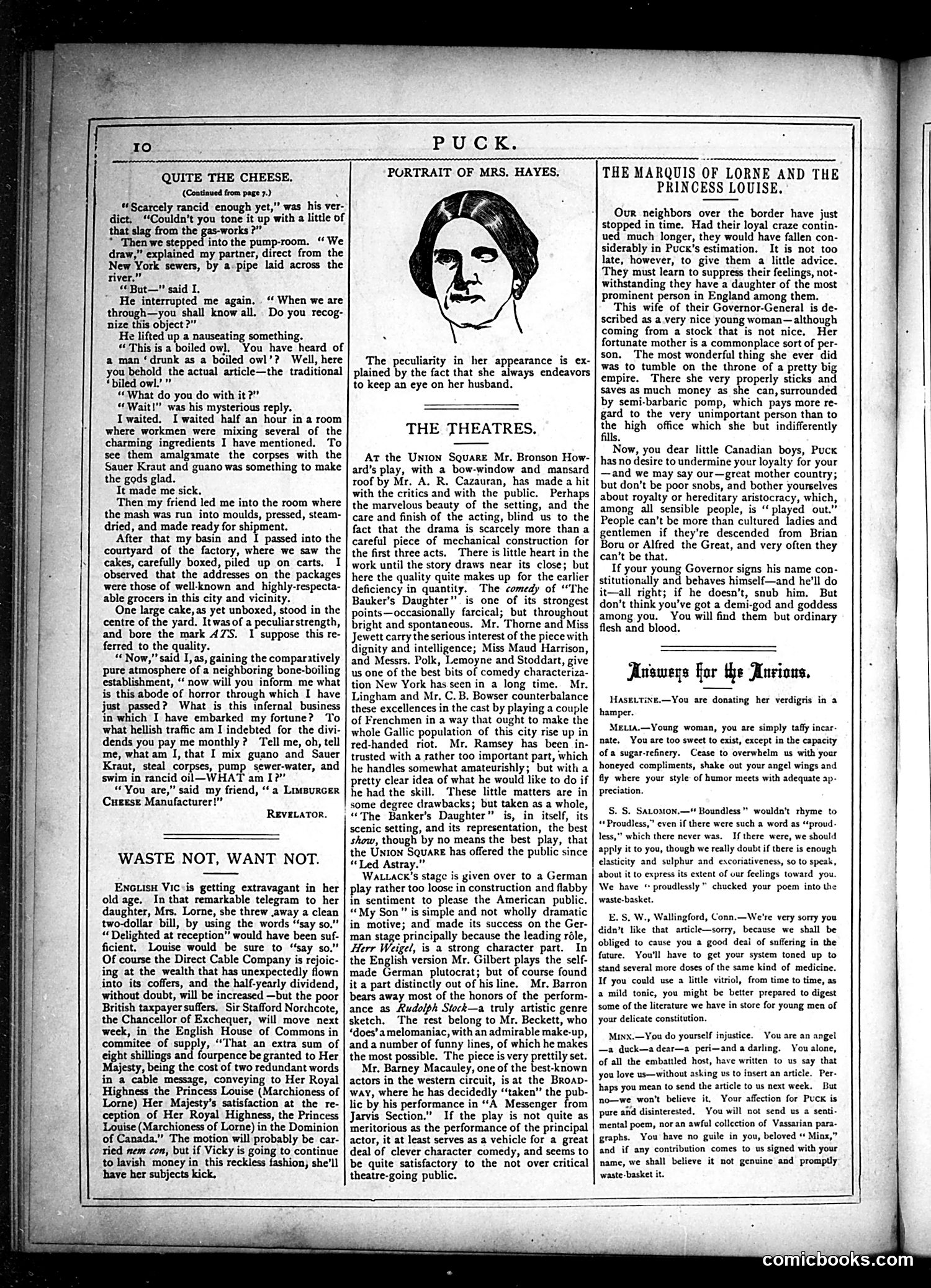
What you’re looking at
This page contains three distinct sections: **"Quite the Cheese"** (left column): A satirical dialogue mocking pretentious social climbers. The narrator describes encountering someone trying to impress with knowledge of "high art" and refined tastes, exposing their ignorance and affectation. **"Portrait of Mrs. Hayes"** (center): A portrait illustration of a woman identified as Mrs. Hayes, with accompanying text praising her dignity and restraint, particularly regarding her daughter's prominent social position. **"The Theatres"** (right column): Theater reviews discussing productions at Union Square, including Mr. Bronson Howard's play and performances by various actors. The critique evaluates both the mechanical construction of scenes and quality of acting. **"Waste Not, Want Not"** (bottom left): Brief gossip about actress English Vic's extravagant cable communications and theatrical affairs. **"Answers for the Curious"** (bottom right): A reader advice column addressing social etiquette and personal matters.
📄 Transcribed text from this page (OCR, searchable)
Machine-transcribed from the original scan — historical spelling and the odd misread are preserved.
10 ; PUCK. QUITE THE CHEESE, (Continued from page 7.) ‘ “Scarcely rancid enough yet,” was his ver- dict. “Couldn't you tone it up with a little of that slag from the gas-works ?” * Then we stepped into the pump-room. “ We draw,” explained my partner, direct from the New York sewers, by a-pipe laid across the «But—" said I. He interrupted me again. . ‘‘ When we are through—you shall know all. Do you recog- nize this object?” He lifted up a nauseating something. “This is a boiled owl. You have heard of a man ‘drunk as a boiled owl’? Well, here you behold the actual article—the traditional ‘biled owl.’ «What do you do with it ?” “Wait!” was his mysterious reply. I waited. I waited half an hour in a room where workmen were mixing several of the charming ingredients I have mentioned. To see them amalgamate the corpses with the Sauer Kraut and guano was something to make the gods glad. It made me sick. Then my friend led me into the room where the mash was run into moulds, pressed, steam- dried, and made ready for shipment. ‘After that my basin and I passed into the courtyard of the factory, where we saw the cakes, carefully boxed, piled up on carts, I observed that the addresses on the packages were those of well-known and highly-respecta- able grocers in this city and vicinity. One large cake, as yet unboxed, stood in the centre of the yard. Itwasof a peculiarstrength, and bore the mark 47S. I suppose this re- ferred to the quality. “Now,” said I, as, gaining the comparatively pure atmosphere of a neighboring bone-boiling establishment, ‘ now will you inform me what is this abode of horror through which I have just passed? What is this infernal business in which I have embarked my fortune? To what hellish traffic am I indebted for the divi- dends you pay me monthly? Tell me, oh, tell me, what am I, that I mix guano and Sauer Kraut, steal cor pump sewer-water, and swim in rancid VHAT am I?” “You are,” said my friend, ‘a Lutsurcer Cugese Manufacturer!” REVELATOR. WASTE NOT, WANT NOT. Encuisx Vic:is getting extravagant in her old age. In that remarkable telegram to her daughter, Mrs. Lorne, she threw away a clean two-dollar bill, by using the words “say so.” “Delighted at reception” would have been suf- ficient. Louise would be sure to “say so. Of course the Direct Cable Company is rejoic- ing at the wealth that has unexpectedly flown into its coffers, and the half-yearly dividend, without doubt, will be increased —but the poor British taxpayer suffers. Sir Stafford Norchcote, the Chancellor of Exchequer, will move next week, in the English House of Commons in commitee of supply, ‘That an extra sum of eight shillings and fourpence be granted to Her sjesty, being the cost of two redundant words in a cable message, conveying to Her Royal Highness the Princess Louise (Marchioness of Lorne) Her Majesty’s satisfaction at the re- ception of Her Royal Highness, the Princess Louise (Marchioness of Lorne) in the Dominion of Canada.” The motion will probably be car- ried nem con, but if Vicky is going to continue to lavish money in this reckless fashion, she'll have her subjects kick, PORTRAIT OF MRS. HAYES. The peculiarity in her appearance is ex- plained by the fact that she always endeavors to keep an eye on her husband. THE THEATRES. At the Union Square Mr. Bronson How- ard’s play, with a bow-window and mansard roof by Mr. A. R. Cazauran, has made a hit with the critics and with the public. Perhaps the marvelous beauty of the setting, and the care and finish of the acting, blind us to the fact that the drama is scarcely more than a careful piece of mechanical construction for the first three acts, There is little heart in the work until the story draws near its close; but here the quality quite makes up for the earlier deficiency in quantity. The comedy of “The Bauker’s Daughter”. is one of its strongest points—occasionally farcical; but throughout bright and spontaneous. Mr. Thorne and Miss Jewett carry the serious interest of the piece with dignity and intelligence; Miss Maud Harrison, and Messrs. Polk, Lemoyne and Stoddart, give us one of the best bits of comedy characteriza- tion New York has seen in a long time. Mr. Lingham and Mr. C. B. Bowser counterbalance these excellences in the cast by playing a couple of Frenchmen in a way that ought to make the whole Gallic population of this city rise up in red-handed riot. Mr, Ramsey has been in- trusted with a rather too important part, which he handles somewhat amateurishly; but with a pretty clear idea of what he would like to do if he had the skill. These little matters are in some degree drawbacks; but taken as a whole, “The Banker's Daughter” is, in itself, its scenic setting, and its representation, the best show, though by no means the best play, that the Union Square has offered the public since “Led Astray.” Wattack's stage is given over to a German play rather too loose in construction and flabby in sentiment to please the American public. “My Son” is simple and not wholly dramatic in motive; and made its success on the Ger- man stage principally because the leading réle, Herr Weigel, is a strong character part. In the English version Mr. Gilbert plays the self- made German plutocrat; but of course found it a part distinctly out of his line. Mr. Barron bears away most of the honors of the perform- ance as Rudolph Stock—a truly artistic genre sketch. The rest belong to Mr. Beckett, who ‘does’ a melomaniac, with an admirable make-up, and a number of funny lines, of which he makes the most possible. The piece is very prettily set. Mr. Barney Macauley, one of the best-known actors in the western circuit, is at the Broap- way, where he has decidedly “taken” the pub- lic by his performance in “A Messenger from Jarvis Section.” If the play is not quite as meritorious as the performance of the principal actor, it at least serves as a vehicle for a great deal of clever character comedy, and seems to be quite satisfactory to the not over critical theatre-going public. THE MARQUIS OF LORNE AND THE PRINCESS LOUISE. Our neighbors over the border have just stopped in time. Had their loyal craze contin- ued much longer, they would have fallen con- siderably in Puck's estimation. It is not too late, however, to give them a little advice. They must learn to suppress their feelings, not- withstanding they have a daughter of the most prominent person in England among them. This wife of their Governor-General is de- scribed as a very nice young woman—although coming from a stock that is not nice, Her fortunate mother is a commonplace sort of per- son. The most wonderful thing she ever did was to tumble on the throne of a pretty big empire. There she very properly sticks and saves as much money as she can, surrounded by semi-barbaric pomp, which pays more re- gard to the very unimportant person than to the high office which she but indifferently fills. Now, you dear little Canadian boys, Puck hasno desire to undermine your loyalty for your —and we may say our—great mother country; but don’t be poor snobs, and bother yourselves about royalty or hereditary aristocracy, which, among all sensible peopie, is “played out.” People can’t be more than cultured ladies and gentlemen if they’re descended from Brian Boru or Alfred the Great, and very often they can’t be that. If your young Governor signs his name con- stitutionally and behaves himself—and he'll do it—all right; if he doesn’t, snub him. But don’t think you've got a demi-god and goddess among you. You will find them but ordinary flesh and blood. Answers for the Anrions, Haseutine.—You are donating her verdigris in a hamper. MeLta.—Young woman, you are simply taffy incar- nate. You are too sweet to exist, except in the capacity ofa sugar-refinery. Cease to overwhelm us with your honeyed compliments, shake out your angel wings and fly where your style of humor meets with adequate ap- preciation. S. S. SaLoMon.— Boundless” wouldn't rhyme to “*Proudless,” even if there were such a word as “proud. less," which there never was. If there were, we should apply it to you, though we really doubt if there is enough elasticity and sulphur and escoriativeness, so to speak, about it to express its extent of our feelings toward you. We have “ proudlessly” chucked your poem into the waste-basket. E. S, W., Wallingford, Conn.—We're very sorry you didn’t like that article—sorry, because we shall be obliged to cause you a good deal of snffering in the fature. You'll have to get your system toned up to stand several more doses of the same kind of medicine. If you could use a little vitriol, from time to time, as a mild tonic, you might be better prepared to digest some of the literature we have in store for young men of your delicate constitution. Minx.—You do yourself injustice. You are an angel —a duck—adear—a peri—and a darling. You alone, of all the embattled host, have written to us say that you love us—without asking vs to insert an article. Per- haps you mean to send the article to us next week. But no—we won't believe it, Your affection for Puck is pure and disinterested, You will not send us a senti- mental poem, nor an awful collection of Vassarian para- graphs. You have no guile in you, beloved “+ Minx,” and if any contribution comes to us signed with your name, we shall believe it not genuine and promptly waste-basket it. Comicbooks.com