
A complete issue · 16 pages · 1878
Puck — November 20, 1878
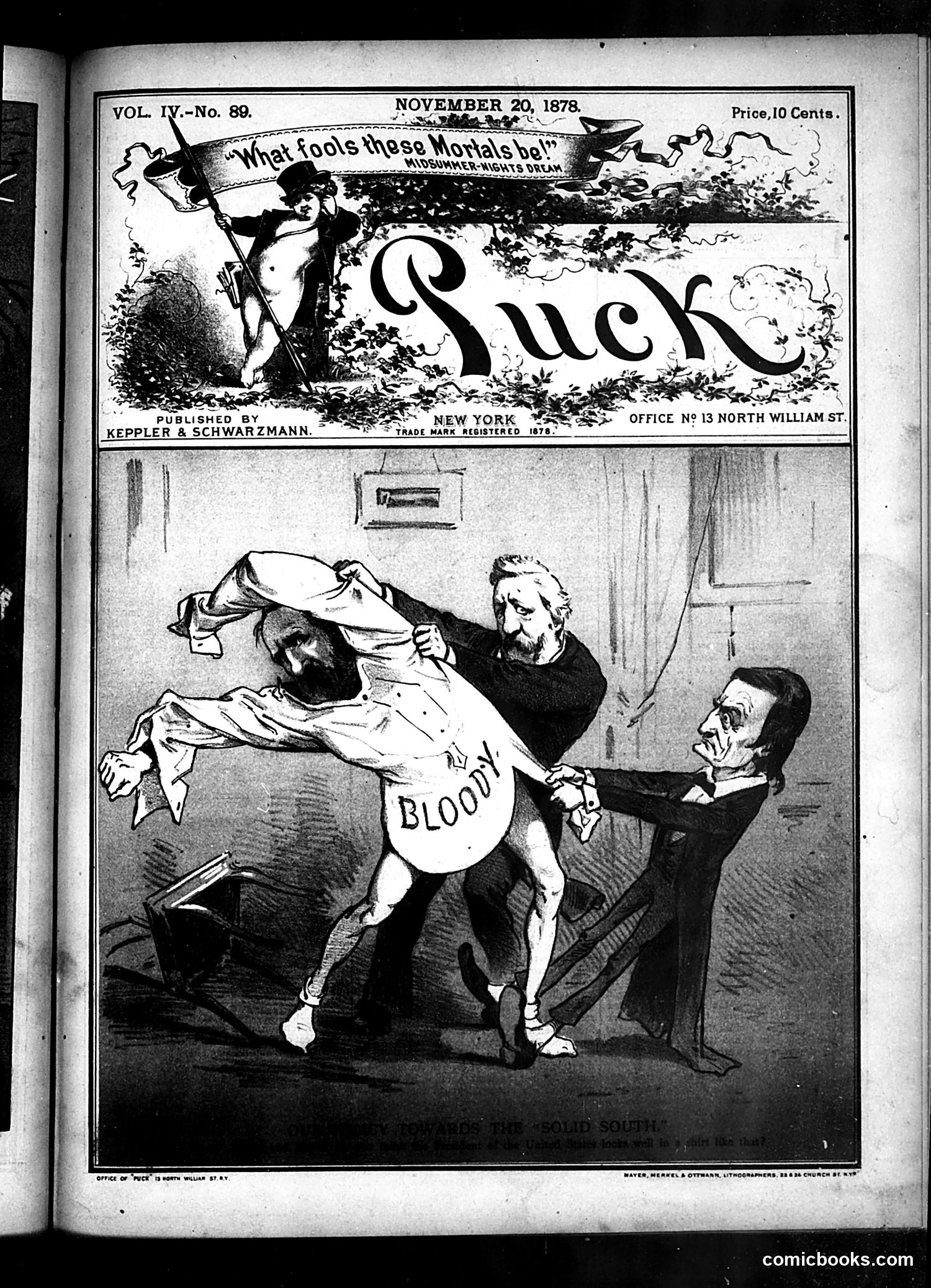
This satirical cartoon depicts a figure labeled "BLOODY" being physically restrained by two well-dressed men in what appears to be an indoor setting. The caption references "towards the 'Solid South,'" suggesting commentary on post-Reconstruction Southern politics. The "Bloody" label likely refers to "Bloody Shirt" rhetoric—a political tactic where Republicans invoked Civil War violence and Southern atrocities to mobilize voters. The cartoon appears to satirize efforts to control or restrain this inflammatory political strategy. The two men restraining the figure likely represent political figures or factions attempting to manage the increasingly divisive use of Civil War memories in electoral politics during the 1878 midterm elections. The overall message critiques the continued weaponization of sectional conflict for political gain during the Reconstruction era's conclusion.
This page consists primarily of **text content rather than cartoons**—it contains editorial commentary, reader letters, and notices rather than illustrated satirical cartoons. The main article, "The President and His Shirt," criticizes President Mr. Hayes for remaining neutral in political disputes, suggesting his lack of decisive leadership has disappointed both sides. The text attacks Hayes for being ineffectual and warns against diplomatic compromises abroad. Another section, "Puck Returns Thanks," acknowledges reader contributions, including a brick from a Mr. A.T. Stewart's remains—a peculiar donation Puck treats as darkly humorous. The page also includes notices about stolen property and other brief items. Without visible illustrations, this appears to be a text-heavy issue focused on political commentary rather than visual satire.
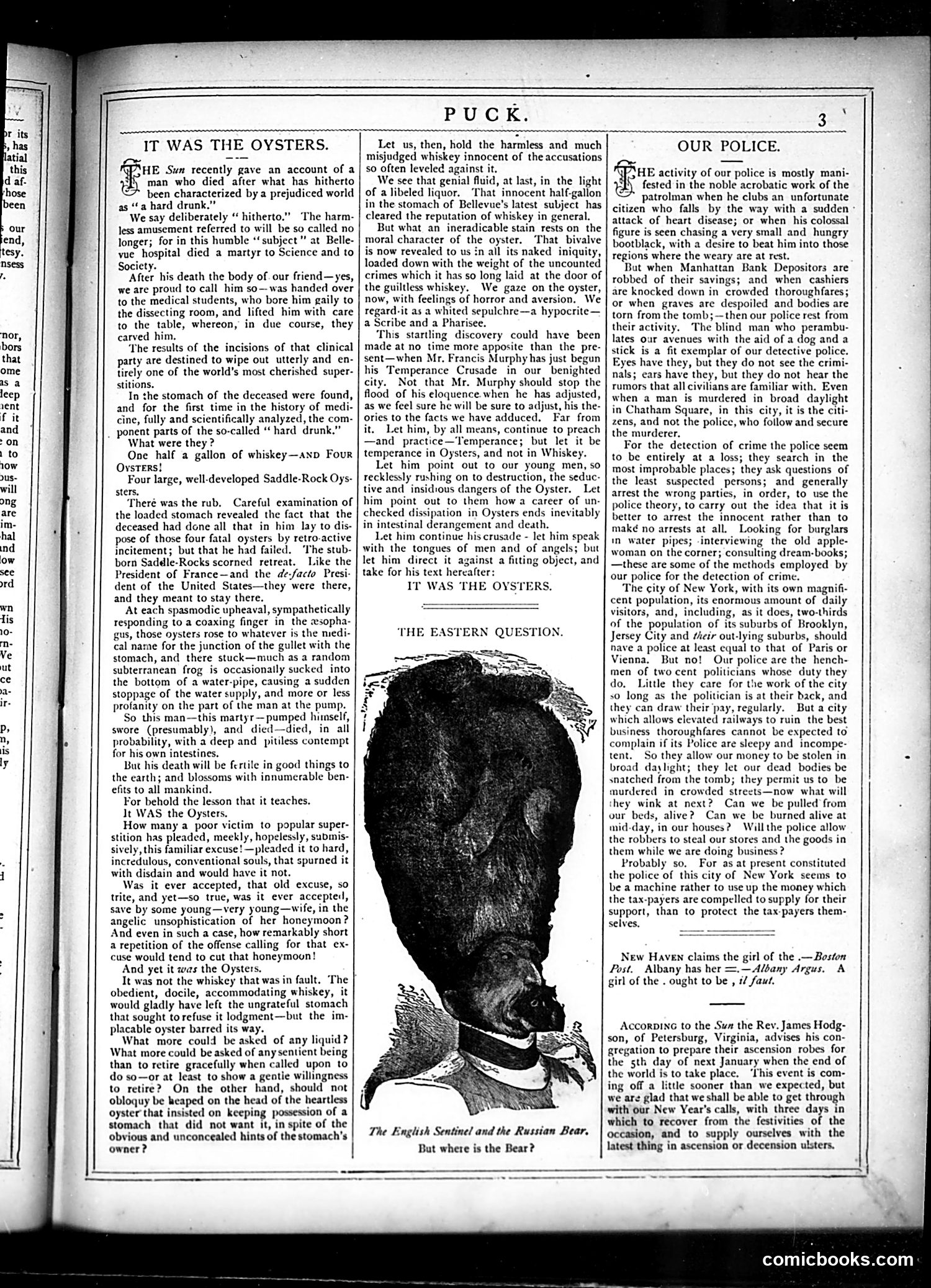
This cartoon illustrates Cold War-era anxieties about imperial powers. The image depicts a large bear (representing Russia) confronting a British sentinel, with the caption asking "But where is the Bear?" The satire criticizes British foreign policy and military preparedness regarding Russian expansion. The "English Sentinel" represents British defensive capabilities or political resolve, while the aggressive bear symbolizes Russian imperial ambitions—a common Victorian-era metaphor for Russian power. The surrounding text discusses New York police effectiveness and other civic matters, but this cartoon specifically mocks British geopolitical awareness or response to the "Russian Question"—the period's anxieties about Russian territorial and political influence in Asia and Europe.
This page contains three distinct pieces: a poem titled "Apart," an article about "Paddleford's Panorama" describing a visit to the Great Metropolis at Washington Hall, and satirical commentary on urban life. The content critiques financial institutions and social inequality. One section mocks a "Safety Trust Fund" and bank officials, suggesting corruption where depositors' money disappears through hidden errors or deliberate theft. The piece satirizes how the poor suffer when wealthy institutions mismanage funds. The panorama section describes a theatrical performance depicting city scenes—including a printer's office, editorial rooms, and various urban characters—apparently performing social commentary through staged tableaux. Overall, the page reflects Puck's typical late-19th-century focus on institutional fraud, class disparities, and urban social problems presented through literary and visual satire.
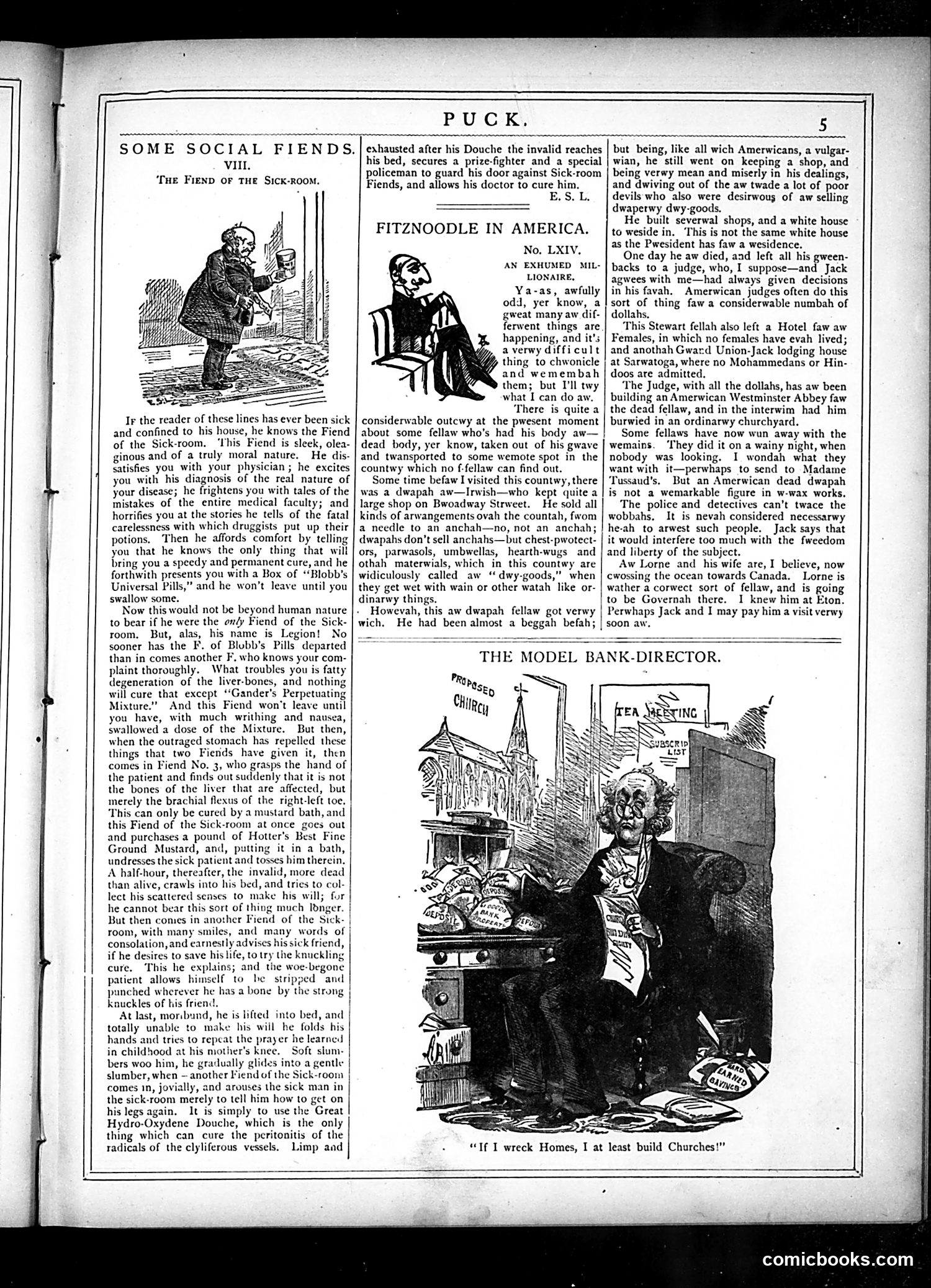
This page contains two separate satirical pieces: **"Some Social Friends: The Fiend of the Sick-room"** (left) mocks the "friend" who visits invalids with dubious folk remedies—mustard baths, various "mixtures," and the "Great Hydro-Oxydene Douche." The satire targets both the well-meaning but harmful visitor and probably patent medicine quackery of the era. **"The Model Bank-Director"** (right) is a visual satire showing a pompous figure surrounded by church and tea meeting signage, with the caption "If I wreck Homes, I at least build Churches!" This critiques hypocritical bank directors who engage in financial malfeasance while maintaining respectable public facades through charitable works and religious affiliation—suggesting moral corruption masked by social respectability.
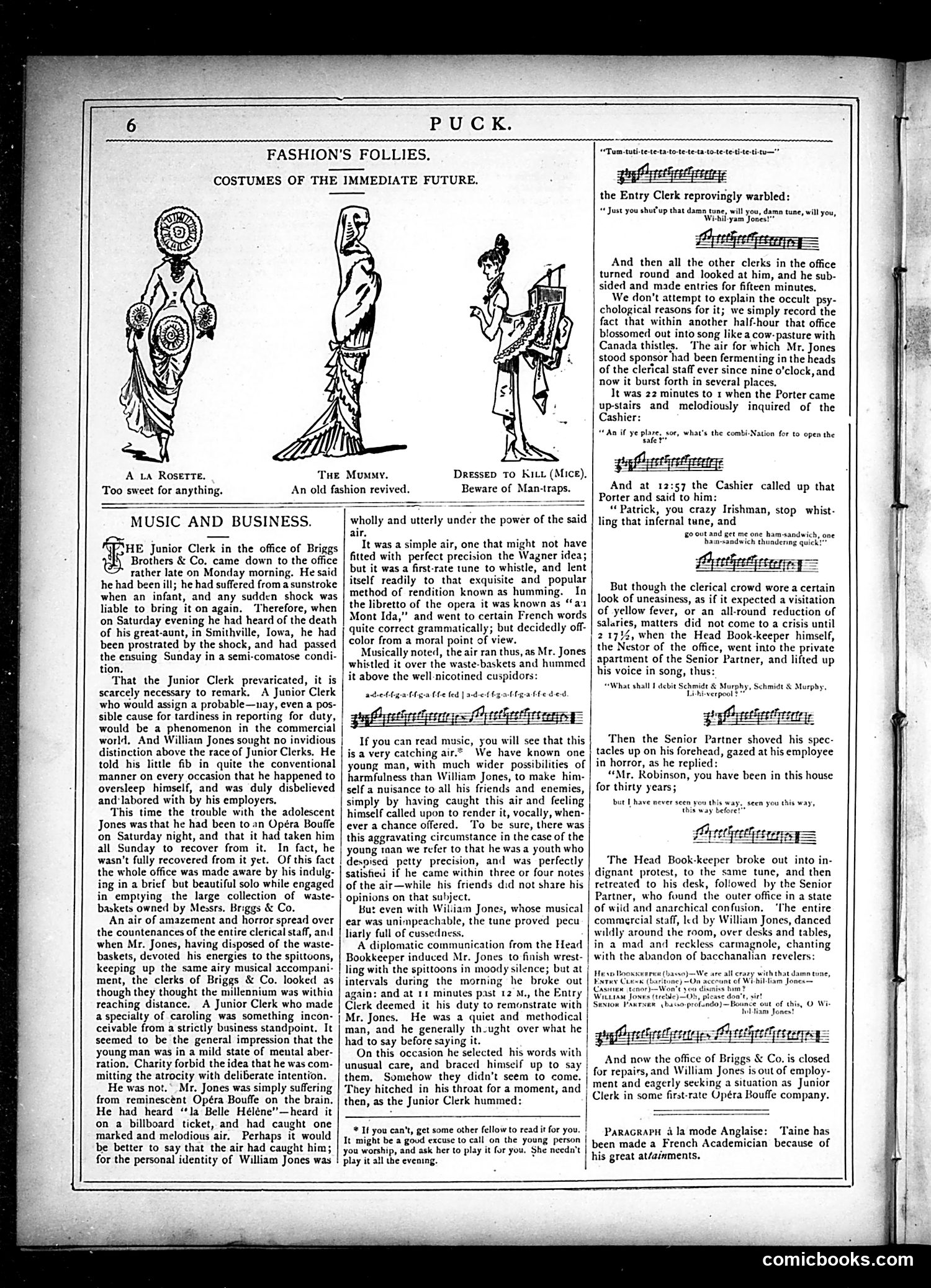
This page satirizes absurd future fashion predictions. Three illustrated women's outfits are labeled "À La Rosette," "The Mummy," and "Dressed to Kill (Mice)." The accompanying story about the Junior Clerk at Briggs Brothers & Co. is unrelated satirical content—a humorous anecdote about a young office worker whistling an irritating tune that disrupts the entire office. The Head Bookkeeper attempts to stop him through various tactics, with the narrative focusing on how this minor annoyance escalates into office chaos. The fashion illustrations mock exaggerated, impractical future dress designs, likely poking fun at contemporary fashion magazines' sensationalized predictions. The overall page combines visual and textual satire typical of Puck's humor.
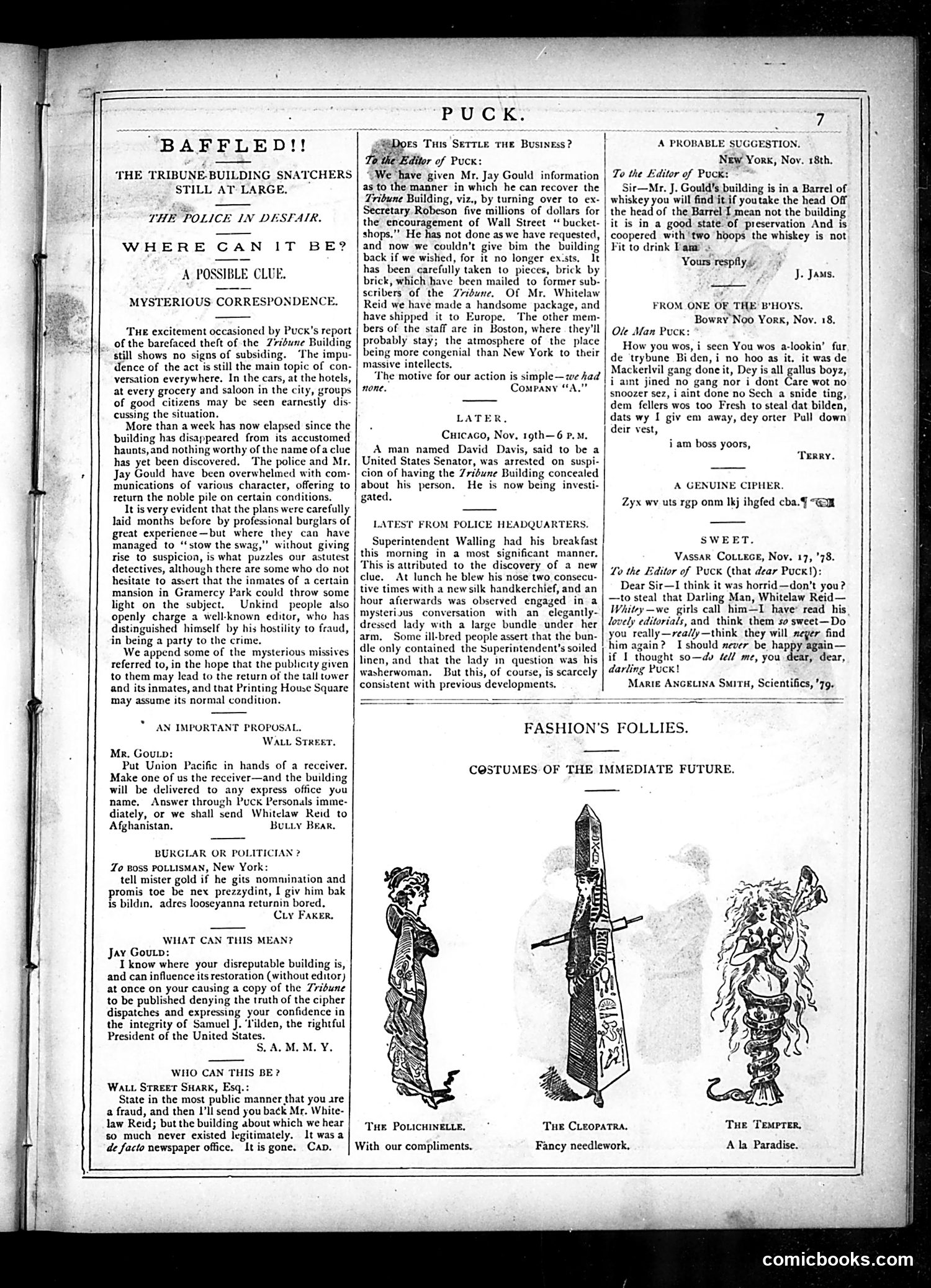
This page primarily consists of satirical correspondence and reader letters rather than political cartoons. The main content addresses the theft of the *Tribune Building* and discusses recovery methods for Mr. Jay Gould's stolen property. The "Fashion's Follies" section at bottom shows three humorous costume designs labeled "The Polichinelle," "The Cleopatra," and "The Tempest"—likely satirizing contemporary women's fashion trends through exaggerated theatrical references. The letters mock various public figures and situations: "Bully Bear" appears to be a recurring character/pseudonym, and references to "Whitelaw Reid" and the *Tribune* building theft suggest commentary on New York's prominent newspaper magnates and their rivalries during this period (dated November 1882).
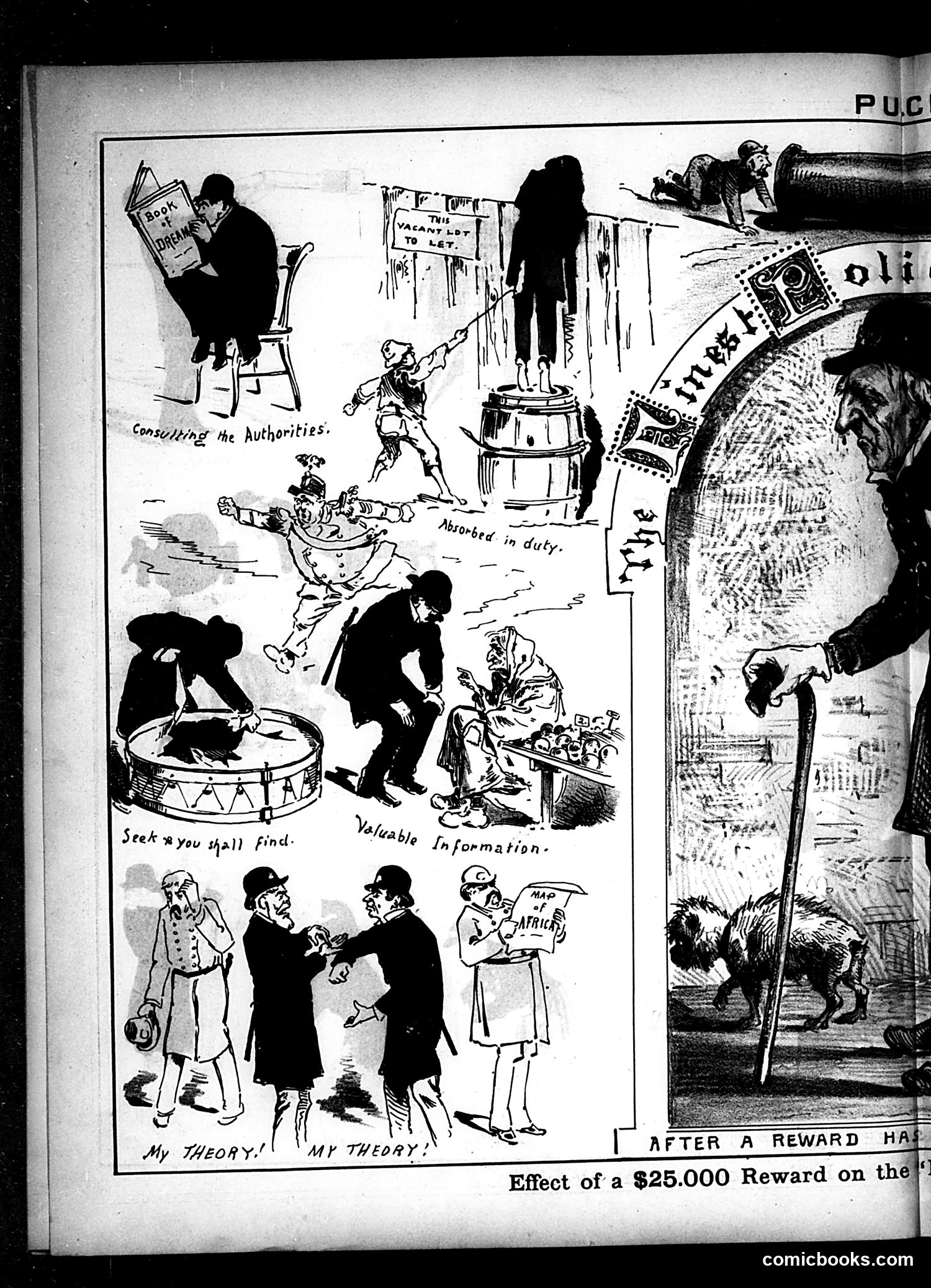
This political cartoon satirizes the effects of a $25,000 reward on public behavior and criminal investigation. The central panel shows various figures engaging in chaotic, self-interested conduct: people "consulting the authorities" while reading books, someone "absorbed in duty" standing on barrels, individuals engaged in what appears to be treasure-hunting or information-selling ("valuable information"), and at bottom, men debating their competing theories about the reward. The satire suggests that offering such a large bounty corrupts the investigative process—transforming it from legitimate law enforcement into a circus of opportunists, amateur theorists, and self-serving actors. Rather than solving crimes efficiently, the reward incentivizes confusion, competing claims, and performative behavior that actually obstructs justice.
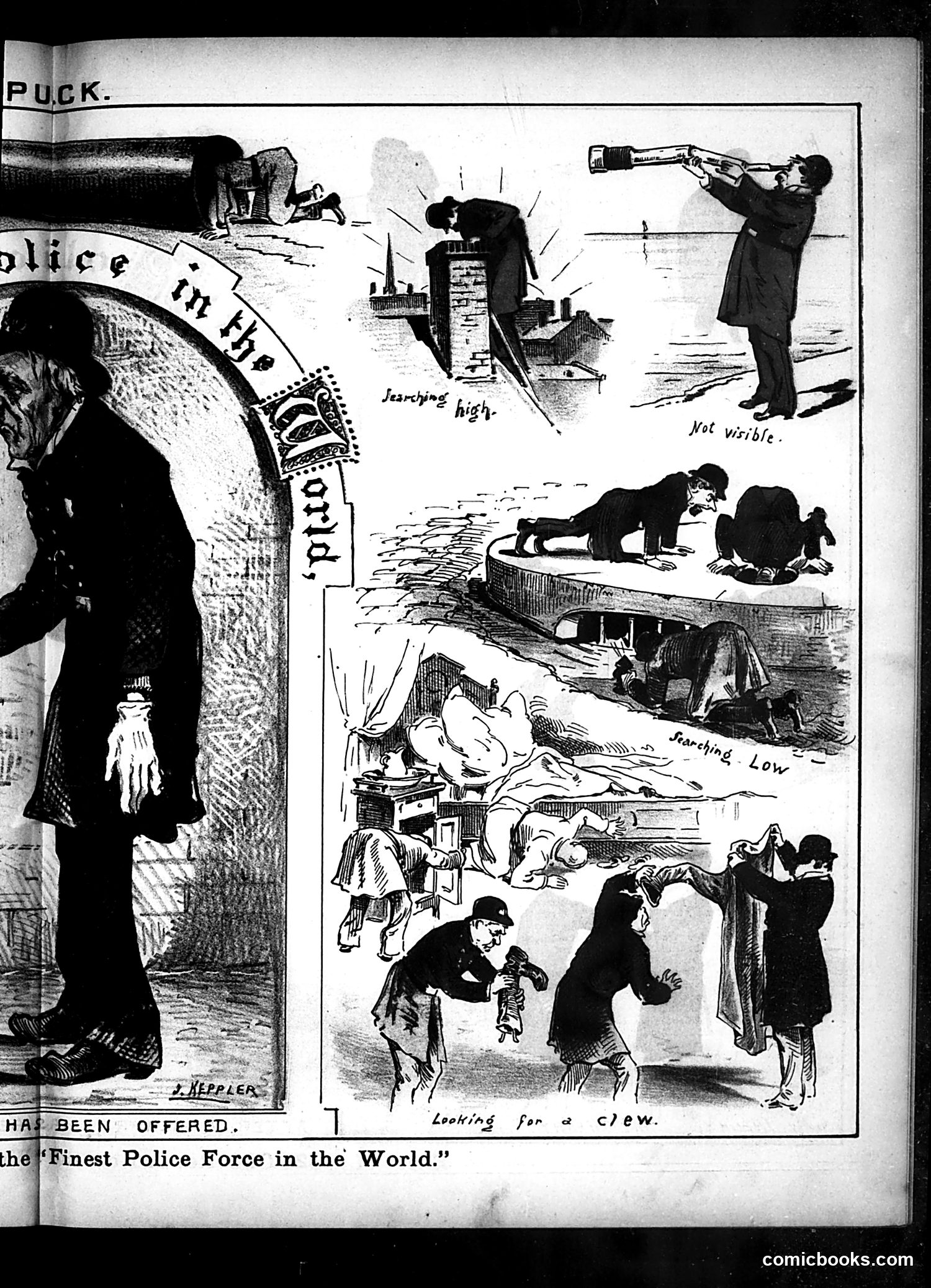
This satirical page criticizes the New York Police Department's competence and conduct. The central image shows a large police badge labeled "Police Dept" containing scenes depicting officers failing at their duties: "searching high" for criminals with a telescope, "not visible" suspects, "searching low" with officers crawling on the ground, and "looking for a clew" [sic] while examining evidence inadequately. The left panel shows a dejected policeman, labeled "Police Dept Has Been Offered" (text partially cut off), apparently illustrating the department's poor reputation. The subtitle sarcastically calls this the "'Finest Police Force in the World'"—clearly mocking the NYPD's actual performance and effectiveness. The cartoon suggests systemic incompetence and ineffectual crime-fighting capabilities during this period.
This page contains two distinct pieces: 1. **"Rondeau"** — A poem mourning the death of someone (the text mentions "Gone down below" repeatedly), though the specific person isn't identified in the visible portion. 2. **"The History of a Move"** — A humorous prose narrative about relocating to Jubayana Street. The narrator describes the chaos of moving day, mistakenly entering the wrong house, encountering an unfamiliar family at dinner, and subsequent comedic misunderstandings with neighbors. The piece satirizes the confusion and misadventures typical of urban moves and the awkwardness of new neighborhoods. At bottom, **"Answers for the Anxious"** provides reader responses to previous queries. No political satire or caricatures are visible on this page—it's primarily literary humor and domestic comedy typical of Puck's mixed content.
This page contains the conclusion of a serialized story titled "A Mother's First Love," not a political cartoon. The narrative describes a widow named Lucy who, after her husband's death, devoted herself to her young daughter. The story recounts Lucy's grief, her attempts to move forward, and ultimately her discovery of renewed joy through maternal love and a budding romance. The text is a sentimental Victorian-era domestic drama, typical of Puck's fiction content. It contains no political satire, caricatures, or social commentary—just a melodramatic tale of loss and redemption aimed at the magazine's general readership. This represents Puck's broader editorial mix beyond its famous satirical cartoons.
This page contains a serialized romantic story titled "Puck" rather than a political cartoon. The narrative is a sentimental tale about lost love—a man recalling his relationship with Lucy, a woman he loved years ago. He describes how poverty separated them, how she married another, and his lingering heartache despite her apparent happiness. The story emphasizes themes of class, fate, and unrequited love typical of 19th-century melodrama. There's a brief editorial note at the bottom referencing the "Stewart business" and a joke about oil found in the country, but this appears unrelated to the main story. This is literary content rather than satire or political commentary. No specific historical figures or events are identified or caricatured.
This page contains **"The Candidate,"** a satirical poem mocking a political candidate who campaigns while being entirely unqualified for office. The verse ridicules a man who: - Greets voters with "courtly grace" but is crude and lazy - Cannot work or manage his own affairs - Relies on his wife's income while claiming competence - Represents the "horny hand of the workingman" despite doing no actual labor The satire targets the hypocrisy of candidates who pose as "common men" while being dependent, dishonest, and incompetent. This appears to critique a specific contemporary candidate (likely 1880s-1890s), though the figure isn't identified by name. The remainder of the page contains unrelated items: "Mr. Eppenstein's Babies" (a humorous anecdote) and advertisements, including one for compressed yeast.
This page is primarily **advertising**, not political satire or editorial cartoons. It contains numerous commercial advertisements for late 19th-century products and services, including: - Clothing retailers (Arnold, Constable & Co.; Nicoll, the Tailor) - Furs and fashion accessories - Patent and trademark services - Mineral water and champagne brands - Dental services - A bookstore claiming to be "Cheapest Book-Store in the World" The only illustrated element appears to be a portrait accompanying an advertisement for **Hunyadi János mineral water**, marketed as a natural aperient (laxative), with testimonials from European physicians and professors. There is no political cartoon or satirical content visible on this page—it functions as a standard advertising section from *Puck* magazine.
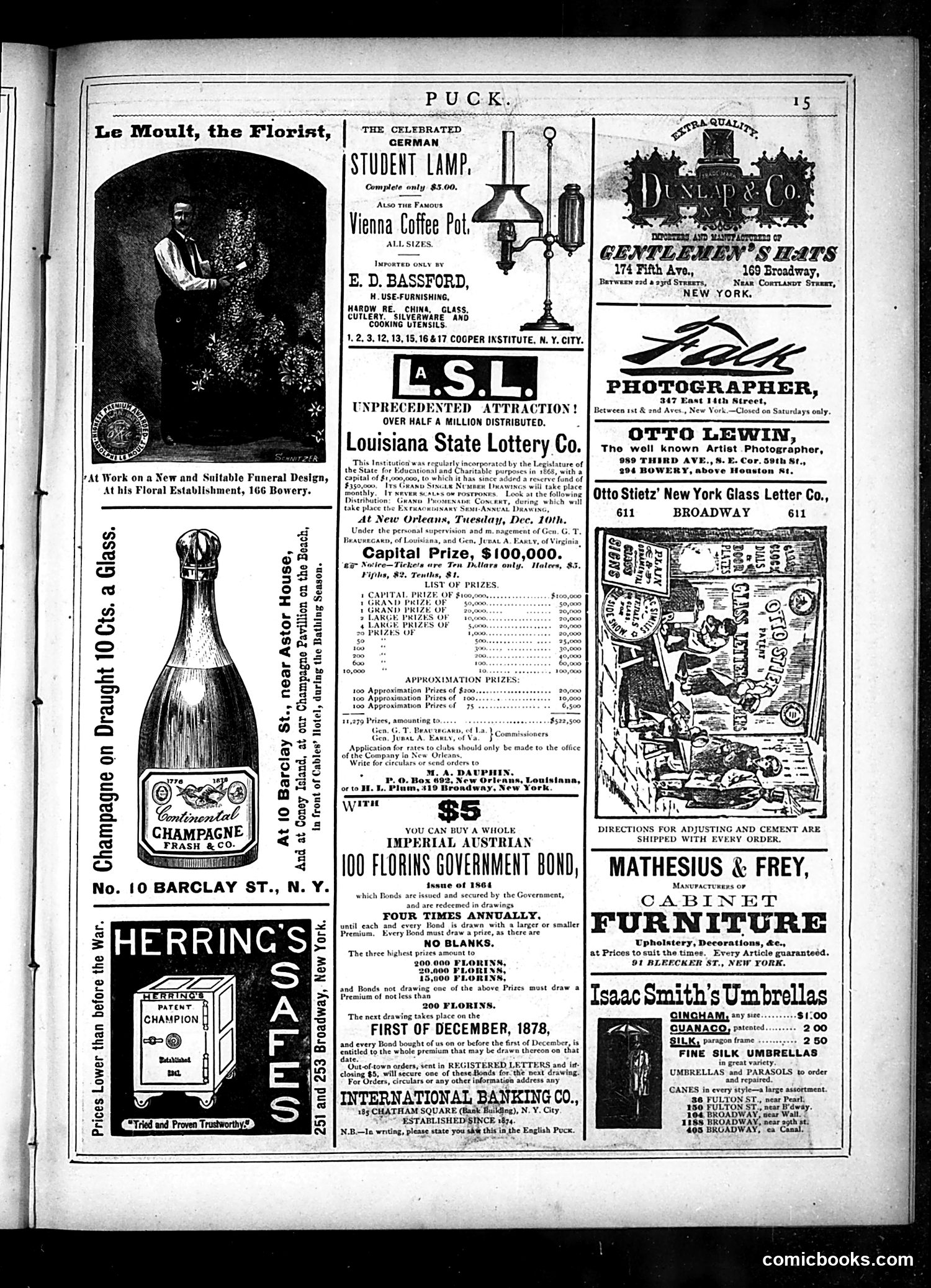
This page is **primarily advertisements** rather than satirical content. It's page 15 of Puck magazine and features commercial ads for various products and services: champagne, safes, lamps, coffee pots, lottery tickets, government bonds, umbrellas, furniture, and photography services. The only editorial content is a photograph of "Le Moult, the Florist" at top left, showing a man arranging flowers at his establishment (106 Bowery). This appears to be a straightforward business feature rather than satire. The Louisiana State Lottery advertisement is notably prominent, suggesting this was a significant commercial concern in the period. The page reflects late 19th-century New York City commercial life and advertising practices.
This Puck cartoon satirizes financial manipulation through counterfeiting. The image depicts figures engaged in what appears to be fraudulent activity—likely representing stock manipulation or currency counterfeiting schemes of the Gilded Age period. The ornate decorative border at top suggests wealth and legitimacy being undermined. Multiple figures are shown in dynamic poses suggesting chaos or criminal activity, with "counterfeits aflutter" referencing false documents or worthless currency being circulated. The central point appears to be mocking how wealthy speculators or criminals could artificially depress ("hammer down") legitimate prices through flooding markets with fraudulent alternatives—a common concern during Puck's era of financial scandals and limited market regulation. The specific individuals referenced are unclear without additional context or caption information.