
Puck, 1878-11-20 · page 11 of 16
Puck — November 20, 1878 — page 11: what you’re looking at
What you’re looking at
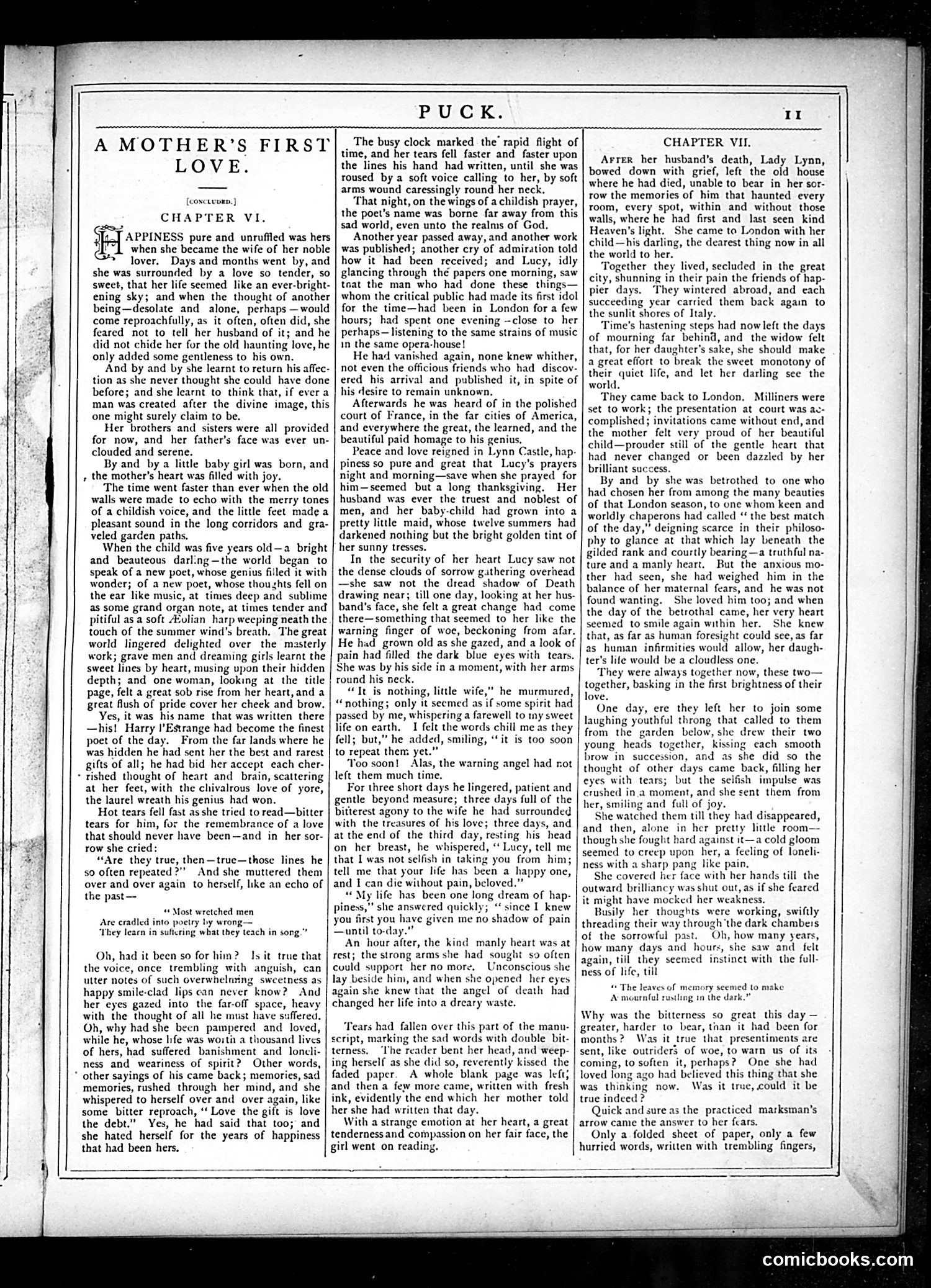
This page contains the conclusion of a serialized story titled "A Mother's First Love," not a political cartoon. The narrative describes a widow named Lucy who, after her husband's death, devoted herself to her young daughter. The story recounts Lucy's grief, her attempts to move forward, and ultimately her discovery of renewed joy through maternal love and a budding romance. The text is a sentimental Victorian-era domestic drama, typical of Puck's fiction content. It contains no political satire, caricatures, or social commentary—just a melodramatic tale of loss and redemption aimed at the magazine's general readership. This represents Puck's broader editorial mix beyond its famous satirical cartoons.
📄 Transcribed text from this page (OCR, searchable)
Machine-transcribed from the original scan — historical spelling and the odd misread are preserved.
PUCK. II A MOTHER’S FIRST LOVE. (coxcteven.} CHAPTER VI. APPINESS pure and unrufiled was hers when she became the wife of her noble lover. Days and months went by, and she was surrounded by a love so tender, so sweet, that her life seemed like an ever-bright- ening sky; and when the thought of another being—desolate and alone, perhaps — would come reproachfully, as it often, often did, she feared not to tell her husband of it; and he did not chide her for the old haunting love, he only added some gentleness to his own. And by and by she learnt to return his affec- tion as she never thought she could have done before; and she learnt to think that, if ever a man was created after the divine image, this one might surely claim to be Her brothers and sisters were all provided for now, and her father’s face was ever un- clouded and serene. By and by a little baby girl was born, and the mother’s heart was filled with joy. The time went faster than ever when the old walls were made to echo with the merry tones of a childish voice, and the little feet made a pleasant sound in the long corridors and gra- veled garden paths. When the child was five years old—a bright and beauteous darling—the world began to speak of a new poet, whose genius filled it with wonder; of a new poet, whose thouzhts fell on the ear like music, at times deep and sublime as some grand organ note, at times tender and pitiful as a soft olian harp weeping neath the touch of the summer wind’s breath, The great world lingered delighted over the masterly work; grave men and dreaming girls learnt the sweet lines by heart, musing upon their hidden depth; and one woman, looking at the title page, felt a great sob rise from her heart, and a great flush of pride cover her cheek and brow. Yes, it was his name that was written there —his!’ Harry I’Estrange had become the finest poet of the day. From the far lands where he was hidden he had sent her the best and rarest gifts of all; he had bid her accept each cher- rished thought of heart and brain, scattering at her feet, with the chivalrous love of yore, the laurel wreath his genius had won. Hot tears fell fast as she tried to read—bitter tears for him, for the remembrance of a love that should never have been—and in her sor- row she cried: “Are they true, then—true—those lines he so often repeated?" And she muttered them over and over again to herself, like an echo of the past— Most wretched men Are cradled into poetry by wrong— ‘They learn in suftcring what they teach in song.” Oh, had it been so for him? Is it true that the voice, once trembling with anguish, can ulter notes of such overwhelming sweetness as happy smile-clad lips can never know? And her eyes gazed into the far-off space, heavy with the thought of all he must have suffered. Oh, why had she becn pampered and loved, while he, whose life was woiti a thousand lives of hers, had suffered banishment and loncli- ness and weariness of spirit? Other words, * other sayings of his came back; memories, sad memories, rushed through her mind, and she whispered to herself over and over again, like some bitter reproach, “Love the gift is love the debt.” Yes, he had said that too; and she hated herself for the years of happiness that had been hers, The busy clock marked the’ rapid flight of time, and her tears fell faster and faster upon the lines his hand had written, until she was roused by a soft voice calling to her, by soft arms wound caressingly round her neck. ‘That night, on the wings of a childish prayer, the poet’s name was borne far away from this sad world, even unto the realms of God. Another year passed away, and another work was published; another cry of admiration told how it had been received; and Lucy, idly glancing through thé papers one morning, saw tnat the man who had done these things— whom the critical public had made its first idol for the time—had been in London for a few hours; had spent one evening —close to her perhaps— listening to the same strains of music in the same opera-house! He had vanished again, none knew whither, not even the officious friends who had discov. ered his arrival and published it, in spite of his desire to remain unknown, Afterwards he was heard of in the polished court of France, in the far cities of America, and everywhere the great, the learned, and the beautiful paid homage to his genius. Peace and love reigned in Lynn Castle, hap- piness so pure and great that Lucy’s prayers night and morning—save when she prayed. for him—seemed but a long thanksgiving. Her husband was ever the truest and noblest of men, and her baby-child had grown into a pretty little maid, whose twelve summers had darkened nothing but the bright golden tint of her sunny tresses. In the security of her heart Lucy saw not the dense clouds of sorrow gathering overhead —she saw not the dread shadow of Death drawing near; till one day, looking at her hus- band’s face, she felt a great change had come there—something that seemed to her like the warning finger of woe, beckoning from afar. He had_ grown old as she gazed, and a look of pain had filled the dark blue eyes with tears. She was by his side in a moment, with her arms round his neck. “It is nothing, little wife,” he murmured, “ nothing; only it seemed as if some spirit had passed by me, whispering a farewell to iny sweet life on earth, I felt the words chill meas they fell; but,” he added, smiling, ‘it is too soon to repeat them: yet.” ‘Yoo soon! Alas, the warning angel had not left them much time, For three short days he lingered, patient and gentle beyond measure; three days full of the bitterest agony to the wife he had surrounded with the treasures of his love; three days, and at the end of the third day, resting his head on her breast, he whispered, ‘ Lucy, tell me that I was not selfish in taking you from him; tell me that your life has been a happy one, and I can die without pain, beloved.” “My life has been one long dream of hap- pines,” she answered quickly; ‘since I_ knew you first you have given me no shadow of pain —until to-day.” An hour after, the kind manly heart was at rest; the strong arms she had sought so often could support her no more, Unconscious she lay beside him, and when she opened her eyes | again she knew that the angel of death had changed her life into a dreary waste. Tears had fallen over this part of the manu- script, marking the sad words with double bit- terness. ‘The reader bent her head, and weep- ing herself as she did so, reverently kissed the faded paper. A whole blank page was left; and then a few more came, written with fresh ink, evidently the end which her mother told her she had written that day. With a strange emotion at her heart, a great tenderness and compassion on her fair face, the girl went on reading. CHAPTER VII. Arrer ber husband’s death, Lady Lynn, bowed down with grief, left the old house where he had died, unable to bear in her sor- row the memories of him that haunted every room, every spot, within and without those walls, where he had first and last seen kind Heaven's light. She came to London with her child—his darling, the dearest thing now in all the world to her. Together they lived, secluded in the great city, shunning in their pain the friends of hap- pier days, They wintered abroad, and each succeeding year carried them back aga to the sunlit shores of Italy. Time's hastening steps had now left the days of mourning far behind, and the widow felt that, for her daughter's sake, she should make a great effort to break the sweet monotony of their quiet life, and let her darling see the world. They came back to London. Milliners were set to work; the presentation at court was ac- complished ; invitations came without end, and the mother felt very proud of her beautiful child—prouder still of the gentle heart that had never changed or been dazzled by her brilliant success. By and by she was betrothed to one who had chosen her from among the many beauties of that London season, to one whom keen and worldly chaperons had called “ the best match of the day,” deigning scarce in their philoso- phy to glance at that which lay beneath the gilded rank and courtly bearing—a truthful na- ture and a manly heart. But the anxious mo- ther had seen, she had weighed him in the balance of her maternal fears, and he was not found wanting. She loved him too; and when the day of the betrothal came, her very heart seemed to smile again within her. She knew that, as far as human foresight could see, as far as human infirmities would allow, her daugh- ter’s life would be a cloudless one. They were always together now, these two— together, basking in the first brightness of their love. One day, ere they left her to join some laughing youthful throng that called to them from the garden below, she drew their two young heads together, kissing each smooth brow in succession, and as she did so the thought of other days came back, filling her eyes with tears; but the selfish impulse was crushed in.a moment, and she sent them from her, smiling and full of joy She watched them till they had disappeared, and then, alone in her pretty little room— though she fought hard against it—a cold gloom seemed to creep upon her, a feeling of loneli- ness with a sharp pang like pain, She covered her face with her hands till the outward brilliancy was shut out, as if she feared it might have mocked her weakness. Busily her thoughts were working, swiftly threading their way through ‘the dark chambers of the sorrowful past. Oh, how many years, how many days and hours, she saw and felt again, till they seemed instinet with the full- ness of life, till ¢ leaves of memory seemed to make A mournfal rustlin; the dark.” Why was the bitterness so great this day — greater, harder to bear, than it had been for months? Was it true that presentiments are sent, like outrider3 of woe, to warn us of its coming, to soften it, perhaps? One she had loved long ago had believed this thing that she was thinking now. Was it true, could it be true indeed ? Quick and sure as the practiced marksman’s arrow came the answer to her fears. Only a folded sheet of paper, only a few hurried words, written with trembling fingers, comicbooks.com