
Puck, 1878-11-20 · page 3 of 16
Puck — November 20, 1878 — page 3: what you’re looking at
What you’re looking at
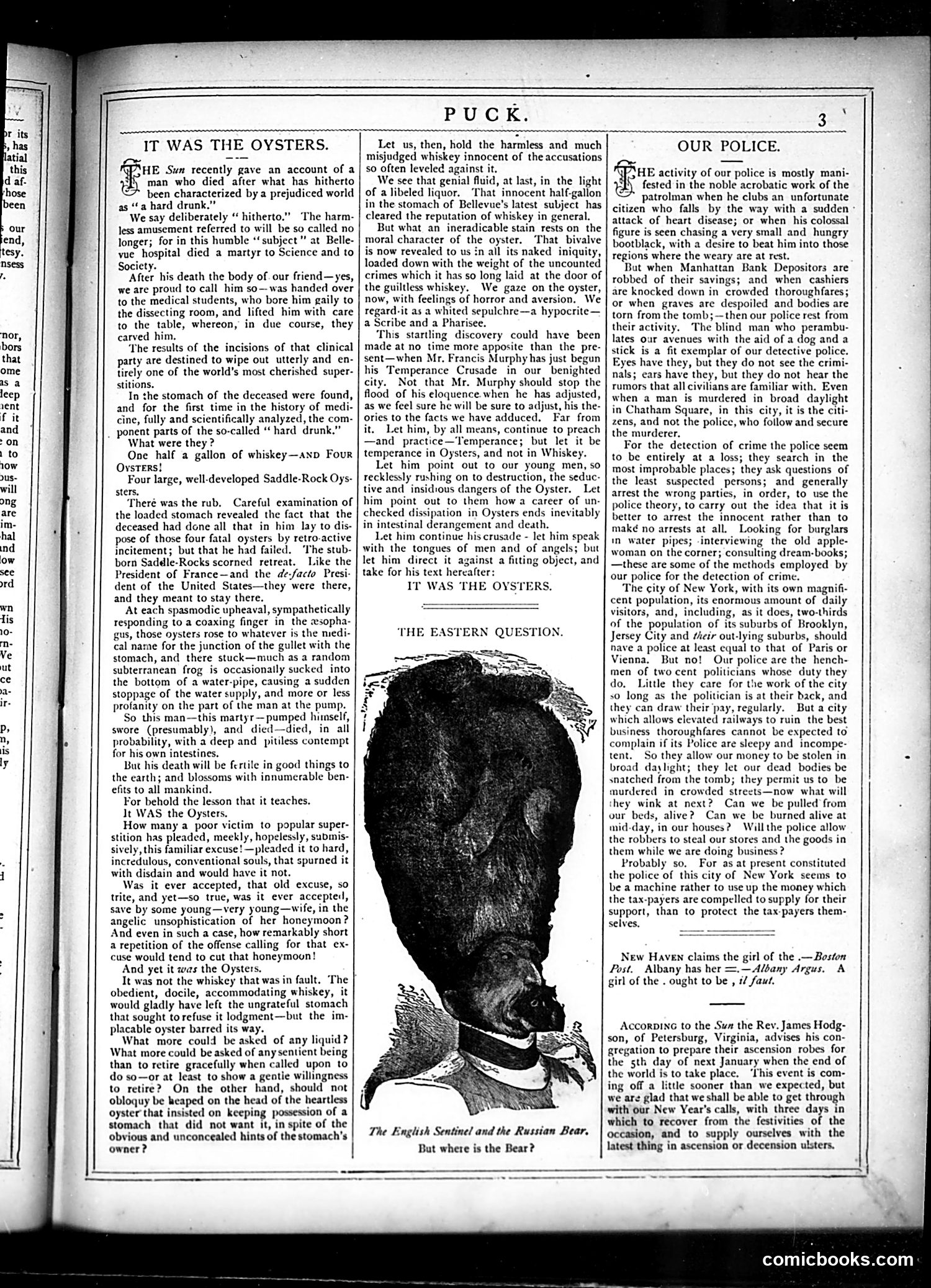
This cartoon illustrates Cold War-era anxieties about imperial powers. The image depicts a large bear (representing Russia) confronting a British sentinel, with the caption asking "But where is the Bear?" The satire criticizes British foreign policy and military preparedness regarding Russian expansion. The "English Sentinel" represents British defensive capabilities or political resolve, while the aggressive bear symbolizes Russian imperial ambitions—a common Victorian-era metaphor for Russian power. The surrounding text discusses New York police effectiveness and other civic matters, but this cartoon specifically mocks British geopolitical awareness or response to the "Russian Question"—the period's anxieties about Russian territorial and political influence in Asia and Europe.
📄 Transcribed text from this page (OCR, searchable)
Machine-transcribed from the original scan — historical spelling and the odd misread are preserved.
nor, bors that ome as a leep vent f it and >on 1 to 10Ww Dus- will ong are im- nd rd ut PUCK. IT WAS THE OYSTERS. HE Sun recently gave an account of a man who died after what has hitherto %@ teen characterized by a prejudiced world as ‘¢a hard drunk.” We say deliberately “ hitherto.” The harm- less amusement referred to will be so called no longer; for in this humble “subject " at Belle- yue hospital died a martyr to Science and to Society. ‘After his death the body of our friend—yes, we are proud to call him so—-was handed over to the medical students, who bore him gaily to the dissecting room, and lifted him with care to the table, whereon, in due course, they carved him. ‘The results of the incisions of that clinical party are destined to wipe out utterly and en- tirely one of the world’s most cherished super- stitions. In the stomach of the dece: were found, and for the first time in the history of medi- cine, fully and scientifically analyzed, the com- ponent parts of the so-called “hard drunk.” What were they ? One half a gallon of whiskey—anp Four Oysters! Four large, well-developed Saddle-Rock Oys- sters, ‘Theré was the rub, Careful examination of the loaded stomach revealed the fact that the deceased had done all that in him lay to dis pose of those four fatal oysters by retro-active incitement; but that he had failed. ‘Ihe stub- born Saddle-Rocks scorned retreat. Like the President of France—and the de-facto Presi- dent of the United States—they were there, and they meant to stay there. At each spasmodic upheaval, sympathetically responding to a coaxing finger in the wsopha- gus, those oysters rose to whatever is the medi- cal name for the junction of the gullet with the stomach, and there stuck—much as a random subterranean frog is occasionally sucked into the bottom of a water-pipe, causing a sudden stoppage of the water supply, and more or less profanity on the part of the man at the pump. So this man—this martyr—pumped hitnself, swore (presumably), and died—died, in all probability, with a deep and pitiless contempt for his own intestines. But his death will be fertile in good things to the earth; and blossoms with innumerable ben- efits to all mankind. For behold the lesson that it teaches. Jt WAS the Oysters. How many a poor victim to popular super- stition has pleaded, meekly, hopelessly, submis- sively, this familiar excuse !—pleaded it to hard, incredulous, conventional souls, that spurned it with disdain and would have it not. Was it ever accepted, that old excuse, so trite, and yet—so true, was it ever accepted, save by some young—very young—wife, in the angelic unsophistication of her honeymoon? And even in such a case, how remarkably short a repetition of the offense calling for that ex- cuse would tend to cut that honeymovun! And yet it was the Oysters. It was not the whiskey that was in fault. The obedient, docile, accommodating whiskey, it would gladly have left the ungrateful stomach that sought to refuse it lodgment—but the im- placable oyster barred its way. What more could be asked of any liquid? What more could be asked of any sentient being than to retire gracefully when called upon to do so—or at least to show a gentle willingness to retire? On the other hand, should not obloquy be keaped on the head of the heartless oyster that insisted on keeping possession of a stomach that did not want it, in spite of the obvious and unconcealed hints of the stomach’s Let_us, then, hold the harmless and much misjudged whiskey innocent of the accusations so often leveled against it. We see that genial fluid, at last, in the light of a libeled liquor. ‘That innocent half-gallon in the stomach of Bellevue's latest subject has cleared the reputation of whiskey in general. But what an ineradicable stain rests on the moral character of the oyster. That bivalve is now revealed to us in all its naked iniquity, loaded down with the weight of the uncounted crimes which it has so long laid at the door of the guiltless whiskey. We gaze on the oyster, now, with feelings of horror and aversion. We regard-it as a whited sepulchre—a hypocrite— a Scribe and a Pharisee. This startling discovery could have been made at no time more apposite than the pre- sent—when Mr. Francis Murphy has just begun his Temperance Crusade in our benighted city. Not that Mr. Murphy should stop the flood of his eloquence. when he has adjusted, as we feel sure he will be sure to adjust, his the- ories to the facts we have adduced. Far from it. Let him, by all means, continue to preach —and practice—Temperance; but let it be temperance in Oysters, and not in Whiskey. Let him point out to our young men, so recklessly rushing on to destruction, the seduc- tive and insidious dangers of the Oyster. Let him point out to them how a career of un- checked dissipation in Oysters ends inevitably in intestinal derangement and death, Let him continue his crusade - let him speak with the tongues of men and of angels; but let him direct it against a fitting object, and take for his text hereafte IT WAS THE OYSTERS. THE EASTERN QUESTION. The English Sentinel and the Russian Bear, But where is the Bear? owner? OUR POLICE. pee activity of our police is mostly mani- wh fested in the noble acrobatic work of the <* patrolman when he clubs an unfortunate citizen who falls by the way with a sudden attack of heart disease; or when his colossal figure is seen chasing a very small and hungry bootblack, with a desire to beat him into those regions where the weary are at rest. But when Manhattan Bank Depositors are robbed of their savings; and when cashiers are knocked down in crowded thoroughfares; or when graves are despoiled and bodies are torn from the tomb;—then our police rest from their activity. The blind man who perambu- lates our avenues with the aid of a dog and a stick is a fit exemplar of our detective police. Eyes have they, but they do not see the crimi- nals; ears have they, but they do not hear the rumors that all civilians are familiar with. Even when a man is murdered in broad daylight in Chatham Square, in this city, it is the citi- zens, and not the police, who follow and secure the murderer, For the detection of crime the police seem to be entirely at a loss; they search in the most improbable places; they ask questions of the least suspected persons; and generally arrest the wrong parties, in order, to use the police theory, to carry out the idea that it is better to arrest the innocent rather than to maké no arrests at all. Looking for burglars i water pipes; -interviewing the old apple- woman on the corner; consulting dream-books; —these are some of the methods employed by our police for the detection of crime. The city of New York, with its own magnifi- cent population, its enormous amount of daily visitors, and, including, as it does, two-thirds of the population of its suburbs of Brooklyn, Jersey City and their out-lying suburbs, should nave a police at least cqual to that of Paris or Vienna, But no! Our police are the hench- men of two cent politicians whose duty they do, Little they care for the work of the city so long as the politician is at their back, and they can draw their pay, regularly. But a city which allows elevated railways to ruin the best business thoroughfares cannot be expected to complain if its Police are sleepy and incompe- tent. So they allow our money to be stolen in broad daylight; they let our dead bodies be snatched from the tomb; they permit us to be murdered in crowded streets—now what will hey wink at next? Can we be pulled from our beds, alive? Can we be burned alive at mid-day, in our houses? Will the police allow the robbers to steal our stores and the goods in them while we are doing business ? Probably so. For as at present constituted the police of this city of New York seems to be a machine rather to use up the money which the tax-payers are compelled to supply for their support, than to protect the tax-payers them- selves, New Haven claims the girl of the Boston Post. Albany has her =.—Albany Argus. A girl of the . ought to be , #7 faut. AccorDINc to the Sun the Rev. James Hodg- son, of Petersburg, Virginia, advises his con- gregation to prepare their ascension robes for the sth day of next January when the end of the world is to take place. ‘This event is com- ing off a little sooner than we expected, but we are glad that we shall be able to get through with our New Year's calls, with three days in which to recover from the festivities of the occasion, and to supply ourselves with the latest thing in ascension or decension ulsters. comicbooks.com