
Puck, 1878-11-20 · page 10 of 16
Puck — November 20, 1878 — page 10: what you’re looking at
What you’re looking at
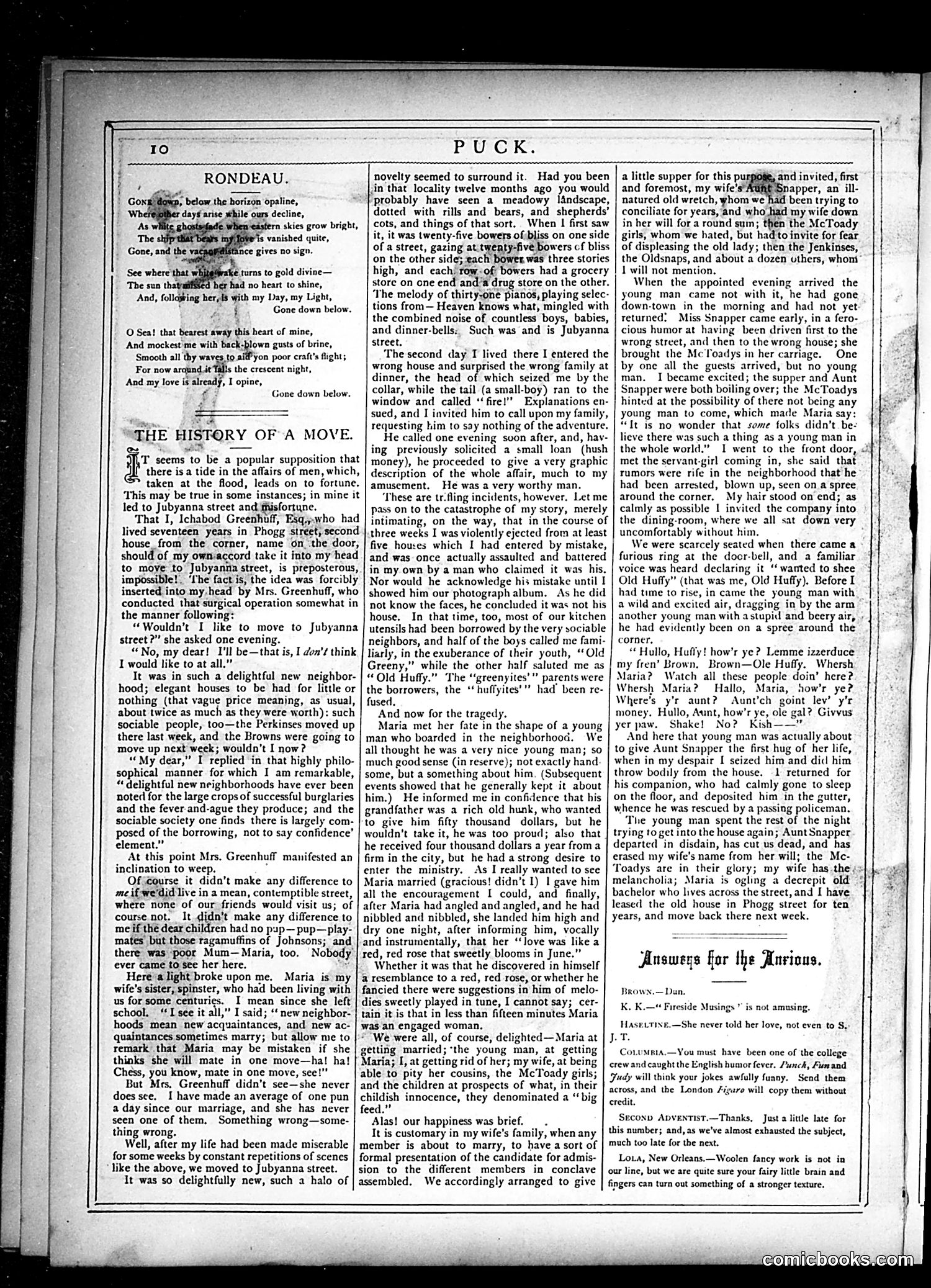
This page contains two distinct pieces: 1. **"Rondeau"** — A poem mourning the death of someone (the text mentions "Gone down below" repeatedly), though the specific person isn't identified in the visible portion. 2. **"The History of a Move"** — A humorous prose narrative about relocating to Jubayana Street. The narrator describes the chaos of moving day, mistakenly entering the wrong house, encountering an unfamiliar family at dinner, and subsequent comedic misunderstandings with neighbors. The piece satirizes the confusion and misadventures typical of urban moves and the awkwardness of new neighborhoods. At bottom, **"Answers for the Anxious"** provides reader responses to previous queries. No political satire or caricatures are visible on this page—it's primarily literary humor and domestic comedy typical of Puck's mixed content.
📄 Transcribed text from this page (OCR, searchable)
Machine-transcribed from the original scan — historical spelling and the odd misread are preserved.
RONDEAU. , below the horizon opaline, Hedstern skies grow bright, As vanished quite, ance gives no sign. e o: turns to gold divine— fed her had no heart to shine, her,4s with my Day, my Light, ut Gone down below. O Sea! that bearest away this heart of mine, And mockest'me with back-plown gusts of brine, Smooth all thy waves,to.aiff'yon poor craft's flight; For now arqund.it Tails the crescent night, And my love is already, Topine, one down below. THE HISTORY OF A MOVE. Ir seems to be a popular supposition that there is a tide in the affairs of men, which, taken at the flood, leads on to fortune. This may be true in some instances; in mine it led to Jubyanna street and fisfortyne. That I, Ichabod Greenhuff, Esq,;who had lived seventeen years in Phogg street, second house. from’ the corner, name On_-the door, should of my own: accord take it into my head to move to Jubyanta Street, is preposterous, impossible! ‘The fact is, the idea was forcibly inserted into. my, head by Mrs. Greenhuff, who conducted that surgical operation somewhat in the manner following: “Wouldn't I like to move to Jubyanna street?” she asked one evening. “No, my dear! I'll be—that is, I don's think 1 would like to at all.” It was in such a delightful new neighbor- hood; elegant houses to be had for little or nothing (that vague price meaning, as usual, about twice as much as they were worth): such sociable people, too—the Perkinses moved up there last week, and the Browns were going to move up next week; wouldn’t I now? “My dear,” I replied in that highly philo- sophical manner for which I am remarkable, “ delightful new neighborhoods have ever been noted for the large crops of successful burglaries and the fever and-ague they produce; and the sociable society one finds there is largely com- posed of the borrowing, not to say confidence’ element.” At this point Mrs. Greenhuff manifested an inclination to weep. Ofcourse it didn’t make any difference to meif-we'did live in a mean, contemptible street, where none of our friends would visit us; of course not. It didn’t make any difference to me if thé dear children had no pup— pup—play- mates but those ragamuffins of Johnsons; and there was poor Mum—Maria, too. ‘Nobody’ ever came to see her here. Heré’a light broke upon me. Maria is my wife's sister, spinster, who had been living with us for some centur I mean since she left school. “I see it all,” I said; “ new neighbor- hoods mean new acquaintances, and new ac- quaintances sometimes marry; but allow me to remark that Maria may be mistaken if she thinks she will mate in one move—ha! ha! Chess, you know, mate in one move, see!”* But Mrs, Greenhuff didn’t see—she never does see. I have made an average of one pun a day since our marriage, and she has never seen one of them. Something wrong—some- thing wrong. Well, after my life had been made miserable for some weeks by constant repetitions of scenes like the above, we moved to Jubyanna street. It was so delightfully new, such a halo of novelty seemed to surround it. Had you been in that locality twelve months ago you would probably have seen a meadowy iAndscape, dotted with rills and bears, and shepherds’ cots, and things of that sort. When | first saw it, it was twenty-five bowers ofibliss on one side of a street, gazing at.twenty-five bowers cf bliss on the other side; each bower was three stories high, and cach} row. oft bowers had a grocery store on one end and’a drug store on the other. ‘The melody of thirty-one pianos, playing selec- tions from— Heaven knows what, mingled with the combined noise of countless boys, babies, and dinner-bells:, Such was and is Jubyanna street, The second day T lived there I entered the wrong house and surprised the wrong family at dinner, the head of which seized me by the collar, while the tail (a small-boy) ran to the window and called “fire!” Explanations en- sued, and I invited him to call upon my family, requesting him to say nothing of the adventure. He called one evening svon after, and, hav- ing previously solicited a small loan (hush money), he proceeded to give a very graphic description of the whole affair, much to my amusement. He was a very worthy man. ‘These are trfling incidents, however. Let me Pass on to the catastrophe of my story, merely intimating, on the way, that in the course of three weeks I was violently ejected from at least five hou:es which I had entered by mistake, and was once actually assaulted and battered in my own by a man who claimed it was his. Nor would he acknowledge his mistake until 1 showed him our photograph album. As he did not know the faces, he concluded it was not his house. In that time, too, most of our kitchen utensils had been borrowed by the very sociable neighbors, and half of the boys called me fami- liarly, in the exuberance of their youth, “Old Greeny,” while the other half saluted me as “Old Huffy.” ‘The “greenyites’” parents were the borrowers, the ‘‘huffyites’"” had’ been re- fused. And now for the tragedy. Maria met her fate in the shape of a young man who boarded in the neighborhood. We all thought he was a very nice young man; so much good sense (in reserve); not exactly hand some, but a something about him. (Subsequent events showed that he generally kept it about him.) He informed me in confidence that his grandfather was a rich old hunk, who wanted to give him fifty thousand dollars, but he wouldn't take it, he was too proud; also that he received four thousand dollars a year from a firm in the city, but he had a strong desire to enter the ministry. As I really wanted to see Maria married (gracious! didn’t 1) 1 gave him all the encouragement I could, and finally, after Maria had angled and angled, and he had nibbled and nibbled, she landed him high and dry one night, after informing him, vocally and instrumentally, that her ‘love was like a red, red rose that sweetly blooms in June.” Whether it was that he discovered in himself @ resemblance to a red, red rose, or whether he fancied there were suggestions in him of melo- dies sweetly played in tune, I cannot say; cer- tain it is that in less than fifteen minutes Maria was an engaged woman. * "We were all, of course, delighted—Maria at getting married; the young man, at getting Maria; I, at getting rid of her; my wife, at bei able to pity her cousins, the McToady girls; and the children at prospects of what, in their childish innocence, they denominated a “ big feed.” Alas! our happiness was brief. It is customary in my wife's family, when any member is about to marry, to have a sort of formal presentation of the candidate for admis- sion to the different members in conclave assembled. We accordingly arranged to give a little supper for this pu: and invited, first and foremost, my wife’ PRS, an ill- natured old wretch, whom we: been trying to conciliate for years, and who\had my wife down in her will for a round sum; then the McToady girls, whom we hated, but hadto invite for fear of displeasing the old lady; then the Jenkinses, the Oldsnaps, and about a dozen others, whom 1 will not mention. When the appointed evening arrived the young man came not with it, he had gone down-town in the morning and had not yet: returned: Miss Snapper came early, in a fero- cious humor at having been driven first to the wrong street, and then to the wrong house; she brought the McToadys in her carriage. One by one all the guests arrived, but no young man. I became excited; the supper and Aunt Snapper were both boiling over; the McToadys hinted at the possibility of there not being any young man to come, which made Maria say: “Tt is no wonder that some folks didn’t be- lieve there was such a thing as a young man in the whole world.” met the servant-girl coming in, she said that rumors were rife in the neighborhood that he had been arrested, blown up, seen on a spree. around the corner. My hair stood on end; as calmly as possible 1 invited the company into the dining-room, where we all sat down very uncomfortably without him. We were scarcely seated when there came a furious ring at the door-bell, and a familiar voice was heard declaring it ‘‘ wanted to shee Old Huffy” (that was me, Old Huffy), Before I had time to rise, in came the young man with a wild and excited air, dragging in by the arm another young man with astupid and beery air, + he had evidently been on a spree around the corner. “Hullo, Hufly! how’r ye? Lemme izzerduce my fren’ Brown, Brown—Ole Huffy. Whersh Maria? Watch all these people doin’ here? Whersh Maria? Hallo, Maria, how’r ye? Where's y'r aunt? = Aunt’ch goint lev’ y’r money. Hullo, Aunt, how’r ye, ole gal? Givvus yer paw. Shake! No? Kish——" And here that young man was actually about to give Aunt Snapper the first hug of her life, when in my despair I seized him and did him throw bodily from the house. 1 returned for his companion, who had calmly gone to sleep on the floor, and deposited him in the gutter, whence he was rescued by a passing policeman. The young man spent the rest of the night trying to get into the house again; Aunt Snapper departed in disdain, has cut us dead, and has erased my wife's name from her will; the Mc- Toadys are in their glory; my wife has the, ; Maria is ogling a decrepit old bachelor who lives across the street, and I have leased the old house in Phogg street for ten years, and move back there next week. Answers for the Anrious, Browy.—Dun, K. K.—" Fireside Musings is not amusing. Haseutine.—She never told her love, not even to S, JT. Conusnia.—You must have been one of the college crew and caught the English humor fever. Punch, Fun and ‘Judy will think your jokes awfully funny. Send them across, and the London Figaro will copy them without credit. SecoND ApvENTIST.—Thanks, Just a little late for this number; and, as we've almost exhausted the subject, much too late for the next. Lota, New Orleans.—Woolen fancy work is not in our line, but we are quite sure your fairy little brain and fingers can turn out something of a stronger texture. I went to the front door, <? icomicbooksscom