
Puck, 1878-11-20 · page 4 of 16
Puck — November 20, 1878 — page 4: what you’re looking at
What you’re looking at
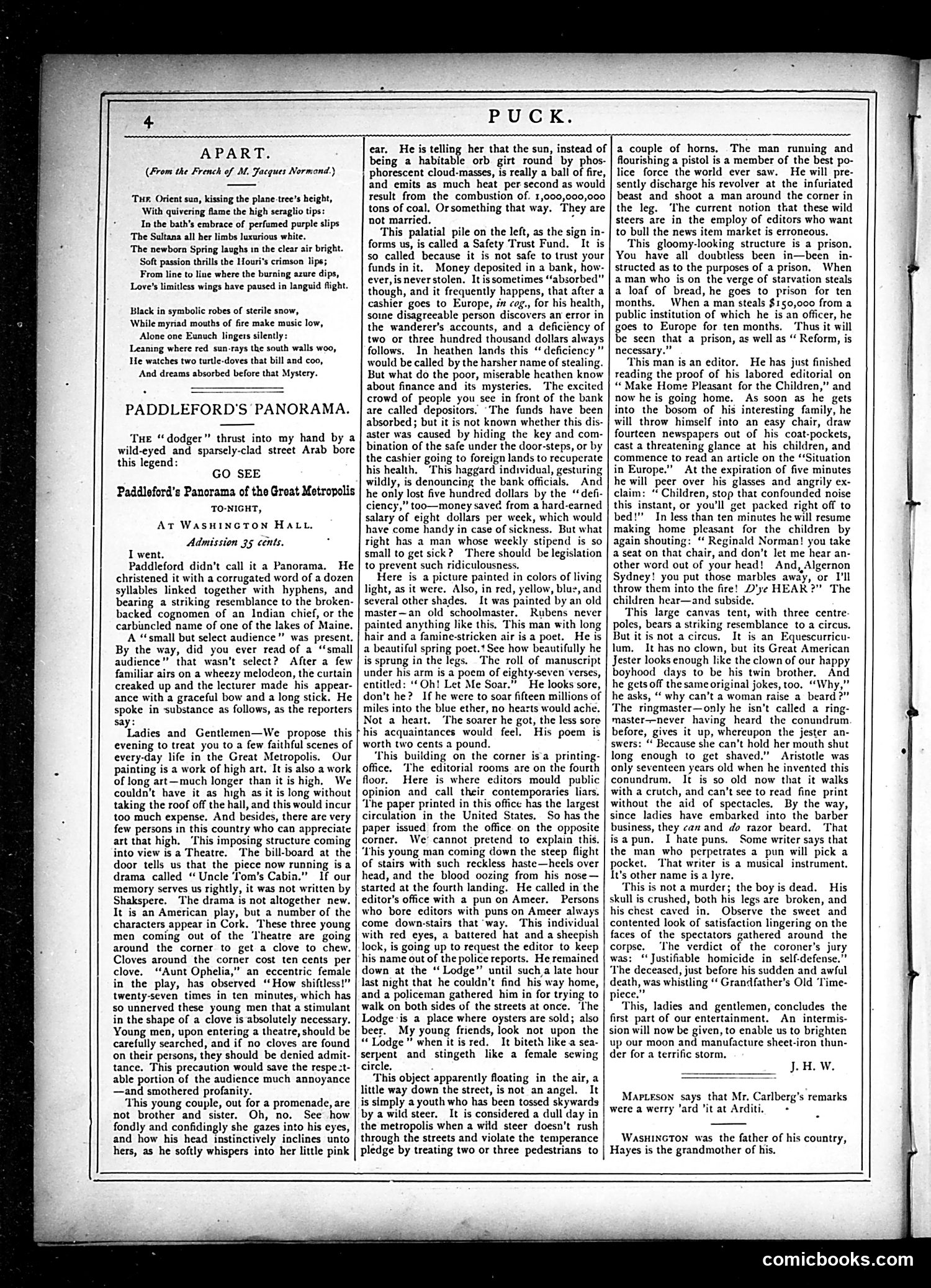
This page contains three distinct pieces: a poem titled "Apart," an article about "Paddleford's Panorama" describing a visit to the Great Metropolis at Washington Hall, and satirical commentary on urban life. The content critiques financial institutions and social inequality. One section mocks a "Safety Trust Fund" and bank officials, suggesting corruption where depositors' money disappears through hidden errors or deliberate theft. The piece satirizes how the poor suffer when wealthy institutions mismanage funds. The panorama section describes a theatrical performance depicting city scenes—including a printer's office, editorial rooms, and various urban characters—apparently performing social commentary through staged tableaux. Overall, the page reflects Puck's typical late-19th-century focus on institutional fraud, class disparities, and urban social problems presented through literary and visual satire.
📄 Transcribed text from this page (OCR, searchable)
Machine-transcribed from the original scan — historical spelling and the odd misread are preserved.
PUCK. APART. (From the French of M. Facques Normand.) Tur. Orient sun, kissing the plane tree’s height, With quivering flame the high seraglio tips: In the bath’s embrace of perfumed purple slips The Sultana all her limbs luxurious white. ‘The newborn Spring laughs in the clear air bright. Soft passion thrills the Houri's crimson lips; From line to line where the burning azure dips, Love's limitless wings have paused in languid flight. Black in symbolic robes of sterile snow, While myriad mouths of fire make music low, Alone one Eunuch lingers silently: Leaning where red sun-rays the south walls woo, He watches two turtle-doves that bill and coo, And dreams absorbed before that Mystery. PADDLEFORD'S PANORAMA. Tue “dodger” thrust into my hand by a wild-eyed and sparsely-clad street Arab bore this legend: GO SEE Paddleford’s Panorama of the Great Metropolis TO-NIGHT, At WasHINGTON HALt. Admission 35 cents. I went. Paddleford didn’t call it a Panorama. He christened it with a corrugated word of a dozen syllables linked together with hyphens, and bearing a striking resemblance to the broken- backed cognomen of an Indian chief, or the carbuncled name of one of the lakes of Maine. A “small but select audience” was present. By the way, did you ever read of a “small audience” that wasn’t select? After a few familiar airs on a wheezy melodecon, the curtain creaked up and the lecturer made his appear- ance with a graceful bow and a long stick. He spoke in ‘substance as follows, as the reporters say: Wadies and Gentlemen—We propose this evening to treat you to a few faithful scenes of every-day life in the Great Metropolis. Our painting is a work of high art. It is also a work of long art—much longer than it is high, We couldn't have it as high as it is long without taking the roof off the hall, and this would incur too much expense. And besides, there are very few persons in this country who can appreciate art that high. ‘This imposing structure coming into view is a Theatre. The bill-board at the door tells us that the piece now running isa drama called “Uncle ‘Tom's Cabin.” If our memory serves us rightly, it was not written by Shakspere, The drama is not altogether new. It is an American play, but a number of the characters appear in Cork. ‘These three young men coming out of the ‘Theatre are going around the corner to get a clove to chew, Cloves around the corner cost ten cents per clove. ‘Aunt Ophelia,” an eccentric female in the play, has observed ‘How shiftless!”” twenty-seven times in ten minutes, which has so unnerved these young men that a stimulant in the shape of a clove is absolutely necessary. Young men, upon entering a theatre, should be carefully searched, and if no cloves are found on their persons, they should be denied admit- tance. This precaution would save the respe-t- able portion of the audience much annoyance —and smothered profanity. This young couple, out for a promenade, are not brother and sister. Oh, no. See how fondly and confidingly she gazes into his eyes, and how his head instinctively inclines unto hers, as he softly whispers into her little pink ear. He is telling her that the sun, instead of being a habitable orb girt round by phos- phorescent cloud-masses, is really a ball of fire, and emits as much heat per second as would result from the combustion of. 1,000,000,000 tons of coal. Orsomething that way. They are not married. . This palatial pile on the left, as the sign in- forms us, is called a Safety Trust Fund. It is so called because it is not safe to trust your funds in it. Money deposited in a bank, how- ever, is never stolen. It issometimes “absorbed” though, and it frequently happens, that after a cashier goes to Europe, in cog., for his health, some disagreeable person discovers an error in the wanderer’s accounts, and a deficiency of two or three hundred thousand dollars always follows. In heathen lands this “deficiency” would be called by the harsher name of stealing. But what do the poor, miserable heathen know about finance and its mysteries. The excited crowd of people you see in front of the bank are called depositors. “The funds have been absorbed; but it is not known whether this dis- aster was caused by hiding the key and com- bination of the safe under the door-steps, or by the cashier going to foreign lands to recuperate his health. “This haggard individual, gesturing wildly, is denouncing the bank officials. And he only lost five hundred dollars by the ‘‘defi- ciency,” too—money saved from a hard-earned salary of eight dollars per week, which would have come handy in case of sickness. But what right has a man whose weekly stipend is so small to get sick? ‘There should be legislation to prevent such ridiculousness. Here is a picture painted in colors of living light, as it were. Also, in red, yellow, bluz, and several other shades. ‘It was painted by an old master—an old schoolmaster. Rubens never painted anything like this, This man with long hair and a famine-stricken air is a poet. He is a beautiful spring poet.* See how beautifully he is sprung in the legs. The roll of manuscript under his arm is a poem of eighty-seven verses, entitled: ‘‘Oh! Let Me Soar.” He looks sore, don’t he? If he were to soar fifteen millions of miles into the blue ether, no hearts would ache. Not a heart. ‘The soarer he got, the less sore his acquaintances would feel. His poem is worth two cents a pound. ‘This building on the corner isa printing- office. ‘The editorial rooms are on the fourth floor. Here is where editors mould public opinion and call their contemporaries liars. ‘The paper printed in this office has the largest circulation in the United States, So has the paper issued from the office on the opposite corner. We’ cannot pretend to explain this. ‘This young man coming down the steep flight of stairs with such reckless haste—heels over head, and the blood oozing from his nose— started at the fourth landing. He called in the editor's office with a pun on Ameer. Persons who bore editors with puns on Ameer always come down-stairs that ‘way. This individual with red eyes, a battered hat and a sheepish lock, is going up to request the editor to keep his name out of the police reports. He remained down at the ‘‘ Lodge”’ until sucha late hour last night that he couldn’t find his way home, and a policeman gathered him in for trying to walk on both sides of the streets at once. ‘The Lodge ‘is a place where oysters are sold; also beer. My young friends, look not upon the “Lodge” when it is red. It biteth like a sea- serpent and stingeth like a female sewing circle, ‘This object apparently floating in the air, a little way down the street, is not an angel. It is simply a youth who has been tossed skywards by a wild steer. It is considered a dull day in the metropolis when a wild steer doesn’t rush through the streets and violate the temperance pledge by treating two or three pedestrians to a couple of horns, The man running and flourishing a pistol is a member of the best po- lice force the world ever saw. He will pre- sently discharge his revolver at the infuriated beast and shoot a man around the corner in the leg. ‘Ihe current notion that these wild steers are in the employ of editors who want to bull the news item market is erroneous. This gloomy-looking structure is a prison. You have all doubtless been in—been _in- structed as to the purposes of a prison, When a man who is on the verge of starvation steals a loaf of bread, he goes to prison for ten months. When a man steals $150,000 from a public institution of which he is an officer, he goes to Europe for ten months. ‘Thus it will be seen that a prison, as well as “ Reform, is necessary.” ‘This man is an editor. He has just finished reading the proof of his labored editorial on “Make Home Pleasant for the Children,” and now he is going home. As soon as he gets into the bosom of his interesting family, he will throw himself into an easy chair, draw fourteen newspapers out of his coat-pockets, cast a threatening glance at his children, and commence to read an article on the ‘Situation in Europe.” At the expiration of five minutes he will peer over his glasses and angrily ex- claim: ‘ Children, stop that confounded noise this instant, or you'll get packed right off to bed!" In less than ten minutes he will resume making home pleasant for the children by again shouting: “ Reginald Norman! you take a seat on that chair, and don’t let me hear an- other word out of your head! And, Algernon Sydney! you put those marbles away, or I'll throw them into the fire! D'ye HEAR?” The children hear—and subside. This large canvas tent, with three centre poles, bears a striking resemblance to a circus, But it is not a circus. It is an Equescurricu- lum, It has no clown, but its Great American Jester looks enough like the clown of our happy boyhood days to be his twin brother. And he gets off the same original jokes, too. “Why,” he asks, “ why can’t a woman raise a beard ?” The ringmaster—only he isn’t called a ring- master--never having heard the conundrum before, gives it up, whereupon the jester an- swers: “ Because she can’t hold her mouth shut long enough to get shaved.” Aristotle was only seventeen years old when he invented this conundrum, It is so old now that it walks with a crutch, and can’t see to read fine print without the aid of spectacles, By the way, since ladies have embarked into the barber business, they can and do razor beard. That isa pun, I hate puns. Some writer says that the man who perpetrates a pun will pick a pocket. That writer is a musical instrument. It's other name is a lyre, This is not a murder; the boy is dead. His skull is crushed, both his legs are broken, and his chest caved in. Observe the sweet and contented look of satisfaction lingering on the faces of the spectators gathered around the corpse. ‘The verdict of the coroner's jury was: “‘Justifiable homicide in self-defense.” ‘The deceased, just before his sudden and awful death, was whistling ‘‘ Grandfather's Old ‘Time- piece.” This, ladies and gentlemen, concludes the first part of our entertainment. An_ intermis- sion will now be given, to enable us to brighter. up our moon and manufacture sheet-iron thun- der for a terrific storm, J. H.W. MapLeson says that Mr, Carlberg’s remarks were a werry ‘ard ‘it at Arditi, + WasuINGTON was the father of his country, Hayes is the grandmother of his. comicbooks.com =