
A complete issue · 16 pages · 1878
Puck — November 6, 1878
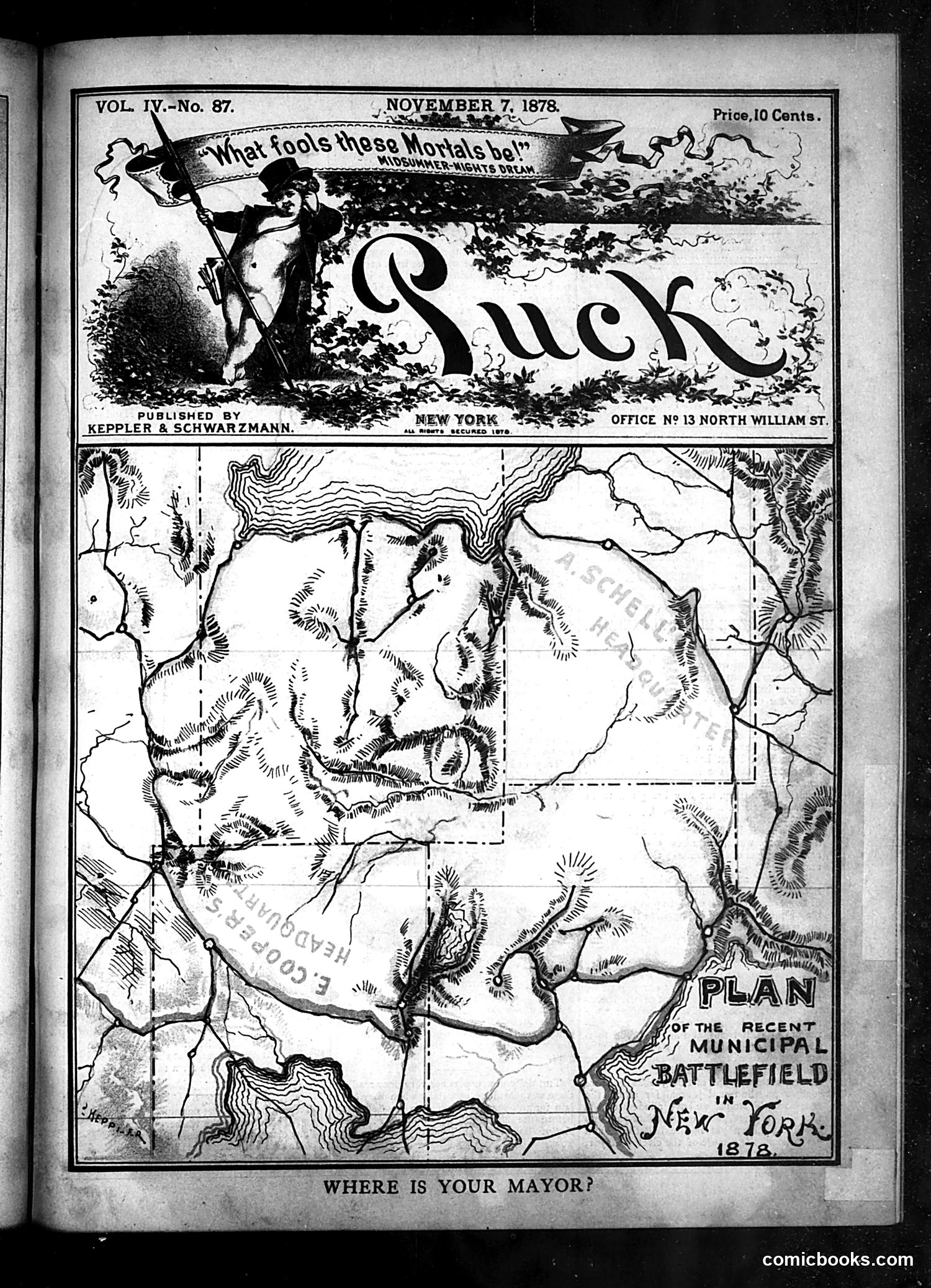
This satirical cover features a map titled "Plan of the Recent Municipal Battlefield in New York, 1878," with the caption "WHERE IS YOUR MAYOR?" The imagery suggests chaos or conflict surrounding New York City's mayoral election or administration during this period. The allegorical figure at top—holding tools and a banner reading "Wish fools these Mortals be"—represents commentary on public foolishness regarding municipal leadership. The map's topographical lines resembling trenches reinforce the "battlefield" metaphor, implying that New York's mayoral politics were contentious and destructive. The satire critiques either the mayor's absence from civic duties or the confusion surrounding mayoral authority—a common Puck theme addressing municipal mismanagement in Gilded Age New York.
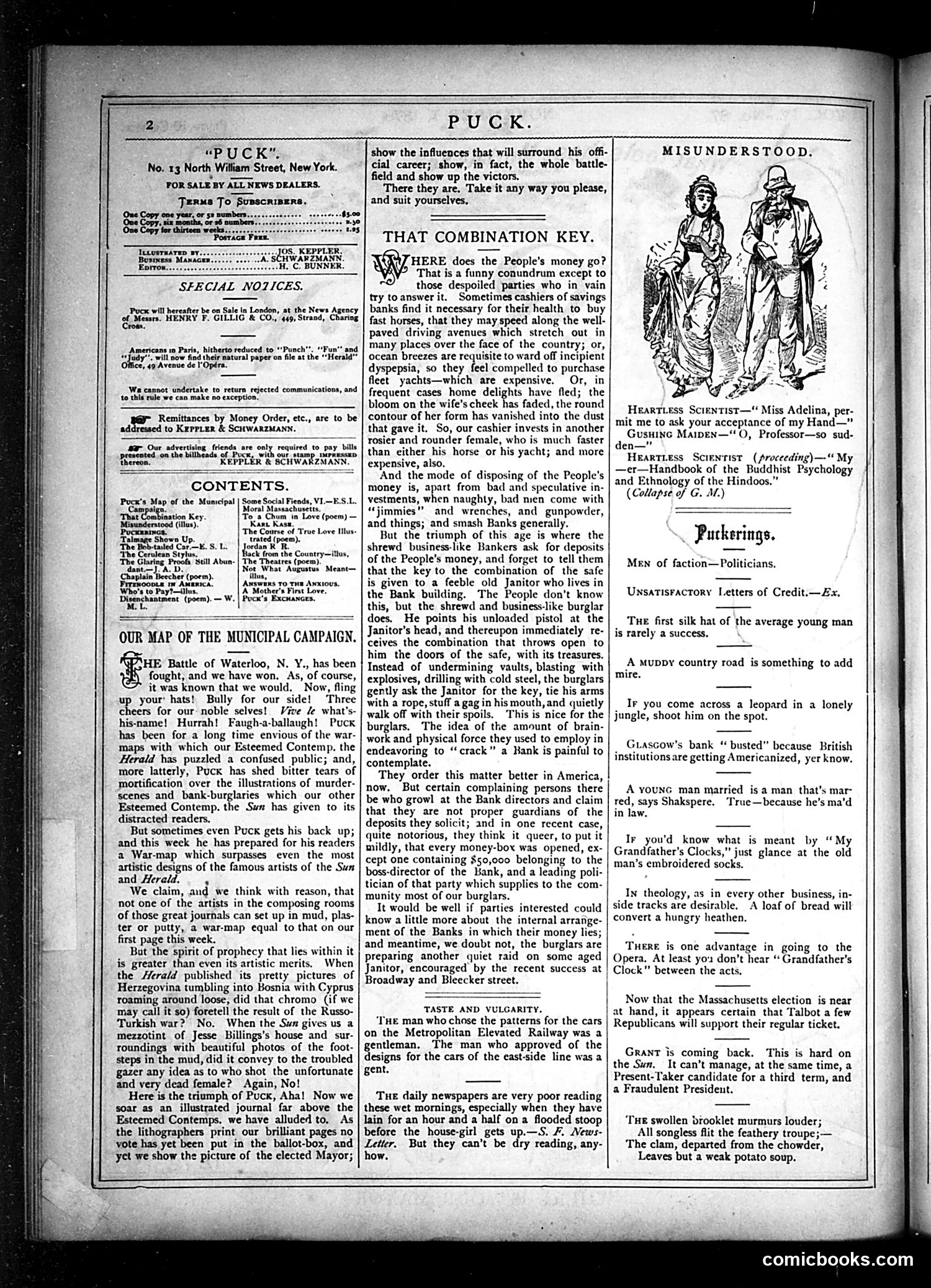
This cartoon depicts two figures in period dress appearing to represent common people or working-class individuals. The title "Misunderstood" suggests social commentary on how certain groups are perceived or treated by society. The accompanying text discusses banks, safes, janitors, and burglaries—indicating this likely satirizes public misconceptions about working-class people (particularly janitors or service workers) in relation to banking institutions and crime. The piece appears to critique either unfair stereotyping of workers as potential thieves, or conversely, the naïveté of banks regarding actual security vulnerabilities. The broader page includes political commentary on elections and class issues, fitting Puck's typical satirical approach to American social and political matters of the era.
This page contains several satirical articles rather than political cartoons. The main pieces critique: 1. **"Talmage Shown Up"** - Attacks Rev. T. DeWitt Talmage, a prominent preacher, mocking his circus-style sermons and theatrical delivery. The piece sarcastically describes his dramatic preaching style as entertaining but intellectually hollow. 2. **"The Bob-Tailed Car"** - Critiques poor conditions on New York railways, particularly regarding conductor pay ($1,465 annually) and the resulting service quality. It frames inadequate wages as causing social problems. 3. **"The Cerulean Stylus"** - A letters section containing reader complaints about pencil-marked advertisements and editorial issues. The satire targets religious humbug, labor exploitation, and publishing standards—typical Puck concerns of social hypocrisy and institutional failure.
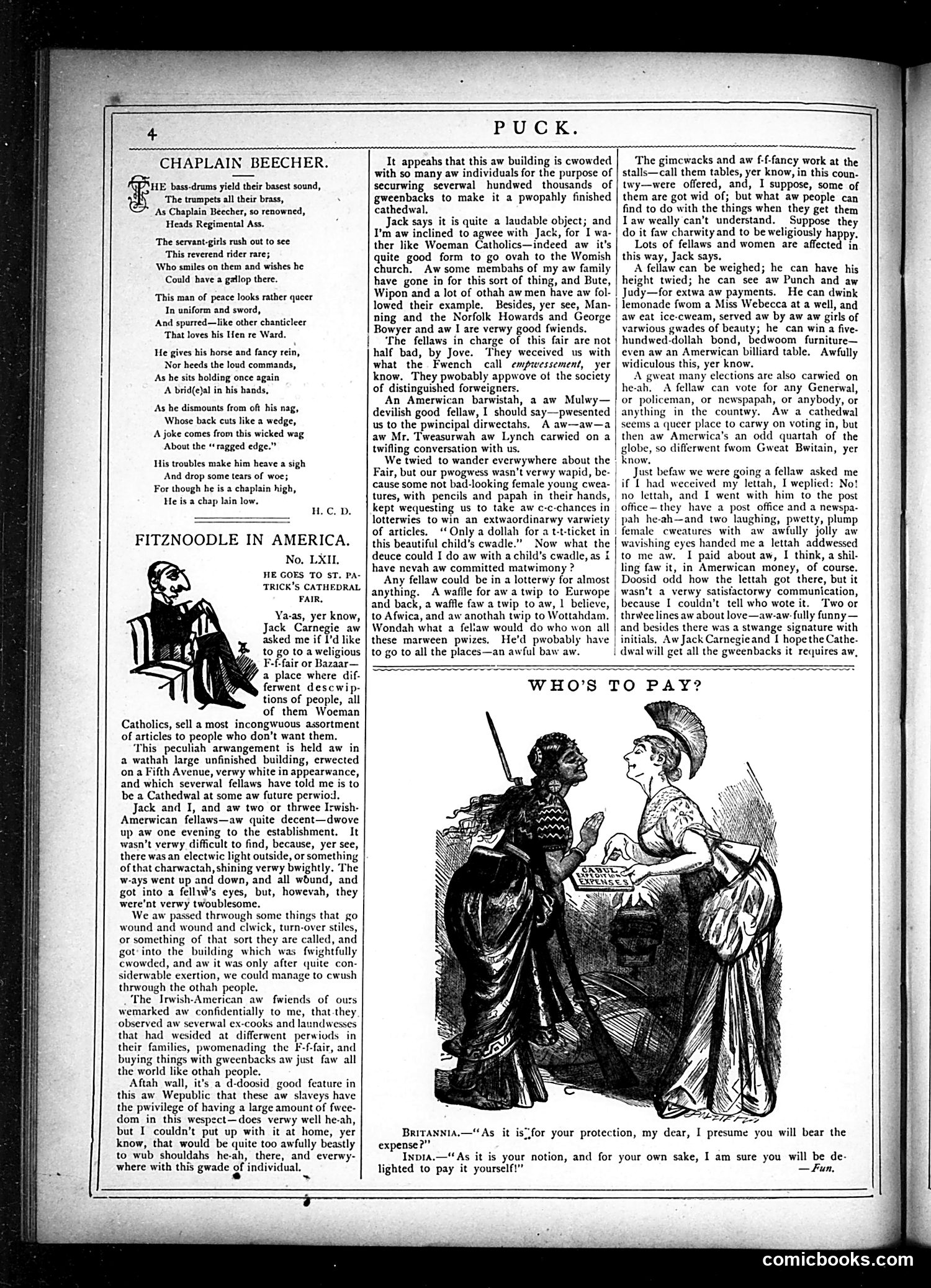
This page contains two distinct pieces: **"Chaplain Beecher"** (left): A poem satirizing Henry Ward Beecher, a prominent clergyman. The text mocks his bass voice and military bearing, suggesting hypocrisy between his preaching and actions. **"Fitznoodle in America, No. LXII"** (center-left): A satirical narrative about Irish-Catholic immigrants establishing a church in New York. It ridicules their efforts to build a cathedral and their fundraising schemes, portraying them as financially incompetent and religiously misguided. **"Who's to Pay?"** (right): A political cartoon showing Britannia (Britain) and India in conversation. Britannia claims India should pay for its own protection, while India counters that Britannia should pay for the notion itself—satirizing British imperial economic exploitation of colonial India. The page overall targets religious hypocrisy, immigrant communities, and imperial politics.
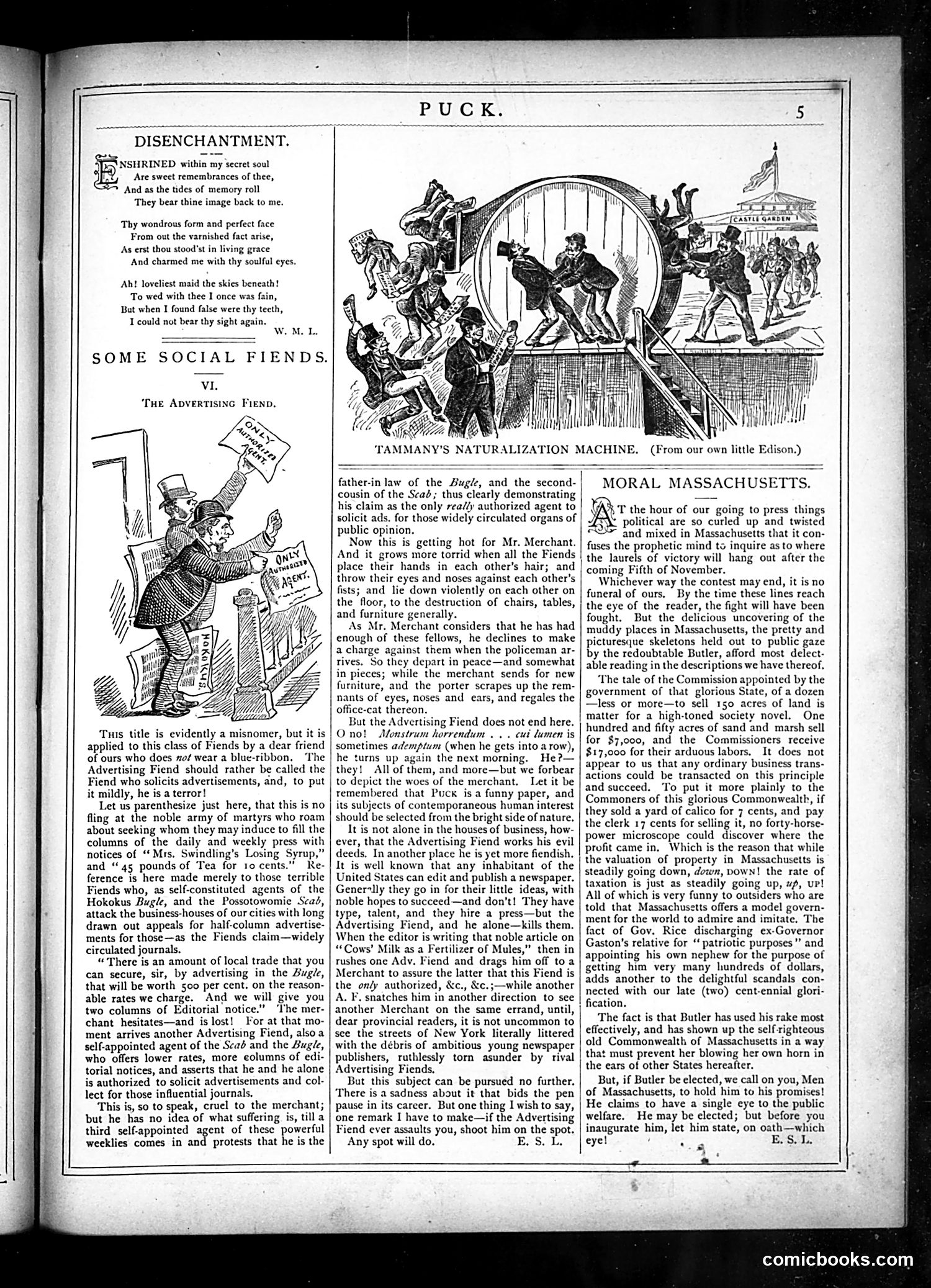
This page contains two separate satirical pieces: **"Tammany's Naturalization Machine"** (main cartoon): Depicts a mechanical contraption processing immigrants into citizens, with figures being processed on one side and emerging as voters on the other. This satirizes Tammany Hall's (New York's Democratic political machine) practice of rapidly naturalizing immigrants to expand their voting base, a common criticism of urban political corruption in the late 19th/early 20th century. **"The Advertising Fiend"** (left column): Mocks newspaper advertising practices and unethical promotion tactics. The text criticizes how advertising agents manipulate merchants and editors, comparing them to destructive forces. It suggests these "friends" ultimately harm publications through aggressive, misleading commercial practices. Both pieces target corruption and ethical failures in contemporary American institutions.
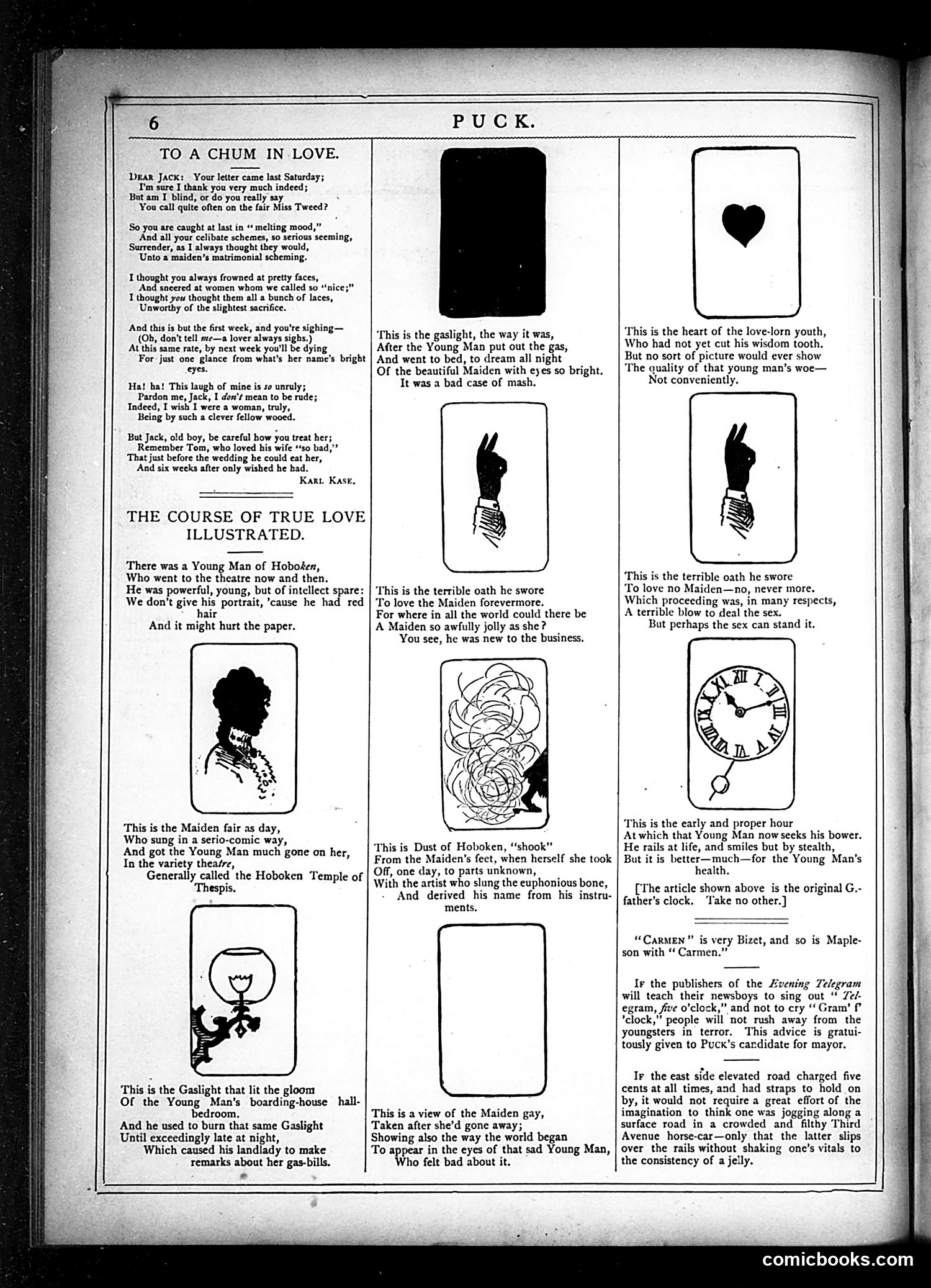
This page presents two satirical pieces mocking romantic folly. The first is a letter to "Jack," humorously chiding him for falling into "melting mood" and scheming to win a maiden—cautioning that love makes fools of men and warning of the practical disasters marriage brings (financial ruin, being "henpecked"). "The Course of True Love Illustrated" uses sequential images to trace a young man from Hoboken's infatuation through romantic delusion to despair. The visual narrative—progressing from love declarations through his obsessive brooding (represented by tangled scribbles) to checking the clock anxiously—satirizes how romantic passion clouds judgment and wastes time, leaving the lovestruck man miserable and diminished.
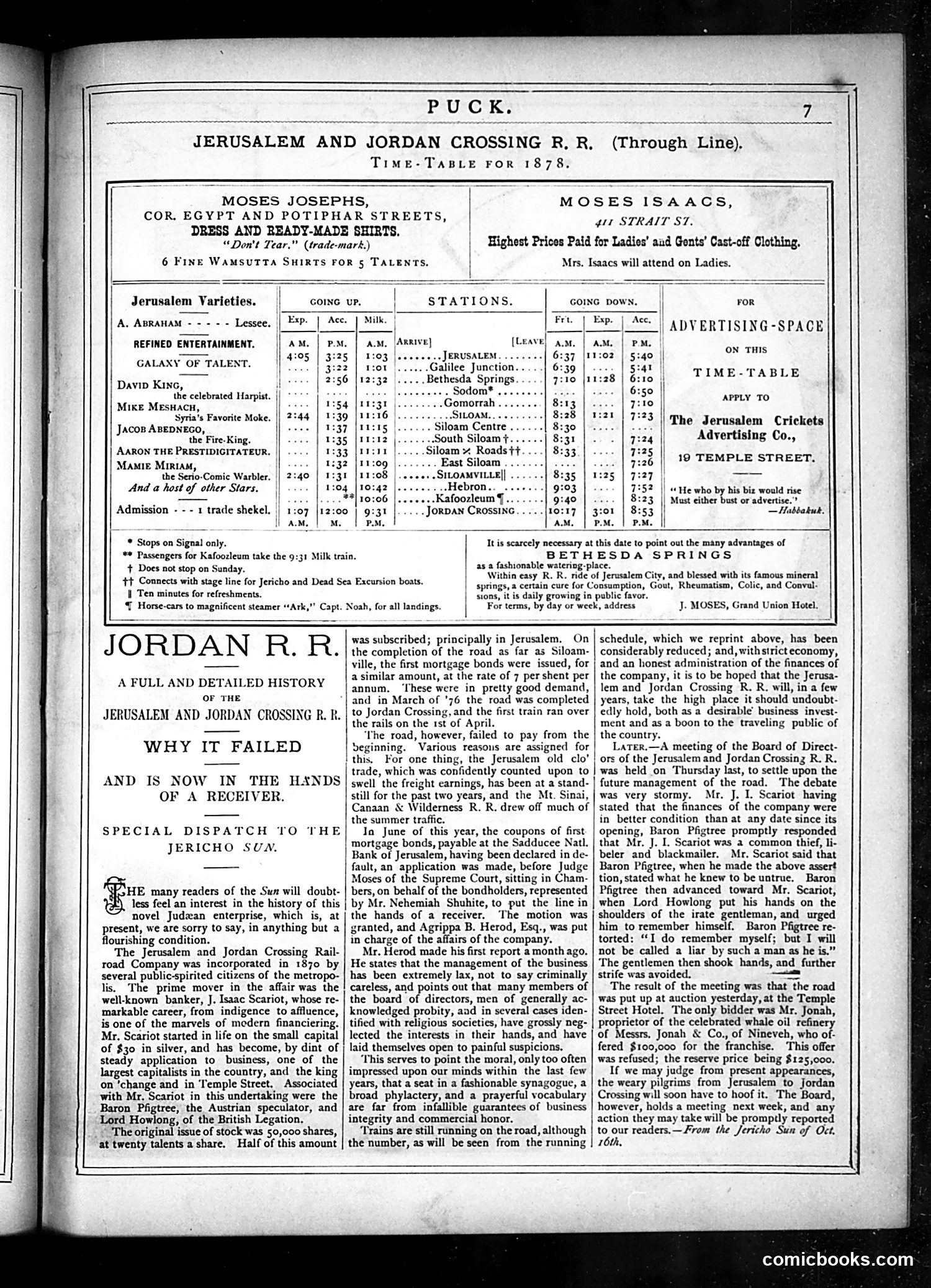
This page from Puck magazine (1878) is primarily **advertising and business reporting rather than satire or political cartoon content**. The main content is a detailed article titled "Jordan R.R.: A Full and Detailed History of the Jerusalem and Jordan Crossing R.R., Why It Failed and Is Now in the Hands of a Receiver" — a serious dispatch to the *Jericho Sun*. The article discusses the failed railroad venture between Jerusalem and Jordan, detailing financial mismanagement, stock speculation, and business collapse involving figures like Baron Scariot and Isaac Scariot. **The satire is subtle**: Puck uses obviously fictional names (Baron Scariot/Isaac Scariot evoke Judas Iscariot) for the railroad swindlers, mocking real-world financial fraud and stock market schemes that victimized investors. The page also includes period advertisements for clothing stores and entertainment venues.
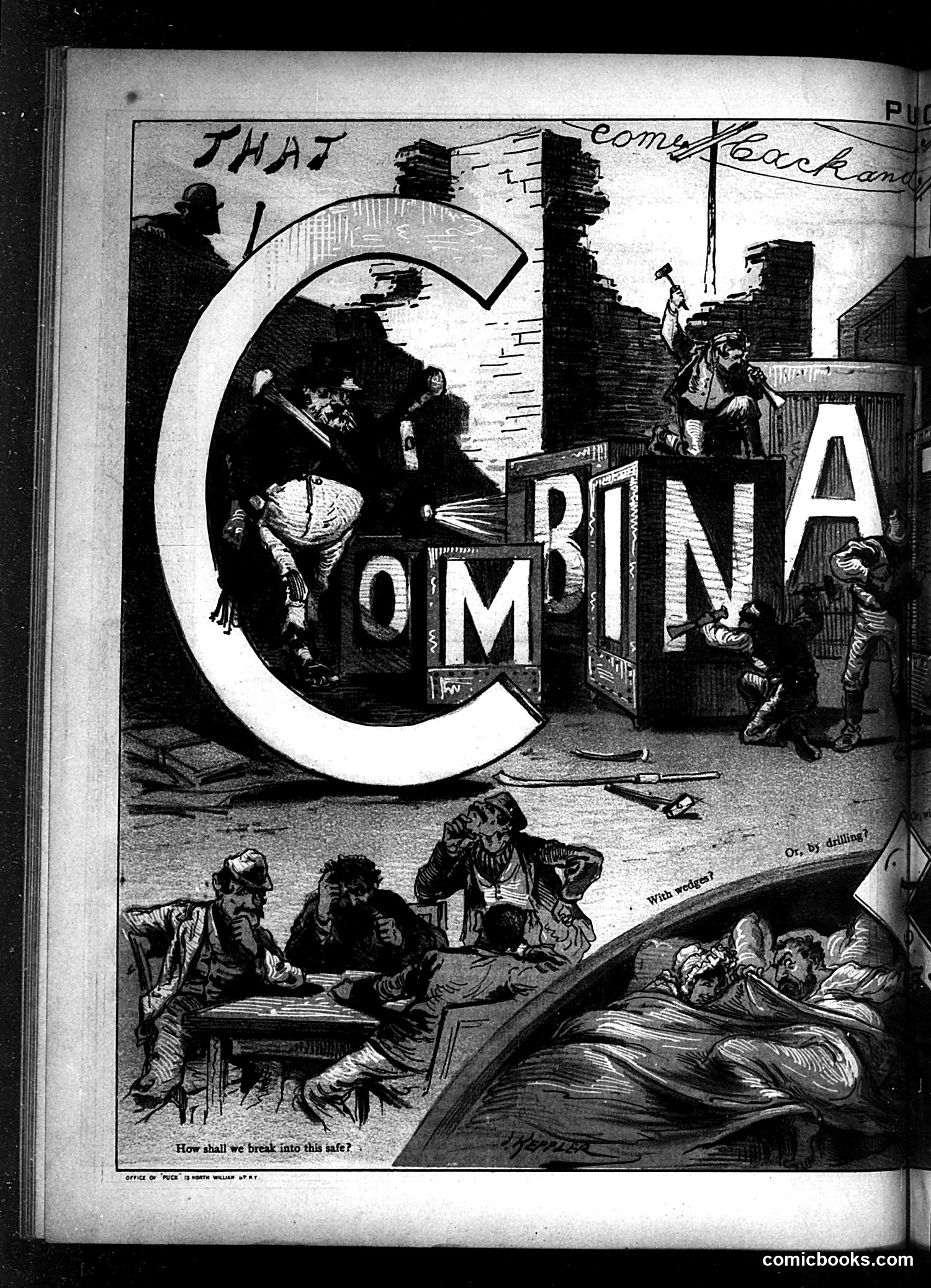
This political cartoon depicts a large "C" (likely representing "Crime") as a safe that criminals are attempting to break into. The composition shows multiple scenes: wealthy figures on top examining the safe, working-class men at a table below (appearing to plan), and people in beds at the bottom right (possibly victims). The caption "How shall we break into this safe?" suggests commentary on organized crime or corruption. The handwritten note "Come back and" at the top is partially illegible but may indicate editorial markup. The satire appears to critique either criminal enterprises, political corruption, or the difficulty authorities face combating organized crime. Without a visible date or additional context, the specific political moment remains unclear, though the class disparities depicted suggest commentary on crime across social strata.
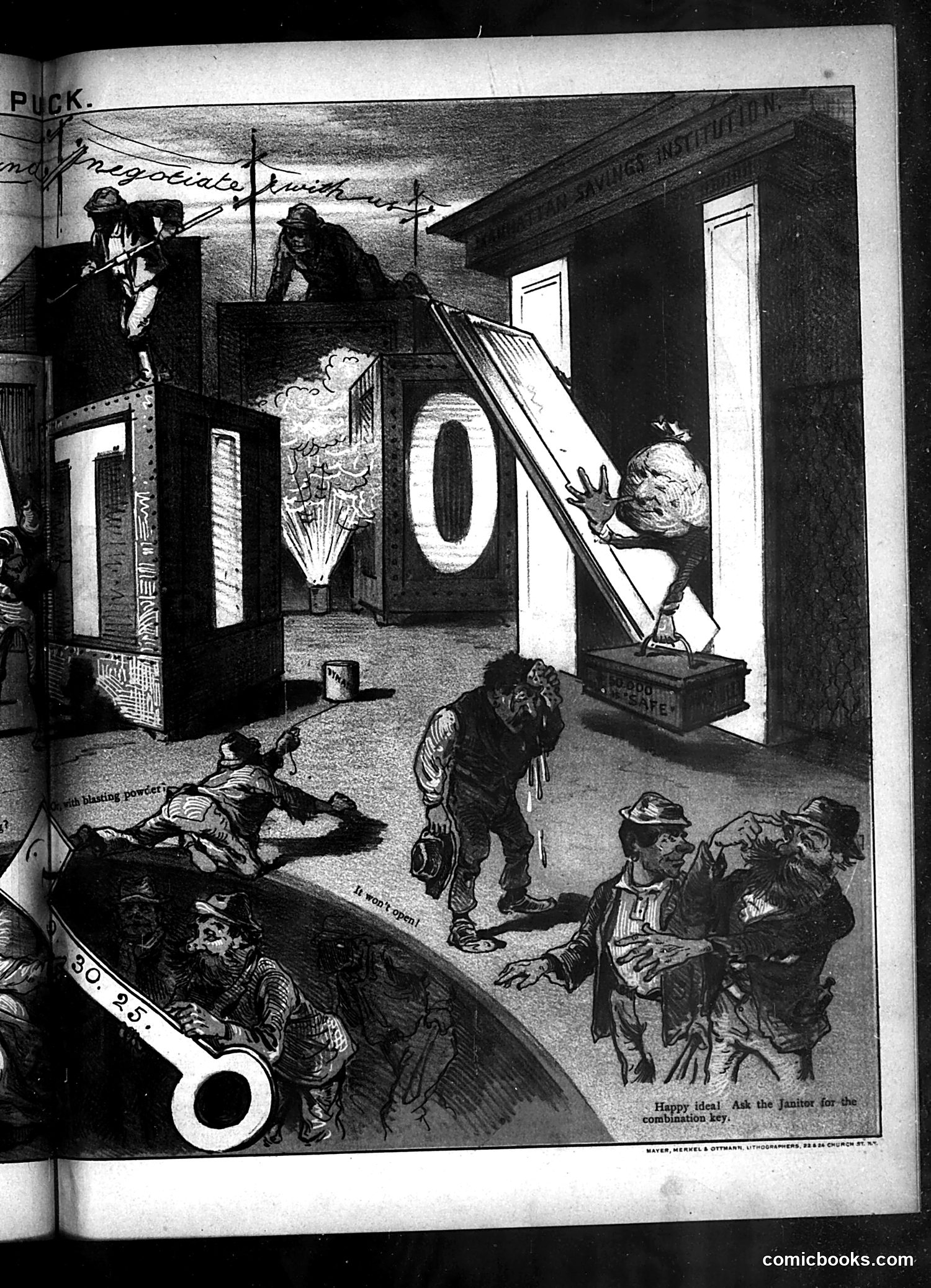
This Puck illustration satirizes institutional corruption, likely from the late 19th or early 20th century. The cartoon depicts what appears to be a government or institutional building with officials conducting shady dealings. Key elements include: - **Figures on the roof/upper level**: Appear to be officials engaged in illicit activity (possibly embezzlement or bribery) - **Lower foreground**: Common citizens observing or suffering from corruption - **The caption** "Happy idea! Ask the Janitor for the combination key" suggests that institutional wrongdoing is so pervasive that even low-level staff (janitors) are involved in or aware of the corruption The satire critiques how graft and misconduct penetrate all levels of institutions, from top officials down to maintenance workers—implying systemic rather than isolated corruption.
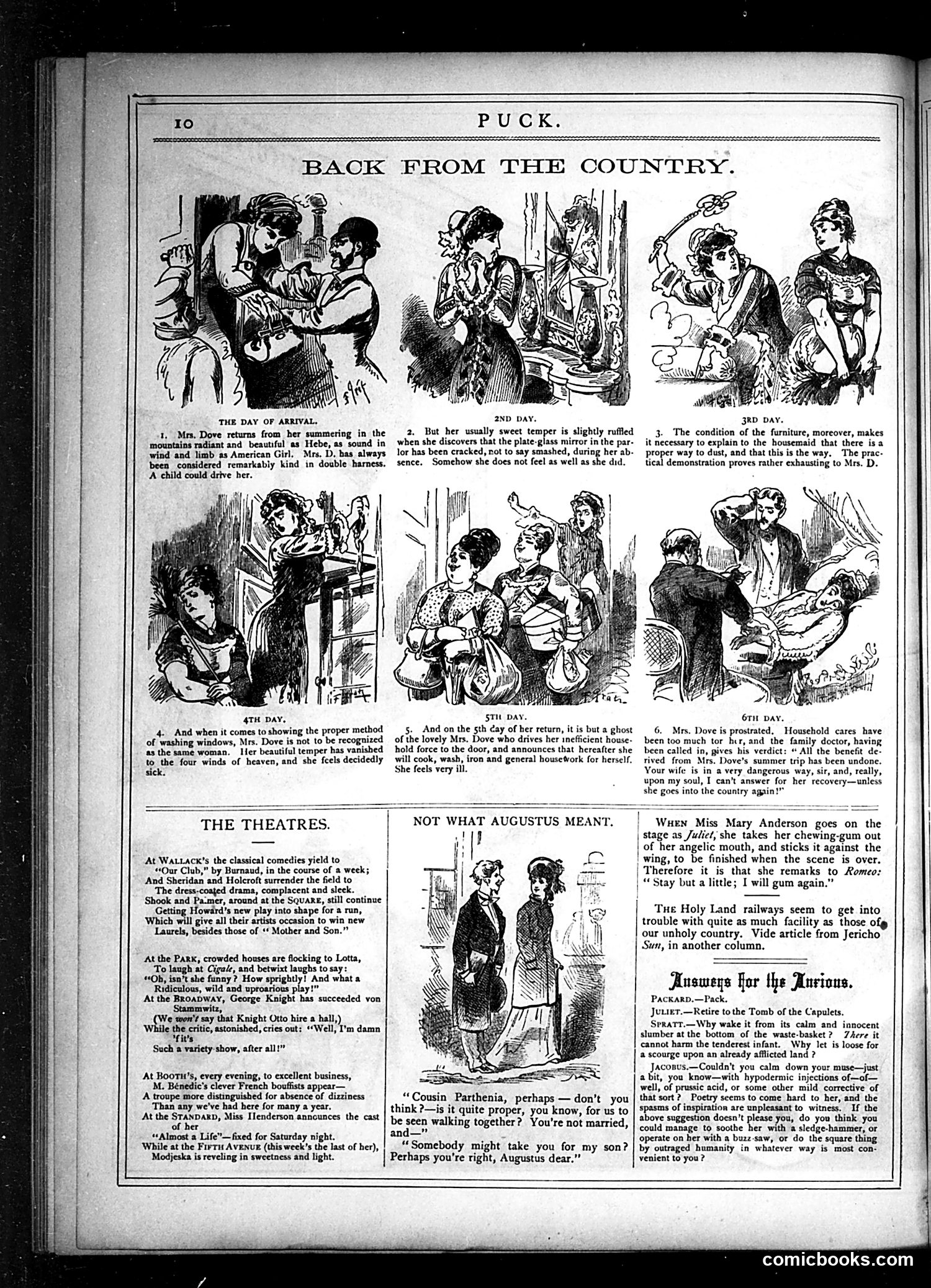
This six-panel comic depicts **Mrs. Dove's return from a country vacation**, satirizing the chaos of urban domestic life. The narrative shows: 1. **The arrival**: Mrs. Dove's maid is disheveled from managing the household alone 2. **Deterioration**: The house has fallen into disrepair—mirrors cracked, furniture damaged 3. **The maid's collapse**: Exhausted from handling all duties unsupervised 4. **Household chaos**: Everything requires repair or replacement 5. **Mrs. Dove's reaction**: She's horrified at the condition 6. **The conclusion**: She threatens another country trip unless things improve The satire mocks **wealthy women's detachment from domestic management** and the vulnerability of household order depending entirely on one servant's labor. It suggests that without constant upper-class supervision, servants cannot maintain standards—a commentary on both class expectations and domestic dependency.
This page contains fiction text titled "A Mother's First Love, Chapter III" rather than political cartoons or satire. It appears to be a serialized romantic story published in Puck magazine, featuring dialogue between characters named Lucy, Harry, and Lord Lyndhurst discussing matters of love, social position, and personal sacrifice. The text itself is literary rather than satirical—it explores themes of class differences, romantic devotion, and moral choices through narrative prose. There are no visible political cartoons, caricatures, or satirical commentary on this particular page. While Puck was known for political satire, this appears to be one of its serialized fiction offerings, likely aimed at entertaining readers between its satirical content.
This page appears to be **Chapter IV of a serialized fiction story**, not a political cartoon. The text is a narrative dialogue between characters named Harry, Lucy, and Lord Lynn, discussing matters of love, poverty, and social status. The story involves a poor young man (Harry) seeking to marry a woman of higher social standing (Lucy), with her father (Lord Lynn) expressing objections based on financial disparity. The dialogue touches on themes of class barriers to marriage—a common Victorian-era concern. Without seeing the actual illustrations that would accompany this text, and given this is primarily prose narrative rather than satirical artwork, I cannot identify specific caricatures or political references that would typically appear in Puck's cartoon content.
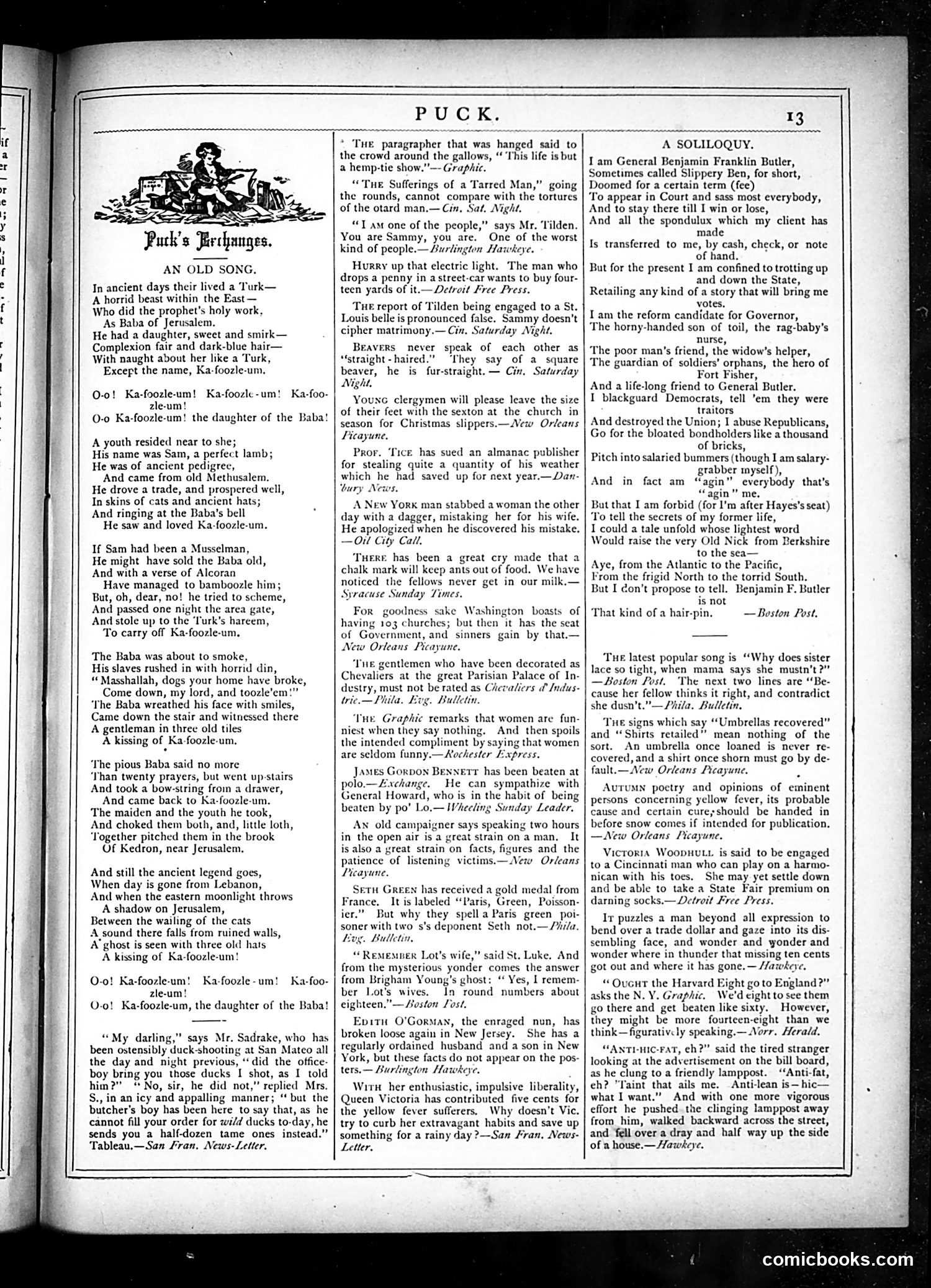
This page contains "Puck's Archaiques," a satirical old song presented in verse form, alongside a "Soliloquy" section with miscellaneous political and social commentary. The song mocks historical and contemporary figures through exaggerated stereotypes—referencing a "Turk," "Baba," and various ethnic caricatures common to 19th-century satire. The accompanying soliloquy skewers American political figures and institutions, including Republicans, Democrats, and various public figures (General Benjamin Franklin Butler appears mentioned). The satire targets political corruption, military conduct, and social hypocrisy. References to "salary-grabbing bummers" and criticism of both major parties suggest commentary on Reconstruction-era politics and perceived governmental malfeasance. The humor relies heavily on period stereotypes and insider political knowledge now largely inaccessible without historical context.
This page is **primarily advertising**, not satirical content. The page contains commercial advertisements for: - Dress materials and clothing (Arnold, Constable & Co.) - Apollinaris mineral water - Vichy water - Patent services - Dental work - Umbrellas - A bookstore The only non-advertising element appears to be a small portrait of **Hunyadi János**, labeled "The Best Natural Aperient," which is actually promotional material for a natural laxative product rather than political satire. There are no discernible political cartoons or satirical commentary visible on this page. It represents typical late 19th-century magazine monetization through advertising rather than editorial content.
This page is **primarily advertising**, not political satire. It features late-19th-century commercial notices for New York businesses including wines, furniture, tailors, cigars, and financial instruments (Austrian government bonds). The only substantial non-advertising content is a section titled **"WHY IS IT?"** — apparently Puck's humorous explanation for why people crowded the Cotton Dental Association's "Free Reason." The joke lists mundane reasons (free admission, no charge, best dentists) before the punchline: people came simply because it was free, without deeper motivation. The page itself serves as a revenue source through classified advertisements rather than delivering satirical commentary. Back number ordering information for Puck magazine appears at bottom.
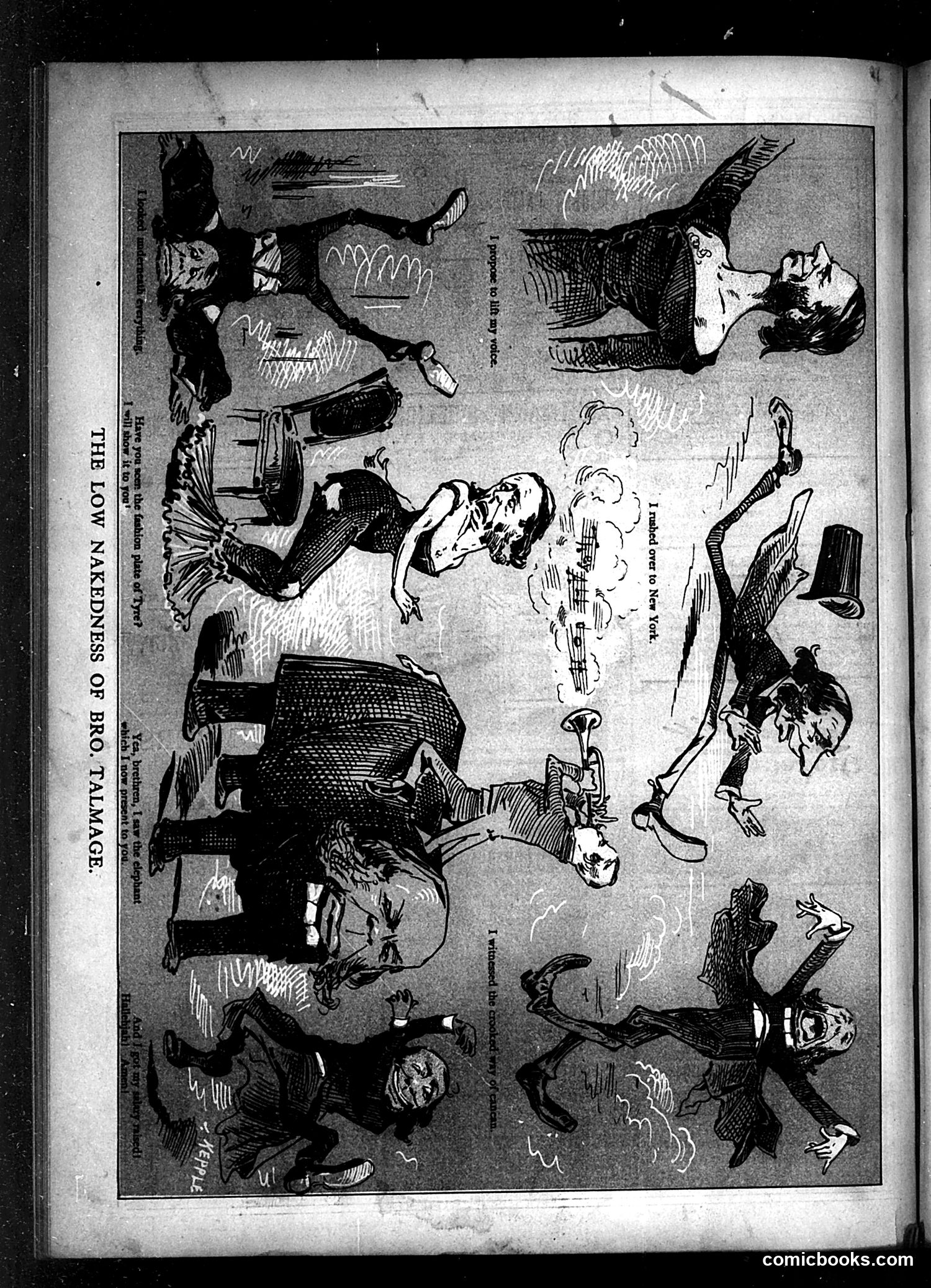
This Puck cartoon satirizes the destructive behavior of bar patrons, likely during Prohibition era or a period of public concern about alcohol-related violence. The page shows multiple vignettes of intoxicated men causing property damage—overturning furniture, breaking items, fighting, and generally creating chaos in what appears to be a saloon setting. The title "Low Ebb of Bar Damage" suggests commentary on the degradation caused by excessive drinking. The cartoon uses exaggerated caricature and dynamic action to mock drunken behavior as foolish and destructive to establishments and social order. This reflects Progressive-era anxieties about saloon culture and alcohol's social costs—concerns that would later fuel Prohibition's support.