
Puck, 1878-11-06 · page 3 of 16
Puck — November 6, 1878 — page 3: what you’re looking at
What you’re looking at
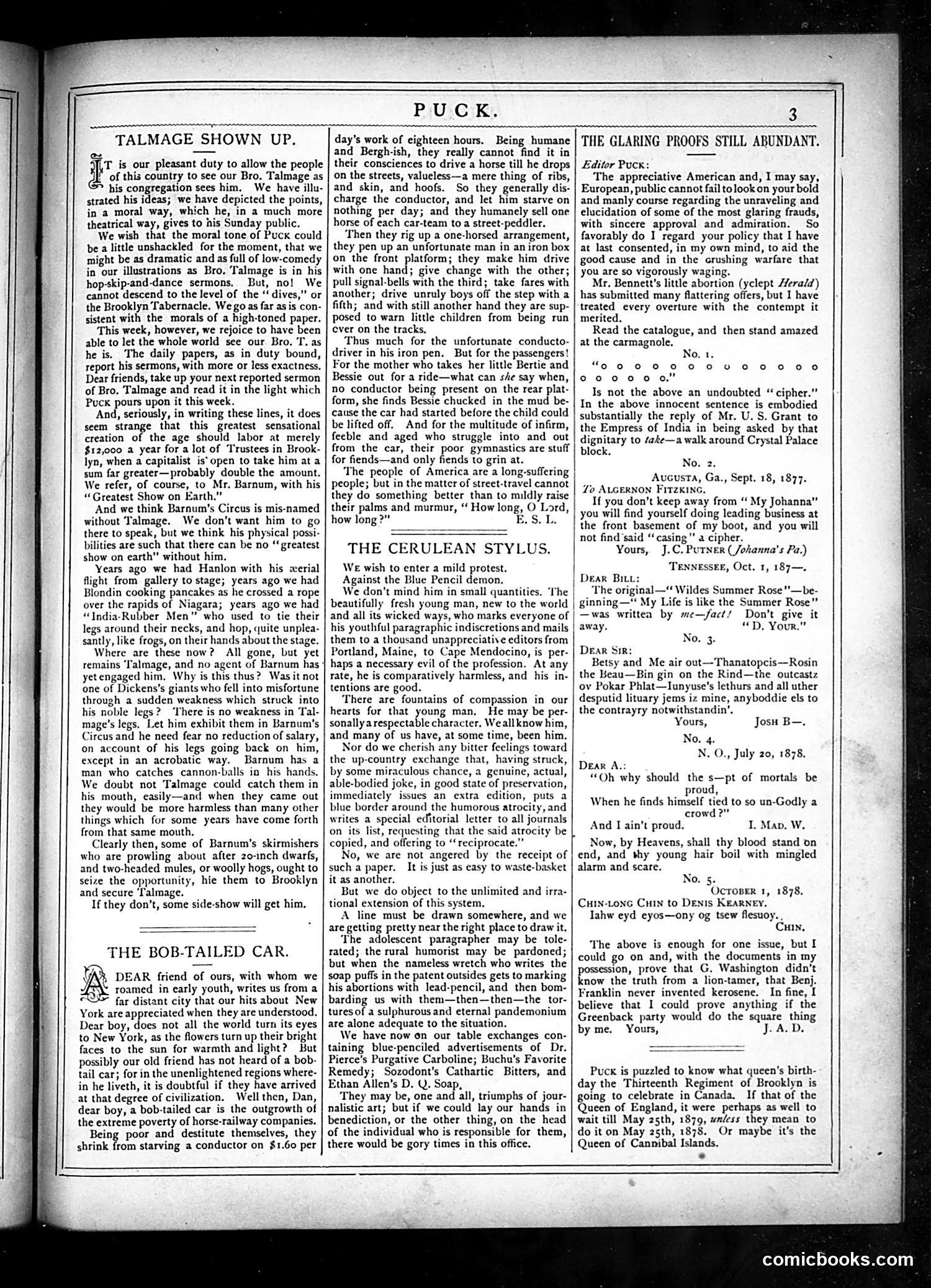
This page contains several satirical articles rather than political cartoons. The main pieces critique: 1. **"Talmage Shown Up"** - Attacks Rev. T. DeWitt Talmage, a prominent preacher, mocking his circus-style sermons and theatrical delivery. The piece sarcastically describes his dramatic preaching style as entertaining but intellectually hollow. 2. **"The Bob-Tailed Car"** - Critiques poor conditions on New York railways, particularly regarding conductor pay ($1,465 annually) and the resulting service quality. It frames inadequate wages as causing social problems. 3. **"The Cerulean Stylus"** - A letters section containing reader complaints about pencil-marked advertisements and editorial issues. The satire targets religious humbug, labor exploitation, and publishing standards—typical Puck concerns of social hypocrisy and institutional failure.
📄 Transcribed text from this page (OCR, searchable)
Machine-transcribed from the original scan — historical spelling and the odd misread are preserved.
F PUCK 3 TALMAGE SHOWN UP. aT is our pleasant duty to allow the people & of this country to see our Bro. Talmage as his congregation sees him. We have illu- strated his ideas; we have depicted the points, in a moral way, which he, in a much more theatrical way, gives to his Sunday public. We wish that the moral tone of Puck could be a little unshackled for the moment, that we might be as dramatic and as full of low-comedy in our illustrations as Bro, Talmage is in his hop-skip-and-dance sermons. But, no! We cannot descend to the level of the “dives,” or the Brooklyn Tabernacle. We go as far as is con- sistent with the morals of a high-toned paper. ‘This week, however, we rejoice to have been able to let the whole world see our Bro. T. as he is. The daily papers, as in duty bound, report his sermons, with more or less exactness, Dear friends, take up your next reported sermon of Bro, Talmage and read it in the light which Puck pours upon it this week. And, seriously, in writing these lines, it does seem strange that this greatest sensational creation of the age should labor at merely $12,000 a year for a lot of Trustees in Brook- lyn, when a capitalist is*open to take him at a sum far greater—probably double the amount. We refer, of course, to Mr. Barnum, with his “Greatest Show on Earth." And we think Barnum’s Circus is mis-named without Talmage, We don’t want him to go there to speak, but we think his physical possi- bilities are such that there can be no ‘‘greatest show on earth” without him. Years ago we had Hanlon with his werial flight from gallery to stage; years ago we had Blondin cooking pancakes as he crossed a rope over the rapids of Niagara; years ago we had “India-Rubber Men” who used to tie their legs around their necks, and hop, quite unplea- santly, like frogs, on their hands about the stage. Where are these now? All gone, but yet yetengaged him. Why is this thus? Was it not one of Dickens's giants who fell into misfortune through a sudden weakness which struck into his noble legs? ‘There is no weakness in Tal- mage’s legs. Let him exhibit them in Barnum's Circus and he need fear no reduction of salary, on account of his legs going back on him, except in an acrobatic way. Barnum has a man who catches cannon-balls in his hands. We doubt not Talmage could catch them in his mouth, easily—and when they came out they would be more harmless than many other things which for some years have come forth from that same mouth, Clearly then, some of Barnum’s skirmishers who are prowling about after 20-inch dwarfs, and two-headed mules, or woolly hogs, ought to seize the opportunity, hie them to Brooklyn and secure ‘Talmage. If they don’t, some side-show will get him. THE BOB-TAILED CAR. DEAR friend of ours, with whom we roamed in early youth, writes us from a far distant city that our hits about New York are appreciated when they are understood. Dear boy, does not all the world turn its eyes to New York, as the flowers turn up their bright faces to the sun for warmth and light? But possibly our old friend has not heard of a bob- tail car; for in the unenlightened regions where- in he liveth, it is doubtful if they have arrived at that degree of civilization, Well then, Dan, dear boy, a bob-tailed car is the outgrowth of the extreme poverty of horse-railway companies. Being poor and destitute themselves, they shrink es starving a conductor on $1.60 per remains ‘Talmage, and no agent of Barnum has | day’s work of eighteen hours. Being humane and Bergh-ish, they really cannot find it in their consciences to drive a horse till he drops on the streets, valueless—a mere thing of ribs, and skin, and hoofs. So they generally dis- charge the conductor, and let him starve on nothing per day; and they humanely sell one horse of each car-team to a street-peddler. ‘Then they rig up a one-horsed arrangement, they pen up an unfortunate man in an iron box on the front platform; they make him drive with one hand; give change with the other; pull signal-bells with the third; take fares with another; drive unruly boys off the step with a fifth; and with still another hand they are sup- posed to warn little children from being run ever on the tracks. Thus much for the unfortunate conducto- driver in his iron pen, But for the passengers! For the mother who takes her little Bertie and Bessie out for a ride—what can she say when, no conductor being present on the rear plat- form, she finds Bessie chucked in the mud be- cause the car had started before the child could be lifted off. And for the multitude of infirm, feeble and aged who struggle into and out from the car, their poor gymnastics are stuff for fiends—and only fiends to grin at. The people of America are a long-suffering people; but in the matter of street-travel cannot they do something better than to mildly raise their palms and murmur, “ How long, O Lord, how long?” E.S. 1. THE CERULEAN STYLUS. WE wish to enter a mild protest. Against the Blue Pencil demon. We don’t mind him in small quantities. ‘The beautifully fresh young man, new to the world and all its wicked ways, who marks everyone of his youthful paragraphic indiscretions and mails them to a thousand unappreciative editors from Portland, Maine, to Cape Mendocino, is per- haps a necessary evil of the profession. At any rate, he is comparatively harmless, and his in- tentions are good. There are fountains of compassion in our hearts for that young man. He may be per- sonallya respectable character. Weall know him, and many of us have, at some time, been him. Nor do we cherish any bitter feelings toward the up-country exchange that, having struck, by some miraculous chance, a genuine, actual, able-bodied joke, in good state of preservation, immediately issues an extra edition, puts a blue border around the humorous atrocity, and writes a special editorial letter to all journals on its list, requesting that the said atrocity be copied, and offering to “reciprocate.” No, we are not angered by the receipt of such a paper. It is just as easy to waste-basket it as another. But we do object to the unlimited and irra- tional extension of this system. A line must be drawn somewhere, and we are getting pretty near the right place to draw it. The adolescent paragrapher may be tole- rated; the rural humorist may be pardoned; but when the nameless wretch who writes the soap pufis in the patent outsides gets to marking his abortions with lead-pencil, and then bom- barding us with them—then—then—the tor- tures of a sulphurous and eternal pandemonium are alone adequate to the situation. We have now on our table exchanges con- taining blue-penciled advertisements of Dr. Pierce’s Purgative Carboline; Buchu’s Favorite Remedy; Sozodont’s Cathartic Bitters, and Ethan Allen’s D. Q. Soap, ‘They may be, one and all, triumphs of jour- nalistic art; but if we could lay our hands in benediction, or the other thing, on the head of the individual who is responsible for them, there would be gory times in this office. THE GLARING PROOFS STILL ABUNDANT. Editor Puck: The appreciative American and, I may say, European, public cannot fail tolook on your bold and manly course regarding the unraveling and elucidation of some of the most glaring frauds, with sincere approval and admiration. So favorably do I regard your policy that I have at last consented, in my own mind, to aid the good cause and in the crushing warfare that you are so vigorously waging. Mr. Bennett's little abortion (yclept Hera/d) has submitted many flattering offers, but I have treated every overture with the contempt it merited. Read the catalogue, and then stand amazed at the carmagnole. No. 1. “9000000000000 ©0000 0.” Is not the above an undoubted “cipher.” In the above innocent sentence is embodied substantially the reply of Mr. U.S. Grant to the Empress of India in being asked by that dignitary to ¢ake—a walk around Crystal Palace block. No. 2. Aucusta, Ga., Sept. 18, 1877. Yo ALGERNON Fitzkinc. If you don’t keep away from “ My Johanna” you will find yourself doing leading business at the front basement of my boot, and you will not find’said “casing” a cipher. Yours, J.C. PurNer ( Johanna’s Pa.) ‘TENNESSEE, Oct. 1, 187—. Dear Bit: ‘The original—“ Wildes Summer Rose""—be- ginning— My Life is like the Summer Rose” —was writtea by me—fact/ Don't give it away. “D, Your.” No. 3. Dear Sir: Betsy and Me air out—Thanatopcis—Rosin the Beau—Bin gin on the Rind—the outcastz ov Pokar Phlat—Iunyuse’s lethurs and all uther desputid lituary jems iz mine, anyboddie els to the contrayry notwithstandin’. Yours, Jos B—. No. 4. N. O., July 20, 1878. Dear A. “Oh why should the s—pt of mortals be proud, When he finds himself tied to so un-Godly a crowd ?” And I ain't proud. I. Map. W. Now, by Heavens, shall thy blood stand on end, and shy young hair boil with mingled alarm and scare. No. 5. Ocroser 1, 1878. Cuin-tonc Cun to Denis KEARNEY. Iahw eyd eyos—ony og tsew flesuoy. . Cun, The above is enough for one issue, but I could go on and, with the documents in my ession, prove that G. Washington didn’t know the truth from a lion-tamer, that Benj. Franklin never invented kerosene. In fine, I believe that I could prove anything if the Greenback party would do the square thing by me. Yours, J. A.D. Puck is puzzled to know what queen's birth- day the Thirteenth Regiment of Brooklyn is going to celebrate in Canada. If that of the Queen of England, it were perhaps as well to wait till May 25th, 1879, wndess they mean to do it on May 25th, 1878. Or maybe it’s the Queen of Cannibal Islands. comicbooks.com