
Puck, 1878-11-06 · page 11 of 16
Puck — November 6, 1878 — page 11: what you’re looking at
What you’re looking at
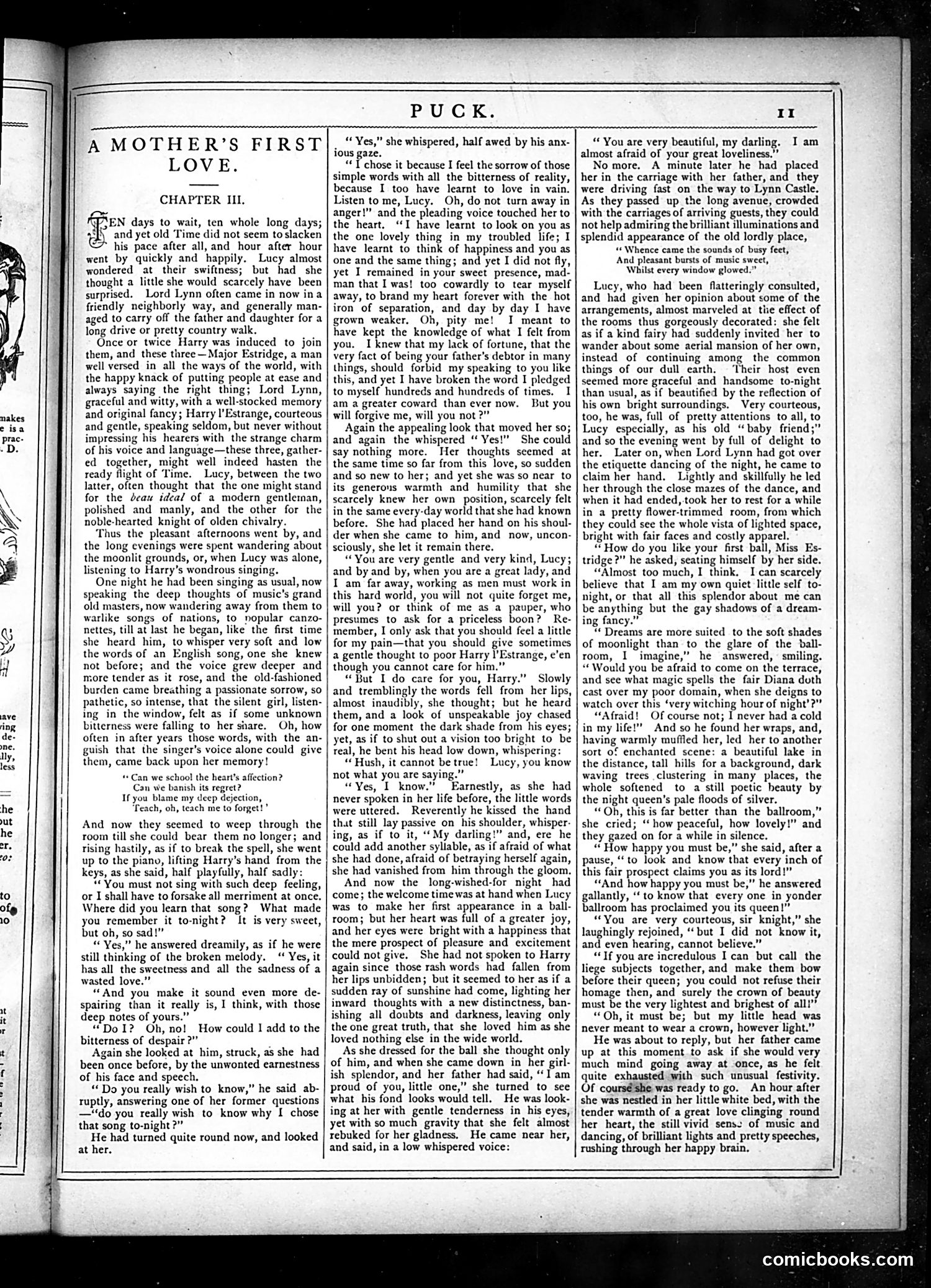
This page contains fiction text titled "A Mother's First Love, Chapter III" rather than political cartoons or satire. It appears to be a serialized romantic story published in Puck magazine, featuring dialogue between characters named Lucy, Harry, and Lord Lyndhurst discussing matters of love, social position, and personal sacrifice. The text itself is literary rather than satirical—it explores themes of class differences, romantic devotion, and moral choices through narrative prose. There are no visible political cartoons, caricatures, or satirical commentary on this particular page. While Puck was known for political satire, this appears to be one of its serialized fiction offerings, likely aimed at entertaining readers between its satirical content.
📄 Transcribed text from this page (OCR, searchable)
Machine-transcribed from the original scan — historical spelling and the odd misread are preserved.
PUCK. II A MOTHER’S FIRST LOVE. CHAPTER III. AEN days to wait, ten whole long days; 4S}) and yet old Time did not seem to slacken <* his pace after all, and hour after hour went by quickly and happily. Lucy almost wondered at their swiftness; but had she thought a little she would scarcely have been surprised. Lord Lynn often came in now ina friendly neighborly way, and generally man- aged to carry off the father and daughter for a long drive or pretty country walk. Once or twice Harry was induced to join them, and these three — Major Estridge, a man well versed in all the ways of the world, with the happy knack of putting people at ease and always saying the right thing; Lord Lynn, graceful and witty, with a well-stocked memory and original fancy; Harry I’Estrange, courteous and gentle, speaking seldom, but never without impressing his hearers with the strange charm of his voice and language—these three, gather- ed together, might well indeed hasten the ready flight of Time. Lucy, between the two latter, often thought that the one might stand for the dcau ideal of a modern gentleman, polished and manly, and the other for the noble-hearted knight of olden chivalry. Thus the pleasant afternoons went by, and the long evenings were spent wandering about the moonlit grounds, or, when Lucy was alone, listening to Harry’s wondrous singing. One night he had been singing as usual, now speaking the deep thoughts of music's grand old masters, now wandering away from them to warlike songs of nations, to popular canzo- nettes, till at last he began, like the first time she heard him, to whisper very soft and low the words of an English song, one she knew not before; and the voice grew deeper and more tender as it rose, and the old-fashioned burden came breathing a passionate sorrow, so pathetic, so intense, that the silent girl, listen- ing in the window, felt as if some unknown bitterness were falling to her share. Oh, how often in after years those words, with the an- guish that the singer’s voice alone could give them, came back upon her memory! «Can we school the heart's affection? Can we banish its regret? If you blame my deep dejection, ‘Teach, oh, teach me to forget!” And now they seemed to weep through the room till she could bear them no longer; and rising hastily, as if to break the spell, she went up to the piano, lifting Harry’s hand from the keys, as she said, half playfully, half sadly: “You must not sing with such deep feeling, or I shall have to forsake all merriment at once. Where did you learn that song? What made you remember it to-night? It is very sweet, but oh, so sad!” “Yes,” he answered dreamily, as if he were still thinking of the broken melody.“ Yes, it has all the sweetness and all the sadness of a wasted love.” And you make it sound even more de- spairing than it really is, I think, with those deep notes of yours.” “Dol? Oh, no! bitterness of despair?” . Again she looked at him, struck, as she had been once before, by the unwonted earnestness of his face and speech, “Do you really wish to know,” he said ab- ruptly, answering one of her former questions —do you really wish to know why I chose that song to-night?” He had turned quite round now, and looked at her. How could | add to the __ “Yes,” she whispered, half awed by his anx- ious gaze. “T chose it because I feel the sorrow of those simple words with all the bitterness of reality, because I too have learnt to love in vain. Listen to me, Lucy. Oh, do not turn away in anger!” and the pleading voice touched her to the heart. ‘I have learnt to look on you as the one lovely thing in my troubled life; I have learnt to think of happiness and you as one and the same thing; and yet I did not fly, yet I remained in your sweet presence, mad- man that I was! too cowardly to tear myself away, to brand my heart forever with the hot iron of separation, and day by day I have grown weaker, Oh, pity me! I meant to have kept the knowledge of what I felt from you. I knew that my lack of fortune, that the very fact of being your father’s debtor in many things, should forbid my speaking to you like this, and yet I have broken the word I pledged to myself hundreds and hundreds of times. 1 am a greater coward than ever now. But you will forgive me, will you not 2” Again the appealing look that moved her so; and again the whispered “Yes!” She could say nothing more. Her thoughts seemed at the same time so far from this love, so sudden and so new to her; and yet she was so near to its generous warmth and humility that she scarcely knew her own position, scarcely felt in the same every-day world that she had known before. She had placed her hand on his shoul- der when she came to him, and now, uncon- sciously, she let it remain there. “You are very gentle and very kind, Lucy; and by and by, when you are a great lady, and I am far away, working as men must work in this hard world, you will not quite forget me, will you? or think of me as a pauper, who presumes to ask for a priceless boon? Re- member, I only ask that you should feel a little for my pain—that you should give sometimes a gentle thought to poor Harry l’Estrange, e’en though you cannot care for him. “But I do care for you, Harry.” Slowly and tremblingly the words fell from her lips, almost inaudibly, she thought; but he heard them, and a look of unspeakable joy chased for one moment the dark shade from his eyes; yet, as if to shut out a vision too bright to be teal, he bent his head low down, whispering: “Hush, it cannot betrue! Lucy, you know not what you are saying.” “Yes, I know.” nestly, as she had never spoken in her life before, the little words were uttered. Reverently he kissed the hand that still lay passive on his shoulder, whisper- ing, as if to it, “My darling!” and, ere he could add another syllable, as if afraid of what she had done, afraid of betraying herself again, she had vanished from him through the gloom, And now the long-wished-for night had come; the welcome time was at hand when Lucy was to make her first appearance in a ball- room; but her heart was full of a greater joy, and her eyes were bright with a happiness that the mere prospect of pleasure and excitement could not give. She had not spoken to Harry again since those rash words had fallen from her lips unbidden; but it seemed to her as if a sudden ray of sunshine had come, lighting her inward thoughts with a new distinctness, ban- ishing all doubts and darkness, leaving only the one great truth, that she loved him as she loved nothing else in the wide world. As she dressed for the ball she thought only of him, and when she came down in her girl- ish splendor, and her father had said, ‘I am proud of you, little one,” she turned to see what his fond looks would tell. He was look- ing at her with gentle tenderness in his eyes, yet with so much gravity that she felt almost rebuked for her gladness, He came near her, and said, in a low whispered voice: “ You are very beautiful, my darling. I am almost afraid of your great loveliness.” No more. A minute later he had placed her in the carriage with her father, and they were driving fast on the way to Lynn Castle, As they passed up the long avenue, crowded with the carriages of arriving guests, they could not help admiring the brilliant illuminations and splendid appearance of the old lordly place, “Whence came the sounds of busy feet, And pleasant bursts of music sweet, Whilst every window glowed.” Lucy, who had been flatteringly consulted, and had given her opinion about some of the arrangements, almost marveled at the effect of the rooms thus gorgeously decorated: she felt as if a kind fairy had suddenly invited her to wander about some aerial mansion of her own, instead of continuing among the common things of our dull earth. Their host even seemed more graceful and handsome to-night than usual, as if beautified by the reflection of his own bright surroundings. Very courteous, too, he was, full of pretty attentions to all, to Lucy especially, as his old “baby friend;” and so the evening went by full of delight to her. Later on, when Lord Lynn had got over the etiquette dancing of the night, he came to claim her hand. Lightly and skillfully he led her through the close mazes of the dance, and when it had ended, took her to rest for a while in a pretty flower-trimmed room, from which they could see the whole vista of lighted space, bright with fair faces and costly apparel. “How do you like your first ball, Miss Es- tridge?” he asked, seating himself by her side. “Almost too much, I think. I can scarcely believe that I am my own quiet little self to- night, or that all this splendor about me can be anything but the gay shadows of a dream- ing fancy.” “« Dreams are more suited to the soft shades of moonlight than to the glare of the ball- room, I imagine,” he answered, smiling. “Would you be afraid to come on the terrace, and see what magic spells the fair Diana doth cast over my poor domain, when she deigns to watch over this ‘very witching hour of night’?”” “Afraid! Of course not; I never had a cold in my life!” And so he found her wraps, and, having warmly muffled her, led her to another sort of enchanted scene: a beautiful lake in the distance, tall hills for a background, dark waving trees clustering in many places, the whole softened to a still poetic beauty by the night queen’s pale floods of silver. “Oh, this is far better than the ballroom,” she cried; “how peaceful, how lovely!” and they gazed on for a while in silence. “How happy you must be,” she said, after a pause, ‘to look and know that every inch of this fair prospect claims you as its lord!” “And how happy you must be," he answered gallantly, ‘‘ to know that every one in yonder ballroom has proclaimed you its queen!” “You are very courteous, sir knight,” she laughingly rejoined, “but I did not know it, and even hearing, cannot believe.” “If you are incredulous I can but call the liege subjects together, and make them bow before their queen; you could not refuse their homage then, and’ surely the crown of beauty must be the very lightest and brighest of all!”” “Oh, it must be; but my little head was never meant to wear a crown, however light.” He was about to reply, but her father came up at this moment to ask if she would very much mind going away at once, as he feit quite exhausted with such unusual festivity. Of cours@She was ready to go. An hour after she was nestled in her little white bed, with the tender warmth of a great love clinging round her heart, the still vivid sens: of music and dancing, of brilliant lights and pretty speeches, rushing through her happy brain. comicbooks.com