
Puck, 1878-11-06 · page 5 of 16
Puck — November 6, 1878 — page 5: what you’re looking at
What you’re looking at
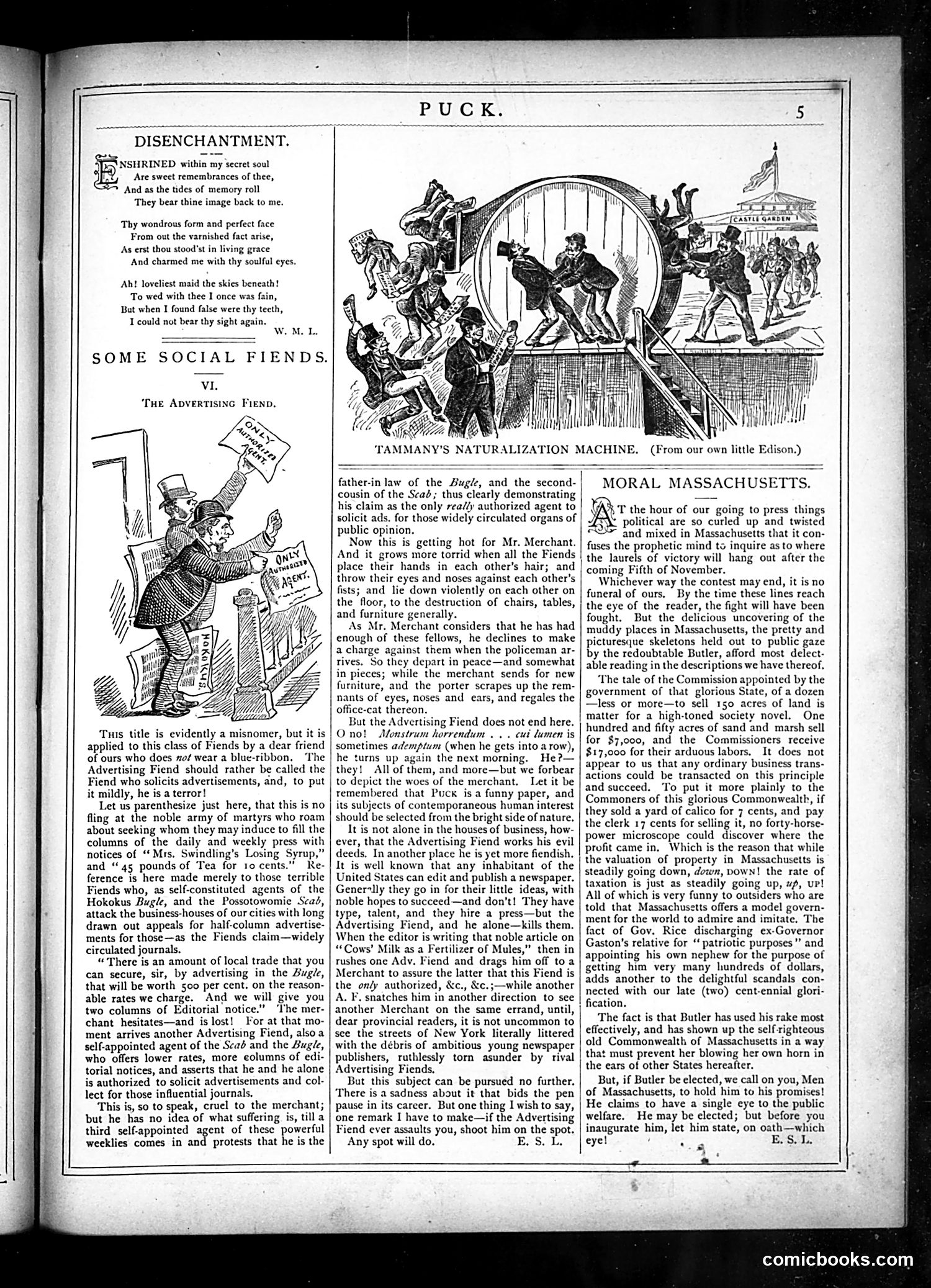
This page contains two separate satirical pieces: **"Tammany's Naturalization Machine"** (main cartoon): Depicts a mechanical contraption processing immigrants into citizens, with figures being processed on one side and emerging as voters on the other. This satirizes Tammany Hall's (New York's Democratic political machine) practice of rapidly naturalizing immigrants to expand their voting base, a common criticism of urban political corruption in the late 19th/early 20th century. **"The Advertising Fiend"** (left column): Mocks newspaper advertising practices and unethical promotion tactics. The text criticizes how advertising agents manipulate merchants and editors, comparing them to destructive forces. It suggests these "friends" ultimately harm publications through aggressive, misleading commercial practices. Both pieces target corruption and ethical failures in contemporary American institutions.
📄 Transcribed text from this page (OCR, searchable)
Machine-transcribed from the original scan — historical spelling and the odd misread are preserved.
DISENCHANTMENT. NSHRINED within my secret soul Are sweet remembrances of thee, And as the tides of memory roll They bear thine image back to me. Thy wondrous form and perfect face From out the varnished fact arise, As erst thou stood’st in living grace And charmed me with thy soulful eyes. Ah! loveliest maid the skies beneath! To wed with thee I once was fain, Bat when I found false were thy teeth, I could not bear thy sight again. W. ML. SOME SOCIAL FIENDS. VI. ‘THE ADVERTISING Fienp. Tus title is evidently a misnomer, but it is applied to this class of Fiends by a dear friend of ours who does nof wear a blue-ribbon, The Advertising Fiend should rather be called the | Fiend who solicits advertisements, and, to put it mildly, he is a terror! Let us parenthesize just here, that this is no fling at the noble army of martyrs who roam about seeking whom they may induce to fill the columns of the daily and weekly press with notices of “Mrs. Swindling’s Losing Syrup,” and ‘45 pounds of Tea for 10 cents.” Re- ference is here made merely to those terrible Fiends who, as self-constituted agents of the Hokokus Bugle, and the Possotowomie Sead, attack the business-houses of our cities with long drawn out appeals for half-column advertise- ments for those—as the Fiends claim—widely circulated journals. “There is an amount of local trade that you can secure, sir, by advertising in the Bugée, that will be worth 500 per cent. on the reason- able rates we charge. And we will give you two columns of Editorial notice.” ‘lhe mer- chant hesitates—and is lost! For at that mo- ment arrives another Advertising Fiend, also a self-appointed agent of the Scaé and the Bugée, who offers lower rates, more columns of edi- torial notices, and asserts that he and he alone is authorized to solicit advertisements and col- lect for those influential journals. This is, so to speak, cruel to the merchant; but he has no idea of what suffering is, till a third self-appointed agent of these powerful weeklies comes in and protests that he is the {ACHINE. (From our own little Edison.) father-in law of the Bugle, and the second- | cousin of the Sead; thus clearly demonstrating his claim as the only rea//y authorized agent to solicit ads. for those widely circulated organs of public opinion, Now this is getting hot for Mr. Merchant. And it grows more torrid when all the Fiends place their hands in each other’s hair; and throw their eyes and noses against each other's fists; and lie down violently on each other on the floor, to the destruction of chairs, tables, and furniture generally. As Mr. Merchant considers that he has had enough of these fellows, he declines to make acharge against them when the policeman ar- rives. So they depart in peace—and somewhat in pieces; while the merchant sends for new furniture, and the porter scrapes up the rem- nants of eyes, noses and ears, and regales the office-cat thereon. But the Advertising Fiend does not end here. Ono! Afonstrum horrendum . . . cui lumen is sometimes ademptum (when he gets into a row), he turns up again the next morning. He?— they! All of them, and more—but we forbear to depict the woes of the merchant. Let it be remembered that Puck is a funny paper, and its subjects of contemporaneous human interest should be selected from the bright side of nature. It is not alone in the houses of business, how- ever, that the Advertising Fiend works his evil deeds. In another place he is yet more fiendish. It is well known that any inhabitant of the United States can edit and publish a newspaper. Genervlly they go in for their little ideas, with noble hopes to succeed—and don’t! They have type, talent, and they hire a press—but the Advertising nd, and he alone—kills them. When the editor is writing that noble article on “Cows’ Milk as a Fertilizer of Mules,” then in rushes one Ady. Fiend and drags him off toa Merchant to assure the latter that this Fiend is the only authorized, &c., &c.;—while another A. F. snatches him in another direction to see another Merchant on the same errand, until, | dear provincial readers, it is not uncommon to see the streets of New York literally littered with the débris of ambitious young newspaper publishers, ruthlessly torn asunder by rival Advertising Fiends, But this subject can be pursued no further. There is a sadness about it that bids the pen | pause in its career. But one thing I wish to say, one remark I have to make—if the Advertising Fiend ever assaults you, shoot him on the spot. Any spot will do. E.S.1 i] Wr the hour of our going to press things SX Political are so curled up and twisted «> and mixed in Massachusetts that it con- fuses the prophetic mind to inquire as to where the laurels of victory will hang out after the coming Fifth of November. Whichever way the contest may end, it is no funeral of ours. By the time these lines reach the eye of the reader, the fight will have been fought. But the delicious uncovering of the muddy places in Massachusetts, the pretty and picturesque skeletons held out to public gaze by the redoubtable Butler, afford most delect- able reading in the descriptions we have thereof. ‘The tale of the Commission appointed by the government of that glorious State, of a dozen —less or more—to sell 150 acres of land is matter for a high-toned society novel. One hundred and fifty acres of sand and marsh sell for $7,000, and the Commissioners receive $17,000 for their arduous labors. It does not appear to us that any ordinary business trans- actions could be transacted on this principle and succeed. To put it more plainly to the Commoners of this glorious Commonwealth, if they sold a yard of calico for 7 cents, and pay the clerk 17 cents for selling it, no forty-horse- power microscope could discover where the profit came in. Which is the reason that while the valuation of property in Massachusetts is steadily going down, down, powN! the rate of taxation is just as steadily going up, wf, uP! All of which is very funny to outsiders who are told that Massachusetts offers a model govern- ment for the world to admire and imitate. The fact of Gov. Rice discharging ex-Governor Gaston's relative for ‘‘ patriotic purposes" and appointing his own nephew for the purpose of getting him very many hundreds of dollars, adds another to the delightful scandals con- nected with our late (two) cent-ennial glori- fication. The fact is that Butler has used his rake most effectively, and has shown up the self-righteous old Commonwealth of Massachusetts in a way that must prevent her blowing her own horn in the ears of other States hereafter. But, if Butler be elected, we call on you, Men of Massachusetts, to hold him to his promises! He claims to have a single eye to the public welfare. He may be elected; but before you inaugurate him, let him state, on oath—which eye! E.S.L. comicbooks.com