
A complete issue · 16 pages · 1878
Puck — October 9, 1878
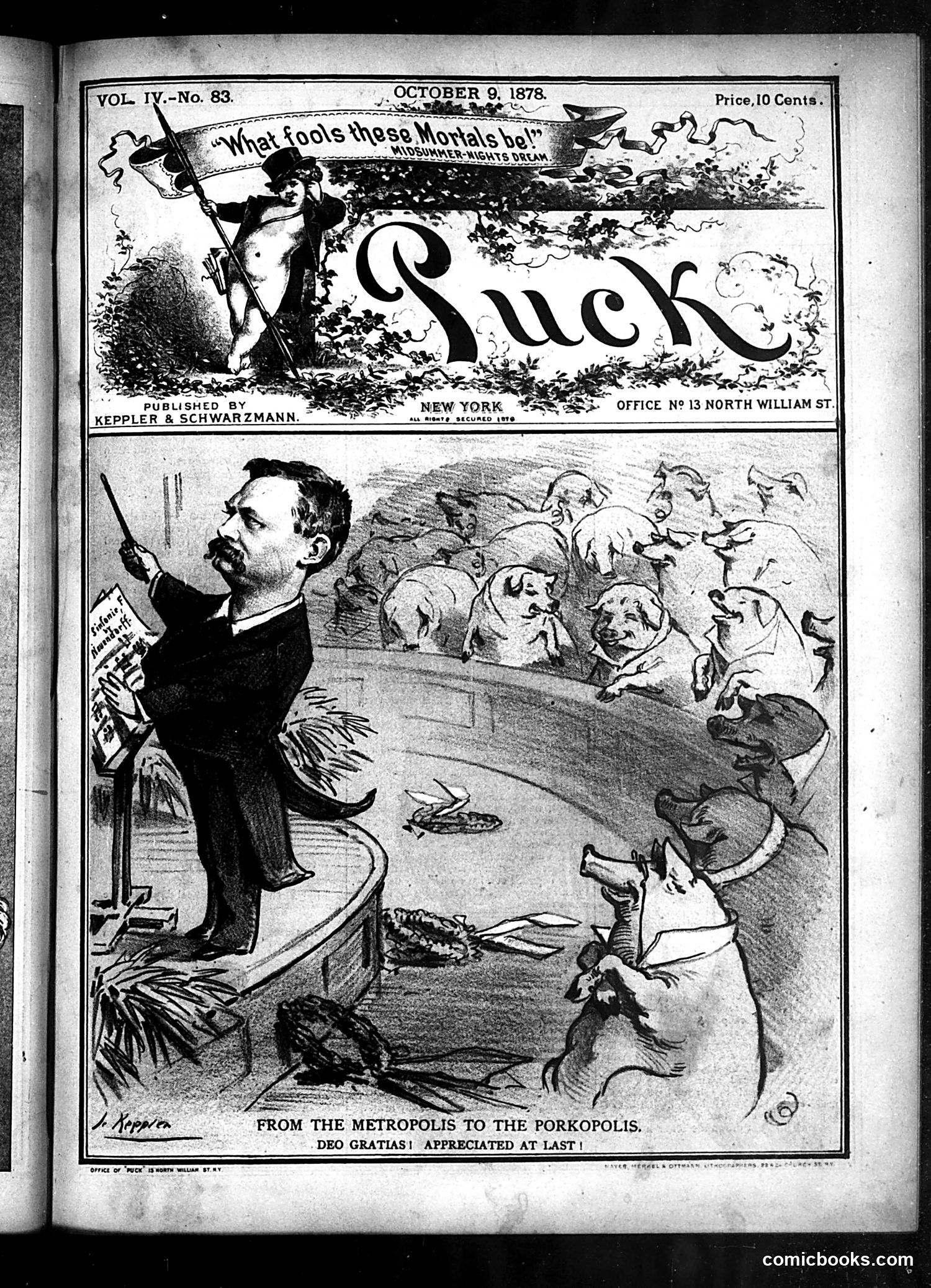
**Main Cartoon: "From the Metropolis to the Porkopolis"** This satire depicts a well-dressed man (likely a New York politician or businessman) conducting a group of pig-headed figures like an orchestra. The title plays on "metropolis" (New York City) versus "porkopolis" (a derogatory term for Cincinnati, known for its pork-packing industry). The cartoon mocks either: - Political corruption or manipulation of lesser officials - Regional class prejudices between sophisticated New York and Midwestern industrial centers - Possibly backroom political dealings where a powerful figure controls subordinates The subtitle "Deo Gratias! Appreciated at Last!" suggests ironic commentary on finally receiving recognition—whether for corrupt practices or for controlling incompetent associates. The exact political context remains unclear without additional historical documentation.
This page contains primarily **text content rather than political cartoons**. The main articles include: 1. **"The Girl of the Period"** — social commentary on young women who've "gone astray," contrasting idealized femininity with reality. References seduction, abandonment, and bodies found in barrels. 2. **"Adieu, Thomas!"** — satirizing Theodore Thomas, a prominent musician, mocking his "sudden exodus" and suggesting his financial loss ("estimated—beer not included"). 3. **"Granpa Cooper's Upas Tree"** — apparently ridiculing an older man (likely a public figure named Cooper) for his outdated views and refusal to acknowledge modern progress. The page reflects late 19th-century concerns about morality, changing social roles, and generational conflict, typical of Puck's satirical approach to contemporary issues.
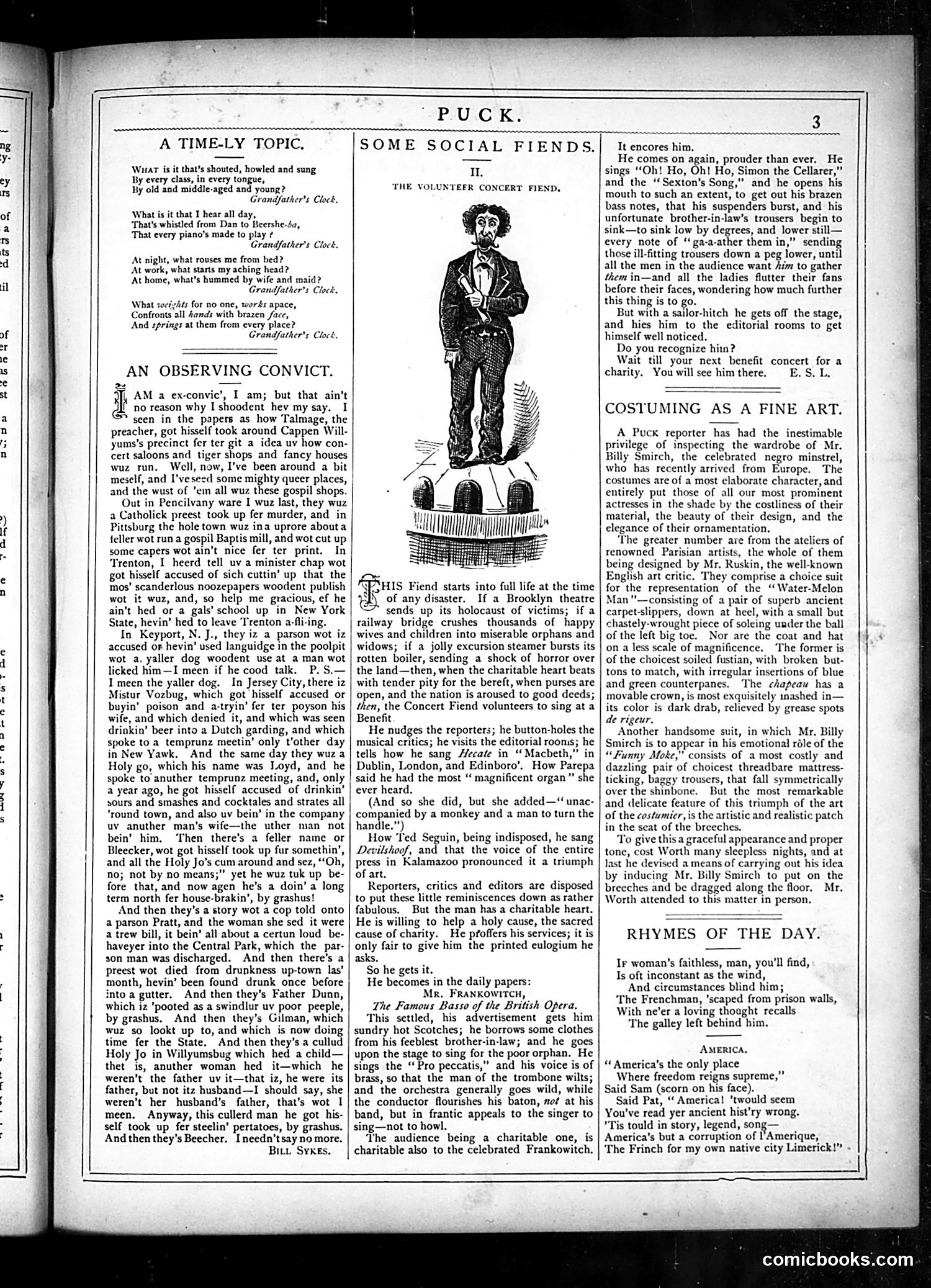
This page contains three distinct pieces of social satire: 1. **"A Time-ly Topic"** (verse): Mocking Grandfather's Clock, a popular song, through parody questions about domestic life's mundane sounds. 2. **"An Observing Convict"** (main article by Bill Sykes): A satirical monologue from an ex-convict's perspective, critiquing American hypocrisy. The speaker observes that criminals are punished harshly while respectable citizens (preachers, judges, politicians) commit sins with impunity—murder, theft, corruption—without consequence. The satire targets moral double standards in society. 3. **The central illustration** shows a man in formal dress standing on a pedestal, likely depicting "The Volunteer Concert Fiend" discussed in the accompanying article about elaborate theatrical costumes and performances. The page's overarching theme: exposing pretense and hypocrisy in American society.
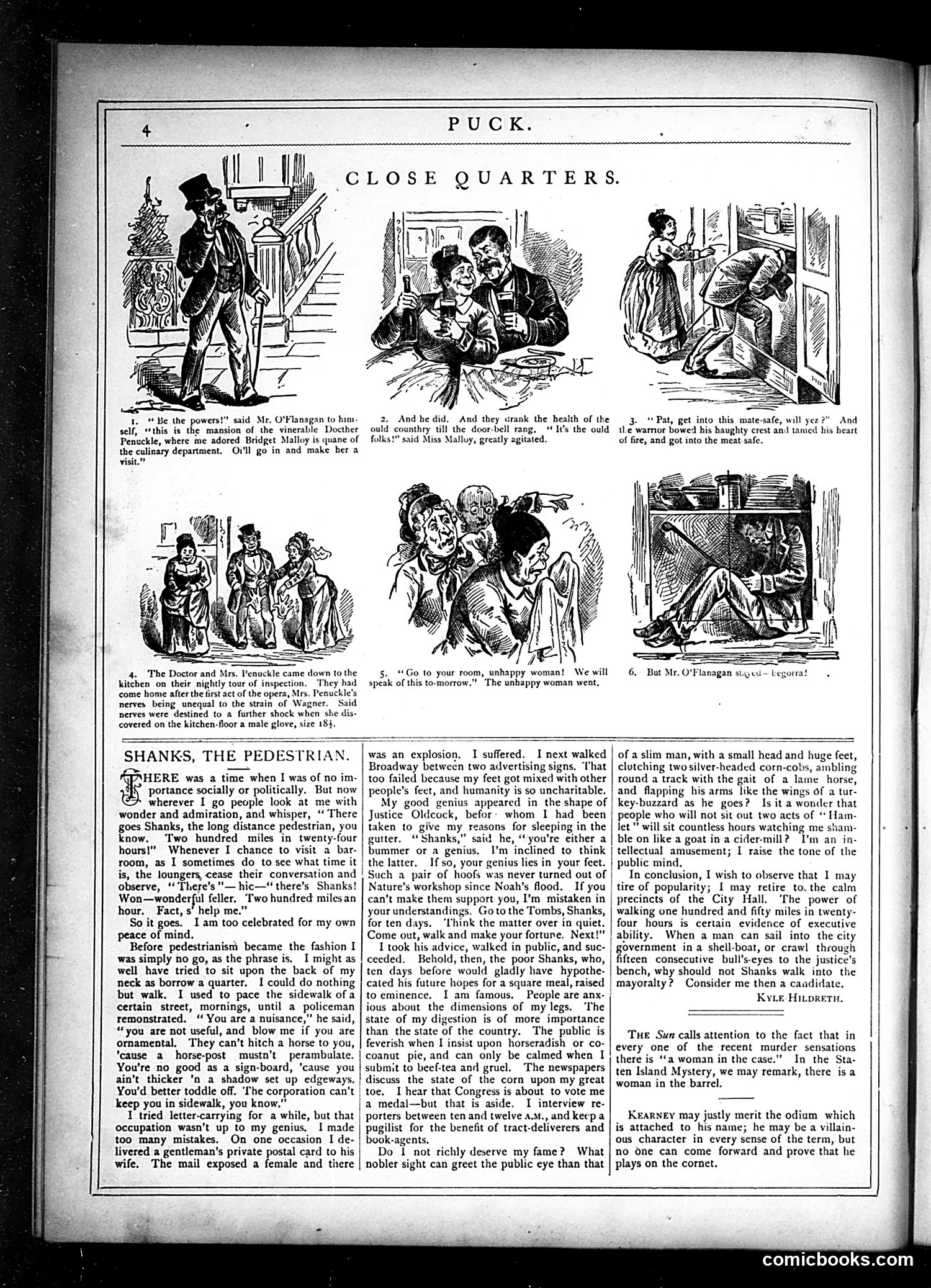
This page contains satirical sketches and a column mocking urban living conditions and social pretense. The six cartoon panels titled "Close Quarters" appear to depict domestic discomfort and cramped apartment life—showing people in awkward situations within confined spaces. The essay "Shanks, the Pedestrian" criticizes wealthy New Yorkers who complain about urban inconveniences while refusing to walk or use public transportation. The author ridicules those claiming hardship despite their privilege, sarcastically suggesting they suffer from "indigestion" and need to appreciate their advantages. The piece mocks both the wealthy's entitlement and contemporary social complaints about city living, advocating for humility and perspective among the privileged classes.
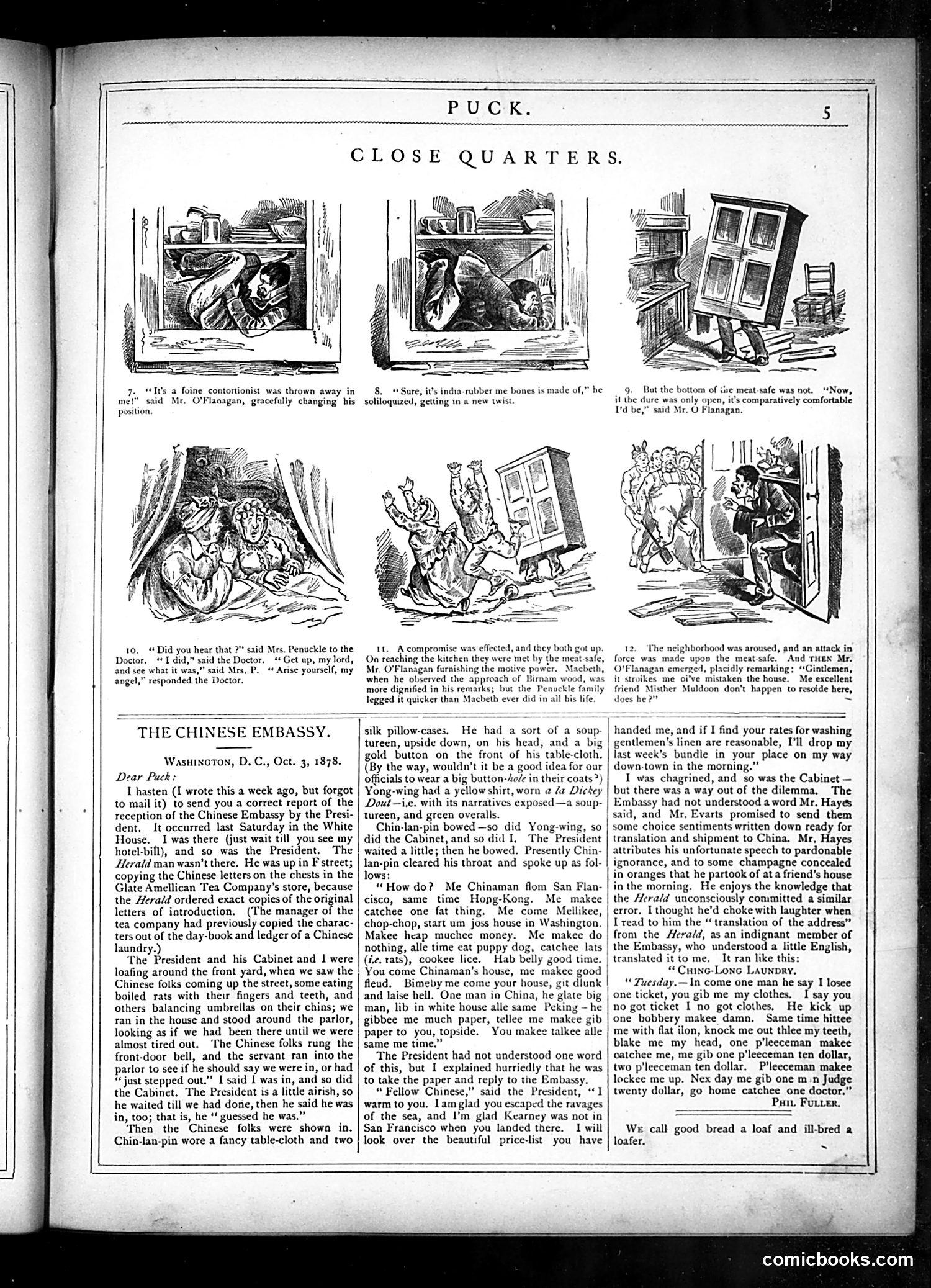
**"Close Quarters"** (top section): Six comic panels depicting domestic chaos. The captions reference Mr. O'Flanagan in awkward situations—thrown from windows, squeezed into tight spaces, dealing with furniture mishaps. The humor derives from slapstick physical comedy and marital discord, likely satirizing working-class tenement living conditions of the era. **"The Chinese Embassy"** (bottom): A satirical account from Washington, D.C., October 3, 1878, mocking a Chinese Embassy reception. The author ridicules Chinese visitors' appearance, customs, and speech patterns through offensive caricature and broken-English dialogue. The piece reflects period anti-Chinese xenophobia while portraying diplomats as comical figures. The satire targets both the Chinese and American officials who received them.
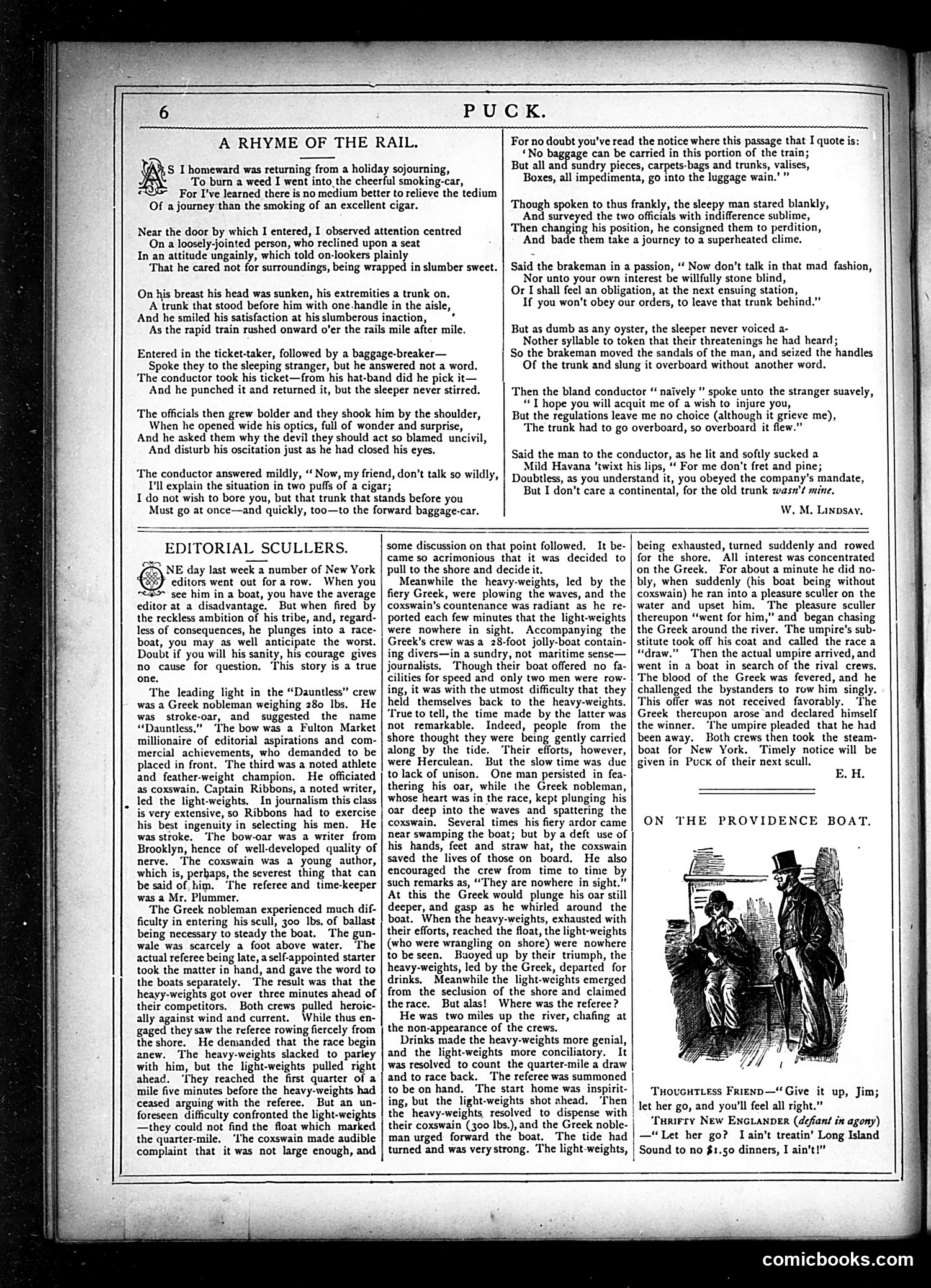
This page contains three distinct pieces: 1. **"A Rhyme of the Rail"** — A narrative poem about a railway passenger encounter, satirizing sleeping-car conductors and baggage handlers' indifference to customer complaints. The humor targets the poor service and dismissive attitudes of railroad workers. 2. **"Editorial Scullers"** — A detailed account of a rowing competition featuring Greek athletes ("the Dauntiless crew"), satirizing journalistic coverage of sporting events. It mocks the verbose, dramatic reporting style typical of the era. 3. **"On the Providence Boat"** — A brief illustrated comic featuring what appears to be social commentary about boat travel, though details remain unclear from this excerpt. The page primarily satirizes transportation industry incompetence and inflated journalistic coverage rather than specific political figures.
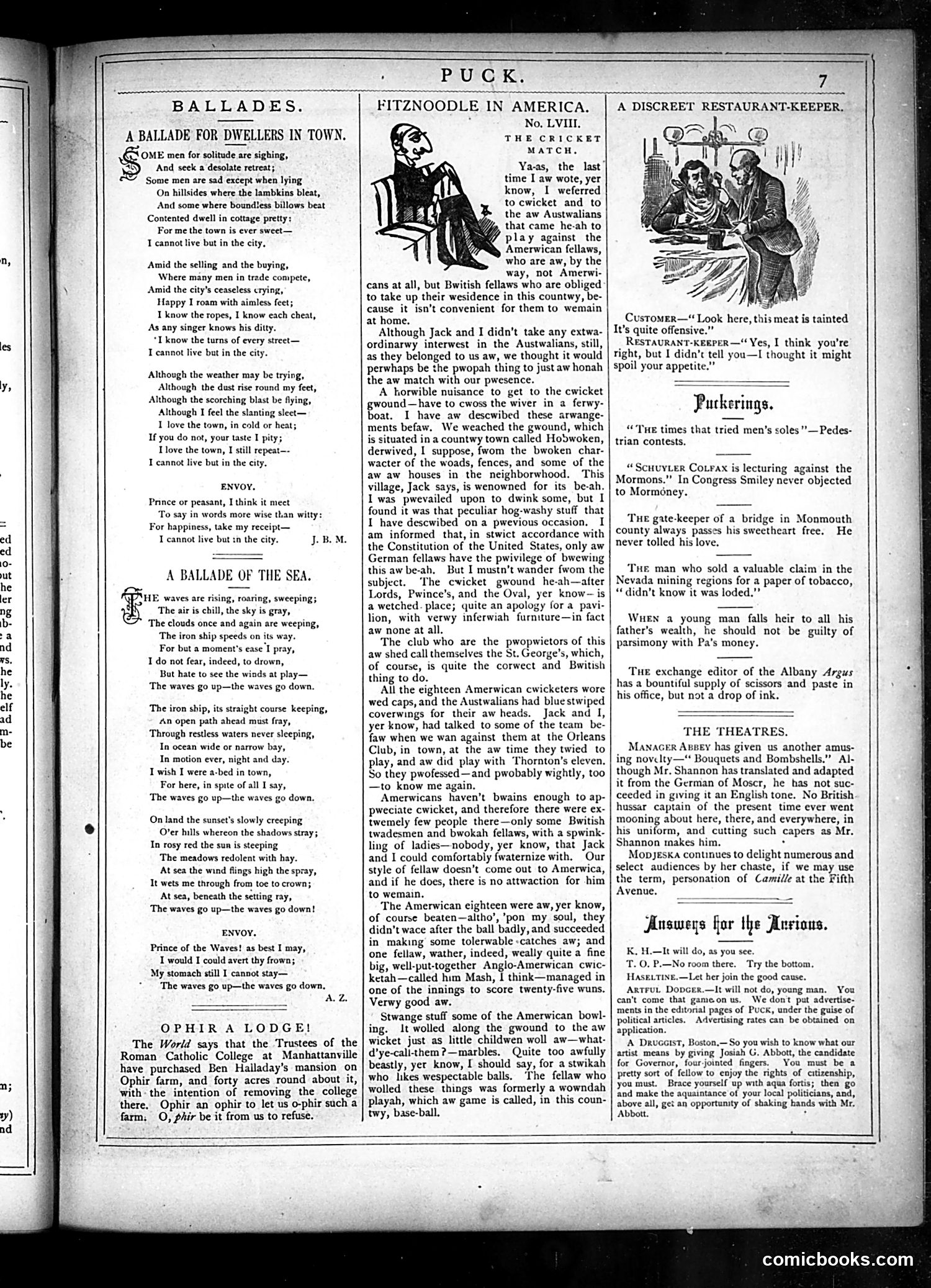
This cartoon depicts a restaurant-keeper speaking to a customer who has complained about tainted meat. The keeper dismisses the complaint, insisting the meat is fine and that the customer's appetite is merely "spoilt." The satire targets unscrupulous restaurant owners who prioritize profit over food safety and customer welfare. The keeper's gaslighting response—denying obvious problems and blaming the diner—was likely a common experience in late-19th-century dining establishments with lax health standards. The cartoon critiques both the proprietor's dishonesty and the power imbalance between business owners and consumers, suggesting restaurants could serve questionable food with impunity while customers had little recourse.
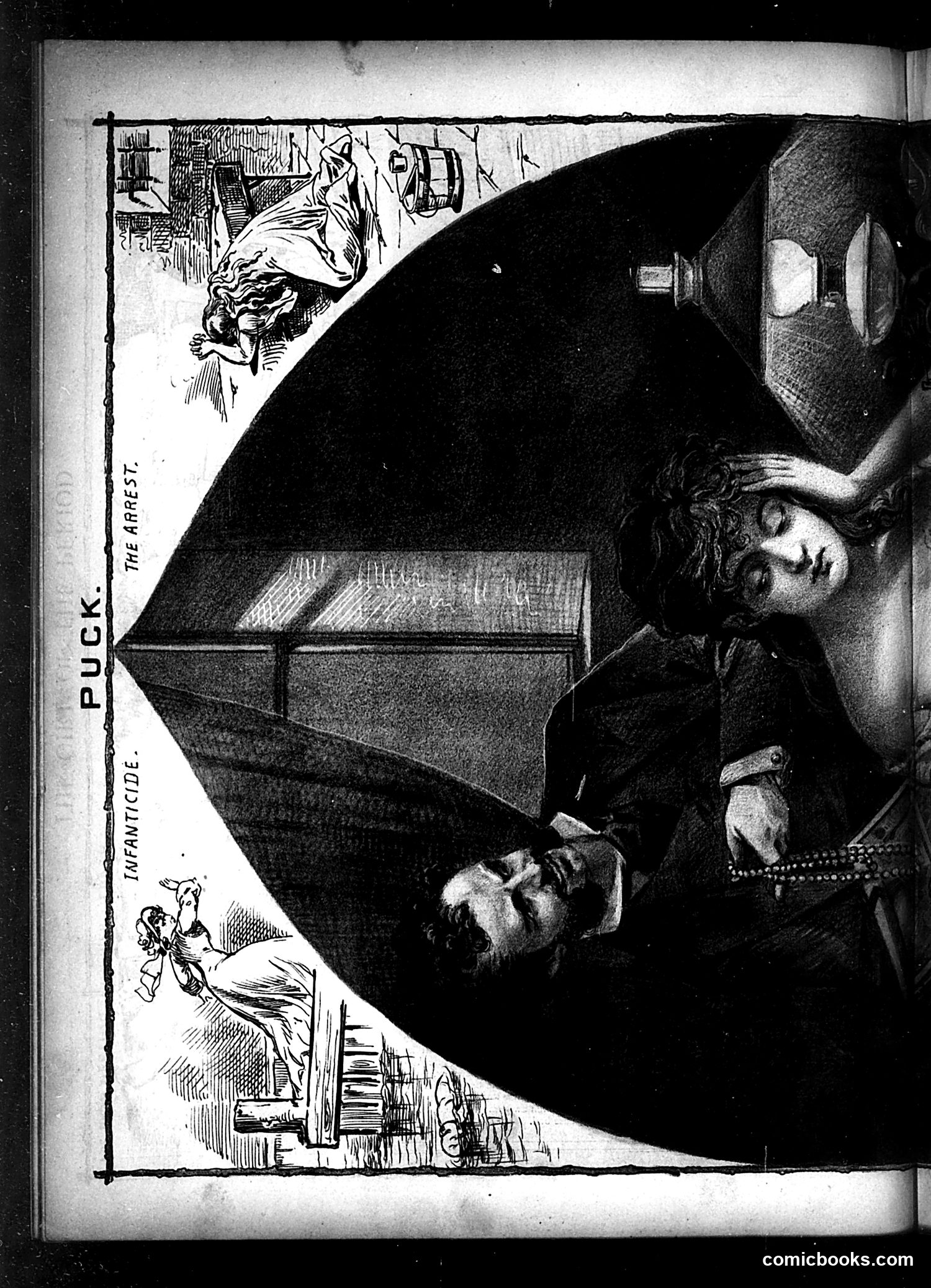
This page depicts a satirical scene titled "The Arrest" with text reading "Imfaithful" visible on the left margin. The cartoon shows two figures in what appears to be a bedroom or domestic interior—a man and woman in apparent distress or confrontation. The composition and dramatic lighting suggest a scandal or embarrassing discovery. Without additional context about the specific issue date, I cannot definitively identify which political or social figures are being caricatured. However, the domestic setting and "infaithful" reference suggest this satirizes a prominent contemporary scandal involving marital infidelity—likely targeting public figures whose personal misconduct was considered newsworthy enough for Puck's satirical treatment. The sketch-style illustrations in the margins may provide additional context clues about the subject matter.
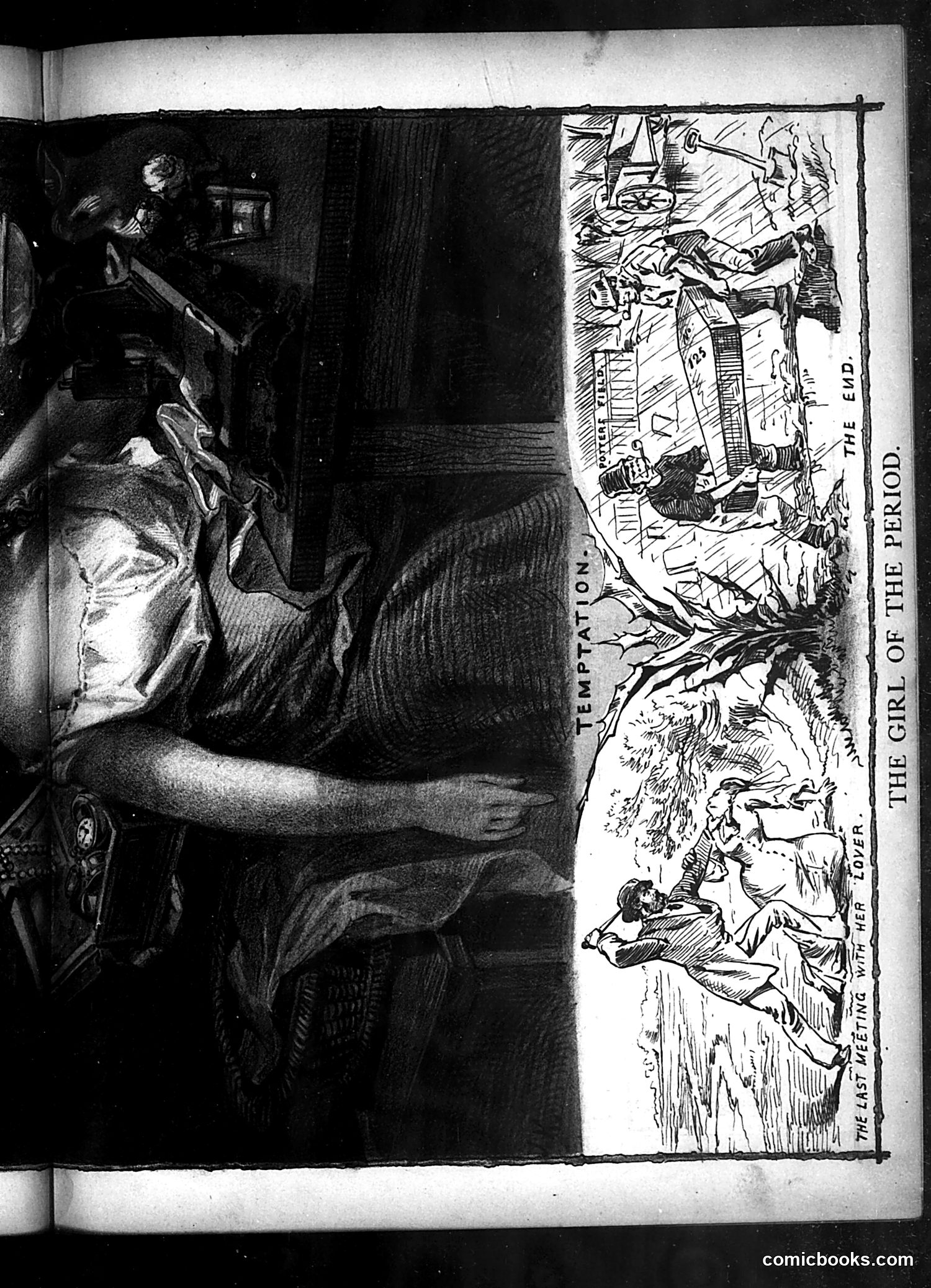
This page depicts a satirical commentary on modern womanhood, likely from the late 19th century. The left illustration shows a woman in contemporary dress in a contemplative pose. The right panel, titled "The Girl of the Period" and "The Last Greeting Her Lover," presents a contrasting domestic scene with multiple figures. The satire appears to critique changing gender roles and women's independence during this era. The "girl of the period" likely refers to the "New Woman"—a controversial figure who challenged Victorian conventions through education, employment, and social freedoms. Puck uses the juxtaposition to mock both modern women's aspirations and traditional domestic expectations, highlighting the cultural tensions surrounding female emancipation that dominated late 19th-century American social discourse.
This page reproduces a theatrical comedy sketch adapted from French playwright Édouard Martin and Albert Monnier by R.B. Valentine. The dialogue presents a domestic comedy involving characters named Edmund, Boreall, and Lucy. The humor centers on marital misunderstandings: Edmund discusses a mysterious portrait and a woman (Mrs. Boreall) while Boreall grows suspicious. The sketch plays on period-typical themes—jealousy, gossip, domestic anxiety about infidelity, and the absurdities of social performance. References to "Coghian of Wallack's" suggest this was written for or associated with that theatrical company. The piece is primarily **domestic comedy rather than political satire**, relying on character-driven humor rather than commentary on current events or figures.
This page contains two distinct pieces: **"Puck" (top):** A dialogue between characters named Boreall, Edmund, and Lucy about acquiring a turkey for Christmas dinner. It's a comedic sketch with minimal political content—mostly domestic humor about holiday meal planning and the expense involved. **"Patient Kitty" (bottom):** By James Payn, this is a longer narrative story about Fred Raynor and a friend who were apprentices together. The story discusses Fred's character development, his relationship with a woman named Kitty, and their courtship. It appears to be a sentimental tale about working-class life, morality, and romance rather than political satire. Neither piece contains obvious political cartoons or caricatures. This page appears devoted to humor, narrative fiction, and social commentary typical of Puck's literary content rather than its famous satirical illustrations.
This page contains three brief satirical items under the heading "Puck's Wittanges" (the magazine's humor section): 1. **"Why is it that people boot a dog and shoo a cat around?"** – A joke about differential treatment of pets. 2. **"How to lose flesh"** – Advises starting at a meat market and ending at "Puck's Fall Reporter," likely mocking a gossip columnist's weight. 3. **"Heavy pressing"** – A pun about a nail question being a "tough nail." The remaining items reference contemporary figures: Edison's photographic improvements, Dr. Hancock's whiskey-disposal machine, and a final joke about a "Democratic candidate for President," mocking political incompetence or fraudulence. These are brief, punchy satirical quips typical of Puck's humor format, mixing wordplay with topical references to public figures and technology.
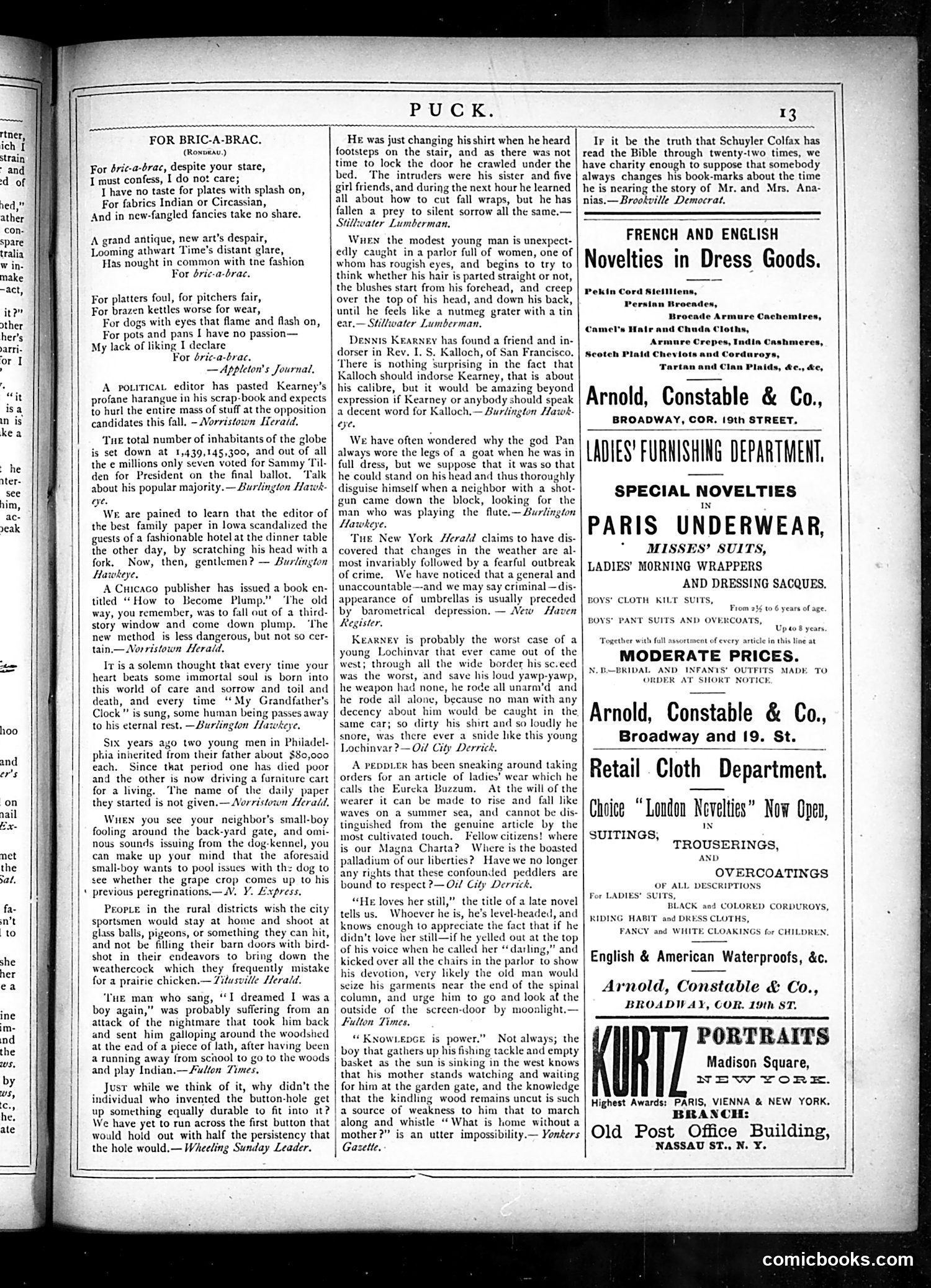
This page is primarily **advertising and miscellaneous content** rather than political cartoons. The left column contains "For Bric-a-Brac" — a humor section with brief jokes and observations from various newspapers (Appleton's Journal, Northwestern Herald, Burlington Hawkeye, etc.). The right side features commercial advertisements, including: - Arnold, Constable & Co. department store ads for "French and English Novelties in Dress Goods" and ladies' fashion items - Kurtz Portraits studio advertisement The humor pieces are gentle social commentary—anecdotes about clothing, umbrellas, and human behavior rather than sharp political satire. This appears to be a typical Puck page mixing light entertainment with retail advertising, targeting upper-middle-class readers interested in fashion and consumer goods.
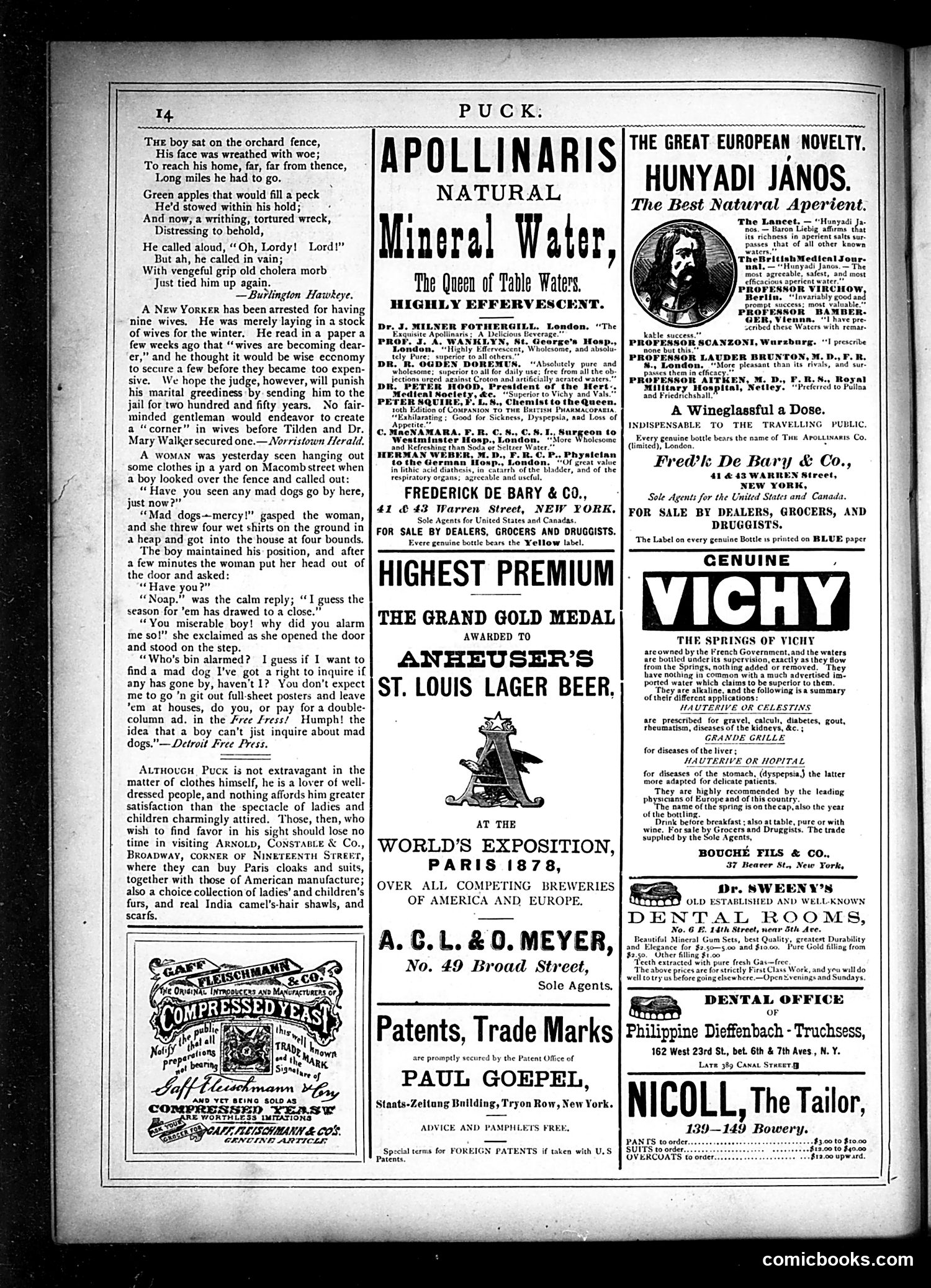
This page is primarily **advertisements and commercial content** rather than political cartoons. The dominant features include: - **Apollinaris Natural Mineral Water** ("Queen of Table Waters") - **Hunyadi János** laxative water, advertised as "The Best Natural Aperient" - **Anheuser's St. Louis Lager Beer**, which won "The Grand Gold Medal" at Paris's 1878 World's Exposition - **Vichy water** for various ailments - Various patent medicines, dental services, and tailoring The left column contains a poem about a boy on an orchard fence and a brief anecdote about a woman and dogs—light humor rather than political satire. The page reflects **late 19th-century American advertising culture**, emphasizing mineral waters, patent medicines, and European products as status symbols and health solutions—common themes in Puck's commercial sections.
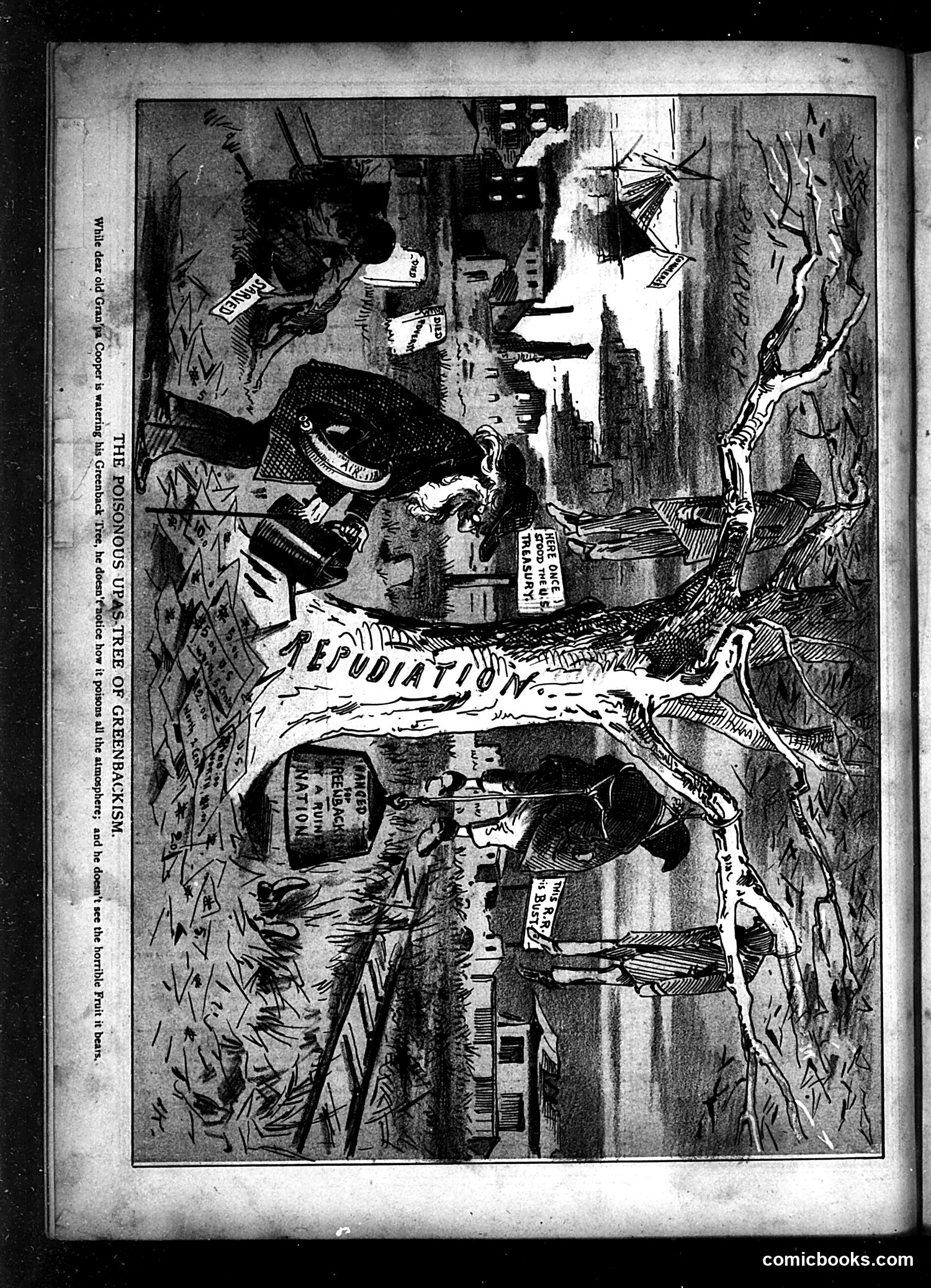
This satirical cartoon depicts a chaotic urban scene titled "REPUDIATION" - likely referencing late-19th-century monetary policy debates. The scene shows disorder and turmoil with various figures engaged in conflict amid buildings and debris. Key elements visible include caricatured figures (some appearing exaggerated in the style of period political cartoons) and text labels referencing financial or political concepts. The "repudiation" theme suggests commentary on currency devaluation or government debt rejection, major political controversies of the Gilded Age. Without clearly legible labels for all figures, the exact targets remain partially unclear, but the cartoon's overall message appears critical of economic policies creating social instability. The chaotic composition emphasizes disorder and societal dysfunction allegedly resulting from contested financial decisions.