
Puck, 1878-10-09 · page 6 of 16
Puck — October 9, 1878 — page 6: what you’re looking at
What you’re looking at
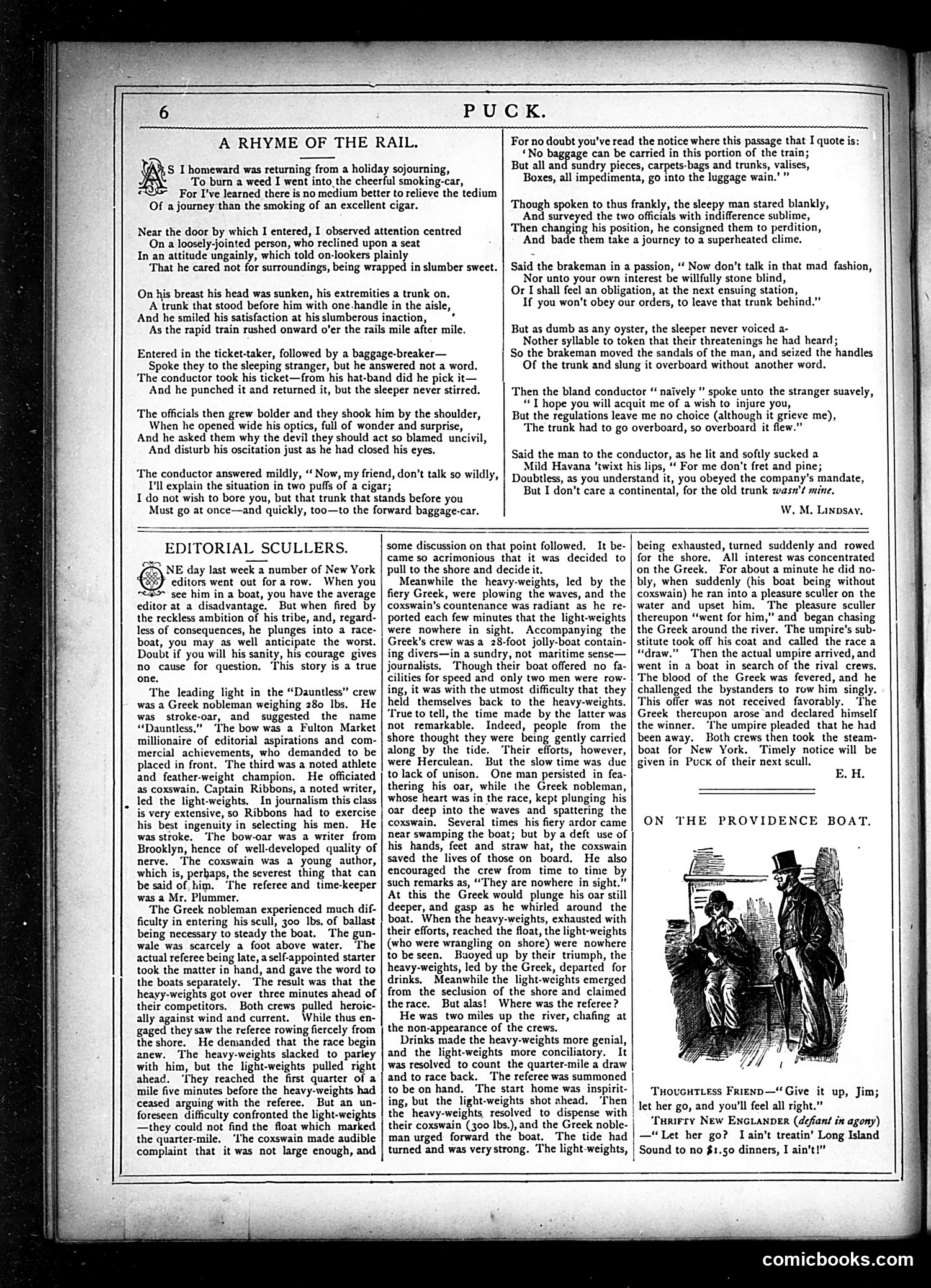
This page contains three distinct pieces: 1. **"A Rhyme of the Rail"** — A narrative poem about a railway passenger encounter, satirizing sleeping-car conductors and baggage handlers' indifference to customer complaints. The humor targets the poor service and dismissive attitudes of railroad workers. 2. **"Editorial Scullers"** — A detailed account of a rowing competition featuring Greek athletes ("the Dauntiless crew"), satirizing journalistic coverage of sporting events. It mocks the verbose, dramatic reporting style typical of the era. 3. **"On the Providence Boat"** — A brief illustrated comic featuring what appears to be social commentary about boat travel, though details remain unclear from this excerpt. The page primarily satirizes transportation industry incompetence and inflated journalistic coverage rather than specific political figures.
📄 Transcribed text from this page (OCR, searchable)
Machine-transcribed from the original scan — historical spelling and the odd misread are preserved.
PUCK. A RHYME OF THE RAIL. S I homeward was returning from a holiday sojourning, To burn a weed I went into, the cheerful smoking-car, y For I’ve learned there is no medium better to relieve the tedium Of a journey than the smoking of an excellent cigar. Near the door by which I entered, I observed attention centred On a loosely-jointed person, who reclined upon a seat In an attitude ungainly, which told on-lookers plainly That he cared not for surroundings, being wrapped in slumber sweet. On his breast his head was sunken, his extremities a trunk on. A trunk that stood before him with one-handle in the aisle, And he smiled his satisfaction at his slumberous inaction, As the rapid train rushed onward o’er the rails mile after mile. Entered in the ticket-taker, followed by a baggage-breaker— Spoke they to the sleeping stranger, but he answered not a word. The conductor took his ticket—from his hat-band did he pick it— And he punched it and returned it, but the sleeper never stirred. The officials then grew bolder and they shook him by the shoulder, When he opened wide his optics, full of wonder and surprise, And he asked them why the devil they should act so blamed uncivil, And disturb his oscitation just as he had closed his eyes. ‘The conductor answered mildly, “ Now, my friend, don’t talk so wildly, I'll explain the situation in two puffs of a cigar; I do not wish to bore you, but that trunk that stands before you Must go at once—and quickly, too—to the forward baggage-car. ‘No bag; But all and. Though spoken to thus And ba The trunk had to go For no doubt you've read the notice where this passage that I quote is: age can be carried in this portion of the train; sundry pieces, carpets-bags and trunks, valises, Boxes, all impedimenta, go into the luggage wain.’” frankly, the sleepy man stared blankly, And surveyed the two officials with indifference sublime, Then changing his position, he consigned them to perdition, le them take a journcy to a superheated clime. Said the brakeman in a passion, ‘ Now don’t talk in that mad fashion, Nor unto your own interest be willfully stone blind, Or I shall feel an obligation, at the next ensuing station, If you won't obey our orders, to leave that trunk behind.” But as dumb as any oyster, the sleeper never voiced a- Nother syllable to token that their threatenings he had heard; So the brakeman moved the sandals of the man, and seized the handles Of the trunk and slung it overboard without another word. ‘Then the bland conductor “ naively ” spoke unto the stranger suavely, “T hope you will acquit me of a wish to injure you, But the regulations leave me no choice (although it grieve me), overboard, so overboard it flew.” Said the man to the conductor, as he lit and softly sucked a Mild Havana ‘iwixt his lips, “ For me don’t fret and pine; Doubtless, as you understand it, you obeyed the company’s mandate, But I don’t care a continental, for the old trunk wasn't mine, W. M, Linpsay, EDITORIAL SCULLERS. (AX NE day last week a number of New York © editors went out fora row. When you “> see him in a boat, you have the average editor at a disadvantage. But when fired by the reckless ambition of his tribe, and, regard- less of consequences, he plunges into a race- boat, you may as well anticipate the worst. Doubt if you will his sanity, his courage gives no cause for question. This story is a true one, The leading light in the “Dauntless” crew was a Greek nobleman weighing 280 lbs. He was stroke-oar, and suggested the name “Dauntless.” ‘The bow was a Fulton Market millionaire of editorial aspirations and com- mercial achievements, who demanded to be placed in front. The third was a noted athlete and feather-weight champion. He officiated as coxswain, Captain Ribbons, a noted writer, led the light-weights. In journalism this class is very extensive, so Ribbons had to exercise his best ingenuity in selecting his men. He was stroke. The bow-oar was a writer from Brooklyn, hence of well-developed quality of nerve. The coxswain was a young author, which is, perbaps, the severest thing that can be said of him. ‘The referee and time-keeper was a Mr. Plummer. The Greek nobleman experienced much dif- ficulty in entering his scull, 300 Ibs, of ballast being necessary to steady the boat. The gun- wale was scarcely a foot above water. The actual referee being late, a self-appointed starter took the matter in hand, and gave the word to the boats separately. The result was that the heayy-weights got over three minutes ahead of their competitors. Both crews pulled heroic- ally against wind and current. While thus en- gaged they saw the referee rowing fiercely from the shore. He demanded that the race begin anew. The heavy-weights slacked to parley with him, but the light-weights pulled right ahead. ‘I'hey reached the first quarter of a mile five minutes before the heavy-weights had ceased arguing with the referee. But an un- foreseen difficulty confronted the light-weights —they could not find the float which marked the quarter-mile. ‘I'he coxswain made audible complaint that it was not large enough, and some discussion on that point followed. It be- came so acrimonious that it was decided to pull to the shore and decide it. Meanwhile the heavy-weights, led by the fiery Greek, were plowing the waves, and the coxswain’s countenance was radiant as he re- ported each few minutes that the light-weights were nowhere in sight. Accompanying the Greek’s crew was a 28-foot jolly-boat contain- ing divers—in a sundry, not maritime sense— journalists. Though their boat offered no fa- cilities for speed and only two men were row- ing, it was with the utmost difficulty that they held themselves back to the heavy-weights. ‘True to tell, the time made by the latter was not remarkable. Indeed, people from the shore thought they were being gently carried along by the tide. Their efforts, however, were Herculean. But the slow time was due to lack of unison. One man persisted in fea- thering his oar, while the Greek nobleman, whose heart was in the race, kept plunging his oar deep into the waves and spattering the coxswain. Several times his fiery ardor came near swamping the boat; but by a deft use of his hands, feet and straw hat, the coxswain saved the lives of those on board. He also encouraged the crew from time to time by such remarks as, “They are nowhere in sight.” At this the Greek would plunge his oar still deeper, and gasp as he whirled around the boat. When the heavy-weights, exhausted with their efforts, reached the float, the light-weights (who were wrangling on shore) were nowhere to beseen. Buoyed up by their triumph, the heavy-weights, led by the Greek, departed. for drinks, Meanwhile the light-weights emerged from the seclusion of the shore and claimed therace. But alas!’ Where was the referee? He was two miles up the river, chafing at the non-appearance of the crews. Drinks made the heavy-weights more genial, and the light-weights more conciliatory. It was resolved to count the quarter-mile a draw and to race back. The referee was summoned to be on hand, The start home was inspirit- ing, but the light-weights shot ahead. ‘Then the heavy-weights resolved to dispense with their coxswain (300 Ibs.), and the Greek noble- | man urged forward the boat. The tide had turned and was very strong. The light-weights, being exhausted, turned suddenly and rowed for the shore. All interest was concentrated on the Greek. For about a minute he did no- bly, when suddenly (his boat being without coxswain) he ran into-a pleasure sculler on the water and upset him. The pleasure sculler thereupon “went for him,” and. began chasing the Greek around the river. The umpire’s sub- stitute took off his coat and called the race a “draw.” Then the actual umpire arrived, and went in a boat in search of the rival crews. The blood of the Greek was fevered, and he challenged the bystanders to row him singly. This offer was not received favorably. ‘The Greek thercupon arose and declared himself the winner. ‘The umpire pleaded that he had been away. Both crews then took the steam- boat for New York. Timely notice will be given in Puck of their next scull. E. H. ON THE PROVIDENCE BOAT. Txovucnttess Frienp—Give it up, Jim; | let her go, and you'll feel all right.” ‘Turipry New ENGLANDER (defiant in agony) —‘“Let her go? I ain’t treatin’ Long Island Sound to no $1.50 dinners, I ain't!” comicbooks.com